Bilingual Answering Service Terms Explained: A Plain-English Glossary
This bilingual answering service glossary is for home service owners in Central Texas who keep hitting jargon while comparing providers. Every entry gives you a plain-English definition first, then tells you why the term matters when you read a quote or sit through a sales call. Use it to decode pricing pages, ask sharper questions, and spot the gaps a provider hopes you will not notice. Nothing here requires a tech background, just a few minutes between jobs.
- AI Receptionist
- 24/7 Answering
- After-Hours Coverage
- Missed Call Rate
- Live Transfer
- Call Bridging
- Bilingual Support
- Language Detection
- Call Script
- Lead Qualification
- Emergency Triage
- Call Summary
- Lead Capture
- Booking Link
- CRM Sync
- Webhook
- Per-Minute Pricing
- Overage Fees
Answering and Availability Terms
AI Receptionist
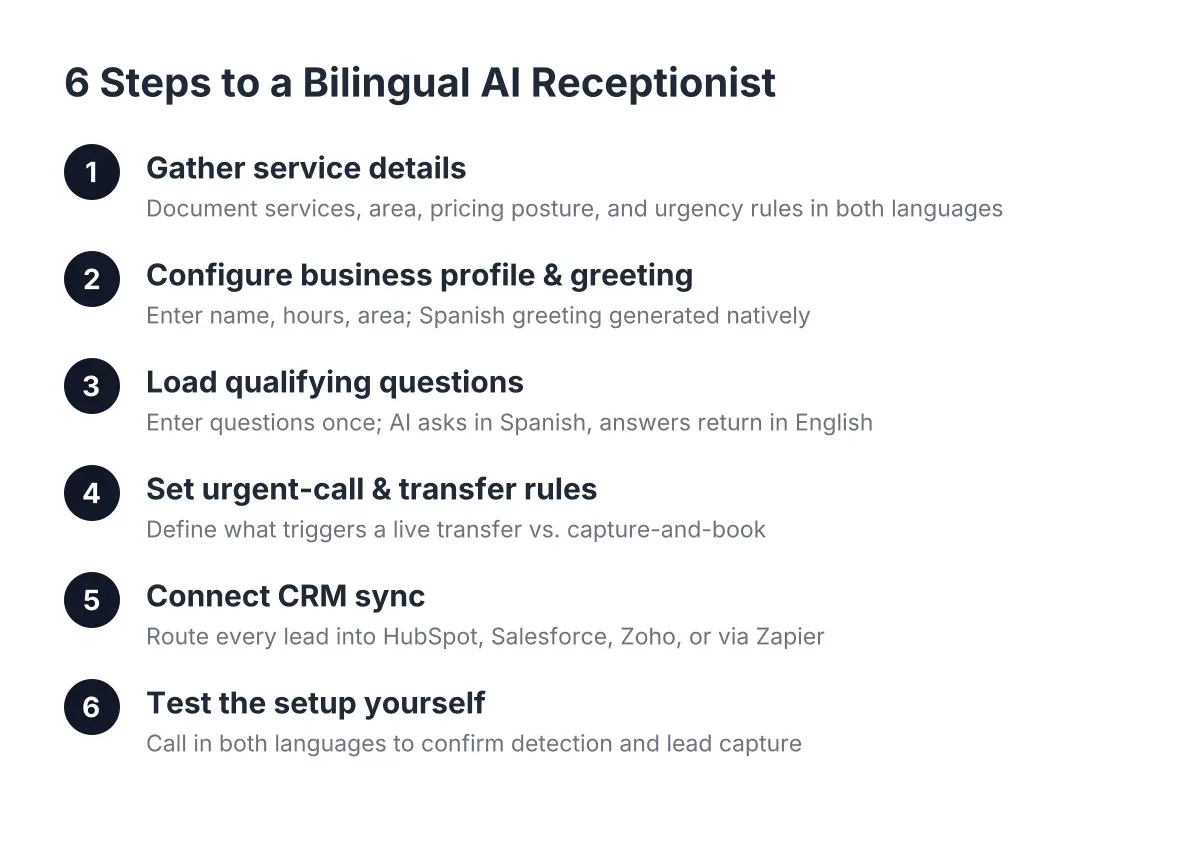
An AI receptionist is software that answers your business phone, talks with callers in natural conversation, and handles tasks like lead capture and booking without a human on the line. Unlike voicemail, it responds to the caller, asks questions, and collects the details you need to win the job. When a provider says "AI receptionist," ask whether it works 24/7 and whether it handles both English and Spanish on the same line. The good ones let you call and try to stump it before you sign anything.
24/7 Answering
24/7 answering means every call gets picked up around the clock, including nights, weekends, and holidays. For trades, this matters because burst pipes and dead AC units in 95° August heat do not wait for business hours. Some providers charge extra for after-hours coverage or route those calls to voicemail, so read the fine print. If 24/7 is included on every plan, that is a real difference, not a slogan.
After-Hours Coverage
After-hours coverage is the portion of an answering service that handles calls outside your normal working hours. Many services quote a low base rate that only covers 9-to-5, then add fees for evenings and weekends. For home service businesses, after-hours calls are often the urgent, high-value ones, so this is not a corner to cut. Ask directly: is after-hours part of the base price or a line item?
Missed Call Rate
A missed call rate is the percentage of incoming calls that never get answered by a person or system. Every missed call is a potential job that went to the next name in the search results, often within minutes. Providers use this number to show what you are losing today versus what full coverage recovers. If you are on a ladder or under a sink most of the day, your real missed call rate is probably higher than you think.
Live Transfer
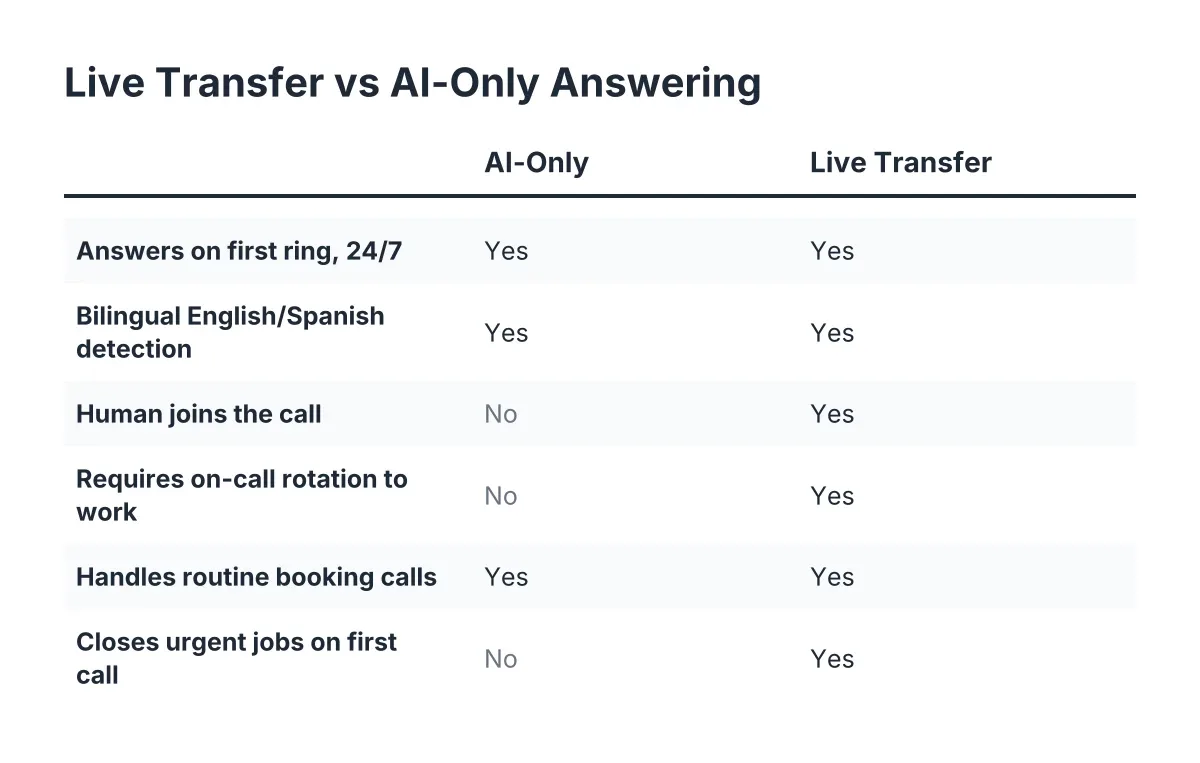
A live transfer is when the answering service connects an active caller directly to you or your crew in real time, instead of just taking a message. It is usually reserved for urgent situations, like a flooded kitchen, where the customer needs to hear a human now. Some services make live transfer standard; others make it opt-in so you control when your phone rings on site. Ask how the service decides what counts as urgent, because bad triage means your phone buzzes for every price shopper.
Call Bridging
Call bridging means the system connects you to a lead with one action, typically a click from a dashboard, without you dialing the number yourself. It matters because speed wins jobs: calling a fresh lead back within minutes beats calling back at dinner. If a provider offers one-click call bridging, you can return calls between jobs without copying numbers off a voicemail.
Bilingual and Call-Handling Terms
Bilingual Support
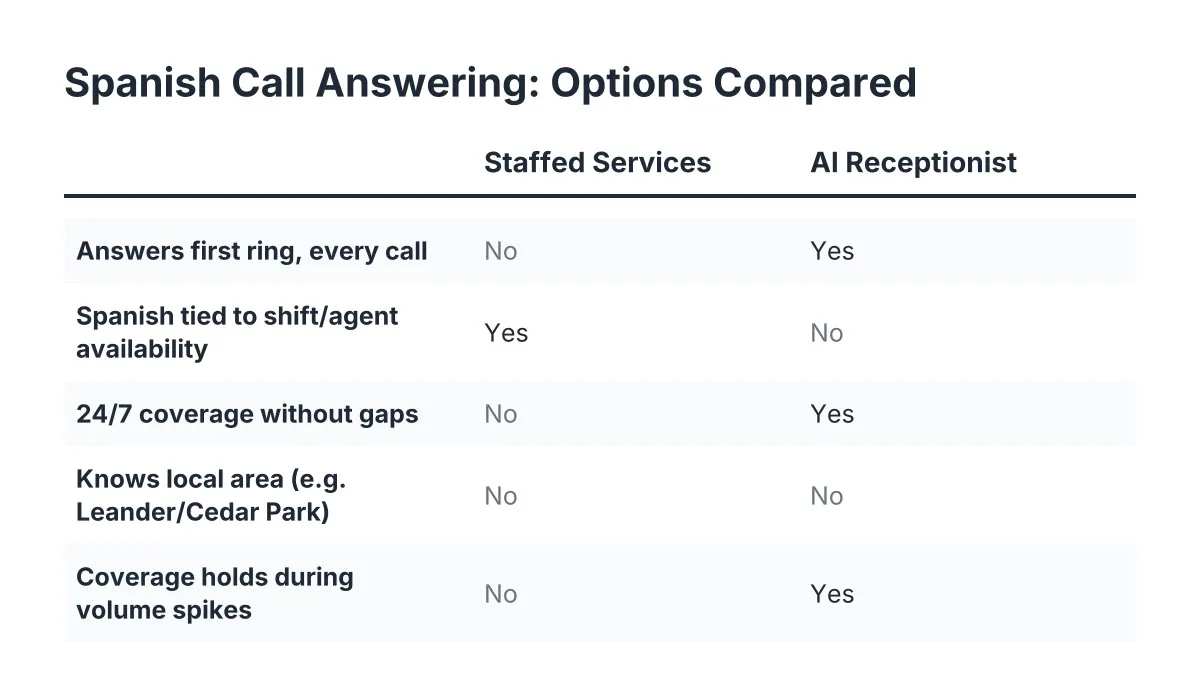
Bilingual support means the service handles calls in more than one language, most commonly English and Spanish in Texas. In Austin and across Central Texas, a Spanish-speaking caller who reaches an English-only line often hangs up and calls a competitor. A true bilingual answering service detects the caller's language and responds in it, on the same phone number, without transferring to a separate line. Watch out for providers who charge Spanish support as an add-on; here is why that gap costs Austin trades real jobs.
Language Detection
Language detection is the ability of a phone system to recognize which language a caller is speaking and switch to it automatically. Without it, Spanish-speaking callers get forced through English menus or asked to "press 2," and many hang up before they get there. Good language detection is invisible: the caller just gets answered in their own language. Ask a provider to demonstrate it live rather than take the brochure's word.
Call Script
A call script is the set of questions and responses a service follows when answering your calls. For trades, a good script asks about the problem, the property, the timeline, and the caller's contact details, in that caller's language. Generic national scripts treat a plumber and a dentist the same; a script built for home service asks about water heaters, not insurance cards. When you evaluate a provider, ask to see or hear the actual script for your trade.
Lead Qualification
Lead qualification is the process of asking callers questions to sort serious, ready-to-book customers from price shoppers and wrong numbers. A qualified lead comes with the job type, urgency, location, and contact details already captured, so you know who to call back first. Services that only take messages leave the sorting to you at 7 p.m. after a full day on site. Qualification is where an answering service earns its keep, so ask exactly which questions get asked.
Emergency Triage
Emergency triage is how an answering service decides which calls are true emergencies that need immediate action and which can wait for a callback. For a plumber, a burst pipe at 2 a.m. is an emergency; a quote request for a bathroom remodel is not. Good triage protects your sleep and your reputation at the same time. Ask any provider to walk you through their exact emergency rules, because "we handle emergencies" without specifics is a red flag.
Call Summary
A call summary is a short written recap of a call, covering who called, what they need, and what happens next. Summaries beat listening to voicemails because you can scan ten of them in the time it takes to replay one message. Some services add AI call intelligence, meaning the software scores each lead and writes the summary for you. If you get summaries by text or email right after each call, you can respond from the truck without guessing.
Booking, Integration, and Pricing Terms
Lead Capture
Lead capture means recording a caller's name, contact details, and job information so you can follow up and win the work. It is the difference between "someone called" and "here is a customer, their problem, and their number." Every missed call without lead capture is revenue walking to a competitor. When comparing services, ask what specific fields get captured and how fast that information reaches you.
Booking Link
A booking link is a web link the service sends a caller so they can pick an appointment time from your real availability. Instead of phone tag, the customer gets booked while the conversation is still warm. This only works if the link reflects your actual calendar, so ask how the provider keeps availability current. A caller who books a slot on the spot is far more likely to become a recurring customer than one waiting on a callback.
CRM Sync
CRM sync means the answering service automatically pushes captured leads into your customer database, such as HubSpot, Salesforce, or Zoho. Without it, someone has to retype every lead by hand, and hand-typed leads get lost. If you already run a CRM, sync should be a checkbox, not a custom project with setup fees. If you do not run a CRM yet, ask whether the service can still send leads by text or email until you do.
Webhook
A webhook is an automatic message one piece of software sends to another the moment something happens, like a new lead arriving. In practice, webhooks let your answering service push each fresh lead into tools like Zapier the second the call ends, no manual export needed. You do not need to understand the plumbing; you just need to know the term means "leads flow automatically." If a provider supports webhooks, connecting your existing tools is usually simple.
Per-Minute Pricing
Per-minute pricing means you pay for the total talk time the service spends on your calls, billed by the minute. It sounds cheap until a chatty month blows past your estimate, because you cannot control how long callers talk. Traditional national call centers lean on this model, which is one reason their bills swing month to month. Flat or plan-based pricing is easier to budget; this cost guide breaks down the common pricing models so you can compare quotes line by line.
Overage Fees
Overage fees are extra charges you pay when your call volume goes past what your plan includes. A quote that looks affordable can double in a busy month if the overage rate is steep. Before signing, ask what a call above your plan costs and whether unanswered or spam calls count against your total. A provider confident in their pricing will answer in one sentence.
Using These Terms
You can now read an answering service quote line by line and know what every row means, from live transfer to overage fees. Keep this glossary for bilingual answering services open during your next sales call and ask the specific questions each entry suggests. The provider who answers plainly is usually the one worth testing. This reference guide helps you understand every feature and cost before committing to a bilingual answering service.
If you're losing revenue to missed calls, NeverMiss ATX can help.
Prefer to talk it through? Call (512) 980-9267 — a quick call is usually the fastest way to get a straight answer for your situation.