How Much Does Bilingual Answering Service Cost?
Answering service cost comes down to three things: how your calls get answered (a human at a national call center or an AI receptionist), how many calls you take each month, and what happens after the phone gets picked up, like lead capture, booking, and CRM sync. Bilingual coverage adds a fourth wrinkle, because most national services charge extra for Spanish while some providers, including us, build it into every plan. Nobody can quote you a real number without knowing your call volume and what you need done on each call. By the end of this guide you will know exactly which factors apply to your shop, and how to get an accurate quote instead of a guess.
What Drives the Cost of a Bilingual Answering Service
Pricing is not random. Five factors do most of the work, and you can figure out where you land on each one before you ever talk to a provider.
Human agents vs. an AI receptionist
This is the biggest fork in the road. Traditional answering services staff real people, and people cost money around the clock. That cost shows up in per-minute or per-call billing, and it climbs fast for 24/7 coverage. An AI receptionist does not sleep, does not need a night-shift premium, and answers the third simultaneous call the same as the first. That structural difference is why AI-based pricing usually lands as a flat monthly plan instead of a meter running on every call. If your calls are mostly the same job over and over, like "my AC quit in 95 degree heat, can someone come today," AI handles that pattern well and the economics favor you. If you genuinely need a human on every single call, expect to pay for that labor.
Call volume and after-hours load
More calls mean more work, so volume pushes price up on almost any billing model. But the direction matters less than the shape. A plumbing outfit that gets slammed at 2 a.m. with burst-pipe calls pays a premium with human services, because overnight staffing is the expensive kind. With a 24/7 AI receptionist, after-hours calls cost the same as a Tuesday at noon. Check your phone log for a month. If a real share of your missed calls happen at night or on weekends, that skews the comparison hard toward flat-rate 24/7 answering.
Bilingual coverage
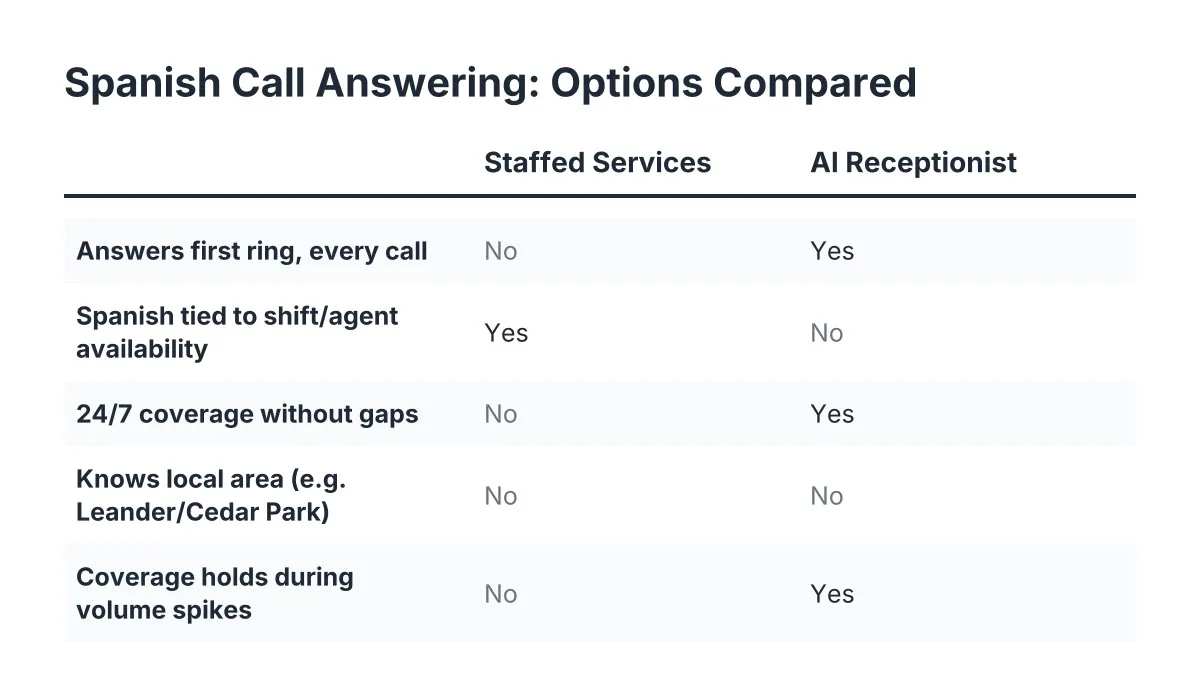
Central Texas runs on two languages, and a lead who opens in Spanish and hits an English-only line usually hangs up and calls your competitor. National services often price Spanish-speaking agents as an add-on, and true 24/7 bilingual human coverage is one of the pricier things you can buy. AI handles both languages on the same call at no extra staffing cost, which is why bilingual support comes standard on every plan we offer. If a meaningful slice of your customers prefer Spanish, ask every provider you compare exactly what bilingual coverage adds to the bill. The answers will vary more than you expect.
What happens on the call
"We answer and take a message" is the cheapest tier anywhere, and it is barely better than voicemail. Price climbs as the service does more: qualifying the lead, sending a booking link so the job gets booked before you are off the ladder, scoring and summarizing the call, and pushing the lead into your CRM through Zapier, HubSpot, Salesforce, or Zoho. Message-taking is cheap because it leaves the follow-up work on your plate. Lead capture plus booking costs more per month but saves you the callback game, and callbacks are where leads die. Decide which outcome you actually need, then price that, not the stripped-down version.
Live transfer and emergency handling
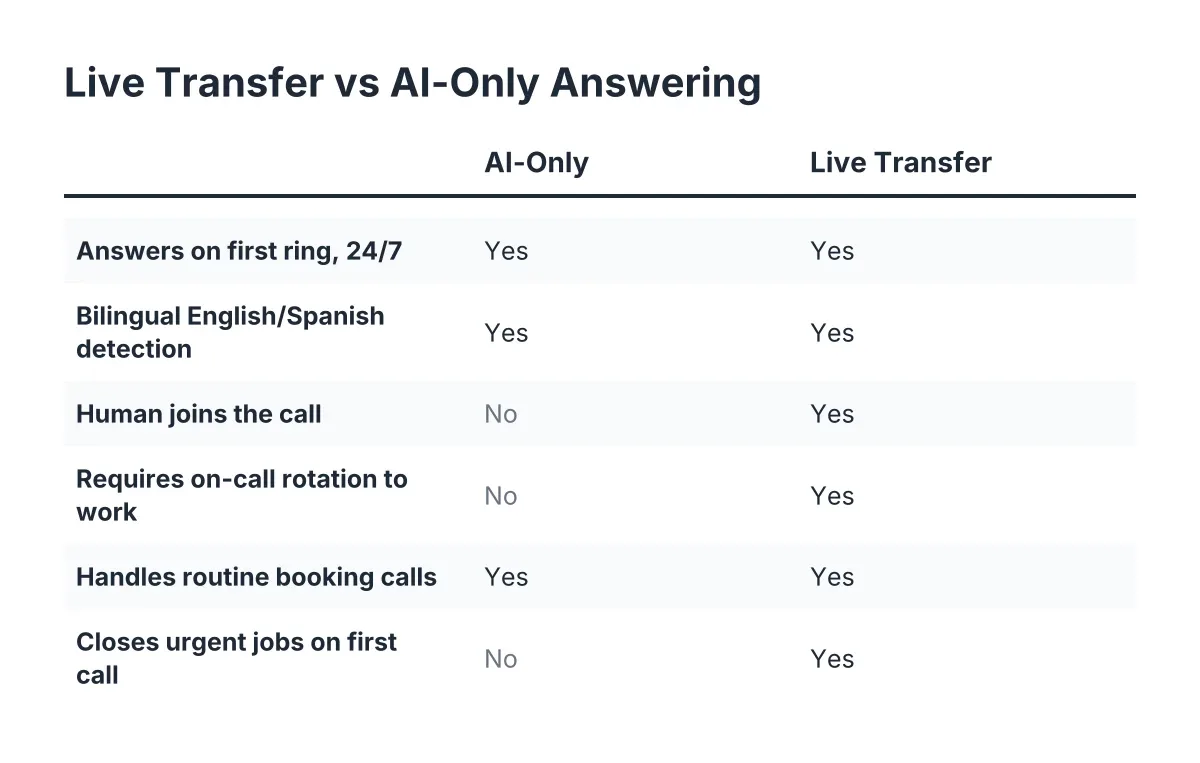
Some calls should reach a human right now. A slab leak flooding a kitchen is not a "leave a message" situation. Opt-in live transfer for urgent calls adds capability, and with human services it adds per-minute charges on top. The question to ask yourself: how often does a true emergency come in, and what is one missed emergency job worth? For most trades, one saved emergency call covers a lot of monthly plan.
Contract terms and setup
Long contracts, setup fees, and per-feature add-ons all move the total you actually pay, separate from the sticker price. Some national services layer on charges for holidays, message delivery, or patching calls through. Setup complexity matters too. A service that takes weeks to script and train costs you time even when the fee is low. Ask for the all-in monthly number under your real call pattern, not the base rate.
Cost Factor Table
| Factor | Pushes the price down when… | Pushes it up when… |
|---|---|---|
| Answering model | An AI receptionist handles calls on a flat monthly plan | Human agents bill per minute or per call, around the clock |
| Call volume | Volume is modest and mostly business hours | Heavy volume with nights, weekends, and simultaneous calls |
| After-hours coverage | 24/7 is built into the plan | Overnight and weekend human staffing carries a premium |
| Bilingual support | English and Spanish are included by default | Spanish-speaking agents are a billed add-on |
| Scope of the call | Simple answer-and-message service | Full lead capture, qualification, booking, and CRM sync |
| Emergency handling | Urgent live transfer is a built-in opt-in | Transfers and patching bill by the minute |
| Contract terms | Transparent flat pricing, no setup surprises | Setup fees, holiday surcharges, and per-feature add-ons stack |
How to Get an Accurate Answering Service Cost Estimate
You can turn a vague quote into a real one in about fifteen minutes of prep. Have this ready before you talk to anyone:
- A month of call data. Total calls, missed calls, and roughly when they come in. Your phone bill or call log has this. After-hours misses matter most.
- Your language split. Even a rough sense of how many customers prefer Spanish changes which providers make sense.
- What you want done on each call. Message only, or qualified lead with a booking link sent and the details pushed to your CRM.
- Your emergency definition. Which calls should transfer to you live, and which can wait for the morning summary.
A good quote answers four questions in writing: what the flat monthly total is under your real volume, what bilingual coverage includes, what happens after hours, and what integrations are covered. If a provider cannot give you a flat number, ask for the effective monthly answering service cost at your actual call volume, including overages. That single question exposes most pricing games.
Estimates differ between providers because the underlying models differ. A per-minute human service and a flat-rate AI receptionist are pricing different things, so compare the total monthly outcome, not the unit rate. And test before you sign. Call the AI yourself, in English and in Spanish, and try to stump it. We invite people to do exactly that, because a five-minute call tells you more than any pricing page.
Ways to Keep the Cost Down
You do not need coupons. You need to buy the right thing.
- Match the model to your call pattern. If most of your calls are qualification and booking, paying per-minute human rates for them is paying a premium for work an AI receptionist does on a flat plan. Save human involvement for the calls that need it, like opted-in emergency transfers.
- Do not pay extra for bilingual. Get bilingual coverage as a standard feature, not an add-on. If a provider charges more for Spanish, that surcharge compounds every single month.
- Skip the message-only trap. The cheapest tier looks like savings until you count the leads that go cold waiting for your callback. A service that gets the job booked while you are on site usually pays for itself on captured work, not on a lower invoice.
- Get the all-in number from two or three providers. Compare setup fees, overage rules, holiday surcharges, and contract length side by side. The lowest base rate is often not the lowest total.
- Feed leads straight into your CRM. Webhooks and CRM sync sound like a luxury, but re-keying leads by hand costs you evenings and dropped follow-ups. Automation here is a cost lever, not a frill.
Cost Questions People Ask
Is an AI receptionist cheaper than hiring a front-desk employee?
A full-time hire comes with wages, taxes, sick days, and coverage only for the hours they work, which never includes 2 a.m. An AI receptionist runs 24/7 on a flat monthly plan and answers every call, including three at once. The honest framing: AI does not replace the human relationship in your business, it captures the calls you would otherwise miss while you are on the job.
Do I pay extra for after-hours or weekend answering?
With human services, often yes, because overnight staffing costs more and that shows up in your bill. With a 24/7 AI receptionist, after-hours is the point, not a surcharge. Ask any provider directly whether nights, weekends, and holidays change the rate.
How does per-minute billing compare to a flat monthly rate?
Per-minute billing looks cheap at low volume and gets unpredictable fast, especially in a busy season when a heat wave floods your line. Flat monthly pricing means your busiest month costs the same as your slowest one. If your call volume swings with the weather, and in Central Texas trades it does, predictability is worth real money at budgeting time.
What does bilingual coverage add to the answering service cost?
With national call centers, Spanish-speaking agents are frequently a paid add-on, and 24/7 bilingual human coverage is one of the most expensive setups you can buy. With our AI receptionist, English and Spanish come on every plan at no extra charge. The right move is to ask each provider for their bilingual pricing in writing and compare.
The Bottom Line
Your answering service cost depends on how calls get answered, how many come in and when, and whether you want messages taken or jobs booked. Flat-rate AI answering with bilingual support built in usually beats per-minute human billing for home service call patterns, but your call log is the proof. Pull a month of data, get two or three all-in quotes, and call the AI yourself before you decide.
If you're losing revenue to missed calls, NeverMiss ATX can help.
Related guide: bilingual answering service — Complete Guide
Prefer to talk it through? Call (512) 980-9267 — a quick call is usually the fastest way to get a straight answer for your situation.