Why Bilingual Answering Services Matter for Austin Home Service Businesses
A Spanish-speaking homeowner in Pflugerville calls about a kitchen remodel. Your phone rings twice, goes to voicemail, and she hangs up. She calls the next number on her list, someone answers in Spanish, and your $18,000 job is gone before you even knew it existed. That single missed Spanish-speaking call is the whole argument for why bilingual answering services matter to Central Texas trades. A bilingual answering service in Austin can be the difference between capturing that lead and losing it to a competitor. This is not a customer service upgrade or a nice touch for your website. It is a revenue decision, and in a market where nearly a third of Austin residents are bilingual, it may be the cheapest growth lever you have not pulled yet.
This guide lays out the numbers behind that claim, walks through what a Spanish-speaking caller actually experiences when they reach your business today, and shows how call handling in both languages works in practice, including how language detection happens on a live call and what it costs when you get this wrong.
The Math on Missed Calls Gets Worse in Two Languages
Start with the baseline problem every small crew owner already knows. Your team is on jobs. Nobody is sitting by the phone. A large share of inbound calls to small home service businesses go unanswered, and most missed callers never call back. For a general construction or multi-trade operation, run that arithmetic against your own average ticket and last month's missed-call count — for most owners the annual number is uncomfortable. Those are jobs you were qualified for, priced right for, and never got to bid.
Now layer language on top of that. According to the City of Austin (U.S. Census Bureau ACS data), 29.6% of Austin residents age 5 and older are bilingual, and 10.3% speak English less than "very well." Zoom out to the state level and the picture gets bigger: about 28.5% of Texans, nearly 7.8 million people, speak Spanish at home, according to U.S. Census Bureau estimates covering 2018 to 2022.
Here is what those two data sets mean when you put them together. A meaningful slice of your missed Spanish-speaking calls are not just missed because nobody picked up. They are missed twice: once by the voicemail, and again by the language barrier when someone finally does call back in English only. The homeowner who speaks English less than "very well" is not going to leave a detailed voicemail in her second language about a foundation crack. She is going to find someone she can talk to.
Speed compounds the problem. A foundational MIT Sloan School of Management / InsideSales.com study found that the odds of contacting a lead drop 100-fold, and the odds of qualifying that lead drop 21-fold, when the callback happens at 30 minutes instead of within 5 minutes. If your plan for Spanish-speaking callers is "my cousin translates when he gets off shift," you are operating on the wrong side of that curve every single time.
What a Spanish-Speaking Caller Experiences When Reaching Your Austin Business
Run this test on your own business. Call your main line and pretend you only speak Spanish. What happens?
For most small trades in Central Texas, the honest answer is one of these:
- Voicemail, in English, asking for a name and number the caller may not be comfortable leaving
- A crew member answering from a job site, picking up words like "agua" and "fuga," and promising a callback that turns into phone tag
- An English-only national answering service that logs "caller did not speak English" as the entire lead record
- Nothing at all, because the phone rang out while you were on a ladder in 95 degree heat
None of those outcomes capture the lead. The caller in that moment is doing you a favor. She picked your business out of a search result or a neighbor's recommendation, dialed the number, and gave you a shot. Every second of confusion after "Hello?" pushes her toward the competitor down the road in Round Rock whose phone gets answered with "¿En qué le puedo ayudar?"
This is where the awareness gap sits for most owners. You know you miss calls. You may not know how many of those missed Spanish-speaking calls were Spanish-first callers who would have booked on the spot if the conversation had started in their language. Your call log does not show a "language barrier" column. It just shows a two-ring hang-up.
The trust factor runs deeper than translation
Language is not just information transfer; it is a trust signal. A homeowner inviting a crew into her house to open walls or rewire a panel wants to explain the problem precisely and understand what she is agreeing to. Doing that in a second language, under stress, about a leak spreading across her ceiling, is a hard ask.
A Five9/TEAM LEWIS survey of 4,000 U.S. and U.K. consumers found 75% prefer talking to a real human over the phone for customer support. Read that correctly: people want conversation, not forms. A Spanish-speaking caller who reaches a dead end does not fill out your English contact form as a fallback. She calls the next business that can hold the conversation.
Why Bilingual Answering Services Matter More for Trades Than Almost Any Other Business
Bilingual answering services matter more in home services than in nearly any other industry because the call itself is the sale. There is no showroom, no shelf, no shopping cart. The phone call is where the lead is captured, qualified, and booked, and it happens once. A retail store gets a second chance when the customer walks in; a remodeler in Cedar Park gets one ring cycle.
Three things make the trades uniquely exposed to the language gap:
- Urgency drives the call. Burst pipes, dead AC units in July, storm-damaged roofs. The caller is not researching; she is hiring today. Whoever answers first, in a language she can use, wins the job.
- The job details live in the conversation. "How old is the water heater? Is the breaker tripping? Slab or pier-and-beam?" Qualifying a lead requires back-and-forth. A garbled half-English exchange produces a garbage lead record, and your crew drives to Georgetown for a job that was misdescribed from the start.
- Recurring customers start with one good call. In multi-trade work especially, the homeowner who hires you for a fence repair calls back for the deck, the drywall, and the bathroom remodel. Lose the first call to a language barrier and you lose the whole lifetime value, not one ticket.
There is a competitive angle too. Plenty of your competitors in Central Texas already have Spanish-speaking crews. If their office line answers in both languages and yours does not, you are conceding a third of the metro market by default. That is not a marketing problem. That is a structural leak in the business.
The Old Options: Hire, Outsource, or Improvise
Once an owner sees the gap, the execution question follows: how does a solo operator or a small crew actually set this up without an office manager to run the project? For years, the traditional choices were limited, and each carried a real cost.
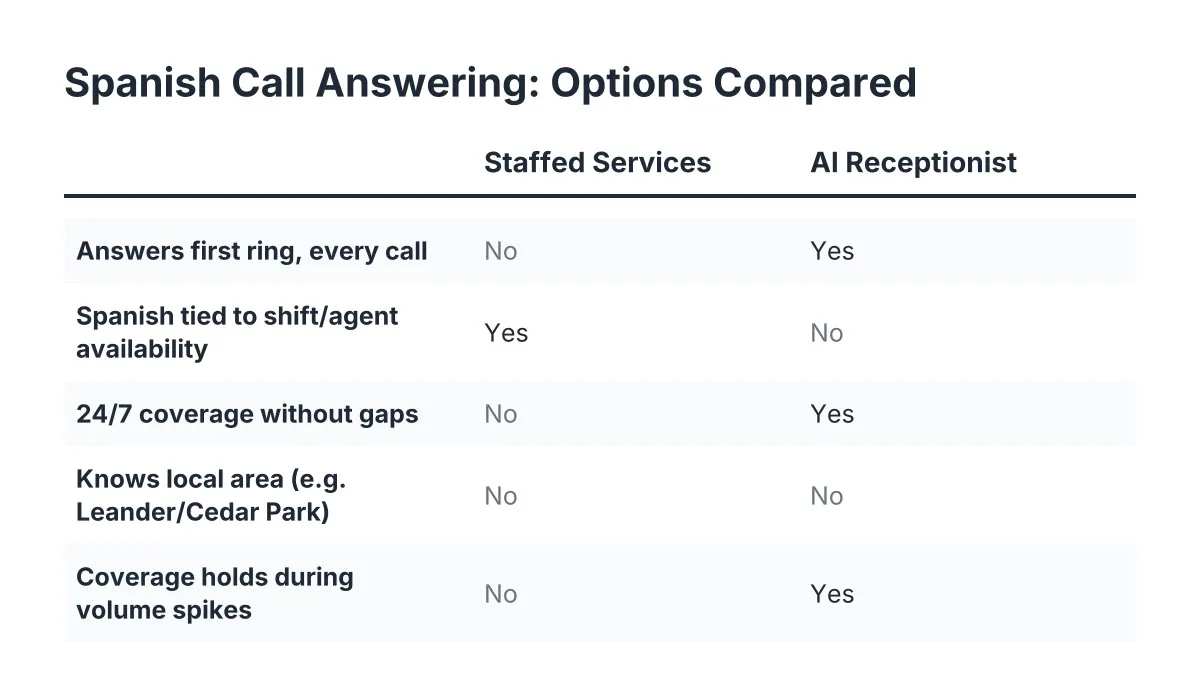
Hire a bilingual office person. A full-time bilingual receptionist in the Austin market runs $38,000 to $50,000 a year with payroll costs, and she works 40 hours a week. Your calls do not. Evenings, weekends, and lunch hours stay uncovered, and those are exactly when homeowners call about the things they noticed after work.
Lean on a bilingual crew member. This is the most common improvisation, and it quietly costs you twice. First, you pull a skilled tradesperson off billable work to translate a phone call. Second, the coverage is accidental; it only works if that specific person is available, off the ladder, and near his phone. When he takes a week off, your Spanish line goes dark.
Sign up with a national answering service. Traditional bilingual answering service providers and Spanish interpreter services exist, and for some businesses they are the right call. However, most are built as high-volume call centers. The agent reading a generic script from another state does not know that Leander and Liberty Hill are different service areas, cannot tell a quote request for a bathroom remodel from a handyman punch list, and often treats Spanish calls as an interpreter services relay: caller talks, agent conferences in a translator, minutes tick by, and the homeowner with water on her floor loses patience. You also pay per minute, so a chatty caller costs more than a booked one.
Each option trades away something a small crew cannot spare: money, billable hours, or local credibility.
How AI Changed the Bilingual Answering Services Math in 2026
Bilingual answering services matter, but until recently they only made financial sense for businesses big enough to absorb the cost. As of 2026, that has changed. An AI receptionist can answer every call in under two rings, detect the caller's language in the first few seconds, and hold the entire conversation in Spanish or English without a handoff, a hold, or a relay through a translator. For a bilingual answering service in Austin, an AI-powered approach means every Spanish-speaking caller gets the same quality experience as an English speaker, and the lead gets captured right the first time.
Here is what that looks like on a real call, mechanically:
- The call connects instantly. No ring-through to voicemail, no "please hold." The AI receptionist greets the caller, 2 a.m. or 2 p.m., weekday or Sunday.
- Language detection happens in the first exchange. If the caller opens with "Hola, tengo una fuga en el baño," the AI recognizes Spanish and continues the entire conversation in Spanish. No menu, no "press 2 para español," no asking the caller to switch. If she opens in English, it stays in English. Mid-call switches work too, which matters in Central Texas households where family members share a phone.
- Lead capture and qualification happen in the caller's language. Name, address, job type, timeline, urgency. The AI asks the questions you would ask, in the language the caller thinks in, so the answers are accurate instead of approximate.
- The appointment gets booked or the booking link goes out. The caller leaves the conversation with a time on the calendar, not a promise of a callback.
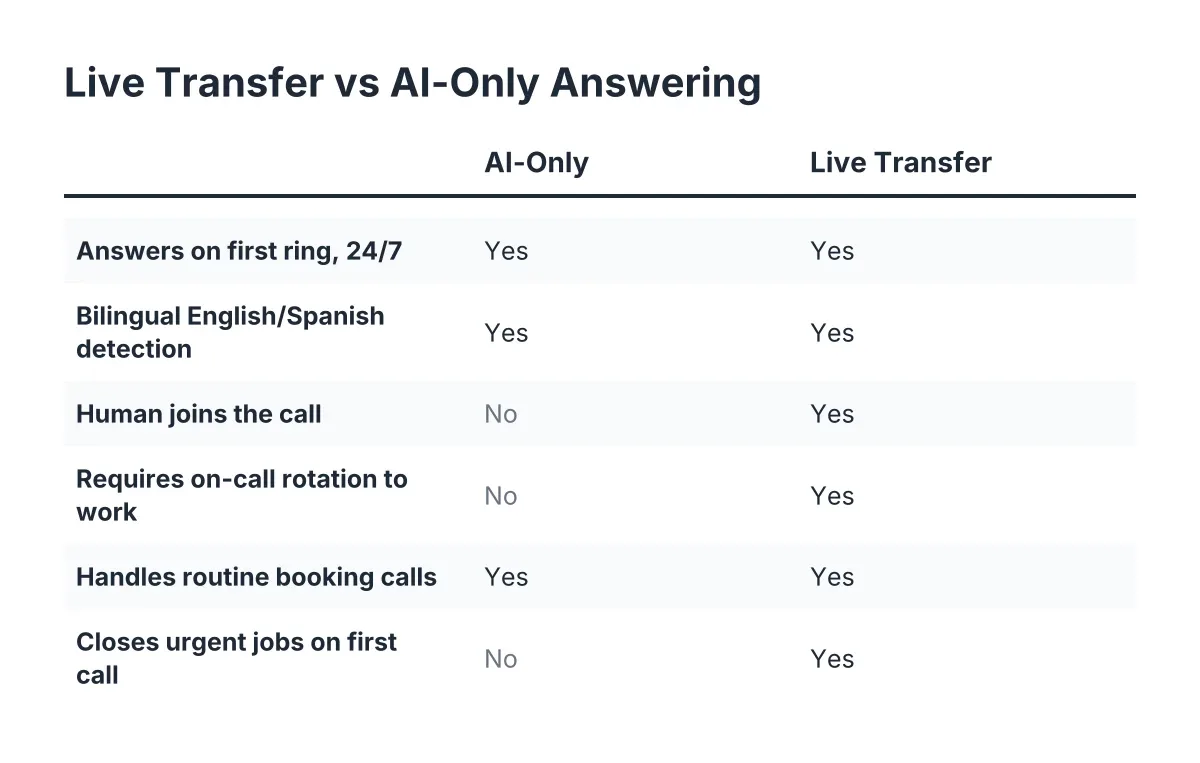
- You get the summary in English. Call intelligence scores the lead and writes up what happened, so you read a clean English summary of a Spanish conversation while you are still on site. If it is a genuine emergency and you have opted in, the call transfers live to your cell.
The distinction that matters here: this is not translation software bolted onto a phone tree, and it is not a multilingual IVR maze. It is one conversation, held natively in the caller's language, that ends in a captured, qualified, booked lead.
Put the skepticism on the table
Fair warning from someone who talks to trade owners every week: your first instinct will be doubt. Can AI actually handle a caller describing a weird plumbing noise in Spanish slang? Sometimes not perfectly, and honesty about that matters. Complex negotiations, detailed change-order discussions, and genuinely ambiguous emergencies still belong with you or a human on your team; a good setup routes those calls to a live transfer instead of pretending the AI can close them.
Consumers are not naive about this either. The same Five9 survey found 84% of people are aware that companies use AI for customer service. Callers do not need to be fooled; they need to be helped. A caller who gets her question answered, her appointment booked, and a confirmation text in her own language does not care whether the voice on the line drew a paycheck. She cares that someone answered.
The practical way to resolve the doubt is to test it. Call an AI receptionist yourself, in Spanish, and try to stump it. Describe a half-finished deck, a mystery breaker trip, a quote request with three trades bundled together. Judge it the way you would judge a new hire on a working interview, not on a brochure.
What Losing One Spanish-Speaking Caller Actually Costs
Abstract percentages do not move a small crew owner. A specific Tuesday does, so here is one built from real Central Texas patterns.
It is late June. Your two-person remodeling crew is mid-demo on a bathroom in Georgetown. At 6:40 p.m., after you have gone home, a homeowner in North Austin calls. Her mother owns a rental duplex, the tenant reported water stains spreading on a ceiling, and she wants someone to open it up, fix the source, and repair the drywall. She speaks Spanish at home and English "well enough for the store, not for construction," as she would put it herself.
Your line goes to an English voicemail. She hangs up without leaving a message, which is what most callers in her position do. The second contractor she calls answers in Spanish, books an inspection for 8 a.m., finds a slow supply-line leak, and walks out three weeks later having done the leak repair, the ceiling, a bathroom refresh the tenant had been asking about, and a bid on the mother's own house.
In that scenario, one answered call chains into a leak repair, a ceiling, a bathroom refresh, and a bid on a second house — plus a recurring customer who owns two properties and has a family full of referrals. Your cost to have won it: answering the phone in her language at 6:40 p.m. Multiply that by a summer, and the question of whether bilingual answering services matter answers itself in your bank statement, not in a blog post.
Making Bilingual Call Coverage Work Without Adding Headcount
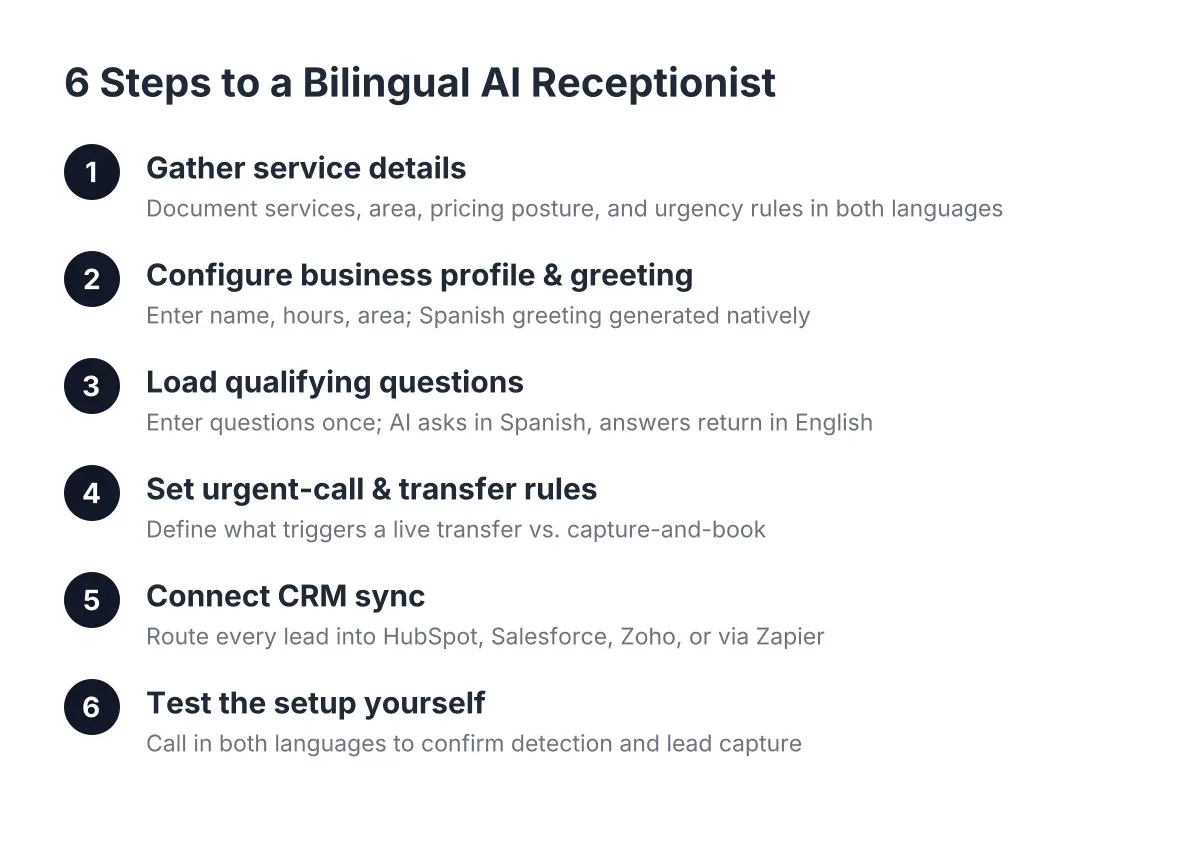
If the argument lands, the next step is execution: how does a solo operator or a small crew actually set this up without an office manager to run the project? The good news is that the moving parts are few.
Feed it your service knowledge. The AI receptionist needs to know what you do and do not take. Remodels yes, roofing no; Round Rock and Cedar Park yes, San Marcos no. For multi-trade businesses this is the highest-leverage step, because accurate scoping in either language is what separates a qualified lead from a wasted drive.
Decide your emergency rules. Define what counts as urgent enough for a live transfer to your cell, and what gets booked for the next open slot. A ceiling actively dripping is a transfer; a "whenever you can get to it" fence repair is a booking.
Connect the lead flow. Summaries and lead records should land where you already work, whether that is a simple weekly report, a Zapier hook into a spreadsheet, or a sync into HubSpot or Zoho. One-click call bridging from a dashboard means following up on a hot Spanish-language lead takes one tap, not a translation project.
Test it in both languages before it goes live. Call it in English. Have someone call it in Spanish. Throw your weirdest real job descriptions at it. Ten minutes of testing tells you more than any sales page.
One honest trade-off to weigh: if you already run enterprise scheduling software with complex crew dispatch across multiple markets, a lightweight AI setup may not fit your operation, and a conversation with your software vendor should come first. This approach is built for the solo operator through the eight-person crew, not the fifty-truck fleet.
The Bottom Line for Central Texas Trades
Nearly one in three of your potential customers in Austin lives in a bilingual household. Your competitors who answer in Spanish are not doing it to be polite; they are doing it because those calls turn into booked jobs and recurring customers. Every English-only voicemail greeting is a quiet referral to the business down the road.
The case for why bilingual answering services matter comes down to three facts worth keeping in your head: a large share of calls to small home service businesses ring out unanswered, most missed callers never call back, and the U.S. Census Bureau counts roughly one in three Travis County residents speaking a language other than English at home. Close the language gap and the answer-rate gap at the same time, and you are not adding a feature. You are recapturing revenue that has been walking out the door in a language you were not answering in.
If you're losing revenue to missed calls, NeverMiss ATX can help.
Prefer to talk it through? Call (512) 980-9267 — a quick call is usually the fastest way to get a straight answer for your situation.