Spanish-Speaking Call Answering Services: What Texas Home Service Businesses Should Look For
A burst pipe does not wait for business hours, and it does not care what language the caller speaks. If you run an emergency trade in Central Texas, you already know the math: the first business to answer wins the job. What many owners underestimate is how often that first answer needs to happen in Spanish. Spanish-speaking call answering trades exist for exactly this gap, and choosing the right one is a revenue decision, not a nice-to-have. This guide walks through what these services actually do, how to evaluate them, and what it costs when a panicked caller hangs up because nobody on the line understood them.
The numbers make the case before any sales pitch does. About 28.5% of Texans, nearly 7.8 million people, speak Spanish at home, according to U.S. Census Bureau estimates (via KXAN). In Austin specifically, 29.6% of residents age 5 and older are bilingual, and 10.3% speak English less than "very well," based on 2022 Census American Community Survey data compiled by the City of Austin. That second figure is the one that should get your attention. One in ten of your potential customers cannot comfortably describe a flooding kitchen or a no-cool situation in English. If your phone line only works in one language, you are invisible to a tenth of your market.
Why Language Is a First-Ring Problem for Emergency Trades
Emergency callers behave differently than routine callers. Someone booking spring lawn service will leave a voicemail or try again tomorrow. Someone with water pouring through a ceiling at 11pm will not. They hang up and dial the next plumber on the list, and they keep dialing until a human-sounding voice answers and understands them.
Now add a language barrier to that panic. Suppose a homeowner in Pflugerville wakes up to a burst pipe and her first language is Spanish. She calls your number. If she hears English-only voicemail, or an answering service agent who asks her to "hold for a Spanish speaker," she is gone in seconds. In that scenario, you did not just lose a $400 emergency call. You likely lost the follow-on water damage referral, the water heater replacement next year, and every neighbor she would have sent your way.
Speed compounds the problem. A foundational MIT Sloan / InsideSales.com study found that the odds of contacting a lead drop 100-fold, and the odds of qualifying that lead drop 21-fold, when the callback happens at 30 minutes instead of within 5 minutes. For emergency work, the real window is tighter than that. A Spanish-speaking caller who reaches voicemail is not a lead you call back. She is a customer your competitor already booked.
What Spanish-Speaking Call Answering Trades Actually Do
A Spanish-speaking call answering service picks up your inbound calls, detects or asks for the caller's language, and handles the full conversation in English or Spanish. That means greeting, triage, lead capture, and booking, not just taking a message. The good ones capture the same details in both languages: name, address, callback number, and the nature of the emergency.
However, the category covers three different models, and they behave differently at 2am on a Saturday. Successful Spanish call answering trades rely on one of these three approaches to answer inbound calls in both languages.
National bilingual call centers
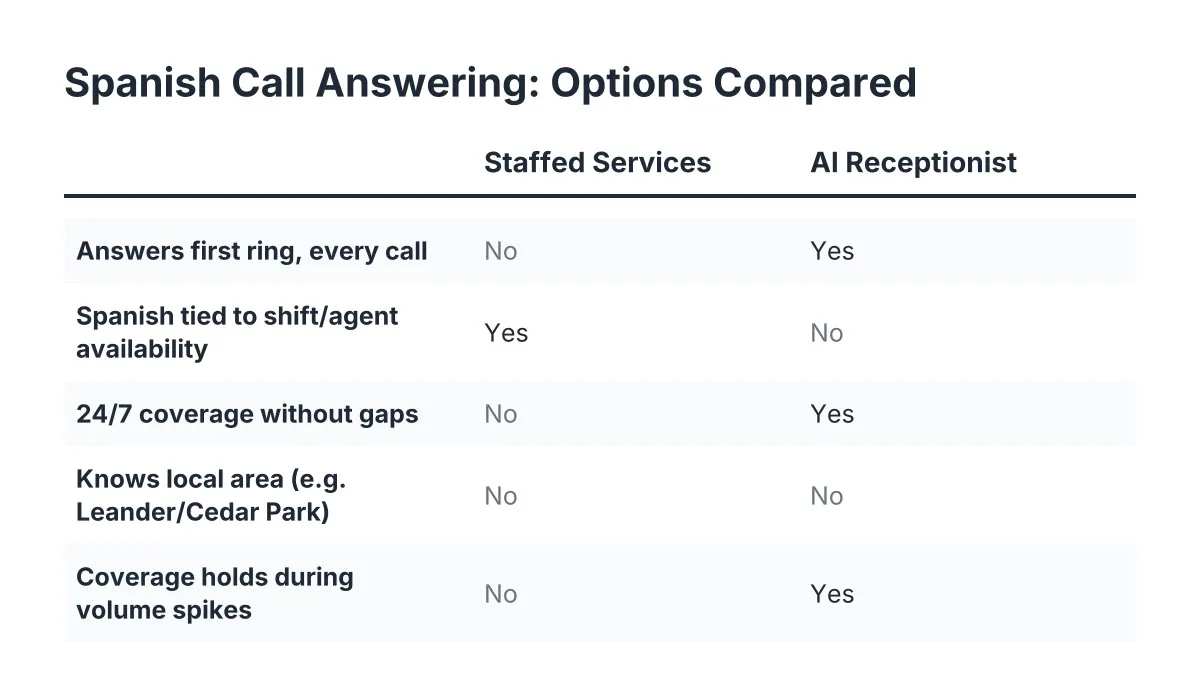
Traditional answering services staff bilingual agents in shared call centers. The Spanish coverage is real, but it is often a subset of the agent pool. During peak hours, or overnight, your Spanish caller may wait on hold longer or get transferred between agents. The agents also work from generic scripts across hundreds of client accounts. They can take a message about "no-cool" or "flooding," but they rarely know whether that means dispatch now or book for morning, and they do not know Central Texas. Ask any of them where Leander is relative to Cedar Park and you will hear typing.
Hiring bilingual staff in-house
An in-house bilingual receptionist gives you the deepest local knowledge and a real relationship with repeat callers. The trade-offs are cost and coverage. One person works about 40 hours a week; your phone rings 168. You would need multiple hires to cover after-hours and weekends, which is where emergency revenue lives. For a solo operator or a crew of five doing $150K to $800K a year, a full-time bilingual hire is a large fixed cost tied to one shift. There is also a quieter risk: if your Spanish coverage is one employee, it disappears when that employee takes vacation, calls in sick, or quits.
AI receptionists with bilingual support built in
The newer option is an AI receptionist that answers every call on the first ring, in English or Spanish, 24/7. There is no separate Spanish queue and no waiting for the right agent, because the same system speaks both languages on every call. The strong versions do more than answer: they qualify the lead, capture the address and urgency, send a booking link, and can live-transfer a true emergency to your cell. Because it is software, coverage does not thin out at 3am or during a February freeze when call volume spikes tenfold.
None of these models is automatically right. The rest of this guide covers how to evaluate them against the way emergency and seasonal trades actually work.
How to Evaluate Spanish-Speaking Call Answering Services: 7 Criteria
Feature lists blur together fast in this category. Therefore, judge any service you are considering against these seven criteria, in roughly this order of importance for an urgent-response trade.
- Answer speed in both languages. Ask specifically: does a Spanish-speaking caller wait longer than an English speaker? With staffed services, the honest answer is often yes during off-peak hours. With an AI receptionist, the answer should be no, because language is not tied to who is on shift.
- How language detection works. The caller should never have to press 2 or navigate a menu in a language they do not read. The best setups greet in English, detect Spanish within the caller's first sentence or two, and switch mid-call without dropping the conversation. Test this yourself before signing anything. Call the line and open in Spanish. If the handoff is clumsy, your panicked 11pm caller will not tolerate it either.
- Emergency triage, not just message-taking. A service that writes "customer called, said something about water" has captured a message, not a lead. You need triage logic: is this flooding right now or a slow drip, is anyone without power or heat, is the caller safe. The service should distinguish "book this for tomorrow" from "wake up the owner," and it should do that in Spanish as reliably as in English.
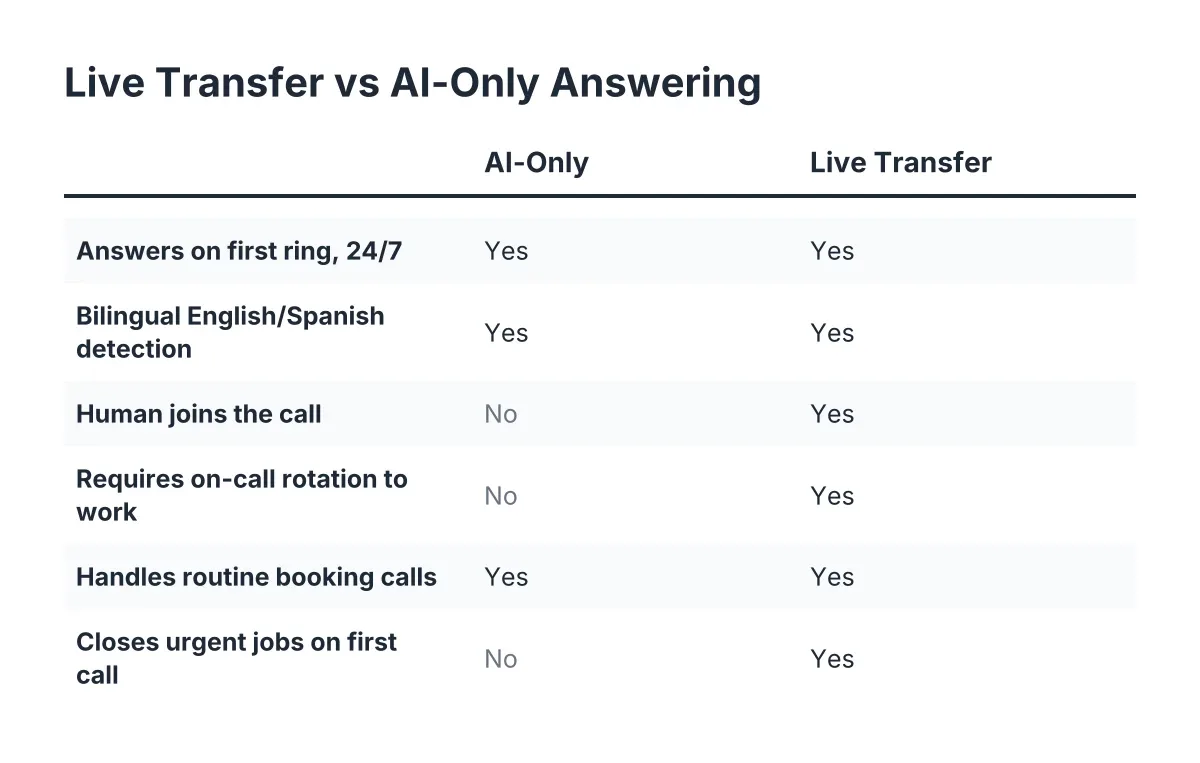
- Live transfer for true emergencies. For urgent trades, opt-in live transfer is the difference between a lead summary you read at 7am and a job you dispatched at 11:15pm. Confirm the transfer is fast, confirm you can set the rules for what qualifies, and confirm the caller is not stranded on hold if you are on site and cannot pick up.
- Lead capture that lands in your workflow. Every call should produce a structured record: name, number, address, urgency, and language. That record should push to wherever you already work, whether that is a CRM like HubSpot or Salesforce, a Zapier flow, or a simple dashboard you check between jobs. If the Spanish calls arrive as untranslated notes you cannot read, the coverage is half-finished.
- Handling recurring versus one-time intent. Seasonal businesses live on recurring customers. A caller asking about monthly pest control or a spring lawn contract is worth several times a one-off job. The service should capture that intent and flag it, in both languages, so you can prioritize the callback that multiplies lifetime value.
- Pricing that survives your peak season. Per-minute billing looks cheap in the slow months and punishes you in July when the no-cool calls stack up. Ask what a heat-wave month actually costs. Flat or predictable pricing matters more for seasonal trades than a low headline rate.
What a Spanish-Speaking Caller Should Actually Hear
Walk through the call from the customer's side, because this is where services separate. Here is an illustrative after-hours call, the kind a typical Austin plumber fields in August.
The phone rings once. The line answers with your business name, in English. Additionally, the caller responds in Spanish: her water heater is leaking and spreading toward the hallway. A well-built system switches to Spanish immediately, without asking her to repeat herself or wait. It stays calm and specific: where is the leak, has she found the shutoff valve, is water reaching any outlets. It captures her address in Round Rock, her callback number, and flags the call as urgent.
From there, one of two things happens based on rules you set. Either the call live-transfers to your cell because a spreading leak meets your emergency threshold, or the system books her into your first morning slot, texts her a confirmation, and sends you a summary in English with the urgency scored. Either way, she never heard voicemail, never hit a language wall, and never dialed your competitor.
Compare that to the common failure modes: a hold queue while an agent hunts for a Spanish speaker, a phone tree asking her to press numbers, or an English-only recording. Each one loses the call at a different point, but they all lose it.
Why Bilingual Coverage Is a Revenue Decision, Not a Courtesy
Owners sometimes file bilingual coverage under customer service, next to a nicer hold message. For Texas trades, that framing undercounts what is at stake. Run rough numbers on your own book of business.
Say a Cedar Park HVAC company takes 200 inbound calls in a summer month. If the local demographics hold, 20 to 30 of those callers are more comfortable in Spanish, and some cannot complete a technical call in English at all. Suppose language friction loses even 10 of them, and your average ticket is $350. That is $3,500 a month gone in peak season, before counting the recurring maintenance contracts those customers would have signed. For pest control and lawn care, where the first call often starts a multi-year recurring relationship, the lifetime value multiplier makes each lost caller more expensive still.
The competitive side cuts the same way. Central Texas has plenty of trades that already answer in Spanish, some because the owner grew up bilingual, some because they invested in Spanish call answering trades early. Every Spanish-speaking caller you miss is a review, a referral network, and a repeat customer handed to one of them. In neighborhoods where word of mouth travels in Spanish, that compounds fast.
There is also a trust dimension that shows up in the data. A Five9/TEAM LEWIS survey found 75% of consumers prefer talking to a real human for customer support, and 84% are aware companies use AI for customer service. Read together, those numbers set the bar for any AI-based option: it has to sound natural, understand context, and hand off to a human when the situation calls for it. Callers accept AI on the line; they do not accept a robotic phone tree in either language.
Where Each Option Fits, Honestly
No single model wins every situation, so match the option to how your business actually runs.
An in-house bilingual receptionist fits best when you already need a full-time office role anyway: dispatch, invoicing, and parts ordering alongside phones. If you are at 10 to 15 crew members with steady daytime volume, that hire can pay for itself, and you can layer an after-hours service on top for nights and weekends.
A national bilingual call center fits businesses that mainly need message-taking at scale and can tolerate hold times, generic scripts, and per-minute costs. If callers rarely need triage and no call is truly urgent, the model works. For emergency trades, the gaps show at exactly the wrong moments.
An AI receptionist with bilingual support on every plan fits solo operators through mid-size crews who cannot justify a full-time hire but cannot afford missed calls either. It answers on the first ring at 2am in either language, captures and qualifies the lead, books the job or transfers the emergency, and costs a fraction of a salary. The honest limitation: an AI receptionist augments your team rather than replacing human judgment. A genuinely ambiguous emergency, a caller in distress, or a complex commercial negotiation still belongs with you or a trusted employee, which is why live transfer rules matter so much in your setup. It also will not walk to the front counter or sign for a parts delivery.
For most recurring and seasonal home service businesses in the $150K to $800K range, the practical answer in 2026 is the third option, sometimes combined with the first as the business grows. What rarely makes sense anymore is the default many owners still run: English-only voicemail after 6pm, in a market where a tenth of callers may not leave an English message at all.
Questions to Ask Before You Sign Up for Spanish-Speaking Call Answering
Before committing to any provider, get direct answers to these questions. Vague responses to any of them are a signal to keep looking.
- Is Spanish included on every plan, or is it an add-on? Some services price bilingual coverage as a premium tier. If a third of your market speaks Spanish at home, that is core coverage, not an upgrade.
- Can I call the line right now and test it in Spanish? Any provider confident in its Spanish handling will invite you to try to stump it. Call after hours, open in Spanish, describe a fake emergency, and see what comes back. Judge the recording, not the brochure.
- How does the service handle a caller who switches language mid-call? Real households do this constantly. The conversation should follow the caller, not force a restart.
- What exactly do I receive after a Spanish call? You want the lead summary in English, with the caller's language noted, urgency scored, and the details structured. Ask to see a sample summary from a real Spanish-language call.
- What are my live transfer rules, and who sets them? You should define what counts as an emergency for your trade: flooding yes, dripping faucet no, no-cool above 95 degrees yes. Confirm you can change these rules by season.
- What happens during a weather event? A February freeze or a spring hail storm can multiply call volume overnight. Staffed services queue; ask what their hold times looked like during the last surge. Software-based services should answer every call simultaneously; ask them to confirm that in writing.
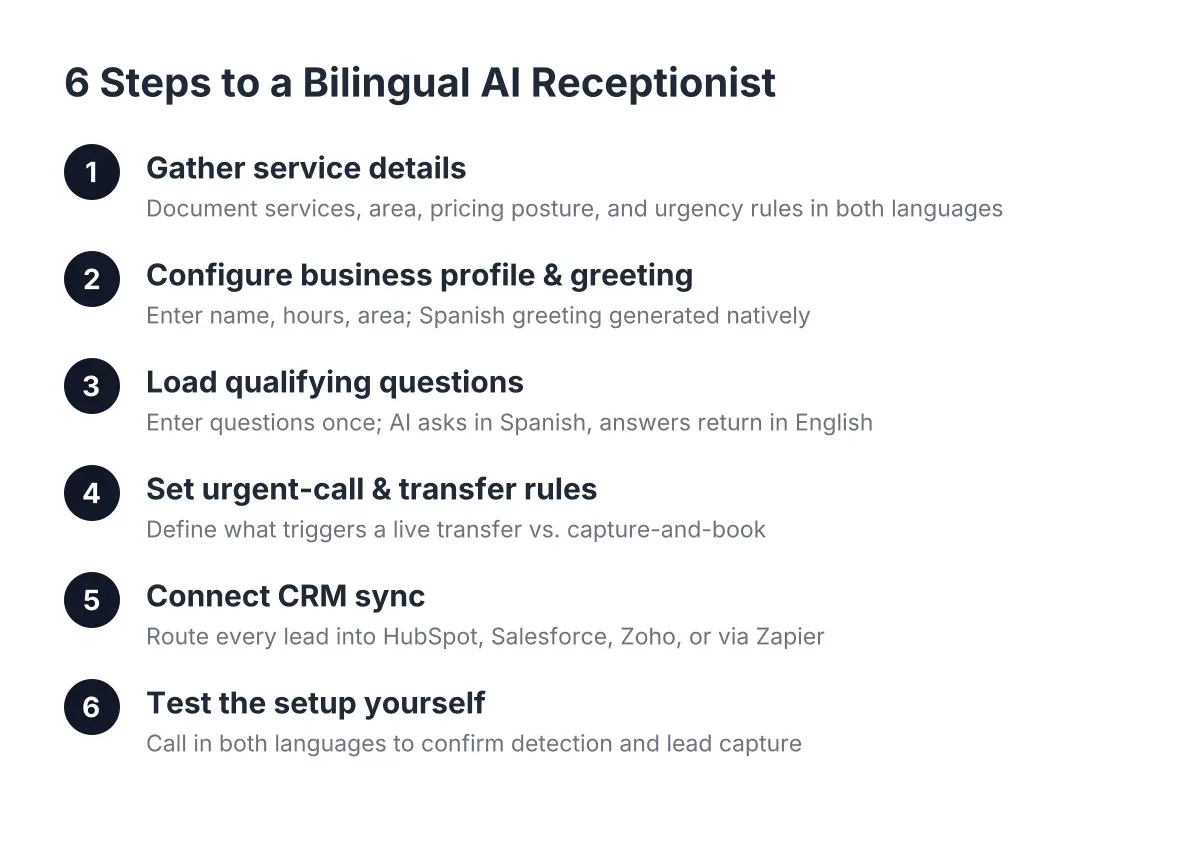
- How long does setup take, and who does it? For a small trade business, setup measured in weeks is a red flag. You should be describing your services, service area, and emergency rules in a conversation, not building call flows yourself.
The Bottom Line for Central Texas Trades
Spanish-speaking call answering services stopped being a niche consideration the moment your service area included Austin, Round Rock, Georgetown, or anywhere else in Central Texas. The demographics are settled, the competitive pressure is real, and the technology now answers both languages on the first ring without a bilingual hire.
Evaluate your options against how emergencies actually unfold: a panicked caller, a narrow window, and no second chances. Whichever model you choose, test it yourself in Spanish before your customers do. The service that handles your hardest fake call at 11pm is the one that will capture the real one.
If you're losing revenue to missed calls, NeverMiss ATX can help.
Related guide: bilingual answering service — Complete Guide
Prefer to talk it through? Call (512) 980-9267 — a quick call is usually the fastest way to get a straight answer for your situation.