How AI Receptionists Answer, Qualify, and Book Jobs 24/7 in English and Spanish
You're on a ladder in Pflugerville, elbow-deep in a condenser unit, and your phone buzzes twice in your pocket. The first caller hangs up after four rings. The second gets your voicemail, hears English only, and dials the next lawn care company on Google, the one that answered in Spanish. This is the exact problem a bilingual AI receptionist answers, qualifies, and books around: every inbound call gets picked up, in the caller's language, while you stay on the job. For a solo tradesperson in Central Texas, that's not a convenience. It's the difference between staying booked through spring and watching leads walk to competitors who answer.
This guide walks through how the whole system works in practice: what a Spanish-speaking caller actually hears, how language detection happens in the first seconds of a call, what qualification questions get asked, how a booking link lands in the caller's texts, and what it costs you when the answer is voicemail instead. If you've already decided to put an AI receptionist on your line, this is the playbook for getting it right.
Why Bilingual Call Handling Is a Revenue Decision in Texas
Skip the demographics lecture; you already know your market. If you run lawn care in Round Rock, pest control in Georgetown, or HVAC maintenance anywhere between Leander and Georgetown, a meaningful share of your inbound calls come from Spanish-speaking households. Some of those callers speak English fine but prefer Spanish for anything involving money, their home, or a stranger showing up at their door. Others won't finish a call that starts and stays in English.
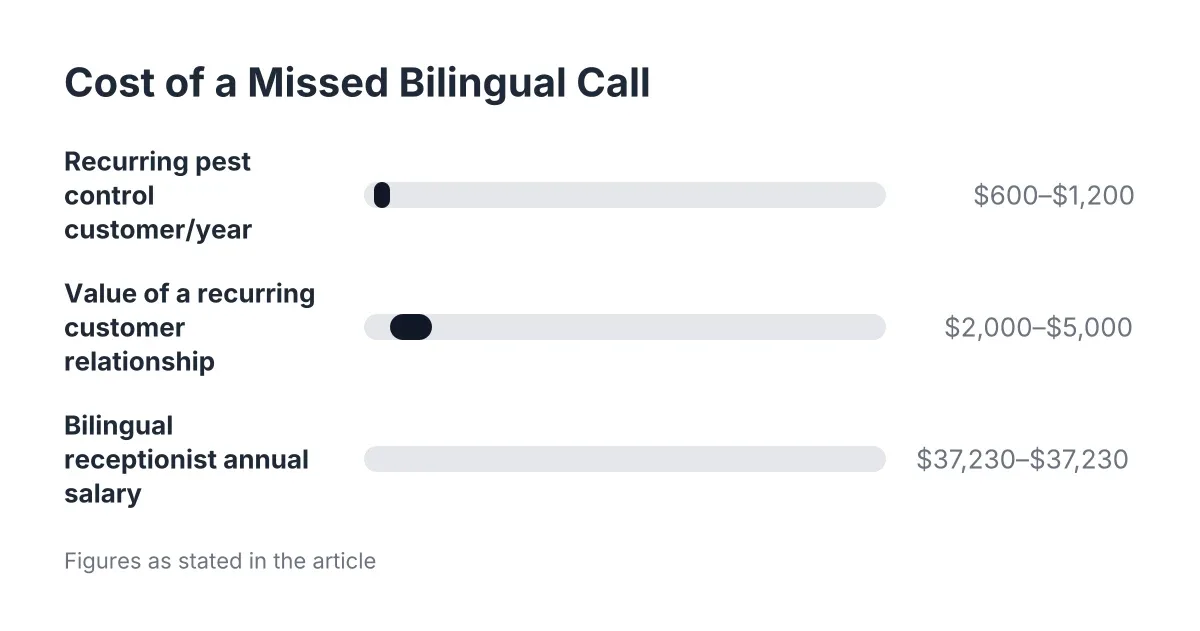
Here's the math that matters. A recurring pest control customer in Cedar Park can easily be worth $600 to $1,200 a year, and recurring customers often stay for years. That first call isn't a $150 job; it's potentially a $2,000 to $5,000 relationship. Lose that call to a language barrier and you didn't miss one job. You handed a competitor a recurring customer for years.
Now stack that against what solo operators already miss. If you're physically unable to answer a real share of your inbound calls because you're on site with tools in your hands, and some portion of the calls you do answer stall out because the caller wanted Spanish, you're leaking revenue from two directions at once. A bilingual answering service closes both leaks with one fix: every call gets answered, in the language the caller opens with, around the clock.
The traditional fixes don't pencil out for a one-person operation. Hiring a bilingual receptionist runs about $17.90 an hour at the national median, or roughly $37,230 a year before benefits, according to the U.S. Bureau of Labor Statistics. That's a full-time salary to cover business hours only, and you'd still miss the 9 p.m. call about roaches in the kitchen. Asking a Spanish-speaking crew member to double as your phone line works until they're running a mower or they quit. Neither option answers at 2 a.m. Both cost more than the problem.
How AI Receptionists Answer and Qualify Every Caller
An AI receptionist answers your business line on the first or second ring, greets the caller by your company name, detects whether they're speaking English or Spanish, and continues the entire conversation in that language. It then asks your qualification questions, captures the lead's details, and texts a booking link before the call ends. No hold music, no "press 2 para español," no voicemail.
That's the whole loop, and it runs the same at 10 a.m. on a Tuesday as it does at 11 p.m. on a Sunday. Let's break down each piece, because the details are where solo operators either win or get burned.
What a Bilingual AI Receptionist Hears from Spanish-Speaking Callers
The caller hears a natural greeting in your company's name. If they respond in Spanish, the AI receptionist switches within the first exchange and holds the conversation in Spanish from that point forward. There's no menu, no transfer, and no awkward pause while software figures things out. The caller experiences one fluid conversation with someone who understood them from the start.
Language detection happens on the caller's first full sentence. The system listens for which language the caller uses, not which one you'd guess from a name or an area code. That matters because plenty of Central Texas households switch between languages mid-call, and a good system follows the caller's lead rather than locking into one language.
Skeptical that it actually sounds natural in both languages? Fair. The honest test is to call the line yourself, open in Spanish, throw in some slang, and try to stump it. Any provider confident in their bilingual handling will invite exactly that test. If they won't let you call and try it before you put it on your business line, that tells you something.
One thing worth flagging: this is not machine translation bolted onto an English script. A Google Translate extension for Chrome can help you read a Spanish email from a customer, but real-time voice conversation is a different animal entirely. Translation tools convert words; a bilingual AI receptionist holds a conversation, asks follow-up questions, and understands that "se me inundó el baño" means someone needs a plumber today, not a quote next week.
The Qualification Questions That Sort Real Jobs from Tire-Kickers
Answering is table stakes. Qualification is where the value compounds, because a captured lead with no context is just a phone number you have to chase. When AI receptionists answer and qualify in the same call, you get back a lead that's already sorted: what they need, where they are, how urgent it is, and whether it's recurring or one-time work.
For a recurring service business, the qualification script should capture at minimum:
- Service type: mowing, fertilization, quarterly pest treatment, HVAC tune-up, or something outside your lanes
- Recurring or one-time intent: "every two weeks through October" is a different lead than "one cleanup before a party"
- Location: so a Georgetown address doesn't end up on your Buda route
- Urgency: routine booking versus "the AC died and it's 95 degrees"
- Contact details: name, callback number, and preferred language, so you know how to follow up
You set these questions during setup, and they should reflect how you actually price and route work. A lawn care operator wants lot size and gate access. A pest control company wants to know if it's ants, rodents, or a wasp nest under the eaves. Generic scripts produce generic leads; five minutes spent customizing your questions pays back on every call afterward.
Booking Without You Touching Your Phone
Once a caller is qualified, the AI receptionist texts them your booking link during or right after the call. The caller picks a slot while their motivation is hot, and you find a booked job in your calendar when you climb down off the ladder. If you sync leads through Zapier, HubSpot, Salesforce, or Zoho, the lead record lands in your CRM automatically with the call summary attached.
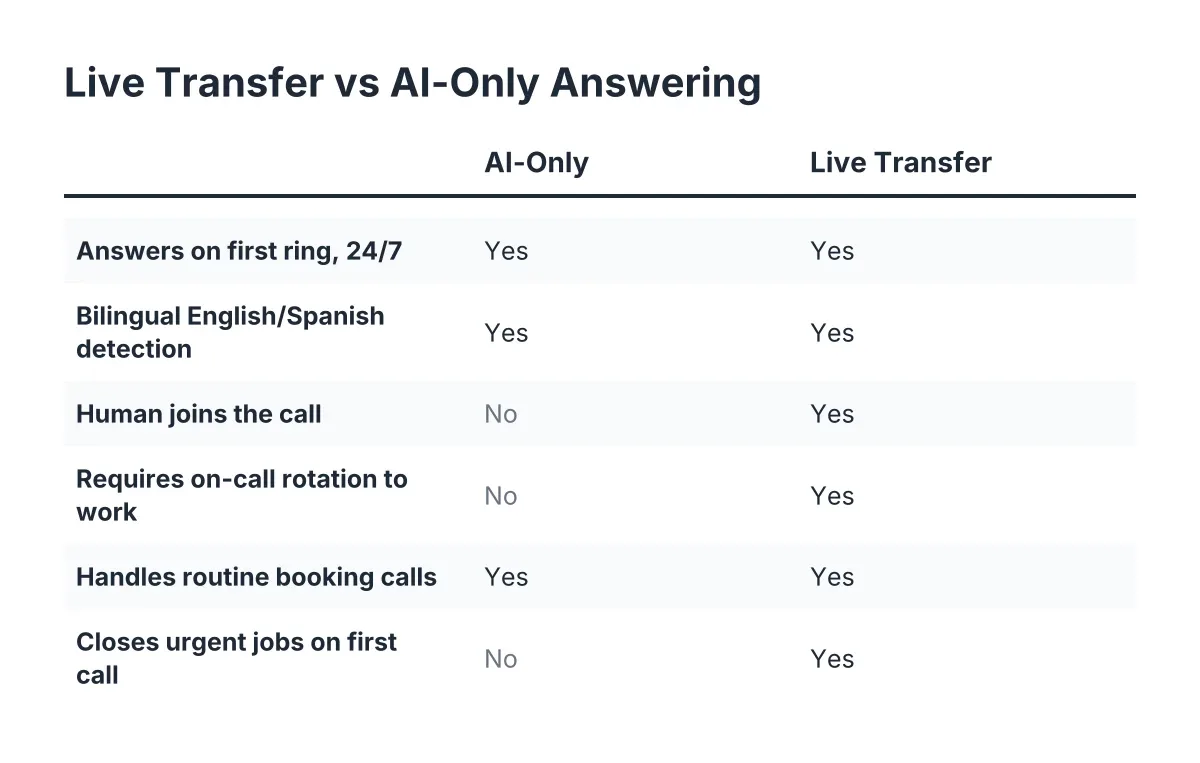
For urgent calls, you can opt into live transfer. A burst pipe or a dead AC unit in July gets bridged straight to your cell, while routine "can you come next week" calls get booked without interrupting you. You define what counts as urgent during setup. This is the piece that lets emergency-capable trades trust the system: the AI captures and books the routine work, and the genuine emergencies still reach a human, you, in real time.
Setting Up a Bilingual AI Receptionist as a Solo Operator
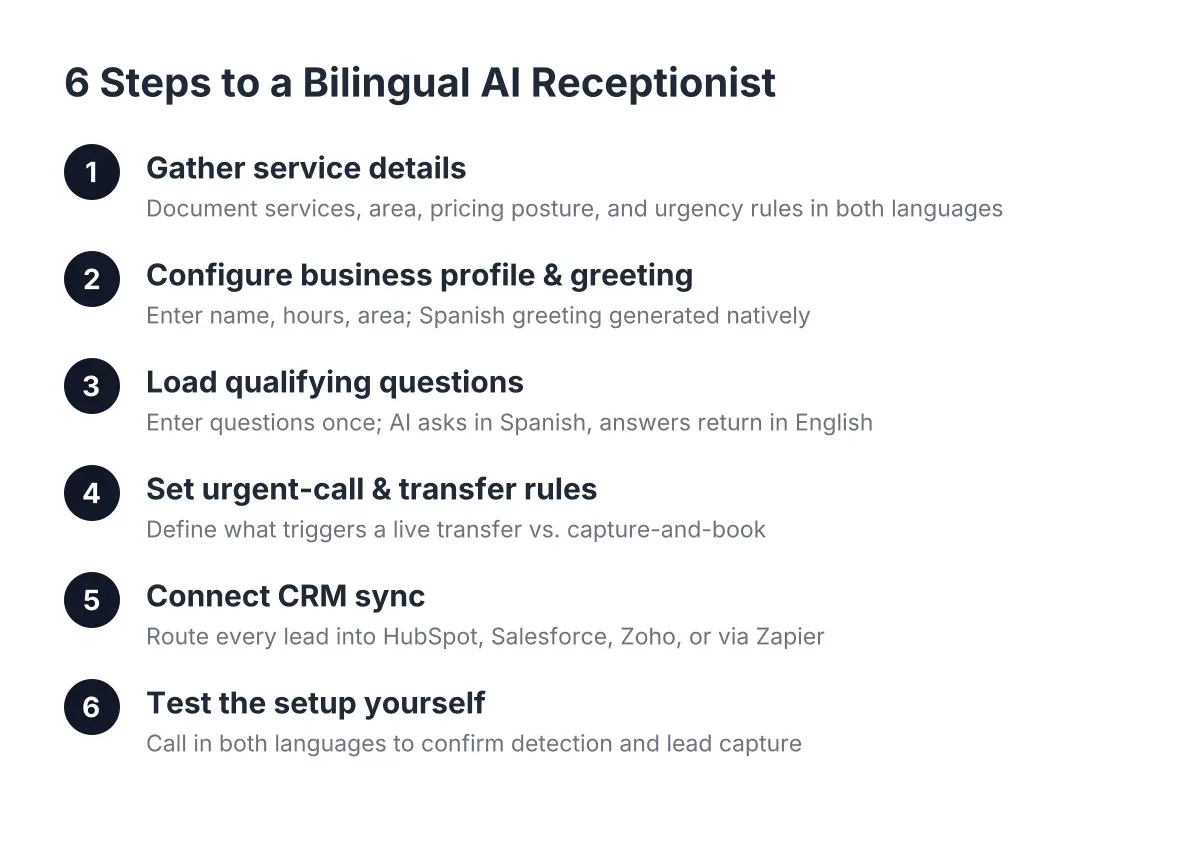
Setup for a solo trade business takes an afternoon, not a project plan. You forward your existing business number, write your qualification questions, connect your booking calendar, and decide your transfer rules. Most solo operators can be live the same day they start, and nothing about your phone number or your customers' experience of reaching your business changes except that someone always picks up.
Here's the sequence that works:
- Forward your line. Keep your existing number. Set conditional forwarding so calls route to the AI receptionist when you don't pick up, or forward everything and let it screen. Conditional forwarding is the popular choice for solo operators: you answer when you can, and nothing slips through when you can't.
- Write your greeting and questions. Give it your company name, your service area (say, Austin through Georgetown, but not past Jarrell), and the five or six questions that tell you whether a job is worth a callback.
- Define your urgency rules. Decide what triggers a live transfer to your cell. For HVAC in summer, "no cooling" probably qualifies. For lawn care, almost nothing does, and that's fine; let everything book itself.
- Connect your booking link and CRM. Drop in your scheduling link so callers can book directly. If you use a CRM, wire the webhook so every lead lands there with a summary.
- Test it in both languages. Call your own line. Then have a Spanish-speaking friend or family member call and try to book a fake job. Listen to the recording. If anything sounds off, adjust the script before real customers hear it.
That last step is not optional. You wouldn't install a customer's system without testing it under load, so don't put an answering system on your revenue line without calling it yourself first.
Tuning Qualification for Seasonal Peaks
Recurring and seasonal businesses have a call pattern that punishes anyone who can't scale answering on demand. Spring booking season for lawn care can triple your daily call volume for six weeks. The first 100-degree week in June does the same for HVAC. After-hours pest calls spike when someone finds scorpions at bedtime.
Therefore, revisit your qualification script at the front edge of each season. In February, a lawn care operator should add a question about season-long recurring service, because a caller booking weekly mowing in March is your highest-value lead of the year. In May, an HVAC maintenance business should tighten its urgency rules so "AC not cooling" calls transfer live while tune-up bookings flow to the calendar. Ten minutes of tuning per season keeps the AI qualifying for the jobs that matter most right now.
Review your weekly report on Monday mornings and look for patterns. If you see Spanish-language calls clustering after 7 p.m., that's your market telling you when Spanish-speaking households handle home service decisions. You can't act on data you never see, and you were never going to hear those calls from a job site anyway.
What Happens When AI Receptionists Answer and Qualify After Hours
After-hours calls are where the bilingual capability earns its keep hardest. A Spanish-speaking homeowner in Round Rock who discovers a pest problem at 9:40 p.m. is going to call down the search results until someone picks up. If your line answers in Spanish, qualifies the job, and books an appointment for Thursday, that lead never sees your competitors. If your line goes to an English-only voicemail, you were never in the running.
Consider a realistic week for a solo pest control operator during summer. Say you miss eight calls while on site or after hours. If three of those callers preferred Spanish and two of the eight would have become quarterly recurring customers at $500 a year for three years, that week's missed calls cost about $3,000 in lifetime value. Multiply by a season and the number stops being abstract.
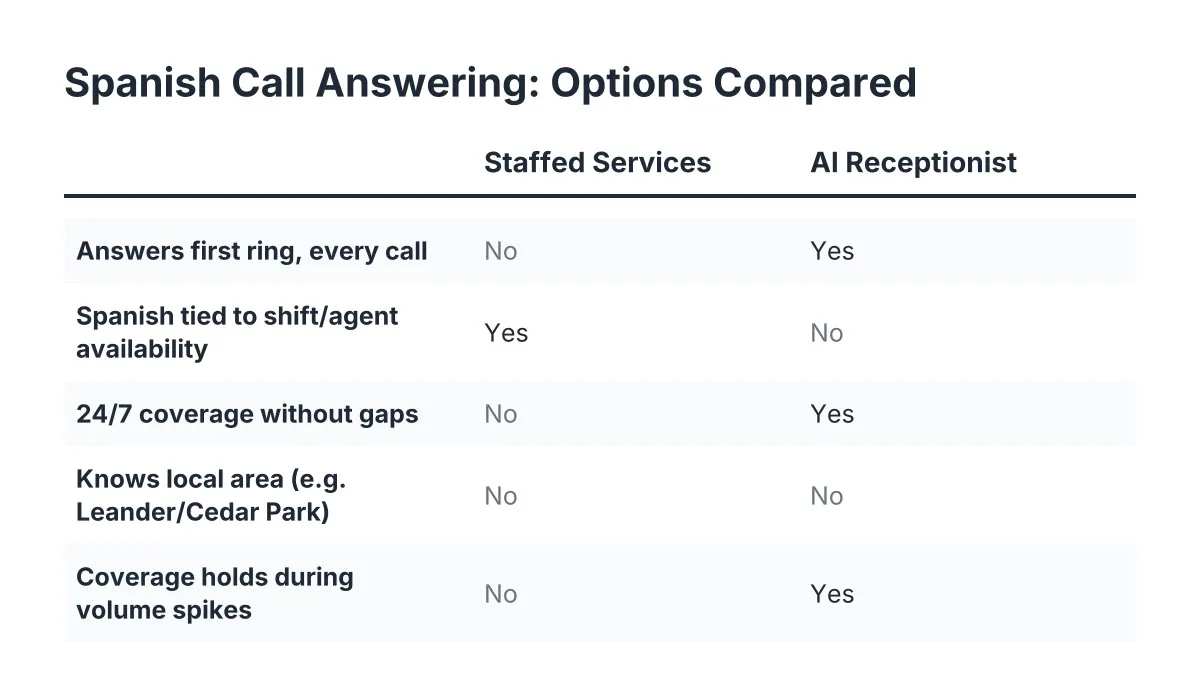
The after-hours window is also where AI has an honest advantage over every human alternative. A hired receptionist works 40 hours; your phone rings across all 168. According to a Five9 survey, 75% of consumers prefer talking to a real human for customer support, and that preference is real. However, the actual choice at 10 p.m. is not human versus AI. It's an AI receptionist that answers in the caller's language versus a voicemail box they'll never leave a message in. Callers who reach a responsive, fluent answer overwhelmingly beat callers who reach nothing.
Worth noting: most consumers already expect this. The same Five9 research found 84% of consumers are aware that companies use AI for customer service. Your callers are not shocked when a fast, capable system answers; they're relieved someone picked up.
Honest Limits: What an AI Receptionist Won't Do
An AI receptionist answers, qualifies, captures, and books; it does not diagnose a failing compressor over the phone or quote a complex irrigation redesign sight unseen. Those decisions stay with you, as they should. The system's job is to make sure the person who needs that expertise actually reaches you instead of your competitor.
There are also fits and non-fits worth being straight about. If you already employ a full-time receptionist who's bilingual and answers reliably, adding AI on top solves a problem you don't have. Multi-location operations with dispatch software and enterprise call routing have different needs than this setup addresses. And for genuinely life-safety emergencies, a gas leak or electrical fire, the right answer is 911 and a licensed professional on site, and any qualification script should say so.
One more distinction, since search results blur it: this is a service that answers your phone, not a job you staff. People searching for work from home answering service jobs are looking at the labor side of national call centers, which is exactly the model a locally built AI receptionist sidesteps. There's no remote agent in another state reading a generic script about a trade they've never worked; the system runs on the questions and service area you defined.
Getting the Most from It Once You're Live
The operators who get the best results treat the first month as a tuning period, not a set-and-forget install. A few habits make the difference:
- Listen to call summaries daily for the first two weeks. AI call intelligence scores and summarizes every conversation. Skim them over lunch. If callers keep asking something your script doesn't cover, add it.
- Call leads back fast using one-click bridging. A qualified lead who booked online needs nothing. A qualified lead who didn't book needs a callback within the hour, and bridging the call from your dashboard beats digging through texts for a number.
- Track Spanish-language lead volume separately. After 60 days, you'll know what share of your captured leads came in Spanish. For most Central Texas trades, that number alone justifies the decision.
- Update your script when your business changes. New service, new coverage area, new pricing floor; if you'd tell a receptionist, tell the AI.
The pattern among small businesses backs up this augment-not-replace approach. According to the National Federation of Independent Business, 98% of small employers using AI report no change in employee headcount. Solo operators aren't using these tools to cut staff they don't have; they're using them to do work that was physically impossible before, like answering a Spanish-language call from the top of a ladder.
The bottom line for a one-person trade business in Central Texas: your hands are your revenue, and they're busy most of the day. Every call that rings out while you're on site is a coin flip on a customer worth years of recurring work, and every Spanish-speaking caller who hits an English-only voicemail isn't a coin flip at all; it's a guaranteed loss. Put a bilingual AI receptionist on the line, tune the qualification questions to your trade, test it in both languages, and let it catch everything you physically can't. Then get back to the job.
If you're losing revenue to missed calls, NeverMiss ATX can help.
Prefer to talk it through? Call (512) 980-9267 — a quick call is usually the fastest way to get a straight answer for your situation.