Live Call Transfer vs. AI-Only Answering: Which Fits Your Austin Trade Business
If you run a plumbing, pest control, or lawn care operation in Austin, TX, you have probably hit the same wall: the phone rings while your crew is on a ladder or under a sink, the caller speaks Spanish, and nobody on staff can answer in their language. When those business owners start comparing options, the question of live transfer vs AI-only comes up fast. Should an AI receptionist handle the whole call itself, or should it hand urgent callers to a human? This guide breaks down both models, what they cost, how bilingual handling works in each, and how to decide which one protects your revenue in Central Texas.
The short version: this is not an either-or decision for most trades. The right setup is usually AI-only handling for the 80 to 90 percent of calls that are routine, with opt-in live transfer for the genuine emergencies. But the details matter, especially when your customer base calls in two languages. Let's get specific.
Why This Decision Is a Revenue Decision, Not a Tech Preference
Every missed first call from a new customer costs more than one job. For a recurring service business, a new pest control or lawn care customer is worth five times a one-time job, because you are winning weekly or monthly service for years. Lose the first call and you lose the whole contract.
Speed compounds the problem. A foundational MIT Sloan / InsideSales.com study found the odds of contacting a lead drop 100-fold, and the odds of qualifying that lead drop 21-fold, when the callback happens at 30 minutes instead of within 5 minutes. A voicemail greeting is a 30-minute callback on a good day. During spring booking season, it is often a next-day callback, and by then the caller has booked your competitor.
Now add language. Austin and the surrounding markets, Round Rock, Pflugerville, Georgetown, have a large Spanish-speaking customer base. If a Spanish-speaking homeowner calls about roaches at 9 p.m. and hears an English-only greeting, they hang up and dial the next listing. You never even see that missed call in your metrics, because it never became a lead. That is the revenue math behind choosing how your phones get answered.
What AI-Only Answering Actually Means
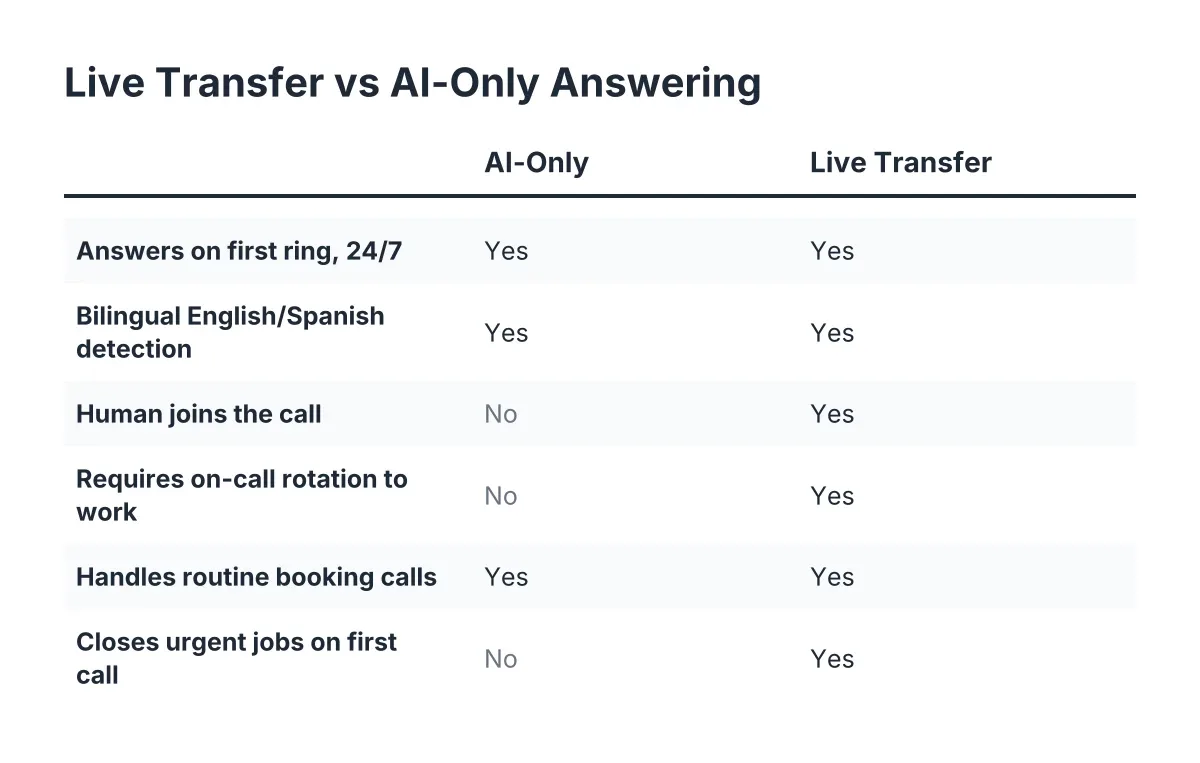
AI-only answering means the AI receptionist handles the entire call from hello to booked appointment, with no human on your end joining the conversation. It answers on the first ring, 24/7, detects whether the caller speaks English or Spanish, qualifies the job, captures contact details, and sends a booking link or books the appointment directly.
Here is what the caller experiences on a well-built system:
- The call is answered immediately, day or night, no hold music.
- The AI greets the caller and detects language from their first response. A caller who answers in Spanish gets the full conversation in natural Spanish, not a translated script.
- It asks the qualifying questions you would ask: what's the problem, where are you located, is this urgent, have you used us before.
- It books the appointment or sends a booking link by text, then sends you a summary with a lead score.
For a lawn care or pest control owner, this covers the bulk of your call volume. A caller wanting a quote for weekly mowing in Cedar Park does not need to talk to you at 7 p.m. on a Tuesday. They need answers, a price range or quote process, and a booked slot. The AI handles that, in either language, while your crew finishes the day's route.
The honest caveat: some callers still want a human. A Five9 survey of 4,000 U.S. and U.K. consumers found 75 percent prefer talking to a real person for customer support. The same Five9 research found 84 percent of consumers are aware companies already use AI for customer service, so the experience is familiar. The practical takeaway is that AI-only works when the AI is good enough that the caller gets what they came for, a booked job, without friction. When the situation is a burst pipe flooding a kitchen, preference for a human becomes something stronger, and that is where transfer comes in.
What Live Call Transfer Adds on Top
Live call transfer means the AI receptionist answers first, figures out what is going on, and then bridges genuinely urgent calls to your cell in real time. The AI does the screening; you only pick up when it matters. It is an opt-in layer, not a replacement for AI handling.
The sequence looks like this. A homeowner in Round Rock calls at 11 p.m. with water pouring from a ceiling. The AI answers in the caller's language, recognizes emergency keywords and urgency signals, and confirms it is a true emergency rather than a Saturday-morning repair that can wait. Then it dials your on-call number, gives you a quick heads-up, and connects the two calls. If you do not pick up, the AI captures everything, tells the caller when to expect a callback, and sends you the full summary and recording so you can call back in minutes, not hours.
Two things make transfer valuable for emergency trades:
- You close urgent jobs on the first call. An emergency plumbing call is won by whoever gets a human voice committing to a truck. Transfer puts you in that conversation only when the job justifies interrupting your evening.
- You stop paying the interruption tax on routine calls. Without screening, every after-hours ring is a coin flip between a $3,000 emergency and someone asking about your hours. With AI screening first, your phone only rings for the coin flips that pay.
There is a trade-off worth naming. Live transfer only works if someone can actually answer. A solo operator elbow-deep in a drain line cannot take a bridged call, and a transfer that rings out feels worse to the caller than a clean AI-handled booking. If you cannot commit to an on-call rotation, pure AI handling with fast callbacks is the more honest setup.
Comparing Live Transfer vs AI-Only: How the Two Models Stack Up
The comparison comes down to five factors: cost, speed, coverage, language handling, and what happens when things go wrong. Here is how they stack up for a Central Texas trade business.
Cost and staffing
AI-only is the cheaper model because no human minutes are involved. In the Austin market in 2026, expect AI receptionist plans in the $199 to $399 per month range depending on call volume and features. Adding live transfer typically does not change the subscription much, since the human answering the transfer is you or your on-call tech, not a paid agent.
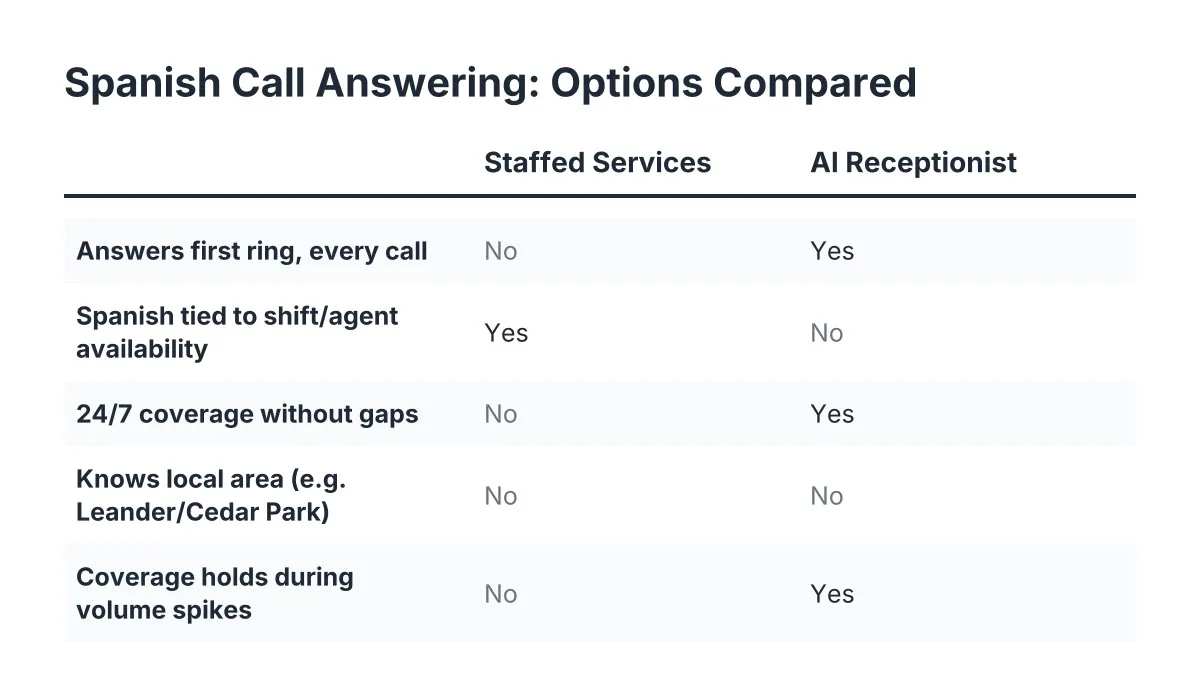
Compare that to the alternatives. A national answering service with bilingual live agents bills per minute, and costs climb fast during your busy season, exactly when you can least predict the invoice. A bilingual office hire runs $40,000 or more per year plus payroll costs, covers one shift, and takes vacations. For a shop doing $200K to $500K in revenue, the AI-plus-transfer model is the only option that covers 24/7 in both languages without a payroll line item. Worth noting: an NFIB survey found 98 percent of small employers using AI reported no change in employee headcount, which matches how trades actually use this. It answers phones; it does not replace the person running your office.
Speed to answer
Both models answer on the first ring, which is the point. The difference shows up after the greeting. AI-only resolves the call in one conversation. Transfer adds a bridge step for urgent calls, usually 20 to 40 seconds while the AI reaches you. For a true emergency, callers wait that long gladly because they know a human is coming.
After-hours and seasonal coverage
This is where AI-only earns its keep for recurring service businesses. A meaningful share of pest control calls come in after hours, and spring booking season can push your daily call volume noticeably higher for several weeks. No transfer model survives that, because you cannot bridge 30 calls a day to a phone in your pocket while your crew is out on jobs. AI-only absorbs the spike, books the routine work, and flags the handful of calls that need you personally.
Bilingual handling in each model
With AI-only, bilingual coverage is structural. The AI receptionist detects the caller's language within the first exchange and runs the entire conversation, qualification, and booking flow in Spanish or English. Every call, every hour, both languages, no staffing dependency.
With live transfer, there is a wrinkle to plan for. The AI can screen and qualify a Spanish-speaking emergency caller in Spanish, but if the person receiving the transfer speaks only English, the bridged conversation gets harder. The fix is practical: let the AI complete the full qualification in Spanish first, so when the call bridges, you already have the address, the problem, and the urgency in the summary. You confirm dispatch; the AI has done the talking. This is exactly the gap a traditional English-only answering service cannot close, and it is why a bilingual answering service built on AI beats bolting a translation line onto a human call center.
When mistakes happen
No system is perfect, human or AI. The question is what failure looks like. With AI-only, a misread call still gets captured: the recording, transcript, and summary land in your dashboard, so a Monday-morning review catches anything scored wrong and you call the lead back. With transfer, the failure mode is a missed bridge, which the system should handle by falling back to full AI capture rather than dropping the caller. Ask any provider to walk you through both failure paths before you sign. For situations involving legal or medical obligations on recorded calls, check requirements with a professional; trades rarely hit these issues, but it is worth confirming for your specific business.
Which Model Fits Which Austin Trade
The decision maps cleanly to how urgent your calls are and how your crew works.
Choose AI-only handling if:
- Most of your calls are quotes, booking requests, and reschedules (lawn care, recurring pest control, cleaning routes).
- Your crew is out all day with phones in pockets, and nobody can reliably take a transfer.
- Seasonal spikes are your main pain: spring booking season, summer lawn calls, post-storm surges.
- Your priority is capturing every lead and converting first calls into recurring contracts.
Add live transfer if:
- You run an emergency trade: plumbing, electrical, or urgent pest work like a wasp nest by the back door.
- You keep an on-call rotation and can answer a bridged call within a minute at night.
- A single after-hours emergency job is worth $500 to $3,000 and gets won by whoever commits a truck first.
- You want the AI to screen out the tire-kickers so the only midnight rings are paying emergencies.
Most emergency trades in Central Texas land on the hybrid: AI-only for everything routine, live transfer switched on for calls the AI flags as true emergencies. You get full lead capture around the clock and a human voice on the calls where a human voice closes the job.
An Illustrative Week: AI-Only Plus Transfer for a Pest Control Shop
Suppose you own a three-tech pest control company in Pflugerville doing about $350K a year. Say it is a Tuesday in April, peak booking season, and your phone takes 22 calls between 7 a.m. and 10 p.m. Here is how the hybrid setup handles them.
Fourteen calls are new customers asking about quarterly service or one-time treatments. Six of those callers speak Spanish. The AI receptionist answers each on the first ring, runs the conversation in the caller's language, qualifies the property and the pest problem, and books eleven of the fourteen. In that scenario, if even four convert to quarterly contracts at roughly $500 a year each, that Tuesday's AI-handled calls are worth about $2,000 in first-year recurring revenue, and multiples of that in lifetime value.
Five calls are existing customers rescheduling or asking about their next visit. The AI handles those without touching your day. Two calls are sales pitches, screened and logged, no interruption. The last call comes at 9:40 p.m., a Spanish-speaking homeowner with a scorpion sting scare and an active infestation near a child's bedroom. The AI qualifies it in Spanish, flags it urgent, and bridges the call to your on-call tech with the address and details already captured. Truck rolls that night, and that customer signs up for quarterly service the following week.
Total human interruptions for the day: one, and it paid. Under a voicemail setup, an illustrative but realistic estimate is that half those 22 callers would never leave a message, and most of the Spanish-speaking callers would hang up at the English greeting. That is the gap between the two phone strategies, measured in contracts.
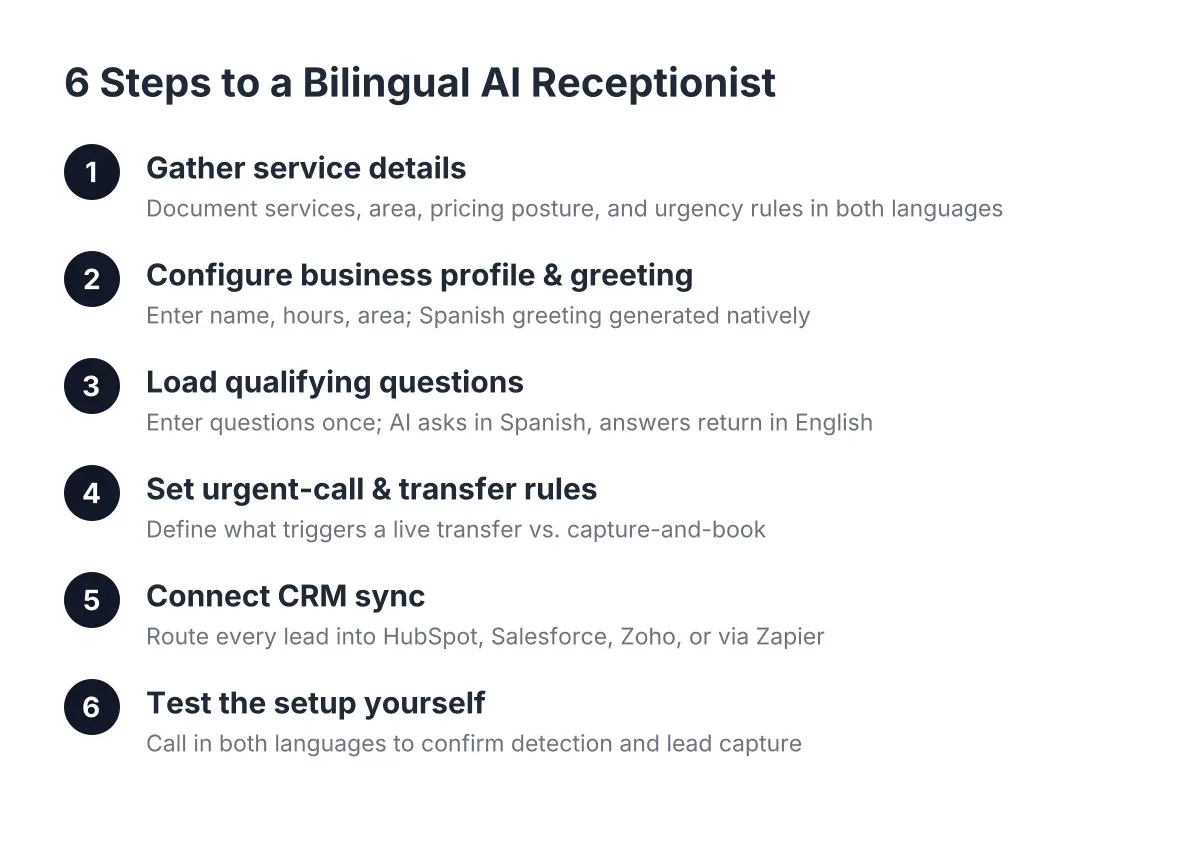
How to Set Up Live Call Transfer With AI-Only Handling
Setup is simpler than most owners expect, and it should not require touching your existing phone number or carrier contract.
- Forward your line. Point your existing business number at the AI receptionist, either full-time or conditionally (after three rings, after hours, or when you are on the job).
- Define your emergency rules. Decide what qualifies for a transfer: flooding, no power, gas smell, active infestation near kids or pets. Everything else stays AI-handled.
- Set the on-call schedule. Give the system the number to bridge urgent calls to, and a fallback behavior if nobody picks up.
- Confirm bilingual flow. Test the Spanish path yourself, or have a Spanish-speaking friend call. The qualification questions, booking flow, and emergency screening should all run natively in Spanish.
- Connect your follow-up tools. Push captured leads to your CRM through webhooks or Zapier, and use one-click call bridging from the dashboard to return calls fast, which matters given how steeply contact odds fall after five minutes.
- Review the weekly report. A Monday morning summary of call volume, languages, lead scores, and booked jobs tells you within two weeks whether the emergency rules need tightening.
One practical tip: before you commit to any provider, call their AI yourself. Try to stump it. Ask about pricing mid-sentence, switch to Spanish halfway through, describe a fake emergency. Ten minutes of testing tells you more than any sales page, and a provider confident in their AI will invite the test.
The Bottom Line for Central Texas Trades
The debate over live transfer vs AI-only answering has a practical answer for Austin home service businesses: run AI-only as your foundation and layer transfer on top for emergencies, if your trade has them and you can answer the bridge. Recurring service businesses with routine call volume often skip transfer entirely and lose nothing. Emergency trades keep it on and win the midnight jobs that competitors send to voicemail.
Either way, the non-negotiable is bilingual coverage on every call. In this market, an English-only phone line quietly hands a meaningful share of your leads to whichever competitor answers in Spanish. The model you choose matters less than making sure the phone gets answered, in the caller's language, on the first ring, every hour of the year. That is the whole decision, and now you have the specifics to make it.
If you're losing revenue to missed calls, NeverMiss ATX can help.
Prefer to talk it through? Call (512) 980-9267 — a quick call is usually the fastest way to get a straight answer for your situation.