Bilingual Answering Service Cost: What Austin Trades Pay for English-Spanish Coverage in 2026
If you run an emergency trade in Austin, TX, you already know why callers hang up on voicemail. A burst pipe at 11pm does not wait, and neither does the caller. What most pricing pages will not tell you is the bilingual answering service cost question hiding inside the bigger one: nearly every live service charges extra for Spanish, and in a market where 29.6% of Austin residents are bilingual, according to City of Austin (U.S. Census Bureau ACS data), that premium is not optional. It is the price of answering your actual market. This guide breaks down what English-Spanish coverage costs across live receptionists, national call centers, virtual services, and AI, including the fees that never make the pricing page, so you can do the ROI math before you ever talk to a sales rep.
Why Bilingual Coverage Is Not a Nice-to-Have in Central Texas
Spanish-speaking callers are not a niche segment here. About 28.5% of Texans, nearly 7.8 million people, speak Spanish at home, according to U.S. Census Bureau estimates covering 2018-2022. Inside Austin city limits, 10.3% of residents speak English less than "very well," per City of Austin ACS data. For a plumber, electrician, or pest control operator working Austin, Round Rock, Pflugerville, and Georgetown, that translates to a meaningful slice of your emergency call volume.
Here is the part that matters for pricing. An English-only answering setup does not just serve those callers poorly; it usually loses them entirely. A panicked caller with flooding in the kitchen who reaches an English-only voice hangs up and dials the next result. Emergency callers abandon faster than routine callers, and there is no second chance on a water heater failure.
Therefore, when you compare answering service plans, you have to compare them at the bilingual tier, not the base tier. That is where the real numbers live, and it is where most published pricing quietly falls apart.
How Much Does an Answering Service Charge?
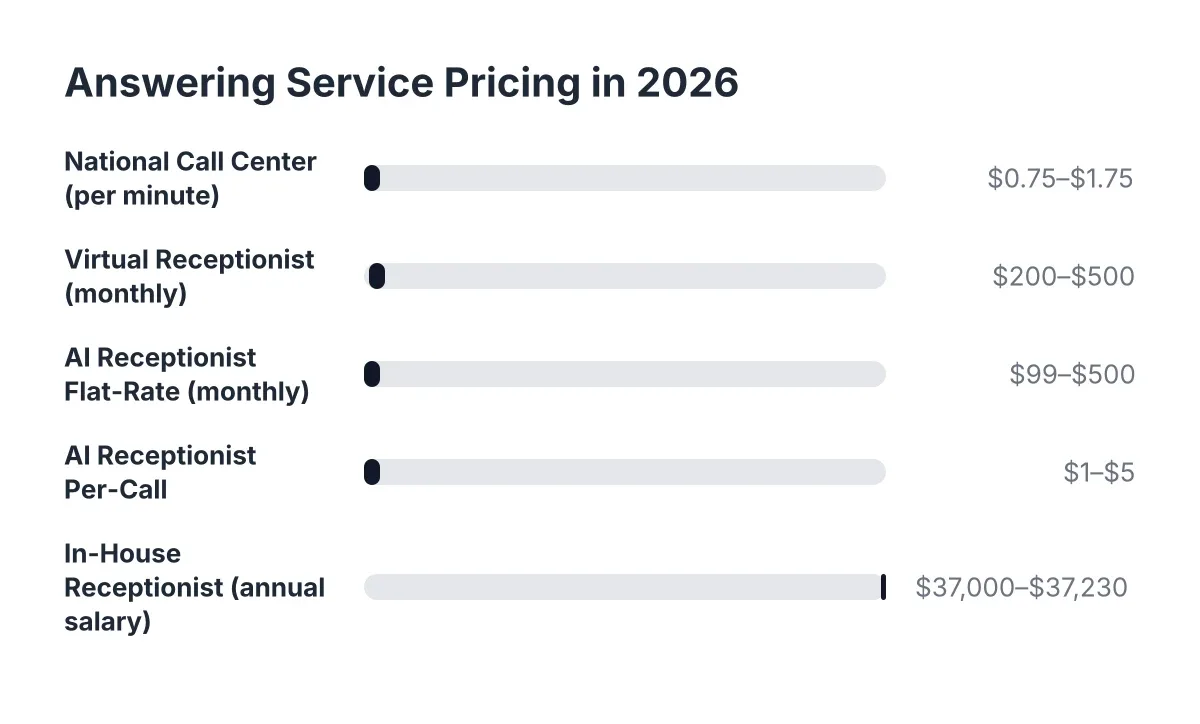
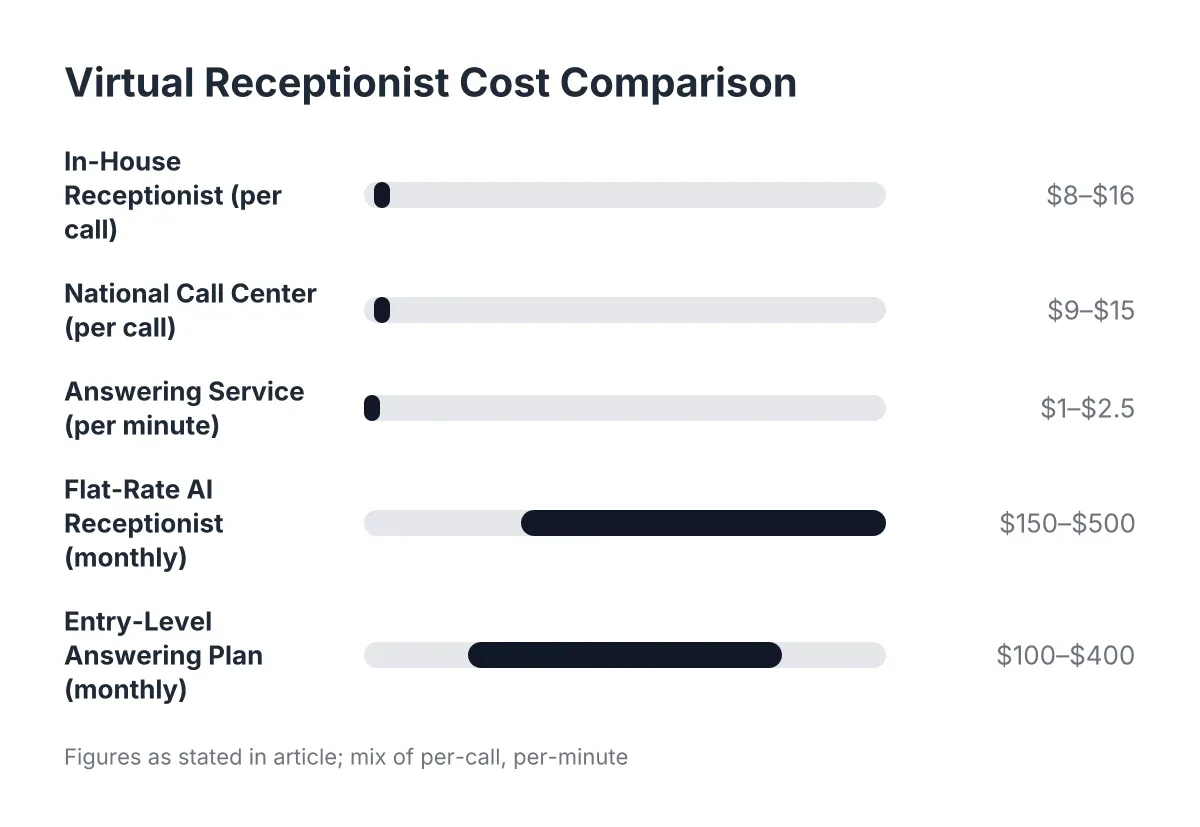
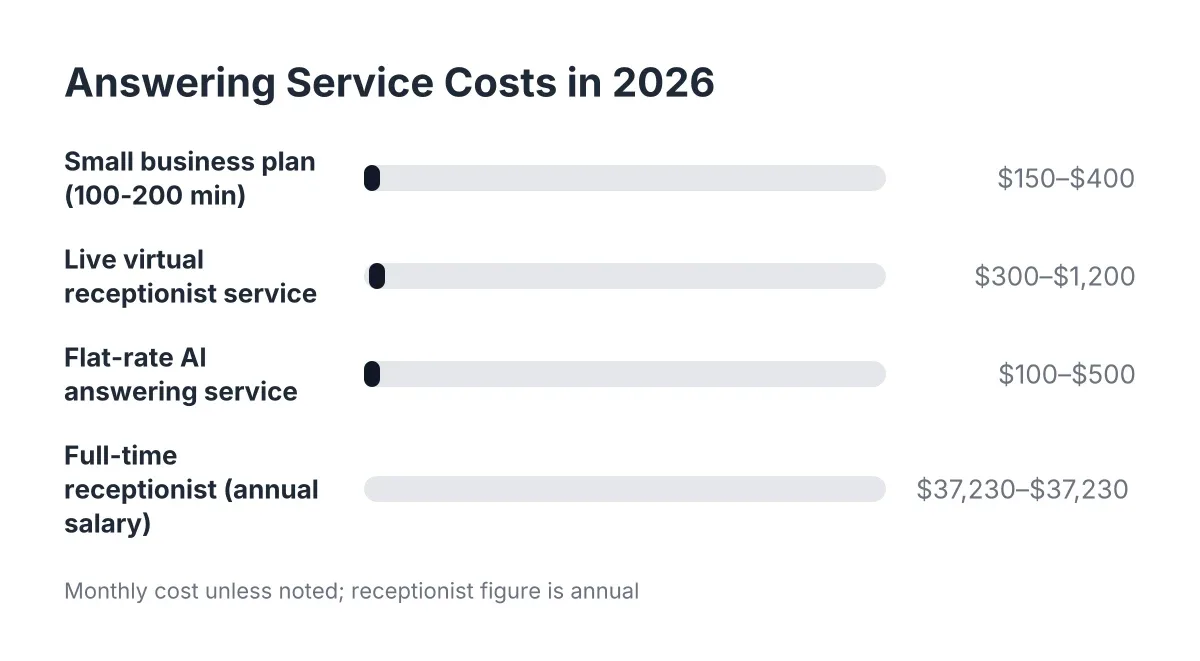
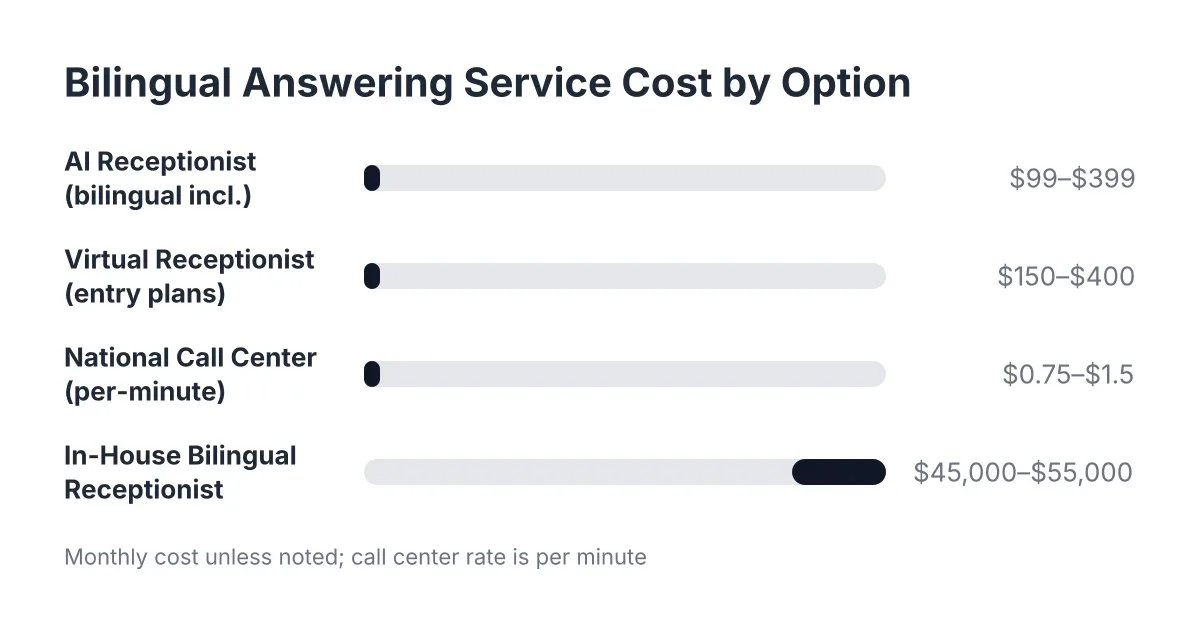
An answering service in 2026 typically charges $0.75 to $1.50 per minute at national call centers, $150 to $400 per month for entry-level virtual receptionist plans with tight minute caps, or $3,000 to $4,500 per month for an in-house hire before benefits. AI receptionists generally run $99 to $399 per month flat, with bilingual coverage included or added cheaply.
Those ranges are wide because the billing models differ. Per-minute plans look cheap until an emergency month spikes your volume. Per-call plans penalize you for wrong numbers and spam unless the contract excludes them. Flat monthly plans cost more in a slow month and far less in a busy one.
For an emergency trade, the honest comparison is not the advertised base rate. It is the fully loaded monthly cost in your worst month, at the bilingual tier, with after-hours coverage included. Run every option through that filter and the field narrows fast.
What Bilingual Answering Service Costs, Option by Option
The premium for English-Spanish coverage shows up differently depending on which model you buy. Here is how each one prices it in 2026, with illustrative ranges based on how these services typically structure plans.
In-House Bilingual Receptionist
Hiring is the most expensive path, and bilingual hiring costs more still. The median hourly wage for receptionists in the U.S. was $17.90 in May 2024, about $37,230 per year before benefits or overtime, according to the U.S. Bureau of Labor Statistics. In Austin's labor market, bilingual candidates command a premium above that median, and you are competing with every medical office and law firm in town for them.
Then stack the hidden costs. Payroll taxes, health benefits, and paid time off typically add 25% to 40% on top of wages. Turnover means re-recruiting and retraining, often mid-season. And one person covers roughly 40 hours a week; your emergency calls run 168. Covering nights and weekends in-house means multiple hires or an overtime bill that makes the whole model collapse for a crew of one to ten techs.
Realistic all-in figure: $45,000 to $55,000 per year for one bilingual receptionist covering business hours only. After-hours remains unsolved.
National Call Center with Spanish Agents
National answering services usually price per minute, and Spanish support is where the upsells start. A typical pattern looks like this, as an illustrative estimate:
- Base rate: $0.85 to $1.30 per minute for English agents
- Bilingual surcharge: 10% to 25% on top, or a higher-tier plan requirement
- After-hours or holiday multipliers: some contracts add 15% to 50% for overnight and holiday coverage
- Overage rates: minutes past your plan bill at a higher rate, often $1.50 or more
- Setup and scripting fees: $50 to $500 one time, sometimes billed again when you change your script
Suppose a two-truck plumbing outfit averages 90 answered calls a month at four minutes each, with a third of callers preferring Spanish. At $1.10 per minute plus a 20% bilingual surcharge on those calls, that month runs roughly $425 before after-hours multipliers. A February freeze that doubles call volume doubles the bill in the same month you are running flat out on site.
There is a second cost that never appears on the invoice. A national agent reading a generic script does not know that "no-cool" in August in Austin is an emergency, or that a slab leak question should capture the address first. Misqualified emergency calls are lost jobs, and lost emergency jobs in the trades often mean losing the follow-on work too, like the water damage restoration behind a burst pipe.
Virtual Receptionist Services
Virtual receptionist pricing for small business plans usually starts around $150 to $300 per month for 50 to 100 minutes. Bilingual coverage tends to be gated behind mid or top tiers, pushing realistic bilingual plans to $300 to $600 per month once you account for actual emergency-trade call volume.
The catch for urgent trades is coverage hours. Many virtual receptionist teams staff business hours with an after-hours voicemail or a costly overnight add-on. For a pest control operator whose calls skew heavily after hours, paying for a service that hands your 11pm roach infestation call to voicemail defeats the purpose.
AI Receptionist with Bilingual Support Built In
AI answering service price per month in 2026 generally runs $99 to $399 flat, and this is where the bilingual premium mostly disappears. Because an AI receptionist is not staffing a second pool of Spanish-speaking agents, English and Spanish can ship on every plan at the same price. There is no surcharge for answering the caller in the language they opened with.
The flat-rate structure also fits emergency volume. A hail storm week that triples your calls does not triple your bill. For Austin trades specifically, a locally built AI receptionist can be configured for the calls this market actually produces: no-cool calls in a 95° heat wave, burst pipes during a freeze, flooding after a spring storm. It answers on the first ring, captures the address and urgency, books the job or delivers a booking link, and can live transfer true emergencies to your cell when you opt in.
One honest trade-off: a Five9/TEAM LEWIS survey found 75% of consumers prefer talking to a real human for customer support. The practical answer for a small trade is not choosing between AI and humans; it is using AI to answer instantly at 2am so the human conversation, you on the phone with a booked customer, happens at all. The alternative to AI at 2am is usually voicemail, not a person.
What English-Spanish Coverage Actually Costs Per Month
Pulling the models together, here is the realistic monthly comparison for an Austin emergency trade needing 24/7 bilingual answering, framed as illustrative 2026 estimates:
- In-house bilingual receptionist: $3,750 to $4,600 per month all-in, business hours only, no nights or weekends
- National call center, bilingual tier: $400 to $900 per month at moderate volume, spiking with emergencies, plus setup fees and overage rates
- Virtual receptionist, bilingual plan: $300 to $600 per month, often with limited overnight coverage
- AI receptionist, bilingual included: $99 to $399 per month flat, 24/7, no per-minute meter
The pattern is consistent. Every human-staffed model charges you for Spanish twice, once in the base rate and again in the surcharge or tier jump, and still leaves gaps overnight. The AI model flattens the cost of bilingual answering service to zero premium because language is a capability, not a second shift of staff.
The Cost Nobody Puts on a Pricing Page: The Missed Call
Every answering service cost comparison eventually runs into the same number, and it is not on any invoice. It is the value of the call that rang while you were under a house with a pipe wrench.
Speed decides emergency work. A foundational MIT Sloan / InsideSales.com study found the odds of contacting a lead drop 100-fold, and the odds of qualifying that lead drop 21-fold, when the callback happens at 30 minutes instead of within 5 minutes. Emergency callers are the extreme case; they do not wait 30 minutes. They call your competitor within 30 seconds.
Now put a dollar figure on it. Say an emergency plumbing call in Austin averages $600 to $1,200, and a burst-pipe job that leads to water damage referral work can run well past that. In that scenario, missing two Spanish-language emergency calls a month, calls an English-only setup never had a chance at, costs more than a full year of a flat-rate AI plan. That is the math to run before comparing base rates.
There is also the recurring customer angle. An emergency caller you answer, calm down, and book tonight becomes the household that calls you first for the next drain, the annual pest treatment, and the panel upgrade. The lifetime value of that first answered call dwarfs whatever the answering plan costs.
What to Verify Before You Sign a Bilingual Plan
Whichever direction you go, pressure-test the contract on these points before committing:
- Is Spanish on every plan, or a paid tier? Get the bilingual price in writing, not the base price.
- Is bilingual coverage 24/7? Some services staff Spanish agents only during business hours, which is useless when 40% of pest calls come in after hours.
- How are emergencies triaged? Ask exactly what happens when a caller says "flooding" or "no power." Live transfer to you, a booked slot, or a message you see in the morning are three different outcomes.
- What do spam and wrong numbers cost? On per-call and per-minute plans, junk calls bill like real ones unless excluded.
- What are the overage rates and contract terms? Month-to-month beats a 12-month lock when you have never heard the service handle your calls.
- Can you test it before buying? The fastest way to judge any AI receptionist is to call it yourself, in English and in Spanish, and try to stump it with a real scenario from your week.
That last point matters more than any pricing page. A service that will not let you hear it handle a panicked bilingual caller before you sign is asking you to buy blind.
Is a Bilingual Answering Service Worth It for an Emergency Trade?
For an emergency trade in Central Texas, bilingual answering pays for itself if it captures even one or two jobs per month that voicemail or English-only coverage would have lost. With emergency plumbing and electrical jobs commonly running $600 or more, a $199 to $399 monthly plan clears its cost on the first saved call.
The worth-it question is really a coverage question. If you are a solo operator, every call you cannot take while on a ladder is a coin flip you lose to whoever answers first. If you run a small crew, your office manager goes home at 5pm and your call volume does not. Either way, the roughly 30% of your market that is bilingual deserves better than a language barrier at their worst moment.
The main scenario where the math gets murkier: if you already contract a national answering service mid-term, or you run multi-location dispatch with complex routing, review your existing agreement and switching costs with your bookkeeper or attorney before making a change. Early termination fees can erase the first few months of savings.
The Bottom Line on English-Spanish Answering Costs in Austin, TX
The bilingual answering service cost story in 2026 comes down to one structural difference. Human-staffed services price Spanish as extra labor, so you pay a surcharge, a tier jump, or a bilingual wage premium, and you still face after-hours gaps and per-minute meters that spike exactly when Austin weather does. AI receptionists price Spanish as a built-in capability, so bilingual, 24/7, first-ring answering comes at a flat monthly rate you can budget in a freeze or a heat wave.
Do the comparison at the bilingual tier, in your worst month, with after-hours included. Then weigh it against the value of the emergency calls you are missing right now, in both languages. For most one-to-ten-tech operations in Austin, Round Rock, Cedar Park, and the rest of Central Texas, that math resolves before the first sales conversation ever happens.
If you're losing revenue to missed calls, NeverMiss ATX can help.
Prefer to talk it through? Call (512) 980-9267 — a quick call is usually the fastest way to get a straight answer for your situation.