Virtual Receptionist Cost Per Call: Does It Actually Beat Hiring Staff?
If you run a roofing, restoration, or storm-response crew in Central Texas, the question is not whether you need someone answering the phone. It is what that coverage costs per call, and whether the math favors hiring, outsourcing, or automating. This guide breaks down virtual receptionist cost per call across every option: a full-time hire, a national call center, a traditional virtual receptionist service, and a flat-rate AI receptionist. By the end, you will be able to run the numbers for your own call volume before you ever talk to a sales rep.
Here is why the per-call math matters more for storm and event-driven operators than for almost anyone else. Your call volume is not steady. A hail storm rolls through Georgetown on a Tuesday night, and by Thursday your phone is ringing 300 to 400 percent more than it did last week. Every one of those calls could be a $7,500 insurance job. The pricing model you choose determines whether that surge is your best week of the year or your most expensive missed opportunity.
How Much Does an Answering Service Charge in 2026?
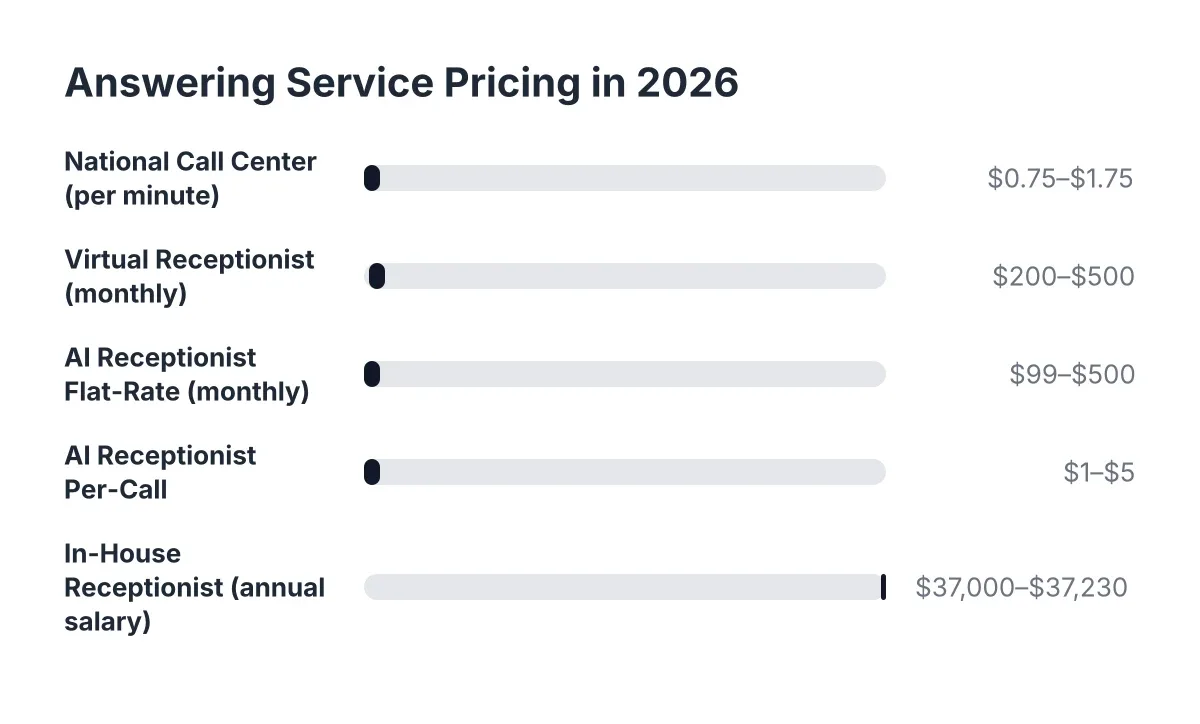
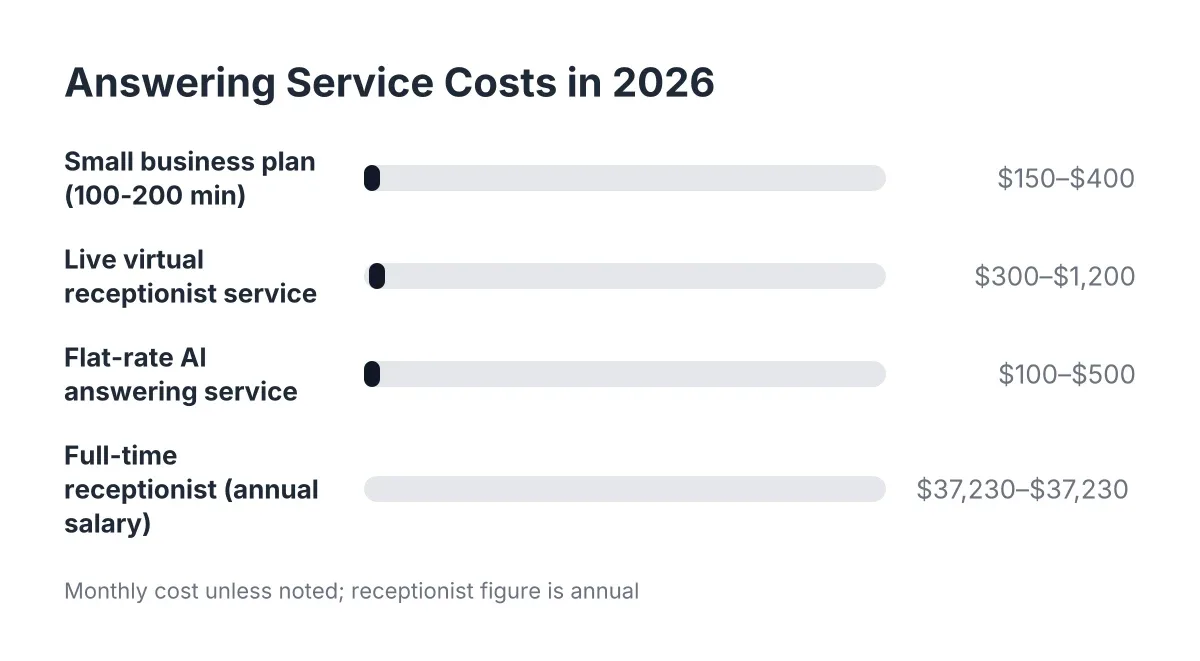
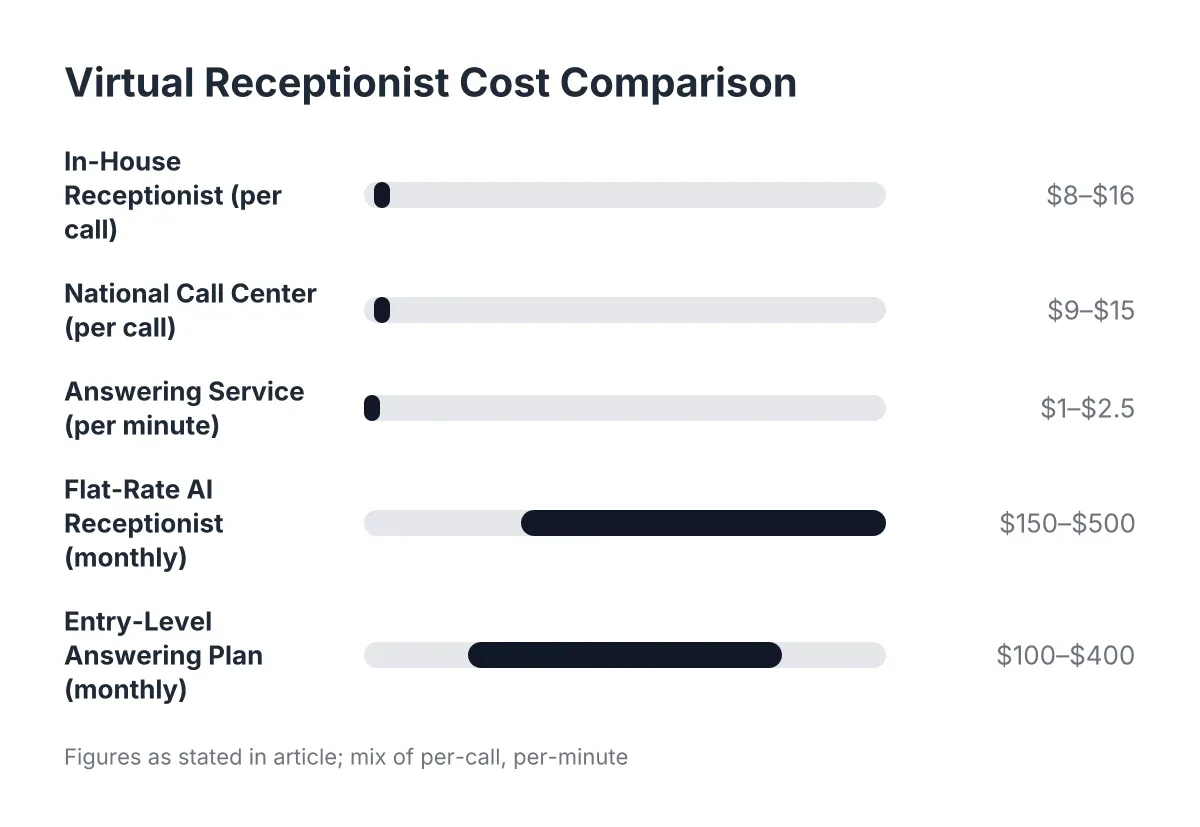
Most business answering services in 2026 charge between $1.00 and $2.50 per minute, or $100 to $400 per month for entry-level plans covering 50 to 100 calls. Full-time in-house receptionists cost far more, and AI receptionist services typically run $150 to $500 per month with unlimited or high-volume answering included.
Those ranges hide a lot, though. The answering service industry prices in at least four different ways, and the way a provider bills you changes what a single call actually costs. Before you compare vendors, you need to know which model you are looking at:
- Per-minute billing. Common with national call centers. You pay for every minute an agent spends on your calls, often including hold time and wrap-up time.
- Per-call billing. A flat fee per answered call, usually $1.50 to $4.00, regardless of length.
- Monthly plans with minute or call bundles. You prepay for a block, then pay overage rates when you exceed it. Overage rates are where storm-season budgets go to die.
- Flat-rate monthly pricing. One price, unlimited or high-cap answering. Most AI receptionist services use this model.
The distinction matters because your call pattern is spiky, not smooth. A bundled plan sized for your slow season will bury you in overage fees the week after a freeze event. That is the core problem this article helps you solve.
The Real Cost of Hiring a Receptionist In-House
Start with the option most owners consider first: hiring someone. According to the U.S. Bureau of Labor Statistics, the median hourly wage for receptionists in the U.S. was $17.90 in May 2024, which works out to about $37,230 per year before benefits or overtime. In the Austin labor market, competitive pay often runs higher.
However, wages are only the visible cost. The fully loaded number includes:
- Payroll taxes and benefits. Health insurance, payroll taxes, and paid time off commonly add 25 to 35 percent on top of base wages. That pushes a $37,000 salary toward $46,000 to $50,000 in true annual cost.
- Training time. A new hire needs weeks to learn your services, your service area from Round Rock to Leander, and how to tell a $7,500 hail claim from a tire-kicker.
- Turnover. Receptionist roles turn over often. Every departure restarts the hiring and training clock, and your phone coverage suffers during the gap.
- Coverage limits. One person works about 2,080 hours a year. Your phone rings across 8,760 hours a year. Nights, weekends, lunch breaks, and sick days are all uncovered.
Now run the per-call math. Suppose a typical storm-response operation fields 250 calls a month in normal months. A $48,000 fully loaded receptionist answering those calls costs you $16 per call. Even at 500 calls a month during a busy season, you are at $8 per call, and only for the calls that land between 8 a.m. and 5 p.m. on weekdays.
There is a second problem that no salary solves: one person answers one call at a time. When hail hits Cedar Park and 12 homeowners call in the same hour, your receptionist takes one call and 11 people hear a busy signal or voicemail. In a post-storm market, those 11 callers dial your competitor next. The competitor who answers every call during a surge can win a year's worth of jobs in a single week.
To be fair, an in-house hire has real advantages. A great receptionist builds relationships, handles complex judgment calls, and becomes part of the crew. If you already employ a full-time receptionist who is worth every penny, an answering service may only make sense as after-hours or overflow coverage, not a substitute.
What National Call Centers and Live Virtual Receptionists Cost
Traditional live-agent services split into two camps: large national call centers and smaller virtual receptionist companies. Both put a human on your line, and both bill in ways that punish call spikes.
Per-minute pricing and where it bites
National call centers typically charge $1.00 to $2.50 per minute. A thorough claim intake call, the kind where you capture the homeowner's insurance carrier, policy details, roof age, and damage description, runs 6 to 10 minutes. At $1.50 per minute, that is $9 to $15 per call. Capture 120 storm calls in a week and you have spent $1,100 to $1,800 on intake alone.
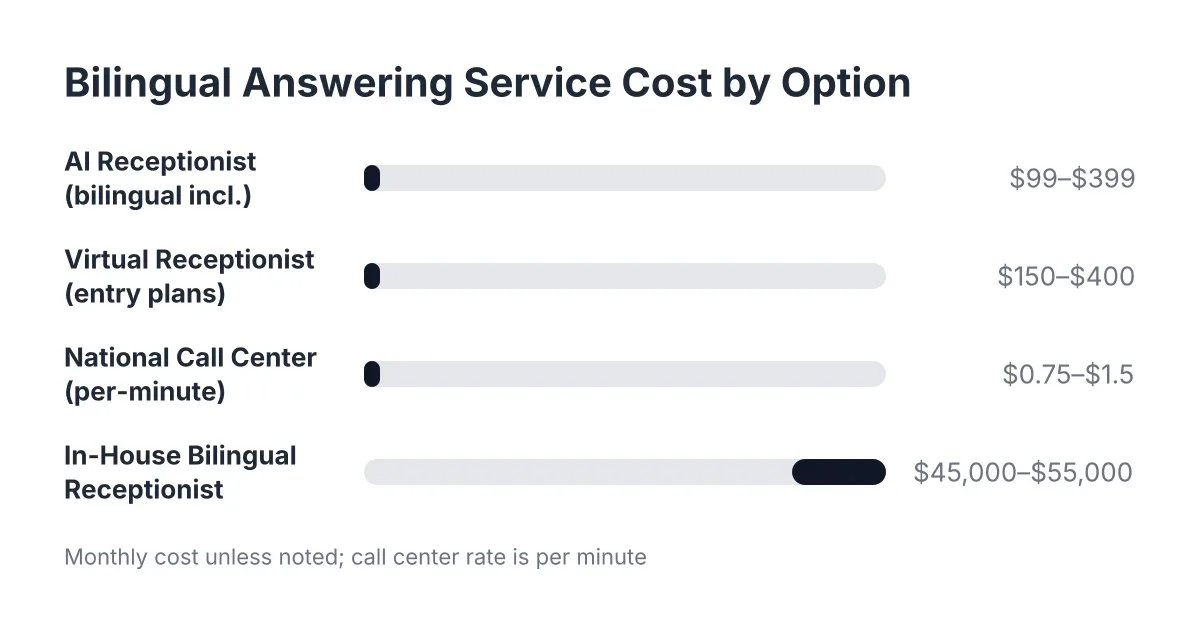
In addition, watch for the fine print. Many services bill in rounding increments, so a 61-second call bills as 2 minutes. Some charge for agent wrap-up time after the caller hangs up. Setup fees, holiday surcharges, and fees for patching calls through to your cell add up fast. Upsells for bilingual answering are common too, which stings in a market where a large share of Central Texas homeowners prefer Spanish.
Virtual receptionist pricing plans for small business
Virtual receptionist companies usually sell monthly bundles: say $150 for 50 minutes, $350 for 200 minutes, or $700 for 500 minutes. Divide it out and virtual receptionist pricing lands between $1.40 and $3.00 per minute, or about $6 to $15 per completed call depending on call length.
The trap for a storm operator is bundle sizing. You would size a plan for normal months, then a weather event triples your volume in 48 hours. Overage minutes often bill above your plan rate, so your most profitable week becomes your most expensive answering service invoice. Hunting for the cheapest virtual receptionist plan by sticker price alone almost guarantees this outcome, because low entry prices pair with high overage rates.
Live services do have strengths worth naming. Experienced human agents handle unusual situations with judgment, and a Five9 survey of 4,000 consumers found 75 percent prefer talking to a real human for customer support. The counterpoint from the same Five9 research: 84 percent of consumers already know companies use AI for customer service, so an AI answering the phone is no longer a surprise to your callers. What callers actually punish is not answering at all.
Virtual Receptionist Cost Per Call: The Comparison Table
The cleanest way to compare options is cost per answered call at your real volume. Here are illustrative 2026 estimates for a home service business handling 250 calls in a normal month:
- In-house receptionist: about $16 per call ($48,000 fully loaded, business hours only, one call at a time)
- National call center: $9 to $15 per call (per-minute billing on 6 to 10 minute intake calls, plus fees)
- Live virtual receptionist bundle: $6 to $15 per call (bundle rate, before overages)
- Flat-rate AI receptionist: roughly $0.60 to $2.00 per call ($150 to $500 monthly plans, 24/7, unlimited simultaneous answering)
Now rerun the numbers for a surge month at 900 calls, the kind a hail event produces:
- In-house receptionist: still one call at a time; per-call cost drops on paper, but a large share of calls go unanswered, which is the most expensive outcome of all
- National call center: $8,000 to $13,000 for the month at per-minute rates
- Live virtual receptionist bundle: bundle blown, overage rates kick in, often $2,000 to $5,000 or more
- Flat-rate AI receptionist: the same flat monthly price, with per-call cost falling to $0.17 to $0.55
This is the structural difference. Human-based pricing scales linearly with volume because every call needs a person's time. AI pricing does not, because the same system answers one call or forty calls at once. For a business whose entire year can hinge on a 72-hour surge, that difference is the whole ballgame.
One caveat belongs here. If your calls routinely require nuanced negotiation, multi-step dispatch decisions, or sensitive conversations, a human layer still earns its cost, and it is worth talking through your specific call types with a provider before committing.
Why Cost Per Call Beats Monthly Price for Storm Operators
Cost per call matters more than monthly price for storm and seasonal operators because call volume swings 300 to 400 percent between slow weeks and surge weeks. A plan that looks cheap at low volume can triple in cost during the exact week you make your money, while flat-rate pricing gets cheaper per call as volume climbs.
There is a second layer to the math: the value of the call itself. When the average insurance job runs $7,500, one missed call is not a $10 loss. It is a shot at $7,500 handed to whichever competitor answered. Miss five calls during a Saturday night surge and the answering service cost debate becomes trivial next to the revenue that walked.
Speed compounds the problem. A foundational MIT Sloan / InsideSales.com study found the odds of contacting a lead drop 100-fold, and the odds of qualifying that lead drop 21-fold, when the callback happens at 30 minutes instead of within 5 minutes. Post-storm homeowners are calling down a list. Voicemail followed by a next-morning callback is functionally the same as never answering.
For example, here is an illustrative Tuesday for a hypothetical Pflugerville roofing crew. Golf-ball hail hits at 9:40 p.m. By midnight the phone has rung 23 times. An in-house receptionist is asleep. A per-minute call center answers, at $12 to $15 per intake, and hands you a $300 overnight bill. A flat-rate AI receptionist answers all 23 calls simultaneously, captures the address, insurance carrier, and damage details on each one, books inspection slots, and texts you a prioritized list before your first coffee. Same night, three different outcomes, three wildly different costs per captured lead.
What Flat-Rate AI Receptionist Pricing Includes
AI answering service prices per month in 2026 generally run $150 to $500 for home service businesses, and the flat rate typically covers what live services sell as add-ons. When you evaluate the virtual receptionist cost per month on an AI plan, check that these are included rather than upcharged:
- 24/7 answering with unlimited simultaneous calls. No busy signals during a surge, no after-hours voicemail.
- Lead capture and qualification. The AI asks your intake questions, captures damage details and insurance information, and separates high-value claims from routine inquiries.
- Booking link delivery. Callers get booked for inspections on the call, not promised a callback.
- Bilingual answering. English and Spanish on every call, without a bilingual surcharge. In Central Texas, this is table stakes, not a premium feature.
- Live transfer for urgent calls. Genuine emergencies, like an active roof leak over a nursery, bridge to your cell rather than sitting in a queue.
- CRM sync and call intelligence. Leads flow into HubSpot, Salesforce, Zoho, or Zapier automatically, with call scoring and summaries so you can triage the $7,500 claims first.
Setup is the other cost to check. Some live services charge $50 to $200 in setup fees plus a multi-week onboarding. Most AI receptionist services set up in days, and the good ones let you call the line yourself and try to stump it before you sign anything. That is the single best due-diligence step available: dial the demo number, describe hail damage in Spanish, ask an oddball question, and judge the answers yourself.
One more data point for owners worried that automation means cutting people. According to the National Federation of Independent Business, 98 percent of small employers using AI reported no change in employee headcount. In the trades, AI answering does not take a job from your crew. It captures the calls nobody was answering, so your crew has more jobs to run.
Is an Answering Service Worth It for a Storm-Driven Business?
An answering service is worth it for a storm-driven business when the value of one captured job exceeds the monthly cost of the service, which it almost always does. If your average insurance job is $7,500 and coverage costs $150 to $500 per month, a single captured surge call pays for one to four years of service.
Therefore, the real question is not whether to get coverage, but which model fits your volume pattern:
- Hire in-house if you need a full-time office presence for walk-ins, paperwork, and dispatch, and you can staff after-hours some other way. Budget $46,000 to $50,000 fully loaded, and accept that surges will overwhelm one person.
- Use a live virtual receptionist or call center if your call volume is steady, your calls demand human judgment, and you can absorb per-minute or overage pricing during spikes.
- Use a flat-rate AI receptionist if your volume is spiky or seasonal, after-hours calls carry real revenue, and you need every simultaneous call answered during a surge at a predictable monthly price.
Many operators land on a hybrid: an AI receptionist as the always-on front line, with live transfer for genuine emergencies and the owner or dispatch manager handling escalations. That structure keeps your virtual receptionist cost per call under a dollar during surge weeks while a human still touches every call that truly needs one.
Run Your Own Numbers Before You Buy
Before you sign with anyone, spend twenty minutes on this exercise. First, pull your call logs from your busiest week last year and your slowest. Next, price each option at both volumes, including overages, after-hours surcharges, bilingual fees, and setup costs. Then divide by calls answered, not calls received, because a plan that leaves surge calls at voicemail is not cheap at any price.
Finally, weigh the per-call cost against your average job value. For a Central Texas storm operator with $7,500 insurance jobs, the spread between a $16 in-house call and a sub-dollar AI-answered call is real money. However, the spread between an answered call and a missed one is the number that actually decides your year. Price for the surge, because the surge is when you get paid.
If you're losing revenue to missed calls, NeverMiss ATX can help.
Prefer to talk it through? Call (512) 980-9267 — a quick call is usually the fastest way to get a straight answer for your situation.