AI Receptionist Cost Breakdown: Setup, Per-Call, and Monthly Fees Explained
You're on a roof in Pflugerville, it's 95 degrees, and your phone buzzes for the fourth time this hour. Every one of those calls is money, and every one you can't answer probably rings a competitor next. Before you pay anyone to answer for you, you need a real AI receptionist cost breakdown: setup, per-call, and monthly fees, laid out side by side, so you know exactly what you'll pay before a sales rep ever gets you on the phone. That's what this guide does, step by step.
The short version: live receptionists cost the most and hide the most, national call centers look cheap until the per-minute meter runs, and AI receptionists are usually flat-rate with little or no setup fee. But "usually" isn't good enough when your average job runs $7,500 and a hailstorm can dump 100 calls on you in 48 hours. So let's do the math properly.
Step 1: Add Up What Missed Calls Already Cost You
Start with the number nobody wants to calculate. If you're a solo operator, you can't answer while you're on a ladder, under a sink, or running a saw — and after-hours calls are landing in voicemail. Pull your phone log for last month and tally the calls you actually missed; for most solo operations the count is uncomfortable.
Here's the math for a Central Texas roofer. Say you get 40 calls a month and miss 14 of them. If even 3 of those would have booked at a $7,500 average ticket, that's $22,500 in work walking to the next name on the search results. Speed matters too: widely cited lead-response research from MIT Sloan School of Management and InsideSales.com found the odds of contacting a lead drop 100-fold — and the odds of qualifying that lead drop 21-fold — when you call back at 30 minutes instead of within 5. After a storm, 30 minutes might as well be 30 days.
The same math applies beyond roofing. A three-tech plumbing crew in Cedar Park doing $350K a year that misses most calls after 6 p.m. and on weekends might be leaving an estimated 8 to 12 real jobs a month on the table at a $400 to $900 average ticket — an estimated $3,500 to $8,000 in monthly revenue. A homeowner with water pouring through a ceiling at 2 a.m. is not waiting until 9 a.m.; they call down the list until someone answers.
Write your own number down. Pull your phone records for the last 90 days, count calls received outside business hours, and multiply by your average ticket and close rate. Every option below gets judged against it, because an answering service isn't a cost line; it's a recovery line.
Step 2: Price a Live Receptionist Honestly, Benefits and All
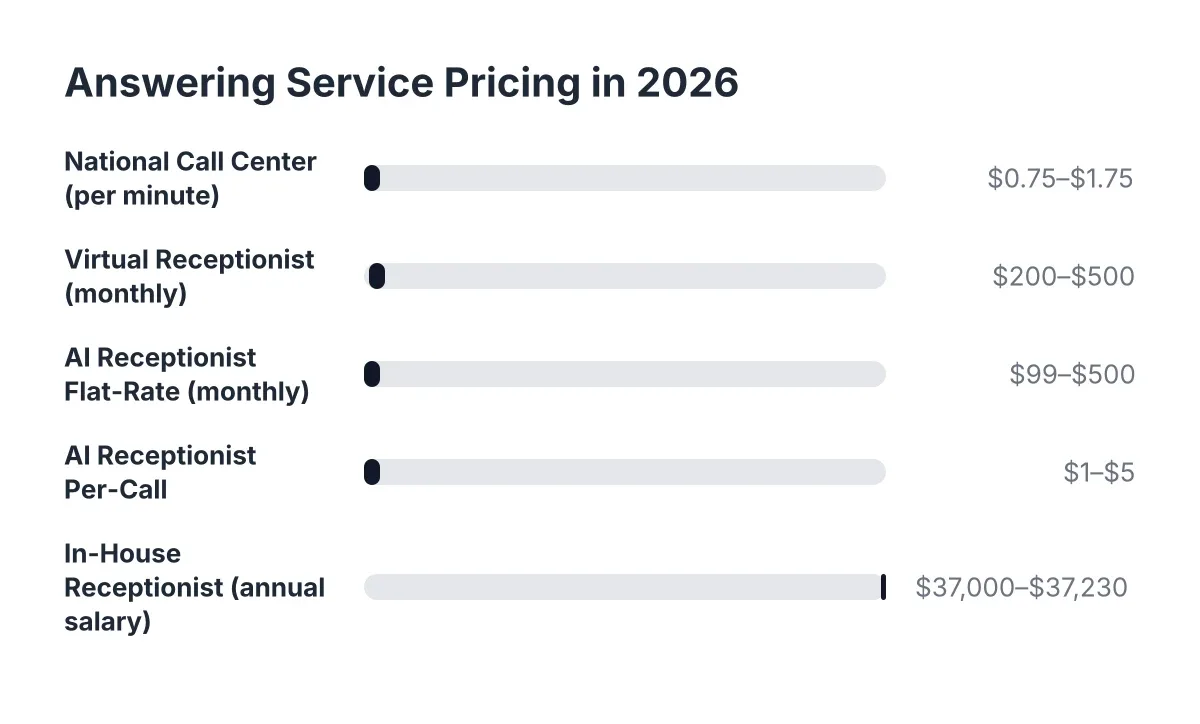
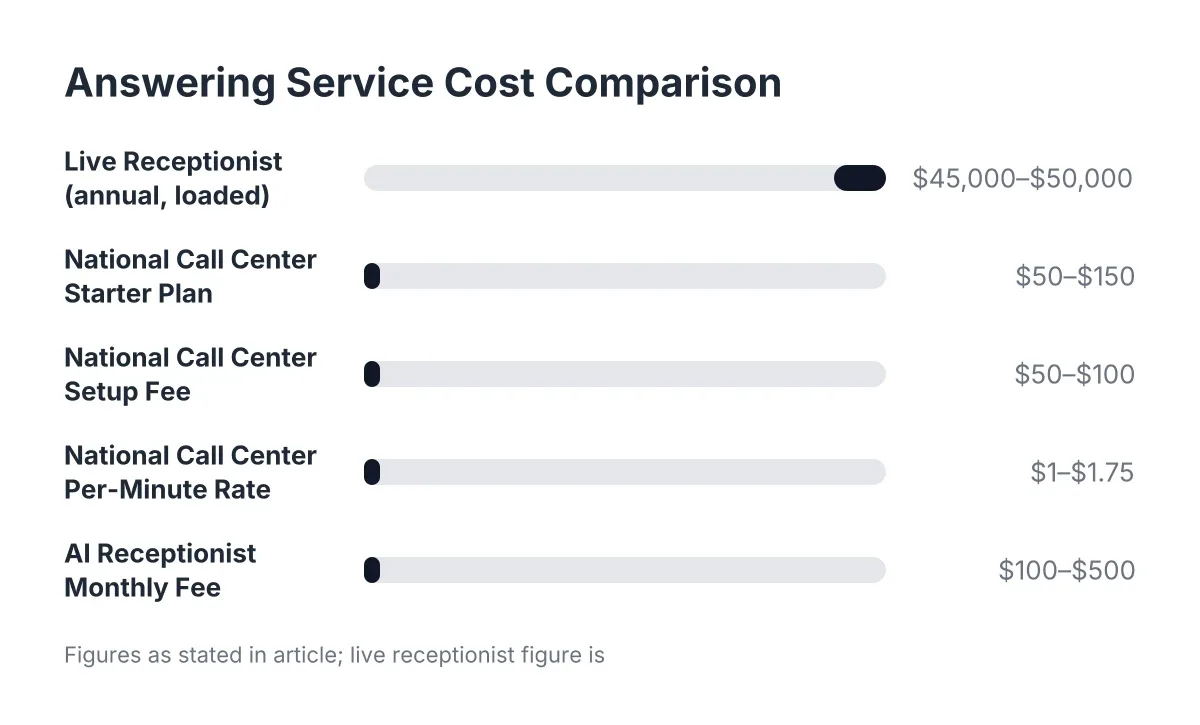
A live receptionist is the most expensive option, and the sticker price is only the start. According to the U.S. Bureau of Labor Statistics, the median receptionist wage was $17.90 per hour in May 2024, about $37,230 per year before benefits, payroll taxes, or overtime. Load in benefits and taxes and you're realistically at $45,000 to $50,000 a year for one person covering roughly 40 hours a week.
If a full-time hire feels heavy, note that going part-time doesn't fix the math. In Austin, where wages run at or above that national median, a part-time receptionist at $18 to $21 an hour for 20 to 25 hours a week costs roughly $1,600 to $2,100 per month in wages alone — before payroll taxes (roughly 8 to 10 percent), workers' comp, and payroll software add another 10 to 15 percent on top. And a part-time hire who left at 1 p.m. can't return a 6 p.m. call until the next morning; by then, that lead has hired the competitor who picked up.
Then come the hidden costs, full-time or part-time:
- Coverage gaps. One person covers business hours only. Nights, weekends, lunch breaks, sick days, and vacations still go to voicemail, and storm calls don't respect a 9-to-5.
- Turnover and training. Front-desk roles turn over often. When they leave, you eat weeks of recruiting and retraining while calls fall through the cracks — budget two to four weeks before a new hire handles calls confidently.
- Management time. You become the trainer, scheduler, and backup answerer, which pulls you off jobs.
- One call at a time. After a hailstorm hits Round Rock, one receptionist handles one call. The other 12 people calling hear a busy signal or ring out.
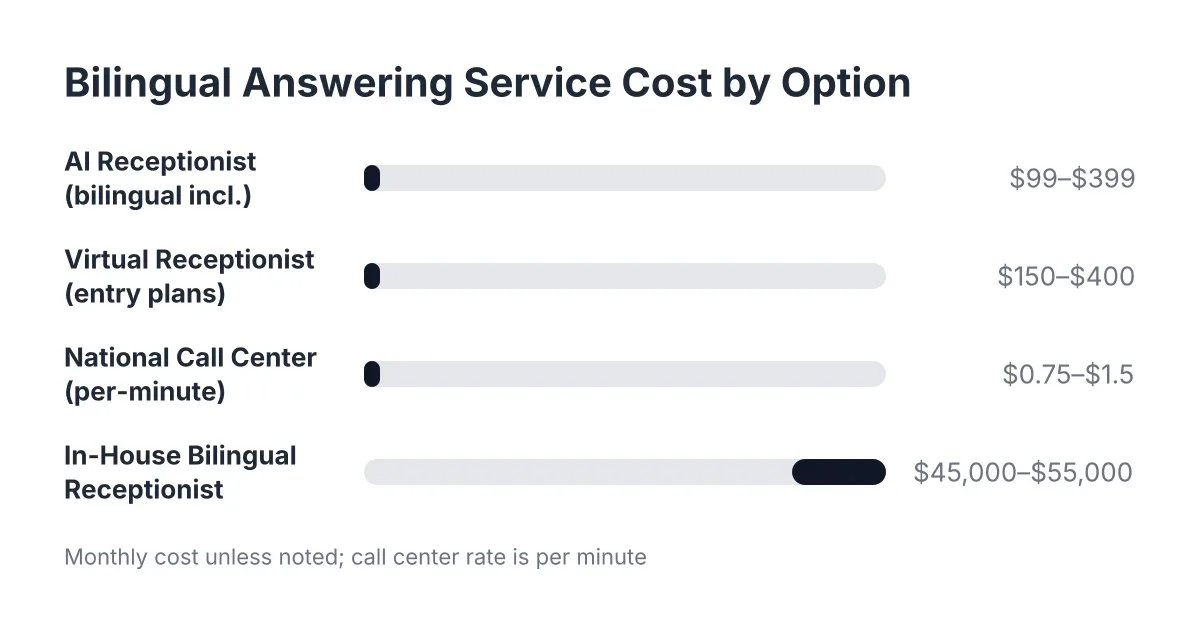
- Bilingual costs extra. Spanish-speaking receptionists typically command higher wages and a narrower candidate pool, and in Central Texas, English-only answering often means missed jobs.
For a solo tradesperson doing $200K a year, hiring a $50K receptionist to answer maybe 40 calls a month never pencils out. That's over $100 per answered call. Interestingly, staffing fears around AI don't hold up either: 98% of small employers using AI reported no change in employee headcount, according to the National Federation of Independent Business. Owners use it to catch what nobody was catching, not to cut anyone — then hire techs, not admin staff, when the extra jobs justify it.
Step 3: Read the Fine Print on National Call Center Pricing
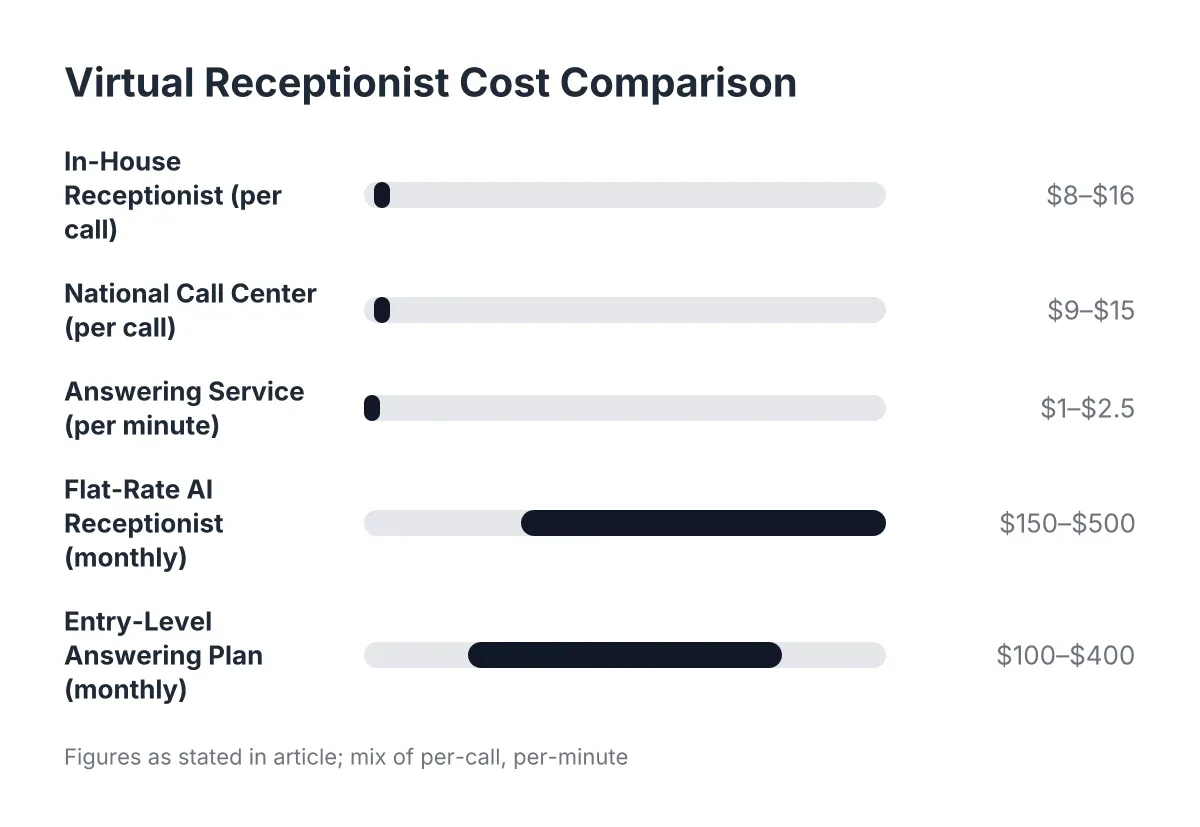
National answering services advertise plans that look affordable, often $50 to $150 a month for a starter tier. The catch is the meter. Most bill per minute, typically $1.00 to $1.75, with a bucket of included minutes that runs out fast.
Do the math on a real call. A storm-damage caller wants to describe the hail, ask about insurance claims, and confirm you serve Georgetown. That's a 6-minute call. At $1.50 per minute, you paid $9 for one call, and the operator reading a generic script may not have captured the claim details you actually need. Multiply by a post-storm surge of 80 calls and your "cheap" plan just billed you $700 in overages in a single weekend.
Watch for these line items before you sign anything in 2026:
- Setup or activation fees, often $50 to $100, sometimes waived if you ask.
- Per-minute overage rates above your included bucket, where the real margin lives.
- Holiday and after-hours surcharges, exactly when storm work hits.
- Upsells for message delivery, patching calls to your cell, or bilingual operators.
- Rounding rules; some services round every call up to the next full minute.
There's also a fit problem money can't fix. A national operator in another state doesn't know that Cedar Park and Leander are 15 minutes apart, or that "the storm last Tuesday" means something specific to your callers. Script-reading isn't market knowledge.
Step 4: Breaking Down the Cost of an AI Receptionist: Setup, Per-Call, and Monthly Fees
An AI receptionist typically costs $100 to $500 per month flat, with setup fees ranging from zero to a few hundred dollars and, on most flat-rate plans, no per-call charges at all. The total cost of an AI receptionist is predictable and transparent. Here's the full breakdown, setup through per-call, so you can compare line by line.
Setup Fees
Most AI receptionist services charge little or nothing to set up. Configuration means loading your services, service area, pricing rules, and booking link; for a straightforward trades business, that's typically a same-week process, not a months-long project. It's a setup conversation, not a hiring pipeline: you feed it your services, service area, pricing guardrails, and emergency criteria once, and it answers correctly on the first day and the five hundredth. Be cautious of any provider quoting a four-figure "implementation fee" for a small operation; that's enterprise pricing leaking into small-business plans. If a provider can't get a solo roofer live within days, keep looking.
Per-Call and Per-Minute Charges
This is where AI pricing diverges from call centers. Flat-rate AI plans include unlimited or high-cap call handling, so the 6-minute insurance-claim call costs the same as a 30-second wrong number: nothing extra. Some AI services do bill per minute at $0.30 to $0.80, cheaper than human operators but still a meter. For storm and event-driven work, flat-rate pricing matters more than the headline price, because your call volume isn't smooth. It spikes 10x in the 48 to 72 hours after weather hits, and a meter punishes you at your best moment.
Monthly Fees and What They Should Include
Expect $100 to $300 per month for solo operators and small crews, and up to $500 for higher-volume multi-crew operations. At that price, the plan should include 24/7 answering — that's 168 hours a week, not the 20 to 25 a part-time hire covers — plus lead capture and qualification, booking link delivery, call summaries, and bilingual support in English and Spanish. Bilingual should not be an add-on in Central Texas; it's table stakes. Same with simultaneous call handling: after a storm, an AI receptionist answers call 1 and call 100 at the same moment, which no single human at any price can do.
Look for CRM sync too. A receptionist writes messages on a notepad or in a shared inbox; a good AI receptionist scores every call, summarizes it, and syncs the lead straight into your CRM through Zapier, HubSpot, Salesforce, or Zoho — so every after-hours caller lands in your pipeline with a summary, a score, and a callback number you can dial in one click.
Emergency Triage: Set the Rules Yourself
Neither a human receptionist nor an AI receptionist should diagnose a gas leak over the phone; both need clear triage rules you define. The honest trade-off: a seasoned human can improvise on a strange call, while an AI receptionist follows your playbook with total consistency but will not freelance beyond it. For emergency trades, that consistency is usually the safer bet at 3 a.m. You set the criteria — active water leak, no power to the whole panel, or suspected gas smell triggers a live transfer to your on-call tech; everything else gets captured, qualified, and booked for morning. A tired hire, or you answering from bed, applies those rules unevenly. The AI applies them the same way every time, and true life-safety situations still get routed to a human or to 911 guidance, where they belong.
Step 5: Run the Cost Comparison Against Your Own Numbers
Now stack the options against the missed-call number you wrote down in Step 1. Here's the annual picture for a typical solo operator or small crew:
- Live receptionist (full-time): $45,000 to $50,000 per year, business hours only, one call at a time, turnover risk included free of charge.
- Part-time receptionist: roughly $20,000-plus per year for 20 to 25 business hours a week — an estimated $18,000 to $22,000 more in direct cost than a flat-rate AI plan, before you count a single after-hours job captured.
- National call center: $1,800 to $8,000+ per year depending on volume, with per-minute billing that spikes exactly when storms spike your calls.
- Flat-rate AI receptionist: $1,200 to $6,000 per year, 24/7, unlimited simultaneous calls, bilingual, predictable to the dollar.
For the roofer losing $22,500 a month in missed storm calls, a $250 monthly flat rate pays for itself with a fraction of one recovered job. That's the ROI math the answering service cost conversation usually buries under plan tiers and minute buckets: the question isn't which service is cheapest, it's which one captures the most revenue per dollar spent. To be fair the other way: if your after-hours call volume is genuinely tiny, a business-hours hire might serve you better, and it's worth saying so plainly. Run your own numbers first.
One honest trade-off. A Five9 and TEAM LEWIS survey found 75% of consumers prefer talking to a human for support, though the same research shows 84% already know companies use AI for customer service. The practical read for trades: callers care most that someone answers now, captures their details, and gets them booked. For genuinely complex situations, an active gas leak, a hostile insurance adjuster, a negotiation over scope, you still want live transfer to your cell or a callback from you. A good AI receptionist handles the intake and hands you the conversation; it doesn't pretend to be you. Instant after-hours call answering is what keeps you inside that five-minute response window every single time.
There's also a first-mover angle worth knowing: the same NFIB research found only 24 percent of small employers currently use AI tools for business activity. That gap is a competitive opening. While your competitor's phone rings to voicemail at 10 p.m. on a Saturday, yours gets answered, the lead gets qualified, and the job gets booked before anyone else wakes up.
Step 6: Pressure-Test the Pricing Before You Commit
Finally, don't take any pricing page at face value, including for AI. Ask every provider these questions and get the answers in writing:
- What is the total first-month cost, including setup, and the flat monthly cost after that?
- Is there any per-call or per-minute charge, ever, including after-hours and holidays?
- What happens during a 100-call surge after a storm? Same price? Same answer speed?
- Is Spanish included on every plan, or billed as an add-on?
- Can it capture insurance claim details, qualify the lead, and send my booking link, or does it just take messages?
Then run the simplest test available: call the number yourself. Ask hard questions in English, then in Spanish. Describe hail damage in Georgetown and see whether it captures the details a claim actually needs. Ten minutes on the phone tells you more than any pricing table, and any provider confident in their product will invite the test.
Once you've run the AI receptionist cost breakdown across setup, per-call, and monthly fees for all the options, the decision usually makes itself. The math isn't close for a one-person operation in storm country. The only expensive choice is the one you're making right now: letting calls ring out while you're on the job.
If you're losing revenue to missed calls, NeverMiss ATX can help.
Prefer to talk it through? Call (512) 980-9267 — a quick call is usually the fastest way to get a straight answer for your situation.