Hidden Fees in Answering Services: What Storm Contractors Actually Pay
The quote said $250 a month. The invoice said $612. If you run a roofing or restoration crew in Central Texas, hidden fees answering services charge are not a minor annoyance; they are a tax on the exact moment you make your money. Post-storm call volume can spike 300 to 400 percent in 48 hours, and most answering services price in ways that punish you hardest during that surge. This guide breaks down what live receptionists, national call centers, and AI receptionists actually cost in 2026, where the fees hide, and how to compare plans before a sales rep gets you on the phone.
Why Answering Service Pricing Punishes Storm-Driven Businesses
Answering service pricing punishes storm and restoration businesses because most plans charge by the minute or by the call, and weather-driven demand arrives in violent spikes rather than a steady monthly average. A plan sized for your quiet months overloads the week hail hits Round Rock, which is exactly when overage rates kick in.
Think about how your year actually works. A roofing crew in Georgetown might take 15 calls a day in February. Then a supercell drops golf-ball hail across Cedar Park and Pflugerville on a Tuesday evening, and the phone takes 200 calls in 48 hours. Per-minute pricing means your answering service bill triples in the same week your crew is stretched thinnest.
Here is the part that stings. The competitor who answers every one of those calls books a year's worth of insurance jobs in three days. At a $7,500 average job, missing even ten calls during a surge is a $75,000 problem. The answering service cost itself is never the real number; the real number is what missed calls cost you while you argue about overage charges.
So before comparing plans, understand the fee structures. That is where the money actually moves.
The Hidden Fees Answering Services Bury in the Fine Print
The most common hidden fees answering services charge include per-minute billing increments, holiday and after-hours surcharges, setup fees, per-call patch fees, message delivery charges, and overage rates that only apply when your volume spikes. Individually each fee looks small. Together they routinely double a quoted monthly rate.
Here are the ones that hit storm and restoration operators hardest.
Per-minute billing and rounding tricks
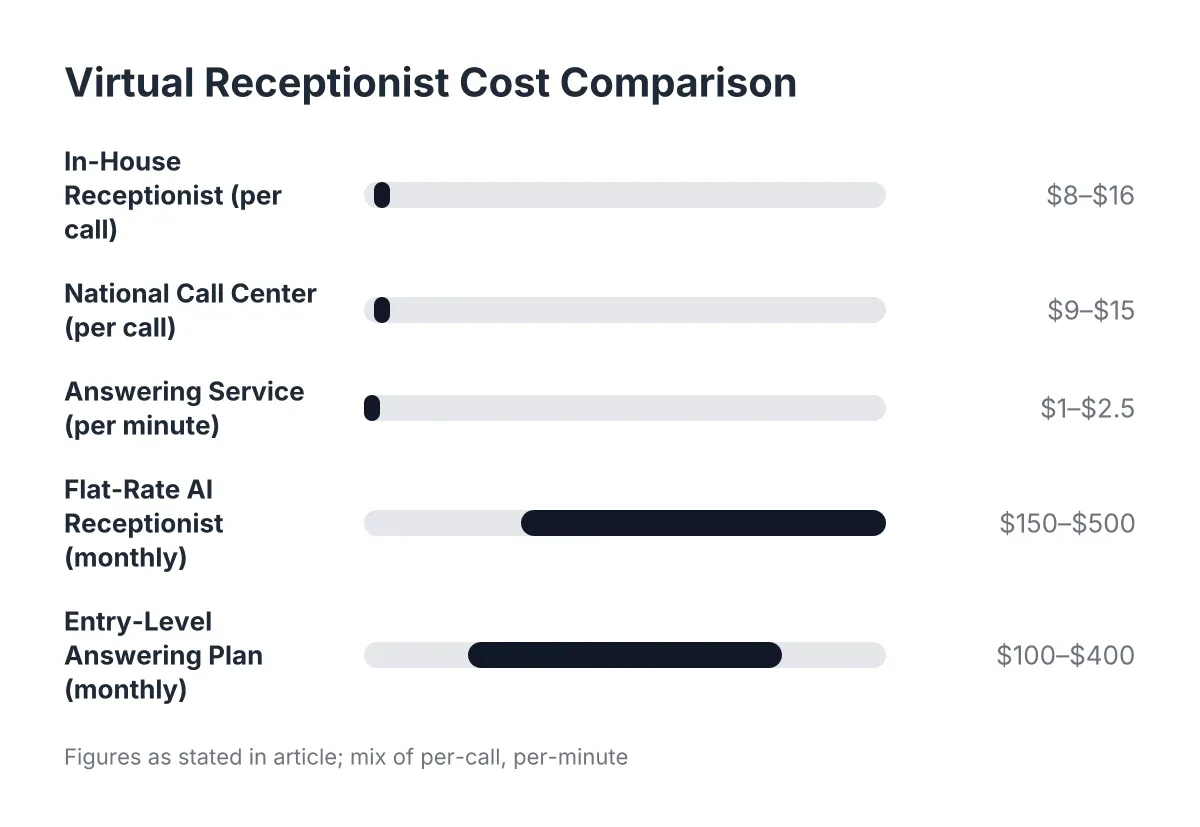
Most national call centers quote a base plan, say $300 a month for 200 minutes, then charge $1.25 to $2.00 per minute after that. Watch the billing increment. Many services bill in 30-second or full-minute increments, so a 65-second call gets billed as two minutes. During a storm surge, when a homeowner spends four minutes describing hail damage to their shingles and gutters, those minutes compound fast.
Do the math on a surge week. Suppose 180 calls averaging three minutes each: that is 540 minutes. If your plan covers 200, you pay overage on 340 minutes. At $1.50 per minute, that is $510 in overage alone, on top of your base rate, in the week you can least afford to review invoices.
After-hours, weekend, and holiday surcharges
Storms do not check the calendar. A major freeze hits Austin on a Friday night, pipes burst across Leander through the weekend, and your answering service charges a 15 to 30 percent premium for every after-hours and weekend minute. Some services add flat holiday fees of $25 to $50 per day on top. For an emergency contractor, after-hours is not the exception; it is the business.
Setup, programming, and script-change fees
Many services charge $50 to $500 to set up your account and program your call script. Fair enough, once. The hidden part is the change fee: $25 to $75 every time you update the script. Want to add insurance claim intake questions after a hail event? That is a change fee and a two-day turnaround, while the calls are coming in now.
Patch, transfer, and message delivery fees
This category is where invoices get creative. Common line items include:
- Call patching fees of $0.50 to $1.50 every time the service transfers a caller to your cell
- Per-message fees for texting or emailing you the caller's details, sometimes $0.10 to $0.50 each
- Fax or "secure delivery" fees that survive from a previous decade
- Charges for wrong numbers, hang-ups, and spam calls, because the agent still answered
That last one deserves attention. Post-storm, out-of-state storm chasers and robocallers flood local lines. With per-call pricing, you pay full rate for every one of them.
Minimum commitments and cancellation penalties
Annual contracts with early termination fees of one to three months' service are standard at national call centers. For a seasonal business, that means paying peak-sized bills through your slow months or paying a penalty to leave.
How Much Does an Answering Service Charge in 2026?
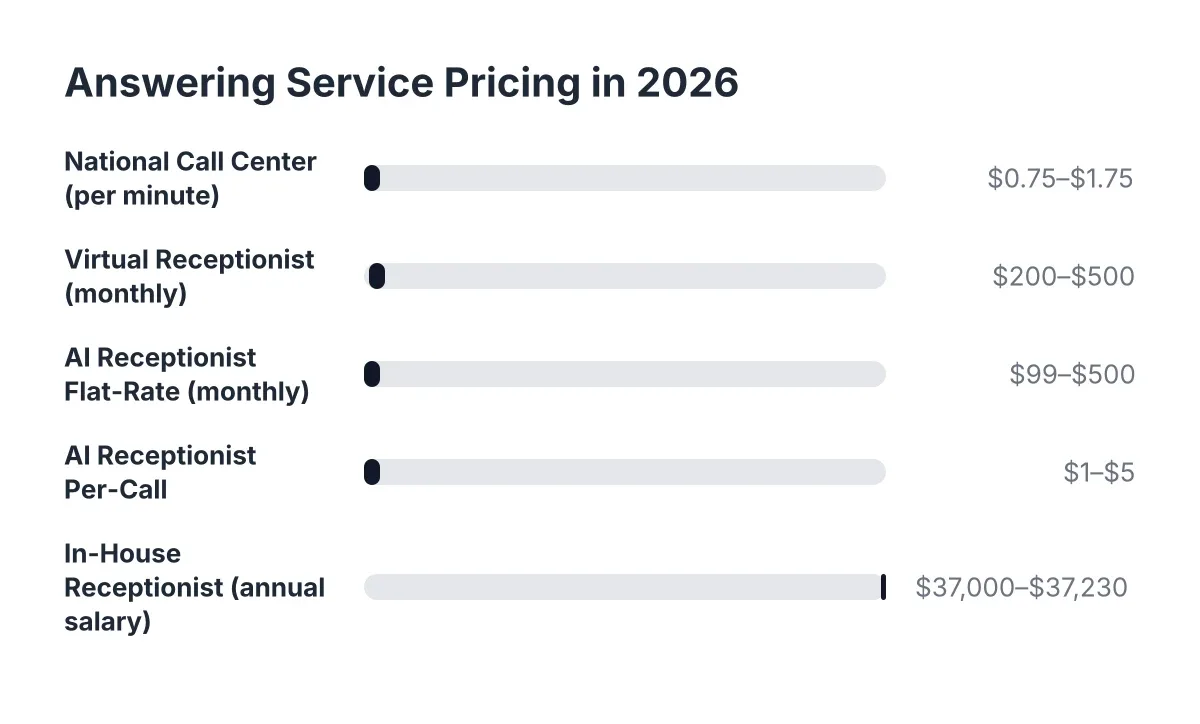
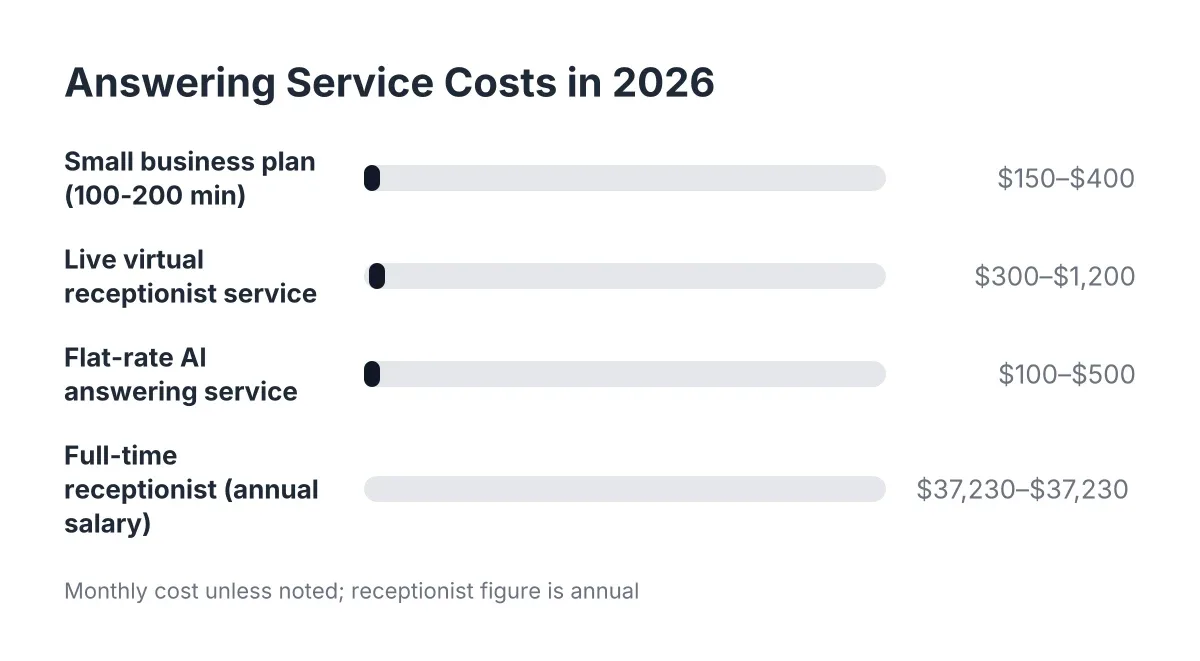
An answering service in 2026 typically charges $150 to $400 per month for a small business plan covering 100 to 200 minutes, with per-minute rates of $0.80 to $2.00 beyond that. Live virtual receptionist services run higher, often $300 to $1,200 monthly. Flat-rate AI answering services generally run $100 to $500 per month with no per-minute overage.
However, the sticker price tells you little until you model your own call pattern. A phone answering service for small business use looks cheap at low volume and gets expensive precisely when volume matters. Here is the honest comparison across the four options a Central Texas trades owner is actually weighing.
Hiring a full-time receptionist
The median hourly wage for receptionists in the U.S. was $17.90 in May 2024, about $37,230 per year before benefits or overtime, according to the U.S. Bureau of Labor Statistics. Add payroll taxes, health coverage, and paid time off, and a realistic all-in cost lands between $45,000 and $55,000 a year for one person covering roughly 40 hours a week.
The hidden costs go past salary. Turnover means re-hiring and re-training every 18 to 24 months for many small offices. One person cannot answer three simultaneous calls, takes lunch, gets sick, and does not work at 2 a.m. during a freeze. For surge-driven businesses, a single receptionist is a bottleneck with benefits.
National call centers and traditional answering services
Base plans of $150 to $400 monthly look manageable. The fee structures above are where the real answering service cost lives, and surge weeks are when they compound. National call centers also carry a cost that never shows on the invoice: agents in another state reading a generic script. They do not know that Pflugerville and Georgetown got hit by the same cell, cannot pronounce Manchaca, and treat a $12,000 full-roof insurance claim the same as a gutter question.
For claim intake, that matters. An agent who captures "roof damage, wants callback" instead of the insurance carrier, claim number, damage description, and whether the homeowner has already filed gives you a callback list, not a qualified pipeline.
Virtual receptionist services
Virtual receptionist pricing for small business plans typically runs $300 to $1,200 per month for a set number of live-agent minutes. Quality is generally higher than bulk call centers, and some offer light scheduling. The economics still break during a surge, though. Live-agent minutes are the product, so 400 percent more calls means 400 percent more minutes, and simultaneous-call capacity is capped by however many agents are free at that moment. Busy signals during the biggest hail event of the year defeat the purpose.
AI receptionists with flat-rate pricing
AI receptionists typically price at a flat monthly rate, often $100 to $500 depending on features, with no per-minute overage and no cap on simultaneous calls. The same system that answers 15 calls on a quiet Tuesday answers 200 during a hail surge for the same price. There are no after-hours surcharges because 24/7 is the default, not an add-on.
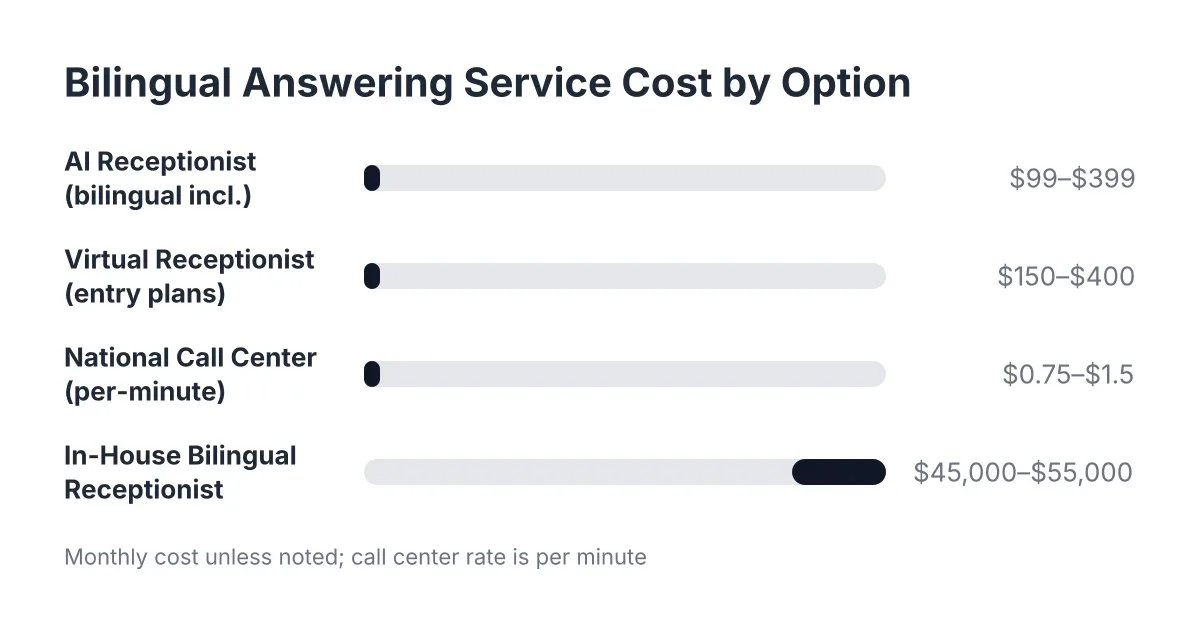
The credible ones do more than answer. They run lead capture with your intake questions, qualify callers, book appointments through your booking link, and send call summaries with scoring so you can triage high-value claims from your truck. Bilingual answering in English and Spanish comes standard on well-built services rather than costing extra, which matters in Central Texas where a meaningful share of post-storm calls come in Spanish.
To be fair about the trade-off: AI handles structured intake and booking well, and a Five9 survey found 75 percent of consumers still prefer talking to a human for customer support. The practical answer for a storm operator is not either-or. It is AI answering and qualifying every call instantly, with live transfer to you for genuine emergencies, so the human conversation happens with a qualified lead instead of a voicemail box.
What Hidden Fees Cost You During a Storm Surge: A Worked Example
Numbers make this concrete. Here is an illustrative scenario, with estimated figures, that any Central Texas roofer will recognize.
Suppose a hail storm crosses Round Rock and Cedar Park on a Wednesday evening in April. Over the next 72 hours, your line takes 220 calls. About 160 are genuine damage calls, 25 are existing customers, and 35 are spam, storm chasers, and wrong numbers. Calls average three minutes because homeowners describe damage and ask about insurance.
On a typical national call center plan in that scenario, the estimated bill looks like this:
- Base plan, 200 minutes included: $299
- Overage: 660 total minutes minus 200 included, so 460 minutes at $1.50: $690
- After-hours and weekend surcharge on roughly half the minutes at 20 percent: about $99
- Patch fees, 40 transfers at $1.00: $40
- Message delivery, 220 messages at $0.25: $55
- Estimated total: about $1,183 for one surge week, and you still paid full rate for 35 junk calls
On a flat-rate AI receptionist at, say, $299 a month in the same scenario, the bill is $299. Every call answered, including three at once at 11 p.m., every damage call qualified with insurance details captured, junk calls filtered rather than billed, and a scored lead list ready for your crew Thursday morning.
The gap is about $884 in fees. The bigger gap is speed. A foundational MIT Sloan and InsideSales.com study found the odds of contacting a lead drop 100-fold, and the odds of qualifying that lead drop 21-fold, when the callback happens at 30 minutes instead of within five. Post-storm, homeowners call down a list and book the first credible roofer who answers. Instant answering is not a convenience during a surge; it is the mechanism by which market share changes hands.
Is an Answering Service Worth It for Storm and Restoration Work?
An answering service is worth it for storm and restoration businesses when it can answer unlimited simultaneous calls, capture insurance claim details accurately, and respond instantly at any hour, because a single booked $7,500 insurance job covers a year of flat-rate service. It is not worth it when per-minute fees, capped capacity, or generic scripts cause missed calls during the surge you bought it for.
Run your own math. If your average job is $7,500 and your close rate on answered storm calls is even one in four, every four answered calls is worth $7,500 in booked work. A service costing $300 a month pays for itself with a single captured lead per quarter. The question was never whether answering the phone is worth it. It is whether the fee structure you signed still makes sense at 200 calls in 48 hours.
There are honest limits to weigh. Complex claim disputes, adjuster negotiations, and situations with legal exposure belong with you or a qualified insurance professional, not any answering service, human or AI. What the service must do is capture the details accurately and get the right calls to you fast.
Adoption is still early enough to be an edge. An NFIB survey found only 24 percent of small employers currently use AI tools for business activity. In a market where the fastest responder wins the insurance job, being in that 24 percent while competitors send surge calls to voicemail is a measurable advantage, not a novelty.
How to Spot Hidden Answering Service Fees Before You Sign
You spot hidden fees in an answering service contract by demanding a sample invoice for a high-volume month, confirming the billing increment, and getting every surcharge, patch fee, and overage rate in writing before signing. If a rep cannot model your storm-week bill on paper, the pricing is designed to be unclear.
Take this checklist into every sales conversation:
- Billing increment. Per second, per 30 seconds, or per minute? Rounding alone can add 20 percent to a bill.
- Overage rate in writing. Ask for the exact per-minute or per-call rate after your plan cap, then model a 4x volume week.
- Simultaneous call capacity. Ask what happens when 15 calls arrive at once. If the answer involves hold queues or voicemail, that is a missed-calls machine during a surge.
- After-hours and holiday surcharges. Get the percentage or flat fee in writing. For emergency trades, after-hours is most of the value.
- Spam and wrong-number billing. Do you pay full rate for junk calls? Post-storm, you will get plenty.
- Patch, transfer, and message delivery fees. Every one should be listed with a dollar amount or confirmed as included.
- Script and setup fees. What does initial setup cost, and what does changing your intake questions cost mid-storm?
- Bilingual answering. Included or an upcharge? In Central Texas, Spanish-language answering is table stakes, not a premium feature.
- Claim intake capability. Can they capture carrier, claim status, damage type, and address on every call, and will you see it in a summary or your CRM?
- Contract term and exit. Month-to-month or annual? What is the cancellation penalty?
In addition, ask for references from other trades businesses in weather-prone regions, or better, test the service yourself. Call it. Describe hail damage in Spanish. Ask an odd question about your service area. Five minutes on the phone tells you more than any pricing page.
The Bottom Line on Answering Service Fees
Hidden fees in answering services all share one design principle: the quoted price assumes your quietest month, and the fee schedule monetizes your busiest one. For storm and event-driven operators, that structure is backwards. You are buying answering capacity for the exact weeks when per-minute pricing, capacity caps, and surcharges do the most damage.
Therefore, compare options on surge economics, not sticker price. A full-time receptionist costs $45,000 or more a year and answers one call at a time. National call centers and virtual receptionists look affordable until a hail event turns minutes into money. Flat-rate AI receptionists cost the same on the worst weather day of the year as on a quiet Tuesday, answer every simultaneous call, capture claim details in English and Spanish, and get scored leads to you while homeowners are still deciding who to hire.
The storm decides when your phone rings. Your contract decides what each ring costs. Read the fee schedule like it is a surge week, because eventually it will be.
If you're losing revenue to missed calls, NeverMiss ATX can help.
Prefer to talk it through? Call (512) 980-9267 — a quick call is usually the fastest way to get a straight answer for your situation.