AI Receptionist Pricing Models: Per-Call vs. Flat-Rate for Plumbers and Emergency Trades
If you run an emergency trade in Central Texas, you already know the math on a missed call. A burst pipe at 11pm is a $2,000 job for whoever answers first, and voicemail does not answer. So you have decided to put something between your phone and your competitors. Now the question is what it costs, and the honest answer depends on which of the AI receptionist pricing models you land on: per-call, per-minute, or flat-rate. This guide breaks down all three, stacks them against the real cost of live receptionists and national call centers, and shows you the ROI math before you talk to anyone's sales rep. For plumbers especially, understanding AI receptionist pricing is crucial because emergency work demands a cost structure that scales with demand, not against it.
We will use plumbing as the running example because emergency plumbing is the hardest test case. Flooding calls come in panicked, after-hours, and in English or Spanish. If a pricing model punishes you for exactly those calls, you need to know before you sign.
How Much Does an Answering Service Charge in 2026?
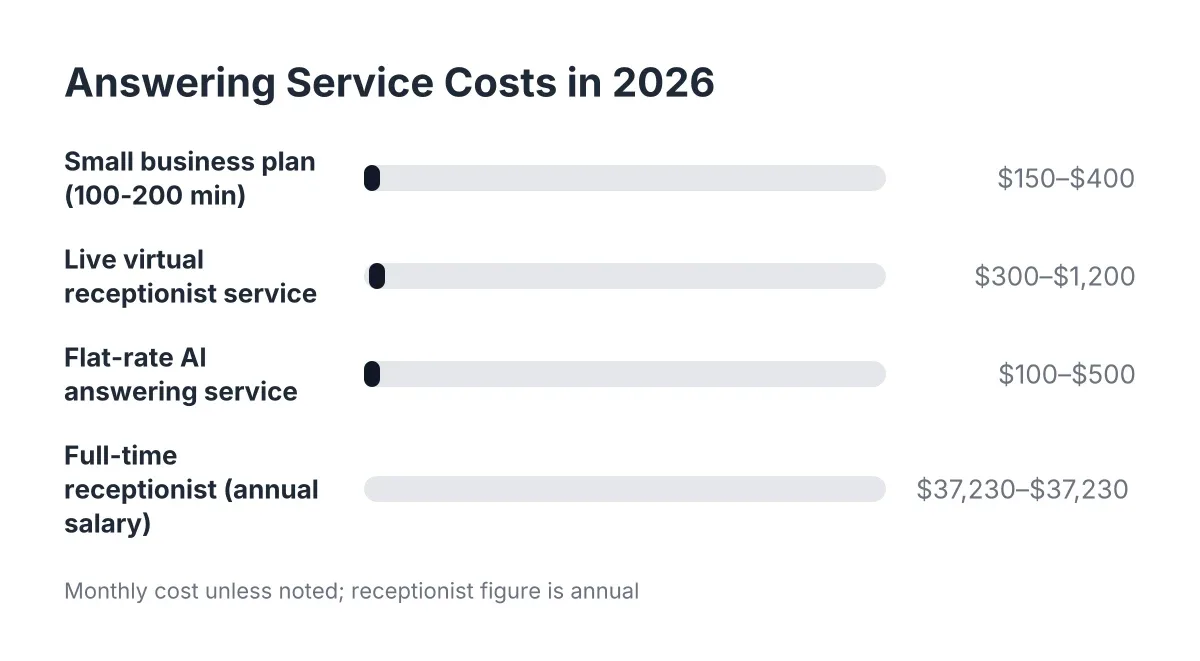
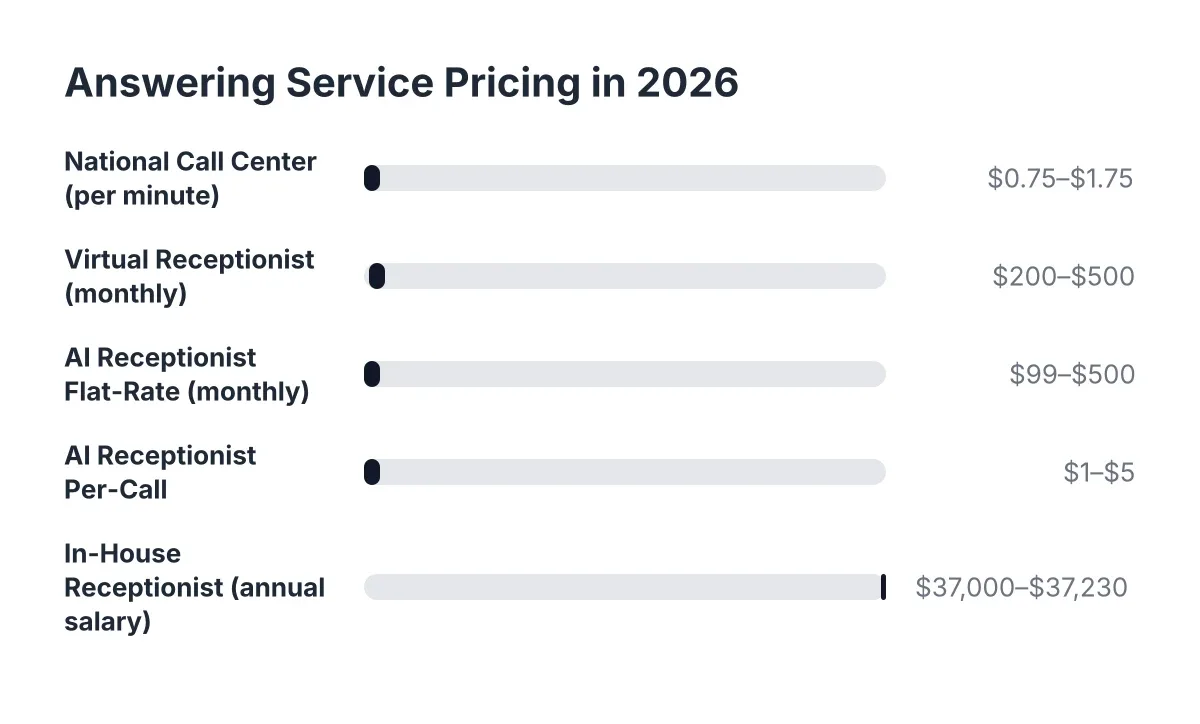
An answering service in 2026 typically charges between $0.75 and $1.75 per minute at national call centers, $200 to $500 per month for basic virtual receptionist plans, or $99 to $500 per month flat-rate for AI receptionists. A live in-house receptionist costs far more, roughly $37,000 per year in wages before benefits.
Those ranges hide a lot, though. The number that matters is not the sticker price. It is the cost per captured lead once you account for overages, after-hours surcharges, and the calls the service fumbles. According to the U.S. Bureau of Labor Statistics, the median receptionist wage was $17.90 per hour in May 2024, about $37,230 per year. That is one person, forty hours a week, no nights, no weekends. Your emergency calls do not keep those hours.
So the real comparison is not "cheap versus expensive." It is "what does each pricing model do to my cost when the phone rings at 2am during a freeze."
The Four Ways You Can Pay to Answer the Phone
Before we get into AI receptionist pricing models specifically, here is the full landscape an owner-operator is choosing from in 2026:
- In-house receptionist: Salary plus benefits, payroll taxes, training, and turnover. Covers roughly 40 of the 168 hours in a week.
- National call center: Per-minute billing, usually $0.75 to $1.75 per minute, with setup fees, holiday surcharges, and per-message fees layered on top.
- Virtual receptionist service: Monthly plans with a bundle of minutes or calls, typically $200 to $500 per month for small business tiers, with overage charges when you exceed the bundle.
- AI receptionist: Either per-call pricing (pay for each answered call) or flat-rate monthly pricing (one predictable number, 24/7 coverage included).
The first three all share a structural problem for emergency trades: they charge you more, or serve you worse, at exactly the moments your business makes its money. Nights, weekends, storm weeks, and August heat waves are when your call volume spikes and when per-minute meters run hottest.
The Hidden Costs of a Live Receptionist
Start with the option most owners consider first: hiring. The wage is only the opening bid. Add payroll taxes, health benefits, paid time off, and equipment, and a $37,230 salary becomes an all-in cost closer to $45,000 to $50,000 a year for many small employers. That is an estimate, but any owner who has run payroll knows the direction is right.
Then there is turnover. Front-desk roles turn over often, and every departure means weeks of hiring, training on your services and service area, and dropped calls in the gap. In addition, one person cannot answer two panicked flooding calls at once, and nobody answers when they are at lunch, sick, or asleep. You are paying full-time money for part-time coverage of a phone that rings around the clock.
The Hidden Costs of National Call Centers
National call centers look cheaper on paper because the entry price is a low per-minute rate. However, the meter runs on everything: hold time, wrap-up time, the operator reading your script slowly. A six-minute emergency call at $1.25 per minute is $7.50, and a busy storm week in Round Rock can burn through 400 minutes fast. That is $500 in a week, on top of monthly base fees.
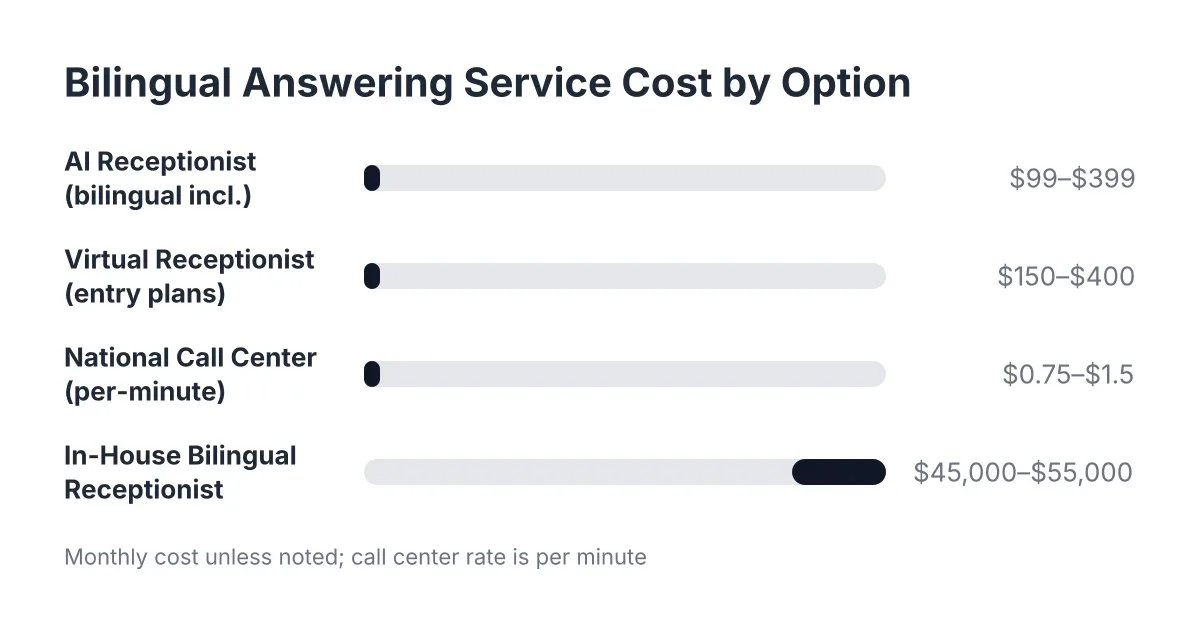
The upsells stack too. Bilingual answering often costs extra. After-hours and holiday coverage often costs extra. Patching a call through to your cell can cost extra. Worst of all for an emergency trade, the operator reading a generic script does not know the difference between a dripping faucet and a slab leak flooding a kitchen in Pflugerville. Triage quality is your revenue, and you cannot buy it by the minute from someone answering for 200 unrelated businesses.
AI Receptionist Pricing for Plumbers: Per-Call vs. Flat-Rate
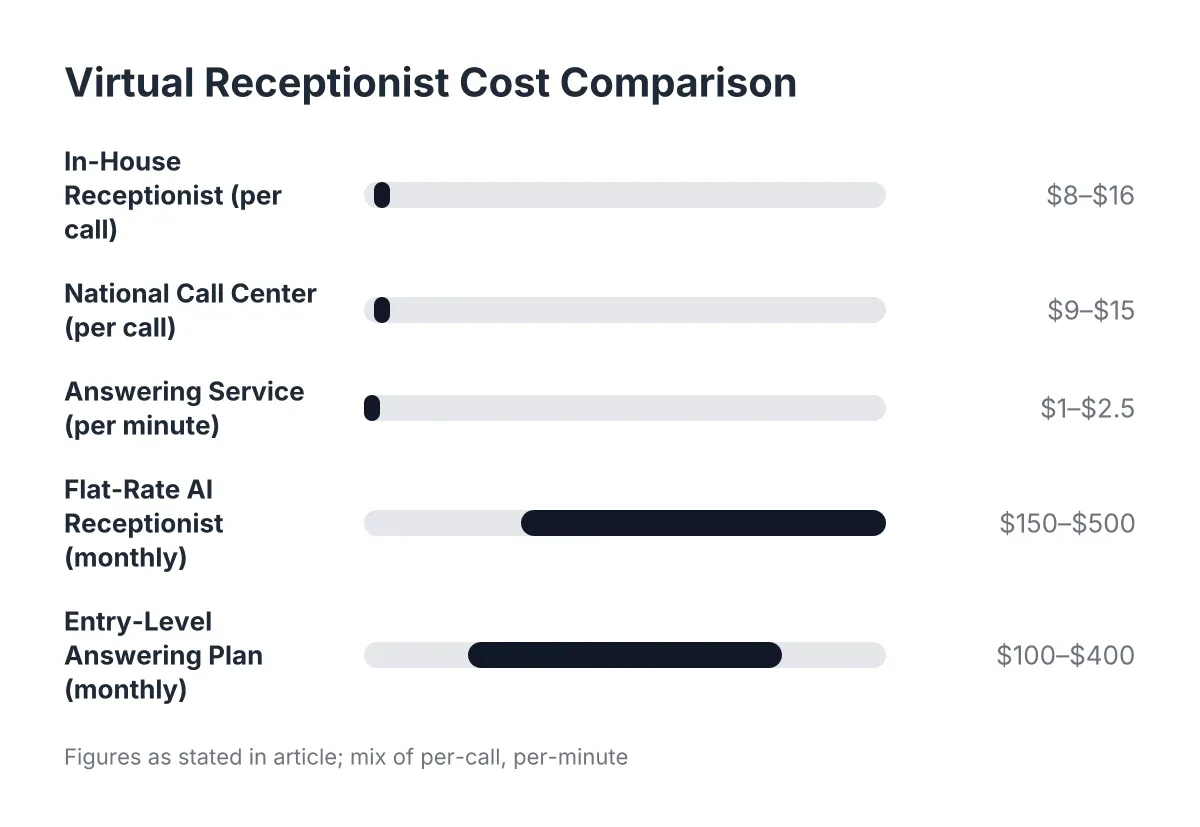
AI receptionist pricing models come in two main forms. Per-call pricing charges a fee for every answered call, usually $1 to $5 depending on call length and features. Flat-rate pricing charges one monthly fee, commonly $99 to $500 in 2026, that covers unlimited or high-volume answering 24/7. The right model depends on your call volume and how spiky it is.
How Per-Call Pricing Works
Per-call plans bill you for each conversation the AI handles. Some vendors charge a flat per-call fee; others convert to per-minute billing once a call runs long. There is usually a small monthly platform fee underneath, say $25 to $50, plus the usage.
For example, suppose a solo handyman in Georgetown gets 40 calls a month. At $3 per call plus a $30 platform fee, that is $150 per month. Reasonable. The model works when volume is low and steady.
The trouble starts when volume is not steady, which describes every emergency trade in Central Texas. A February freeze or an October hailstorm can triple your call volume in 72 hours. Under per-call pricing, your best week of the year is also your most expensive answering week, and you find out on the invoice. Per-call pricing also quietly discourages the behavior you want. If every call costs money, some owners start narrowing what the service answers, which reinvents the missed-call problem you were solving.
How Flat-Rate Pricing Works
Flat-rate plans charge one monthly number that covers answering, lead capture, qualification, and booking, 24/7, with no meter. The AI answers the third call of the night at the same cost as the first. Bilingual answering, call summaries, and CRM sync are typically included rather than sold as add-ons; that is how it works on every plan here, English and Spanish included by default.
The trade-off is honest: at low volume, flat-rate can cost more per call than a usage plan. A brand-new operator getting 10 calls a month might pay $150 flat, which is $15 per answered call. If those are $89 service calls, the math is thin. If even one of them is an emergency reroute or a remodel quote request, the math flips immediately.
Which Model Fits a Plumber or Emergency Trade
For emergency and urgent trades, flat-rate wins in most cases, and the reason is structural, not promotional. Your revenue is concentrated in unpredictable spikes: freezes, floods, heat waves, storm damage. A pricing model that scales cost with volume charges you the most during those spikes. A flat rate turns your answering cost into a fixed line item you can budget against, the same way you budget your truck payment.
Here is the decision in plain terms:
- Under 30 calls a month, mostly routine: Per-call pricing may edge out flat-rate on pure cost. Watch the per-minute conversion clauses on long calls.
- 30 to 150 calls a month, or any emergency work: Flat-rate almost always costs less per captured lead, and it removes invoice surprises during storm weeks.
- Seasonal spikes (freeze weeks, hail season, summer no-cool calls): Flat-rate, no contest. Your one-week surge would blow up any metered plan.
- Growing crew, adding trades: Flat-rate scales without renegotiation, which matters when a two-person operation in Cedar Park becomes a six-person multi-trade shop.
The ROI Math for an Emergency Trade
Run the numbers on a hypothetical but typical scenario. Say a two-truck plumbing outfit in Leander misses 15 calls a month, mostly evenings and weekends when everyone is on site. Suppose a third of those are real jobs at an average ticket of $450. That is roughly $2,250 a month in work going to whoever answered next, or about $27,000 a year.
Against that, a flat-rate AI receptionist in the $150 to $400 monthly range needs to capture one modest job per month to pay for itself. Everything after that first job is margin. And the emergency calls it captures are worth more than their ticket, because a flooding call handled well tonight often becomes water damage follow-on work, a repipe quote, and a recurring customer who saves your number.
Speed is the multiplier here. A foundational MIT Sloan and InsideSales.com study found the odds of contacting a lead drop 100-fold, and the odds of qualifying that lead drop 21-fold, when the callback happens at 30 minutes instead of within 5 minutes. Emergency callers do not wait 30 minutes. They hang up on voicemail and dial the next plumber on the list. Answering on the first ring is not a convenience feature for this work; it is the whole revenue model.
Is an Answering Service Worth It for an Emergency Trade?
An answering service is worth it for an emergency trade when the monthly cost is lower than the value of one or two captured jobs, which it almost always is. A single after-hours flooding call can be worth $1,500 to $4,000 with follow-on work; most 2026 AI receptionist plans cost less than a tenth of that per month.
The worth-it question really splits into two: does it answer, and does it triage. Anything beats voicemail on the first question. The second is where services separate. For an emergency trade, the service has to recognize a true emergency, calm a panic caller, capture the address and the urgency, and either book the job or live-transfer to you immediately. A generic script cannot do that. An AI receptionist trained on your services, your service area from Georgetown down to South Austin, and your definition of "urgent" can, and it does it identically at 2pm and 2am.
Skeptical that AI can handle a high-stress call? That is a fair instinct, and the way to resolve it costs nothing: call the AI yourself and try to stump it. Describe a slab leak in broken sentences. Switch to Spanish mid-call. Ask it what to do while you wait. You will know in three minutes whether it can handle your callers, which is more than any pricing page can tell you. Consumers are ready for this too; according to Five9, 84% of consumers already know some companies use AI to handle customer service interactions.
One honest limitation: an AI receptionist captures, qualifies, books, and transfers, but it does not turn a wrench. For genuinely dangerous situations, an electrical fire or gas smell, the right design is instant live transfer to you or a clear instruction to call 911, and you should confirm any service you evaluate handles that escalation path before you sign.
What a Complete Setup Actually Costs in 2026
When you compare quotes, price the whole stack, not just the answering line. As of 2026, a complete lead-capture setup for a small Central Texas trade typically includes:
- 24/7 AI phone answering: The core line item, flat-rate or per-call as discussed above.
- Bilingual coverage: Free by default on some services, a $50-plus monthly add-on at many call centers. In the Austin market, Spanish-language answering is not optional; a Spanish-speaking caller with a flooding emergency will not wait for a translator.
- Website chat: An AI website chatbot that captures the leads who never call, usually bundled or $30 to $100 extra elsewhere.
- CRM sync and webhooks: Pushing leads into Zapier, HubSpot, Salesforce, or Zoho so nothing lives in a portal you forget to check.
- Live transfer for urgent calls: The opt-in emergency bridge. Metered services often bill transfer minutes; flat-rate plans typically include it.
- Call intelligence and reporting: Scoring, summaries, and a weekly report so Monday morning tells you what last week's phone actually produced.
Setup complexity is the other hidden cost, measured in your hours instead of dollars. A national platform that needs weeks of script-building and IT work is expensive even if the software is cheap. For a solo operator, setup should mean describing your services, your service area, and your emergency rules in a conversation, not a configuration project. If a vendor quotes a setup fee north of a few hundred dollars or a multi-week onboarding, that is a cost line; put it in the comparison.
You are not late to this, for what it is worth. An NFIB survey found only 24% of small employers currently use AI tools for business activity. In the trades, the share is smaller still, which means answering every call in both languages is a competitive edge most of your local competitors do not have yet. And if the worry is that this replaces people, the data says otherwise: NFIB also found 98% of small employers using AI reported no change in headcount. The AI answers the phone so your crew can stay on the job.
Comparing AI Receptionist Pricing Models Before You Sign
Whichever direction you lean, put every quote through the same five questions. This is the checklist that turns a pricing page into an apples-to-apples answering service cost comparison:
- What is my true monthly number at my real volume? Model a normal month and a storm month. Ask the vendor to price both. If the storm month doubles the bill, you have a per-call problem wearing a flat-rate costume.
- What triggers extra charges? Long calls, transfers, after-hours, holidays, Spanish-language calls, texts, and summaries all get metered somewhere. Get the full trigger list in writing.
- Is bilingual answering included or an add-on? In Central Texas this single line item can swing the comparison by $50 to $100 a month.
- How does emergency escalation work, and does it cost extra? Live transfer should be an opt-in feature you control, not a per-minute revenue stream for the vendor.
- Can I test it before I pay? A service confident in its call quality will let you call the AI and pressure-test it with your hardest scenario. One that hides behind a demo video is telling you something.
Run those five questions against a live receptionist, a national call center, a virtual service, and a flat-rate AI receptionist, and the pattern is consistent for emergency trades. The metered options charge the most when you earn the most. The hired option covers a quarter of the hours your phone rings. Flat-rate AI is the only model where the 2am flooding call, the Saturday no-cool call, and the Spanish-language remodel inquiry all cost you the same fixed number you already budgeted.
That predictability is the real product. You know what the phone costs, you know every call gets answered on the first ring, and you can stay under the house on the slab leak in front of you while the next job books itself.
If you're losing revenue to missed calls, NeverMiss ATX can help.
Prefer to talk it through? Call (512) 980-9267 — a quick call is usually the fastest way to get a straight answer for your situation.