Answering Service Cost for a Solo Plumber vs. a 10-Person Crew (2026 Breakdown)
If you run trades work in Central Texas, the question is not whether you need calls answered. It is what answering that phone should cost at your size. The math for a solo plumber and a 10-person crew looks completely different, and most pricing pages hide that. This guide breaks down what a solo plumber, a 10-person crew, and everyone in between actually pays in 2026 across four options: hiring a live receptionist, a national call center, a virtual receptionist service, and a flat-rate AI receptionist. Understanding plumber crew size pricing is essential because the cost of call coverage depends entirely on your operation's scale. By the end, you will know exactly which line items apply to your operation, which ones are hidden until the first invoice, and how to run the ROI math before you ever talk to a sales rep.
One note before the numbers. This comparison holds whether you swing a wrench yourself, run a remodeling crew, or chase hail damage after a Central Texas storm. Call volume, not trade, is what drives the price.
Why Size Changes the Answering Service Math Entirely
A solo operator and a 10-person crew are not buying the same thing, even when they buy from the same vendor. The solo operator is buying missed-call insurance. Every call that hits voicemail while they are under a sink or on a roof is a job that goes to the next name on Google. The crew owner is buying capacity and triage. Ten trucks generate ten times the inbound volume, plus supplier calls, warranty callbacks, and crews calling in from job sites.
That difference shows up in three places on every pricing sheet:
- Volume tiers. Most services price per call or per minute. A solo operation might see 150 calls a month. A 10-person crew can see 800 to 1,500, and after a hail event, that number can triple in 48 hours.
- Feature requirements. A solo plumber needs lead capture, booking, and after-hours coverage. A crew needs all of that plus call routing, urgent-call transfer to whoever is on rotation, and CRM sync so the office is not retyping every lead into HubSpot or Zoho.
- The cost of a miss. For a handyman, a missed call might be a $250 repair. For a restoration or roofing operator working insurance jobs, the average ticket can run $7,500. Same missed call, thirty times the damage.
Therefore, the right question is not "how much does an answering service cost" in the abstract. It is "what does coverage cost at my call volume, and what does a missed call cost me at my ticket size." Answer both and the decision gets simple.
What a Solo Plumber Actually Pays for Call Coverage
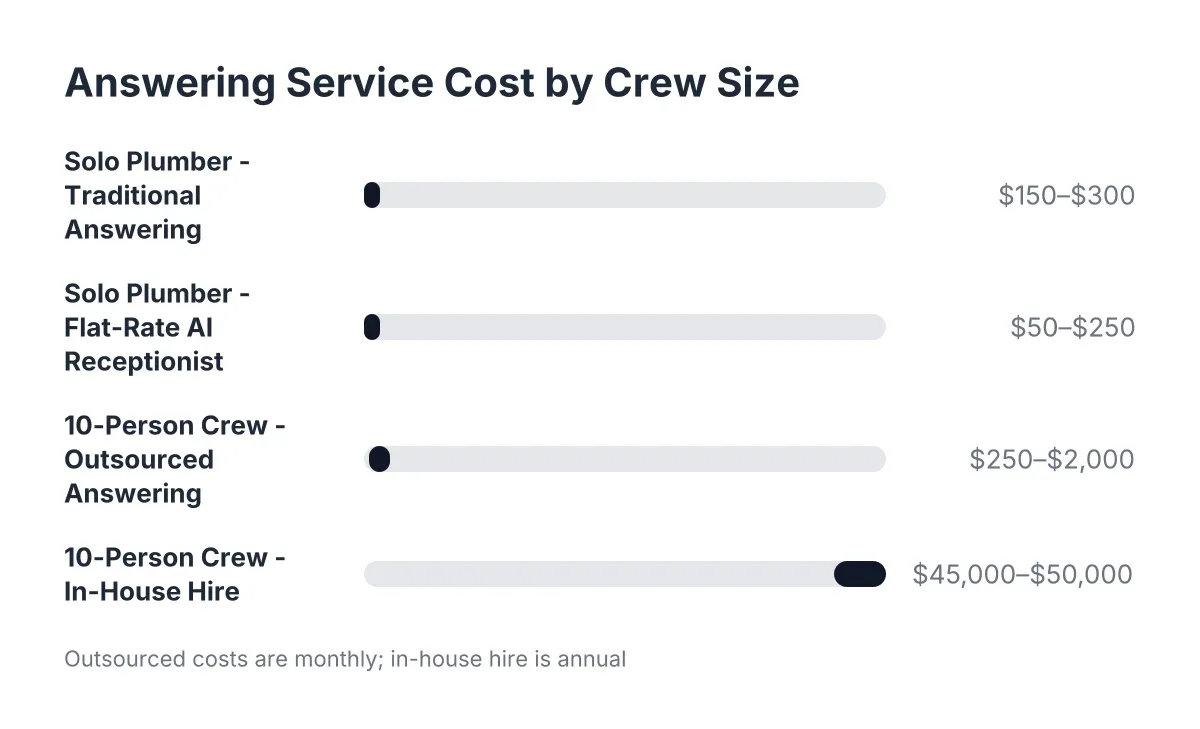
A solo plumber in 2026 typically pays between $50 and $300 per month for professional call coverage, depending on the model. Traditional answering services charge per minute or per call and land at $150 to $300 monthly for typical solo volume. Flat-rate AI receptionist plans usually run $50 to $250 per month with no per-minute meter running.
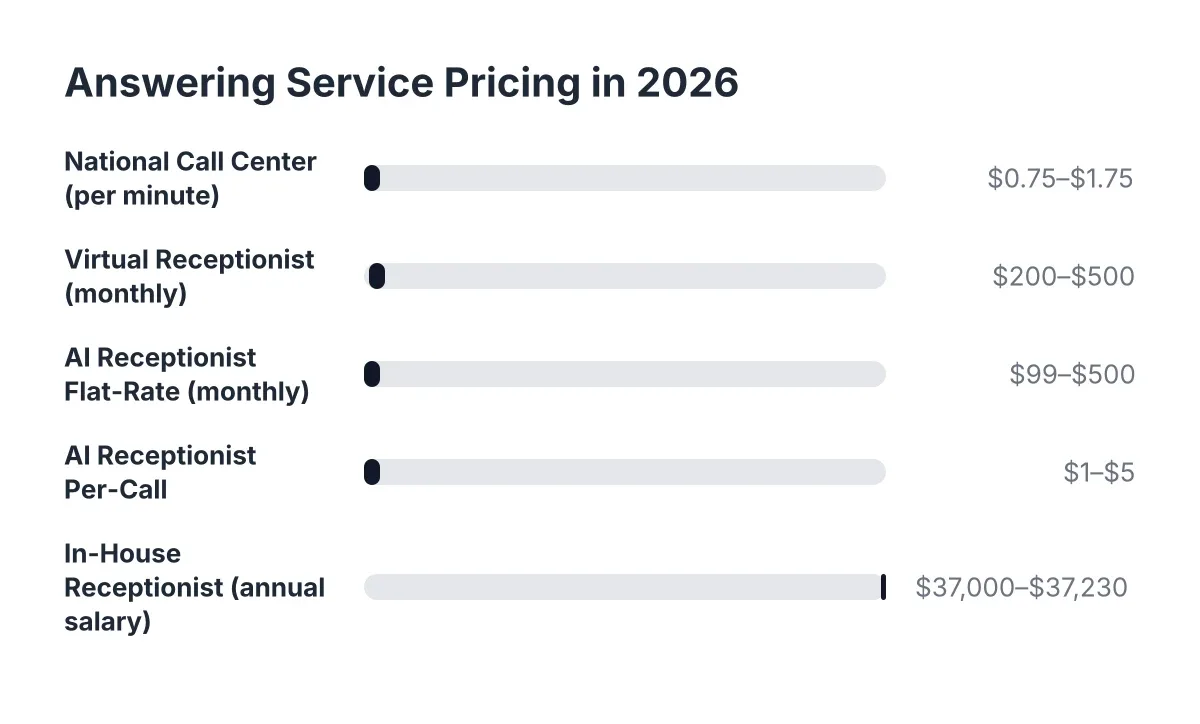
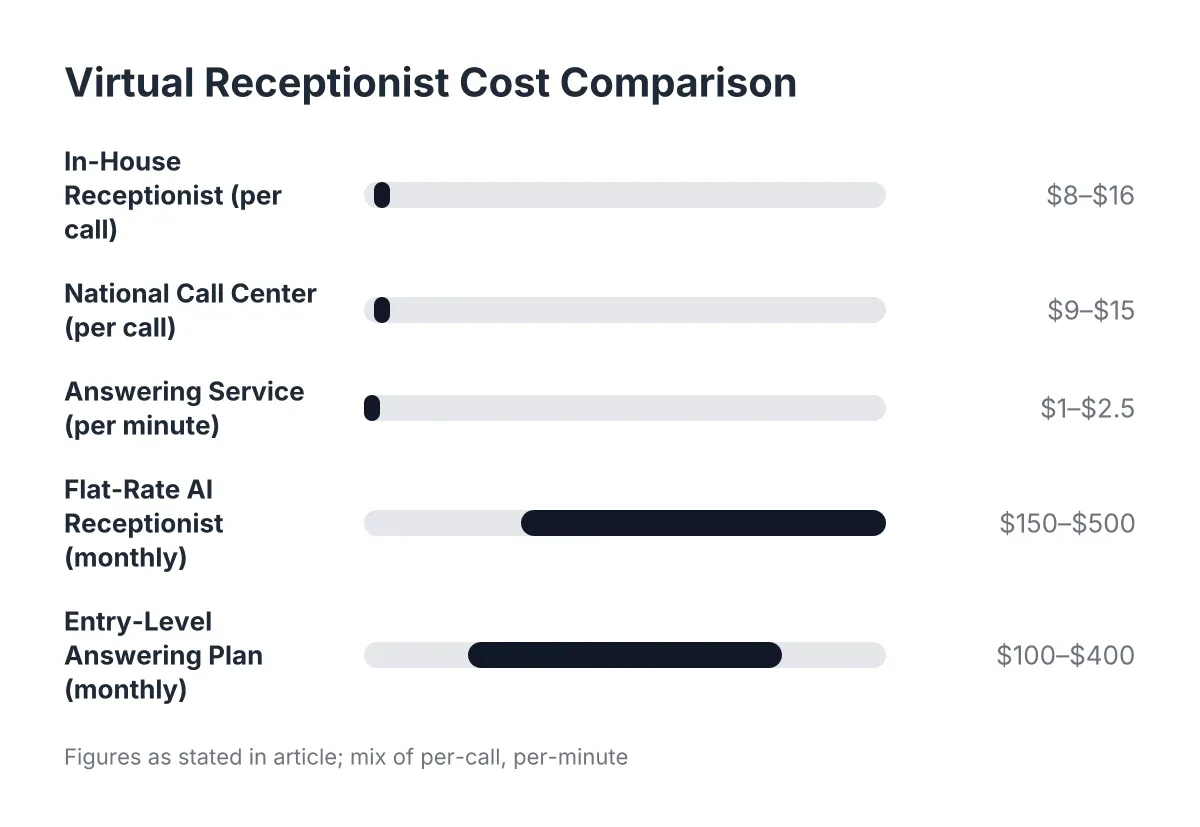
Here is why the per-minute model punishes solo operators. National call center pricing looks cheap on the homepage, often advertised at $0.90 to $1.50 per minute or $1.50 to $2.50 per call. But a real trades call is not 45 seconds. A homeowner describing a water heater leak, giving their address in Pflugerville, and asking about availability runs three to five minutes. At $1.25 per minute, that is $4 to $6 per call. At 150 calls a month, you are at $600 to $900 before the setup fee, the holiday surcharge, and the "extended script" upsell you did not know you agreed to.
Hiring is not realistic at this size either. According to the U.S. Bureau of Labor Statistics, the median receptionist wage was $17.90 per hour as of May 2024, about $37,230 per year before benefits, payroll taxes, or overtime. No solo operation clearing $150K to $250K in revenue can absorb a $45,000 fully loaded hire to answer 150 calls a month. And that hire only covers 40 hours a week, when the calls that hurt most come in at 7 p.m. on a Saturday.
For the solo operator, the decision usually comes down to a flat monthly rate versus continuing to let voicemail eat leads. Voicemail feels free. It is the most expensive option on this page. Speed is the reason. Research from MIT Sloan School of Management and InsideSales.com found the odds of contacting a lead drop 100-fold when the callback happens at 30 minutes instead of within 5 minutes. A voicemail you return at the end of the job is, statistically, a lead you already lost.
Answering Service Cost for a 10-Person Crew
A 10-person crew in Central Texas should budget $250 to $2,000 per month for outsourced answering in 2026, or $45,000 and up for an in-house hire. Per-minute call center plans sit at the top of that outsourced range because crew-level volume, 800 or more calls monthly, multiplies every metered fee. Flat-rate AI plans hold the bottom of the range because volume does not move the price.
At crew scale, the in-house receptionist starts to look reasonable on paper. You have enough volume to keep someone busy, and there is real value in a person who knows your customers. But the sticker price is not the real price. Budget for the full stack:
- Wages: roughly $37,230 per year at the national median, per the U.S. Bureau of Labor Statistics, and Austin-area wages often run above median.
- Benefits and payroll taxes: add 25 to 35 percent, pushing the true cost toward $47,000 to $50,000.
- Turnover and training: front-desk roles turn over often. Every departure means weeks of coverage gaps and retraining someone on your services, your service area from Georgetown to Fort Worth, and your pricing.
- Coverage gaps: one person covers about 2,080 hours a year. There are 8,760 hours in a year. Lunch, sick days, vacation, and every evening and weekend still go to voicemail.
For a multi-trade crew, that last item is the killer. Evenings and weekends are exactly when homeowners call about the remodel, the fence repair, or the burst pipe. Paying $50,000 a year for coverage that misses the highest-intent calls is a bad trade.
The national call center covers 24/7, but the meter problem compounds at crew volume. At 1,000 calls a month averaging four minutes, a $1.10 per-minute plan bills $4,400 monthly, $52,800 a year, more than the receptionist, with none of the local knowledge. Most crews discover this on invoice two, after the first month's promotional tier expires.
Solo Plumber to 10-Person Crew: Pricing by Operation Size
Comparing a solo plumber and a 10-person crew side by side, the annual answering service cost gap runs from about $600 at the low end to over $50,000 at the high end. When understanding plumber crew size pricing, the model you choose matters more than your size, but your size determines how brutally the wrong model punishes you.
Here is the 2026 landscape as realistic estimates, assuming a solo operator at about 150 calls per month and a crew at about 1,000:
- Voicemail: $0 per month, plus every after-hours lead handed to a competitor. At a $400 average ticket and five missed bookable calls a week, that is roughly $8,000 a month in lost work for a solo plumber. At crew scale with bigger tickets, the loss can clear $30,000.
- In-house receptionist: not viable solo; $47,000 to $55,000 fully loaded for a crew, covering only business hours.
- National call center (per minute): $600 to $900 monthly for the solo operator; $3,500 to $5,000 monthly at crew volume, plus setup fees and per-message charges.
- Virtual receptionist service (bundled minutes): $200 to $500 monthly solo; $800 to $2,000 for a crew, with overage fees the month a cold snap bursts pipes across Round Rock and your minutes run out exactly when you need them.
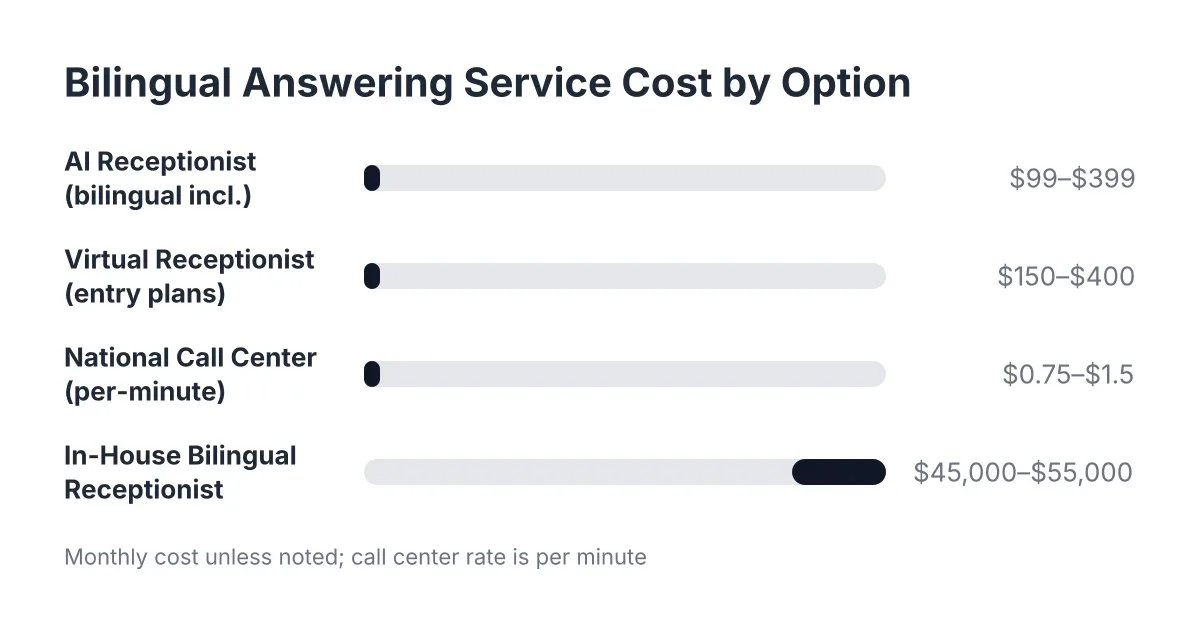
- AI receptionist (flat rate): typically $50 to $250 monthly for a solo operation and $250 to $700 for a crew, with 24/7 coverage, bilingual answering in English and Spanish, and no per-minute meter.
Notice the pattern. Metered pricing scales against you. The busier you get, the more you pay, and your busiest months, the freeze, the hail storm, the summer rush, generate the biggest bills at the exact moment you need every dollar for materials and payroll. Flat-rate pricing scales with you. A 400-call week costs the same as a 40-call week.
The Hidden Costs Nobody Puts on the Pricing Page
Beyond the sticker price, four hidden costs decide whether an answering service actually pays for itself: overage fees, script limitations, language gaps, and lead handoff friction. Each one hits solo operators and crews differently, and each one is invisible until you are locked into a contract.
Overage and surge fees
Bundled-minute plans work fine in an average month. Central Texas does not do average months. When a February freeze or a spring hail event spikes call volume 300 to 400 percent in 48 hours, metered plans bill you for the surge or, worse, throttle you into hold queues. For a storm-driven operator, that surge is the whole year's revenue. The competitor who answers every one of those calls books a year's worth of insurance jobs in a week. Busy signals during a surge are not an inconvenience; they are forfeited market share.
The script ceiling
National call centers work from scripts written for any business anywhere. Ask their agent whether you handle tankless water heater installs in Leander or what a typical trip charge is, and you get "someone will call you back." That answer converts poorly. A local homeowner comparing three plumbers books the one whose phone got answered with a real answer. This is where local, trade-specific setup earns its keep, whether the voice on the line is human or AI.
The bilingual gap
Central Texas is a bilingual market. If your service cannot take a call in Spanish, you are turning away a meaningful slice of Austin, Pflugerville, and Round Rock homeowners before the conversation starts. Most national services charge extra for Spanish-speaking agents or route those calls to a separate queue with longer holds. Bilingual answering should be a default on every plan, not a $100-per-month add-on.
Lead handoff friction
Capturing a call means nothing if the lead dies in an email inbox. Solo operators need the lead texted or pushed to their phone with the details already captured: name, address, problem, and urgency. Crews need it synced into HubSpot, Salesforce, Zoho, or a Zapier flow so dispatch can act without retyping. Ask any vendor exactly how a captured lead reaches you and how fast. If the answer is "a daily email summary," the MIT Sloan and InsideSales.com finding above tells you what those leads are worth by the time you read it: 100 times harder to reach, 21 times harder to qualify.
Running the ROI Math for Your Size
The ROI calculation for any answering service takes three numbers: your average ticket, your booking rate on answered calls, and your current missed-call count. Multiply them, and compare the result against the monthly price. For most trades operations, one recovered job per month covers the entire annual cost of a flat-rate AI receptionist.
Work through a real scenario. Say you run a three-person remodeling and repair crew out of Cedar Park, doing about $450K a year. Your average ticket is $600. You miss about eight calls a week: four during jobs, four after hours. If half of those were bookable and you would have won half of the bookable ones, that is two lost jobs a week, $1,200 weekly, about $5,000 a month walking to a competitor. Against a $200 to $400 monthly flat rate, the service pays for itself with the first recovered call, and everything after is margin.
Now scale that to storm work. A roofing operator after an Austin hail event, average insurance job $7,500, might field 60 calls in a day. A human receptionist handles one call at a time. An AI receptionist answers every simultaneous call, captures the address, damage description, and insurance carrier on each one, and flags the high-value claims for first inspection. Missing ten of those calls is $75,000 in claim intake gone. No monthly fee on this page comes within shouting distance of that number.
Two honest caveats belong in this math. First, an AI receptionist captures and qualifies leads; it does not close them. If nobody follows up on booked appointments, no service at any price saves the sale. Second, if your operation runs on a complex enterprise dispatch system with strict integration requirements, get a technical walkthrough before you commit, because not every platform syncs cleanly with every stack. For a straightforward solo or small-crew setup, that complexity does not apply, and setup is measured in days, not months.
Consumer expectations cut both ways here, and it pays to be clear-eyed about them. According to Five9, 84 percent of consumers know companies use AI for customer service, and 75 percent still prefer talking to a human for support. The practical read for trades: the AI receptionist's job is answering instantly at 2 a.m., capturing the lead completely, and transferring genuine emergencies to a live person on your team. It augments the human relationship, and you remain the human. The homeowner still gets you on site; they just never got a voicemail first.
There is also a competitive angle most owners miss. An NFIB survey found only 24 percent of small employers currently use AI tools in their business. In a market where three out of four competitors still let after-hours calls hit voicemail, being the operation that answers every call, in English or Spanish, at any hour, is a structural advantage that costs less than one recovered job a month.
Matching the Plan to Your Operation, Step by Step
Choosing the right plan comes down to matching four inputs, call volume, ticket size, after-hours share, and surge exposure, against the pricing model. Follow these steps before signing anything, whether you are a solo plumber or running a 10-person crew.
- Count your real call volume. Pull 90 days of phone records. Count total inbound calls, then count how many hit voicemail. Most owners underestimate misses by half.
- Price your average miss. Multiply average ticket by your close rate on answered calls. That is what each missed call costs, and it sets your budget ceiling.
- Map your after-hours share. If more than 20 percent of calls land outside business hours, any option without true 24/7 coverage, including an in-house hire, leaves your most urgent leads uncovered.
- Stress-test the surge. Ask every vendor one question: what happens when 40 calls come in during the same hour after a storm? Metered plans bill for it. Understaffed centers queue it. Get the answer in writing.
- Verify the handoff. Confirm exactly how leads reach you: text, dashboard, webhook, or CRM sync, and how fast. Speed to lead decides whether the service earns its fee.
- Test it yourself. Call the service before you buy. Ask it the questions your customers ask. Ask in Spanish. Try to stump it. Five minutes on the phone tells you more than any pricing page.
The through-line for both ends of the size spectrum is the same. Solo operators should refuse metered pricing because a good month should not cost more than a slow one. Crew owners should refuse business-hours-only coverage because evenings and storm surges are where the money is. In both cases, flat-rate, 24/7, bilingual answering with instant lead delivery is the configuration that makes the ROI math hold up, in a calm week in Georgetown or in the 48 hours after hail hammers half of Travis County.
If you're losing revenue to missed calls, NeverMiss ATX can help.
Prefer to talk it through? Call (512) 980-9267 — a quick call is usually the fastest way to get a straight answer for your situation.