How Much Does Small Business Call Management Cost?
If you run a trade in Central Texas, the honest answer to how much does small business call management cost is: it depends on three things. Call volume, how much you want the service to do beyond answering (booking, lead qualification, CRM sync), and whether you pay per minute like a national call center or a flat monthly rate like an AI receptionist. Those three factors move the number more than anything else. By the end of this page, you will know exactly what to ask providers so you get a real quote instead of a sales pitch.
What Drives the Cost of Small Business Call Management
Every provider prices differently, but the underlying cost drivers are the same. Here is what actually moves the number.
Call volume
This is the biggest one. Traditional answering services bill per minute or per call, so a plumbing company fielding 200 calls a month pays far more than a landscaper fielding 40. If your phone rings constantly during summer, a per-minute model gets expensive fast. AI receptionists usually charge a flat monthly rate instead, which means your July surge of AC calls does not blow up your bill.
How to tell which side you are on: pull your phone records for the last three months. If your call volume swings hard with the seasons, flat-rate pricing protects you. If you get a handful of calls a week, a low per-call plan might work.
Hours of coverage
Business-hours-only coverage costs less than 24/7 coverage with human staff, because someone has to be awake to answer at 2 a.m. That is why national call centers charge a premium for after-hours answering. AI receptionists answer 24/7 by default because software does not sleep, so around-the-clock coverage does not add a line item.
Ask yourself: when do your best jobs call in? Burst pipes and dead AC units do not wait for business hours. If after-hours calls matter to your business, price 24/7 coverage from the start, not as an add-on.
What happens after "hello"
Answering a call is the cheap part. The price climbs with everything you want done next: qualifying the lead, booking the appointment, sending a booking link, transferring urgent calls live, pushing the lead into your CRM. A basic message-taking service costs less than a full lead capture and booking setup. It also does less for you.
Be honest about what a missed call costs you. If a captured and booked lead turns into a recurring customer, paying more for booking and qualification usually pays for itself on the first job.
Language coverage
Bilingual answering matters in Central Texas. National call centers often charge extra for Spanish-speaking agents, or route Spanish callers to a smaller, slower queue. With an AI receptionist, English and Spanish come standard on every plan, so bilingual support does not push your price up. If a provider quotes you an upcharge for Spanish, that tells you something about how they built their service.
Integrations and reporting
If you want leads flowing into HubSpot, Salesforce, Zoho, or a Zapier workflow, some providers charge setup fees or per-integration fees. Same with call scoring, summaries, and reports. Others include webhooks, CRM sync, and a weekly report in the base plan. Ask up front, because integration fees are where an attractive base price quietly grows.
You are on the cheaper side of this factor if you just need messages texted to you. You are on the pricier side if you want every lead scored, summarized, and synced, though that is also where the value lives.
Contract terms and setup
Long contracts, setup fees, and per-seat charges all shift the total cost of ownership. A service that takes weeks to configure costs you time on top of money. Look for month-to-month terms and a setup process you can finish between jobs, not a project that needs its own project manager.
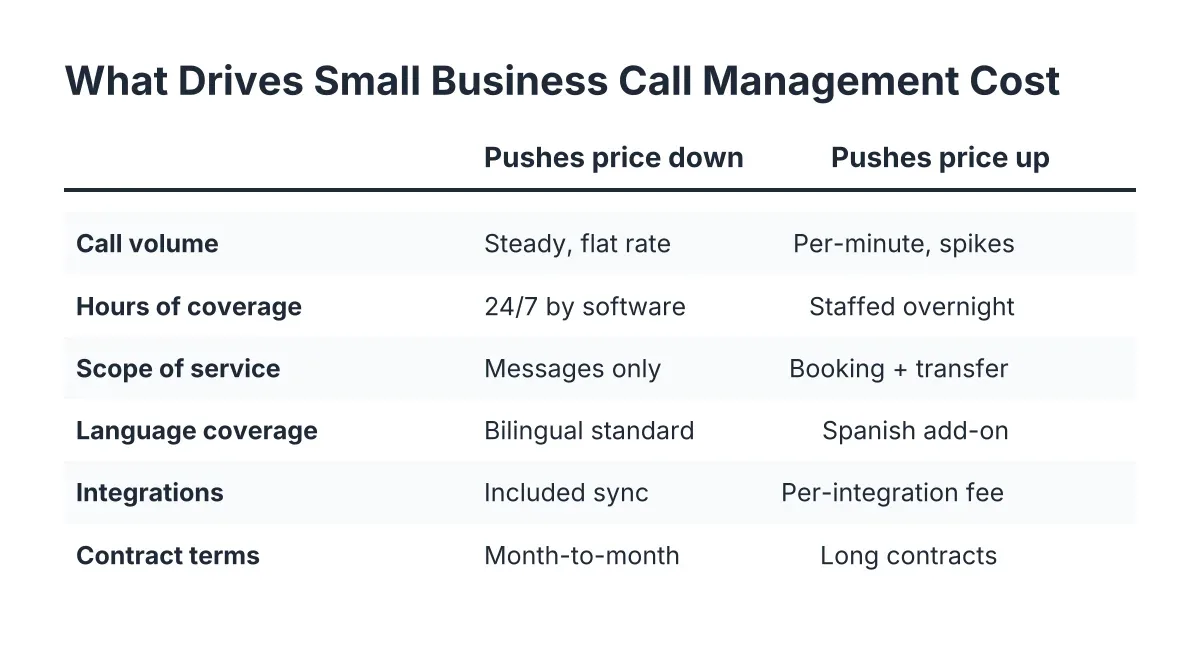
Cost Factor Table
| Factor | Pushes the price down when… | Pushes it up when… |
|---|---|---|
| Call volume | You have steady, low volume, or you pay a flat monthly rate | You pay per minute and volume spikes with the seasons |
| Hours of coverage | Coverage is built in 24/7 by software, not staffed shifts | After-hours answering means paying humans overnight |
| Scope of service | You only need messages taken | You want qualification, booking, live transfer, and follow-up |
| Language coverage | Bilingual answering is standard on every plan | Spanish support is a paid add-on with a separate agent pool |
| Integrations | Webhooks, CRM sync, and reporting come included | Each integration carries a setup or monthly fee |
| Contract terms | Month-to-month with simple setup | Long contracts, setup fees, and per-seat pricing stack up |
How to Get an Accurate Small Business Call Management Estimate
Anyone quoting you a number without asking about your business is guessing. Here is how to get a quote that will match your first invoice.
Have this information ready:
- Your monthly call volume, roughly, from your phone records
- How many calls come in after-hours or on weekends
- Whether you need Spanish answering (in Central Texas, plan on yes)
- What you want done with each call: message, qualification, booked appointment, or live transfer for emergencies
- Which CRM or tools the leads need to land in
A good quote includes: the monthly rate, what counts against any limits, whether after-hours and bilingual answering cost extra, integration fees, setup fees, and contract length. If any of those are missing, ask. If the salesperson dodges, move on.
Why quotes differ so much: a national call center prices human labor by the minute. An AI receptionist prices software by the month. Those are different cost structures, so the same call volume can produce wildly different quotes. Neither number is wrong; they are answering different questions. Your job is to compare total monthly cost for your actual volume, not the teaser rate on the pricing page.
One more test that costs nothing: call the service before you buy it. Try to stump it. Ask about a burst pipe at midnight, switch to Spanish mid-call, ask a weird scheduling question. Five minutes on the phone tells you more than any pricing page.
Ways to Keep the Cost Down
You do not need coupon codes. You need to buy the right thing the right way.
Match the pricing model to your call pattern. If your volume spikes in summer, flat-rate pricing beats per-minute billing. Run last year's July call count through any per-minute quote before signing.
Skip staffed after-hours premiums. If a provider charges extra for nights and weekends, compare against a service where 24/7 answering is the default. After-hours is when the emergency jobs call, so paying a premium for the exact hours you need most is backwards.
Do not pay separately for bilingual. Spanish answering should be standard, not an upsell. In this market, an English-only service means missed calls, and missed calls are the most expensive line item nobody invoices you for.
Compare two or three real quotes. Give each provider the same call volume and scope, then compare total monthly cost. Providers price differently enough that this one afternoon of work is the single best cost lever you have.
Avoid long contracts until the service earns them. Month-to-month terms let you test whether the leads actually get captured and booked. A service confident in its answering does not need to lock you in for a year to keep you.
Cost Questions People Ask
Is an AI receptionist cheaper than hiring a front-desk person?
Yes, and the gap is not close, because a full-time hire means salary, payroll taxes, training, sick days, and coverage gaps at lunch and after 5 p.m. An AI receptionist answers 24/7 without any of that overhead. That said, it is not about replacing a person you already trust; plenty of shops use one to capture the after-hours and overflow calls their office manager cannot reach.
What does a missed call actually cost me?
Think of your average job value, then think about what a recurring customer is worth over five years of service calls, maintenance, and referrals. When someone with a flooded kitchen hits voicemail, they call the next company on the list. So the real question behind what small business call management costs is what one booked emergency call is worth to you. For most trades, one saved job covers the month.
Are there hidden fees I should watch for?
The usual suspects: setup fees, per-minute overages, after-hours surcharges, bilingual upcharges, and per-integration fees for CRM sync. Ask for the all-in monthly number at your real call volume, in writing. A transparent provider will give it to you without a discovery call.
Do I pay more for emergency call handling?
With per-minute call centers, often yes, because urgent calls run longer and after-hours minutes cost more. With an AI receptionist, live transfer for urgent calls is typically an opt-in feature on your plan, not a surcharge that surprises you after a bad storm week. Confirm how emergency triage works before you sign, because a service that cannot tell a burst pipe from a quote request is not worth any price.
The Bottom Line
The honest answer to how much does small business call management cost is that your call volume, coverage hours, and scope set the price, and the pricing model (per-minute versus flat monthly) decides how predictable it is. Get two or three quotes at your real call volume, ask for the all-in number in writing, and call each service yourself to see how it handles a midnight emergency in English and Spanish. The right price is the one that captures every lead while you are on site, up a ladder, with your hands full.
If you're losing revenue to missed calls, NeverMiss ATX can help.
Prefer to talk it through? Call (512) 980-9267 — a quick call is usually the fastest way to get a straight answer for your situation.