Solo Plumber to Multi-Location: Scaling Call Management Without Hiring in Austin, TX
If you run a trade business in Austin, TX, the phone is where growth lives or dies. Solo plumber multilocation scaling sounds like a problem for someday, but scaling call management starts biting long before you open a second shop. The truth is simple: every stage of growth, from one truck to three crews across Round Rock and Georgetown, breaks your phone setup in a new way. This guide walks through every real option a one-to-ten-person shop has, from free call-forwarding hacks to a full AI receptionist, ranked by cost and honest fit. No jargon, no pretending a $400 tool solves a $40 problem, and no pretending a free hack survives a hail storm.
One note before we start. This guide is written for solo operators and small crews. If you already employ a full-time receptionist or run an enterprise-scale operation with dedicated dispatch, most of these options are below your needs.
Why Call Management Breaks at Every Stage of Growth
Call management fails differently at each size of business. A solo plumber misses calls because both hands are on a wrench. A three-person crew misses calls because nobody owns the phone. Additionally, a multi-location shop misses calls because volume outruns any single person's capacity. The fix at one stage becomes the bottleneck at the next.
Here is the pattern most owners in Central Texas live through. At the solo stage, you answer from the truck when you can, and voicemail catches the rest. Except voicemail does not catch much. Most homeowners with a burst pipe or hail-damaged roof hang up and dial the next number on Google. Your competitor who answered just won a job, and if that caller becomes a recurring customer, they won years of revenue.
Speed is not a soft factor here. According to MIT Sloan School of Management / InsideSales.com, the odds of successfully contacting a lead drop 100-fold, and the odds of qualifying that lead drop 21-fold, when a callback happens at 30 minutes instead of within 5 minutes. On a ladder, under a sink, or driving MoPac at 5 p.m., 30 minutes is optimistic. That math is the entire case for fixing your phones before you fix anything else.
For storm and event-driven operators, the math gets brutal. Post-storm demand can spike 300 to 400 percent in 48 hours. Suppose a spring hail storm rolls through Cedar Park on a Tuesday evening. Say your roofing company gets 60 calls between 7 p.m. and noon Wednesday, with an average insurance job worth around $7,500. If you answer 12 of those calls, that is roughly $90,000 in potential work. The other 48 calls, potentially $360,000 in claims, went to whoever picked up. That is not a missed-call problem. That is a market-share problem, and it decides which companies grow after every storm season.
The Full Menu: Every Call Option for a One-to-Ten-Person Shop
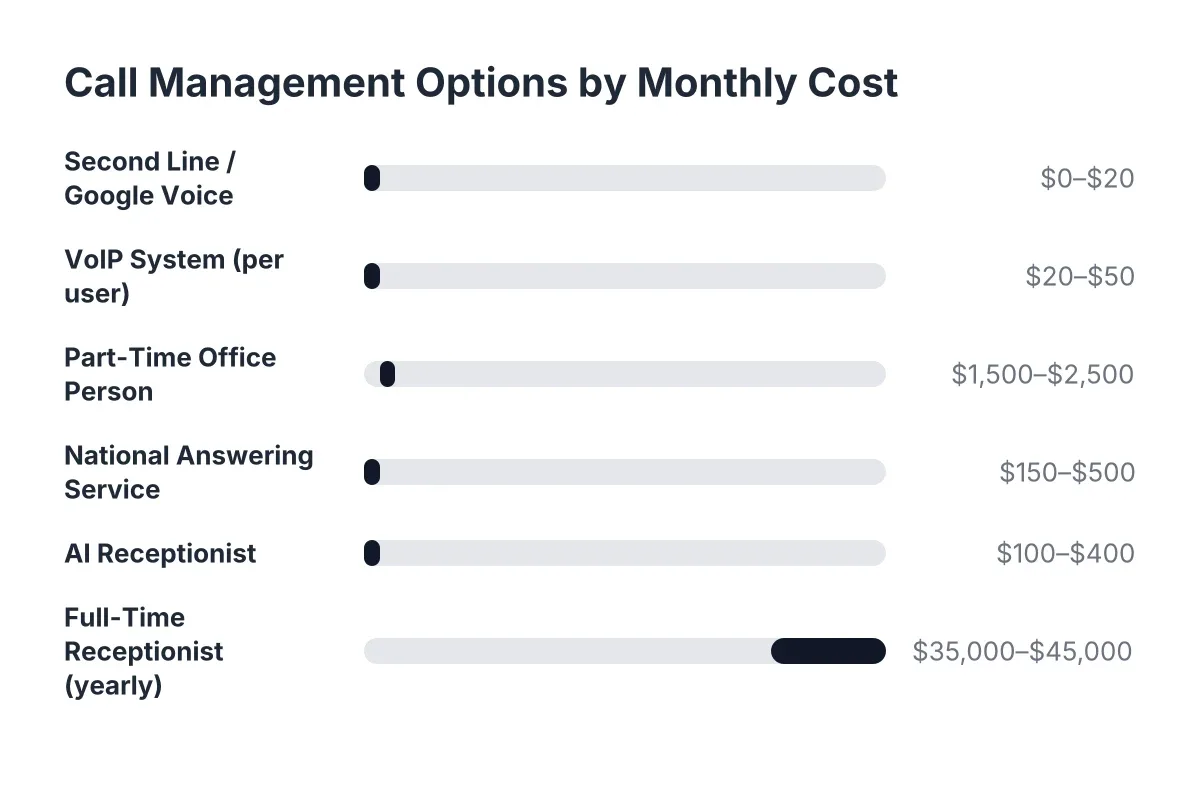
Before comparing costs, you need the honest list. These are the options that exist for small business call management in 2026, in rough order of cost and complexity:
- Do nothing (voicemail). Free, and it costs you the most. Voicemail is where leads go to die, especially after-hours and during surges.
- Call forwarding to your cell or a family member. Free to cheap. Works until the person forwarding to is also on a job, at dinner, or asleep.
- A second phone line or Google Voice number. $0 to $20 a month. Separates business from personal, but does not answer anything you cannot answer yourself.
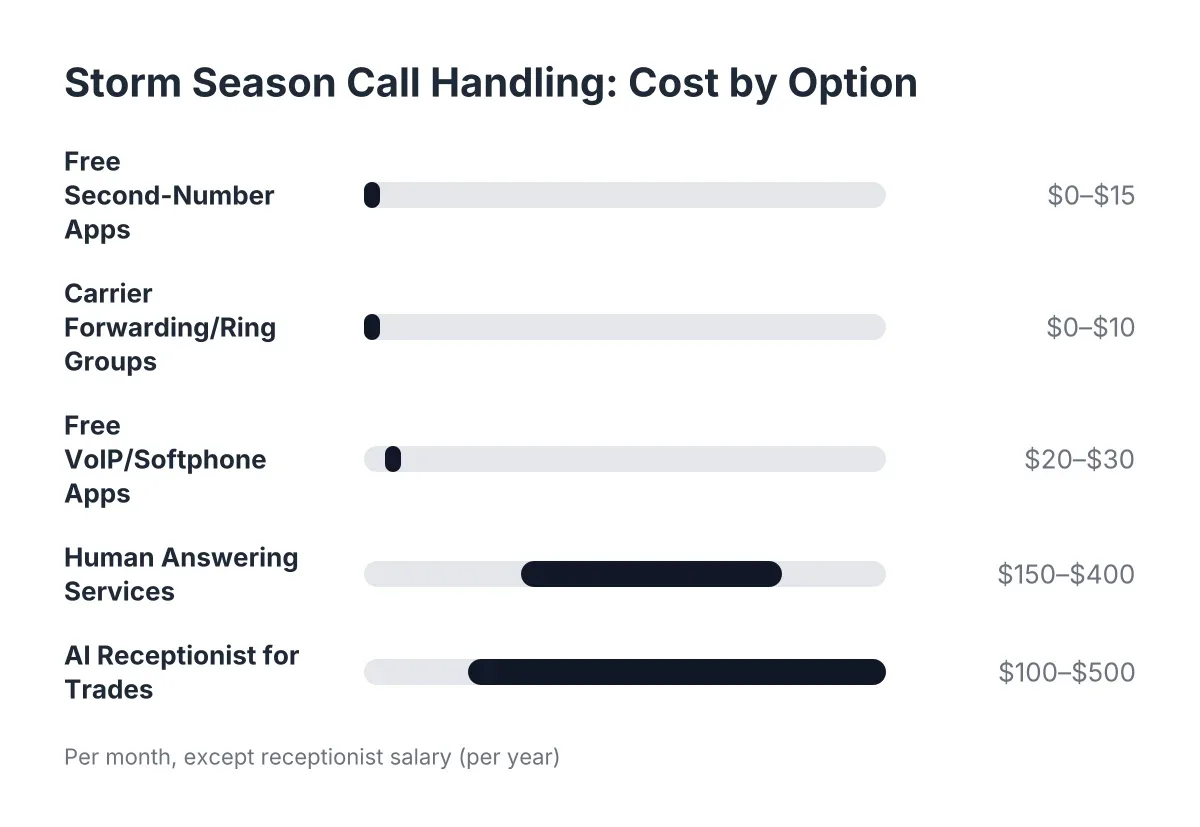
- VoIP phone system with routing and menus. $20 to $50 per user per month. Adds ring groups, business hours rules, and voicemail-to-email. Still requires a human to pick up.
- A part-time office person. $1,500 to $2,500 a month for limited hours. A real human, but only during those hours, and only one call at a time.
- A national answering service. $150 to $500 or more a month depending on minutes. Humans answer, but they read a script, do not know Central Texas, and overage charges spike exactly when storms hit.
- An AI receptionist. Typically $100 to $400 a month as of 2026. Answers 24/7, handles simultaneous calls, captures leads, qualifies them, and books appointments. No sick days, no overage panic during a surge.
- A full-time receptionist. $35,000 to $45,000 a year plus payroll costs in the Austin market. The right call at a certain size, and the wrong one for most shops under ten people.
Every one of these can be the right answer for someone. The question is which one fits your stage, your call volume, and the kind of work you chase.
How Solo Plumber Multilocation Scaling Actually Happens Through the Phone
Growing from a solo operation to multiple locations happens through the phone first, long before a second lease gets signed. The businesses that scale are the ones that stopped losing inbound demand, because captured calls fund the next truck, the next hire, and eventually the next branch. Solo plumber multilocation scaling is, at its core, a call-capture problem wearing a growth costume.
Think about what a second location actually requires: enough steady revenue to cover a lease, a lead flow that justifies crews in two service areas, and systems that do not depend on the owner personally answering everything. All three trace back to the phone. If you miss a third of your inbound calls, you are running a business at two-thirds throttle and wondering why growth feels stuck at one truck.
Therefore, the smart sequence flips the usual thinking. Do not scale operations and then figure out phones. Fix call capture first, let it show you the true demand in your market, and then scale into demand you can already see. An owner in Pflugerville who suddenly captures every after-hours call learns within a month whether the Leander side of town generates enough volume to justify a dedicated crew.
There is also a bilingual dimension that most national tools ignore. In the Austin metro, a meaningful share of homeowners prefer to explain a plumbing emergency or roof leak in Spanish. If your phone setup handles only English, you are invisible to a chunk of your own service area. Any option you evaluate should answer in both English and Spanish by default, not as a paid add-on, because those callers become recurring customers just like anyone else.
Scaling Call Management at Three Growth Milestones
First milestone: your calls exceed what you can answer from the truck. This usually happens around $150,000 to $250,000 in annual revenue. The symptom is a voicemail box that fills weekly and a nagging feeling that the phone rings most when you are elbow-deep in a job.
Second milestone: your crew grows, but nobody owns the phone. At two to five people, calls bounce between whoever is least busy. Details get lost, callers get inconsistent answers, and nobody logs the lead. This is where qualification logic matters: separating a $7,500 insurance job from a tire-kicker, or a recurring maintenance customer from a one-time fix.
Third milestone: volume outruns any single answerer. During a spring booking rush for lawn care, a summer HVAC peak, or a post-storm surge, calls come in simultaneously. One human, however good, answers one call at a time. This is the milestone that decides whether solo plumber multilocation scaling stalls or accelerates, because the surge weeks are where a year of market share gets won or lost.
Ranking the Options by Cost and Real-World Fit
Numbers on a pricing page do not tell you fit. Here is how each option performs against the realities of trade work in Central Texas: 95-degree attics, jobs that run long, and callers who will not wait.
Free and Cheap: Forwarding, Voicemail Greetings, and Ring Groups
Call forwarding and smart voicemail cost nothing and beat doing nothing. Forward the business line to your cell, record a greeting that promises a callback window, and check messages at set times. For a brand-new solo operator with ten calls a week, this is a legitimate starting point.
However, be honest about the ceiling. Forwarding does not answer calls; it relocates them to a person who is still on site with both hands busy. A ring group that hits three cell phones helps a small crew, but it interrupts three paid workers for every tire-kicker. And none of it works after-hours, which is exactly when a slab leak or a downed tree limb generates the highest-intent calls of the month.
Mid-Tier: VoIP Systems and Part-Time Help
A VoIP system in the $20 to $50 per-user range adds real structure: business-hours routing, a simple menu, voicemail transcription to email, and separate numbers per service area. If you are laying groundwork for a second location, per-area numbers with unified routing is genuinely useful plumbing, pun intended.
A part-time office person adds something no software has: judgment and a relationship with repeat callers. For shops doing heavy recurring work, lawn care routes, quarterly pest control, or HVAC maintenance plans, a familiar voice has value. The trade-offs are hours and concurrency. Part-time coverage means most of the week is still uncovered, and one person still answers one call at a time. During a March booking rush, the second and third simultaneous callers hear ringing, then voicemail, then a competitor's greeting.
The Big Three at Decision Time: Answering Service, AI Receptionist, or Full-Time Hire
A national answering service puts a human on every call for $150 to $500 a month in typical plans. The humans are real, but they are reading a script from a call center that could be anywhere. They do not know that Georgetown and South Austin are 45 minutes apart, they often charge per minute, and surge weeks generate surprise bills precisely when you are busiest. Bilingual coverage is frequently an upsell, and detail capture for insurance claims varies with whoever picked up.
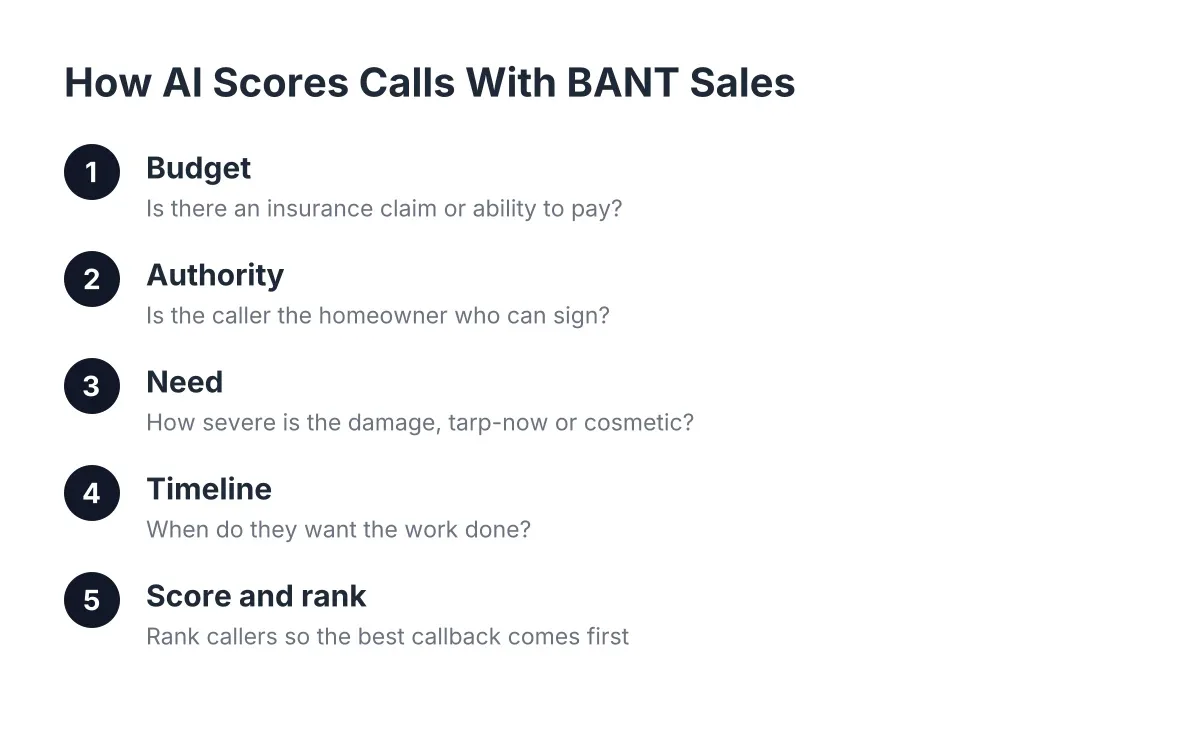
An AI receptionist, typically $100 to $400 a month as of 2026, answers every call 24/7, in English and Spanish, and handles unlimited simultaneous calls. That last point is the one storm operators should sit with. When 30 calls hit in an hour after hail moves through, an AI receptionist answers all 30 at once, captures damage details and insurance information on each, scores them, and books inspections. No overage cliff, no hold queue, no busy signal.
Fair concerns deserve fair answers. Consumers do prefer humans for support; a Five9 survey found 75 percent prefer talking to a real person for customer service, and 84 percent already know companies use AI for these interactions. Two things follow from that. First, the comparison for a small shop is not AI versus a human, because there is no human; it is AI versus voicemail, and callers choose an answered call over a beep every time. Second, good setups keep humans in the loop: urgent calls live-transfer to you when you opt in, and everything else arrives as a summarized, scored lead you call back from the dashboard. If you are skeptical about quality, the honest test is to call one and try to stump it with a real scenario, a water heater question in Spanish or a hail-claim intake, before you sign anything.
A full-time receptionist becomes the right answer eventually. In the Austin market, budget $35,000 to $45,000 plus payroll costs, and know that one excellent hire still covers roughly 40 of the week's 168 hours and one call at a time. Notably, adding tools does not mean cutting people: 98 percent of small employers using AI reported no change in headcount, according to the National Federation of Independent Business (NFIB). Most owners who add an AI receptionist later hire for dispatch and coordination, higher-value work than catching first-ring calls. The same NFIB survey found only 24 percent of small employers use AI tools at all, which means in most Austin trade niches, answering every call is still a competitive edge rather than table stakes.
What Scaling Call Management Without Hiring Looks Like in Practice
Scaling call management without hiring means building a phone layer that grows with call volume instead of with headcount. In practice, that layer answers every call 24/7, qualifies each lead against your criteria, books appointments straight onto your calendar, and syncs everything to your CRM. You add locations and service areas; the phone layer just absorbs the volume.
Here is an illustrative week for a hypothetical two-truck plumbing shop in Round Rock running this setup. Monday morning, the owner reads a weekly report over coffee: 41 calls answered, 26 qualified leads, 11 jobs booked, 3 Spanish-language callers captured, zero missed calls. Tuesday, he is under a house on a repipe when a property manager calls about a six-unit job; the AI receptionist qualifies it, flags it high-value, and he bridges the call back from his truck 20 minutes later, inside the window where contact odds are still strong. Thursday night at 11 p.m., a homeowner in Hutto calls about a burst pipe; the call live-transfers because he opted into emergency transfers, and he wins a $2,800 job his voicemail would have lost. In that scenario, nothing about his week required hiring, training, or managing anyone.
The pieces that make this work are worth naming, because they are your evaluation checklist regardless of vendor:
- 24/7 answering with lead capture, so after-hours and weekend calls become booked jobs instead of voicemails.
- Qualification logic you control, separating emergencies, insurance claims, recurring-service intent, and one-time fixes.
- Booking link delivery, so a caller gets a booking link by text and confirms while intent is hot.
- Bilingual answering on every call, English and Spanish, without an upcharge.
- CRM sync and webhooks into Zapier, HubSpot, Salesforce, or Zoho, so no lead lives only in a notebook.
- Live transfer for urgent calls, so genuine emergencies still reach a human immediately.
- Call scoring and summaries, so you call back the $7,500 claim before the price-shopper.
Setup fears are mostly outdated. A modern AI receptionist setup is forwarding your existing number and answering a questionnaire about your services, service area, and pricing ranges. Most shops go live in a day or two, not weeks, and you keep the number your customers already know.
One honest limitation: an AI receptionist captures and qualifies, but it does not diagnose. Complex commercial bids, insurance-claim negotiations, and anything requiring licensed judgment still need you or a qualified pro on the phone. The point is that you make those calls from a summarized, prioritized queue instead of a jumble of half-legible voicemails.
A Stage-by-Stage Roadmap for Solo Plumber Multilocation Scaling
The right sequence matters more than the right tool. Here is the roadmap that matches each growth stage to its call setup, so solo plumber multilocation scaling happens on purpose instead of by accident.
Stage 1, solo operator, under $200K revenue. Separate your business line from your personal cell, set a callback-window greeting, and forward intelligently. Track missed calls for 30 days. The moment you count more than five missed calls a week, you have outgrown this stage; at Austin job values, five misses can mean $1,500 to $10,000 in walked-away revenue weekly.
Stage 2, solo to first hire, $200K to $400K. Add an AI receptionist or answering layer before you add a field hire. A field hire generates revenue only from captured demand, so capture comes first. This is also where after-hours coverage starts paying for itself, because emergency and post-storm calls carry the highest job values you will see all year.
Stage 3, small crew, $400K to $800K. Layer in qualification logic, CRM sync, and call scoring. Your problem is no longer answering; it is prioritizing. A scored lead queue means the crew lead calls the insurance job first and the fence-quote request second, and your Monday report tells you which zip codes and services are heating up.
Stage 4, second service area or location. Run distinct tracking numbers per area through the same answering layer, and let six months of call data prove demand before you sign a lease. Expansion into Georgetown or Fort Worth should follow the call map, not a hunch. Your phone system already scales; now your operations catch up to it.
The through-line across all four stages is the same. Hiring should follow captured demand, never substitute for capturing it. The shops across Central Texas that grow from one truck to several locations are not the ones with the biggest crews. They are the ones where, when a homeowner calls at 9 p.m. during a freeze or the morning after hail, someone answers, in the caller's language, and books the job before the next number on the list ever rings.
If you're losing revenue to missed calls, NeverMiss ATX can help.
Prefer to talk it through? Call (512) 980-9267 — a quick call is usually the fastest way to get a straight answer for your situation.