Spanish-Speaking Customers Calling Your Business: How to Capture Every Lead
Suppose a hailstorm rolls through Pflugerville on a Tuesday night. By Wednesday morning your phone is ringing nonstop, and a third of those calls open in Spanish. If you have no plan for Spanish-speaking callers small business, those callers hang up, dial the next roofer on the list, and take a $7,500 insurance job with them. This guide walks through every real option a one-to-ten-person trade shop has for handling bilingual call volume, from cheap forwarding hacks to a bilingual AI receptionist, ranked by cost and how well each one actually holds up when the storm surge hits.
This is written for the operator who is already committed to fixing the problem. You are not deciding whether bilingual answering matters; you are deciding how to set it up so it works during the worst 48 hours of the year, which also happen to be the most profitable.
Why Spanish-Speaking Callers Small Business Matters in Your Market
Spanish-speaking callers represent a large share of your addressable market in Central Texas, and most of your competitors handle them badly. About 28.5% of Texans, nearly 7.8 million people, speak Spanish at home, according to the U.S. Census Bureau via KXAN. In Austin specifically, 29.6% of residents age 5 and older are bilingual, and 10.3% speak English less than very well, based on 2022 Census American Community Survey data compiled by the City of Austin.
Run the math against your own call log. If your shop takes 200 calls in the 48 hours after a hail event and the Austin share of bilingual residents holds, roughly a third of them will open in Spanish, and some of those callers will not be able to complete a claim intake in English. At an average insurance job of $7,500, mishandling even ten of those calls is a $75,000 problem in one week.
Here is the part most operators miss. The caller who cannot get through in Spanish does not leave a voicemail. They call your competitor. Post-storm, the roofer who answers every call in both languages does not just win a job; they win a disproportionate share of a neighborhood, because insurance jobs cluster block by block and referrals travel through families.
There is also a speed factor stacked on top of the language factor. A foundational study from MIT Sloan School of Management and InsideSales.com found the odds of contacting a lead drop 100-fold, and the odds of qualifying that lead drop 21-fold, when the callback happens at 30 minutes instead of within 5 minutes. A Spanish-speaking caller who reaches voicemail is a lead you contact late, in a language you may not be able to return the call in. Both penalties compound.
Every Option a Small Trade Shop Actually Has, Ranked
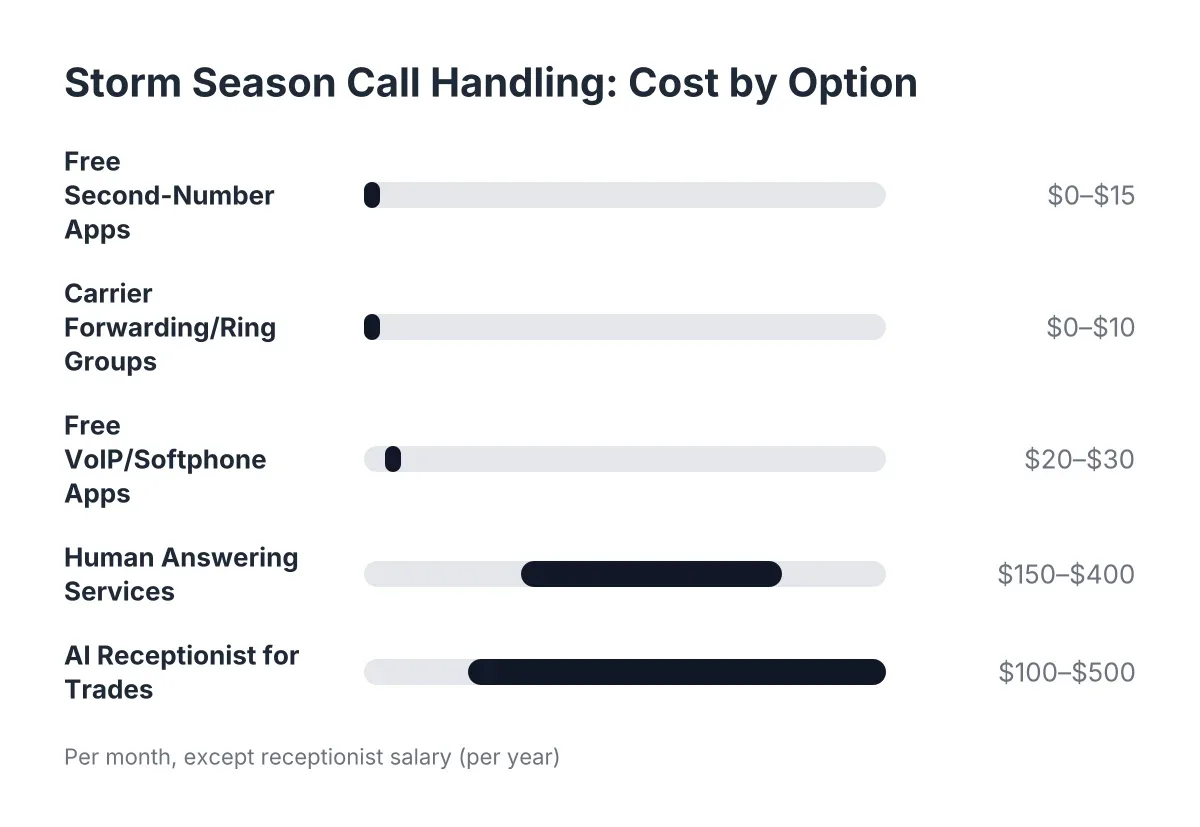
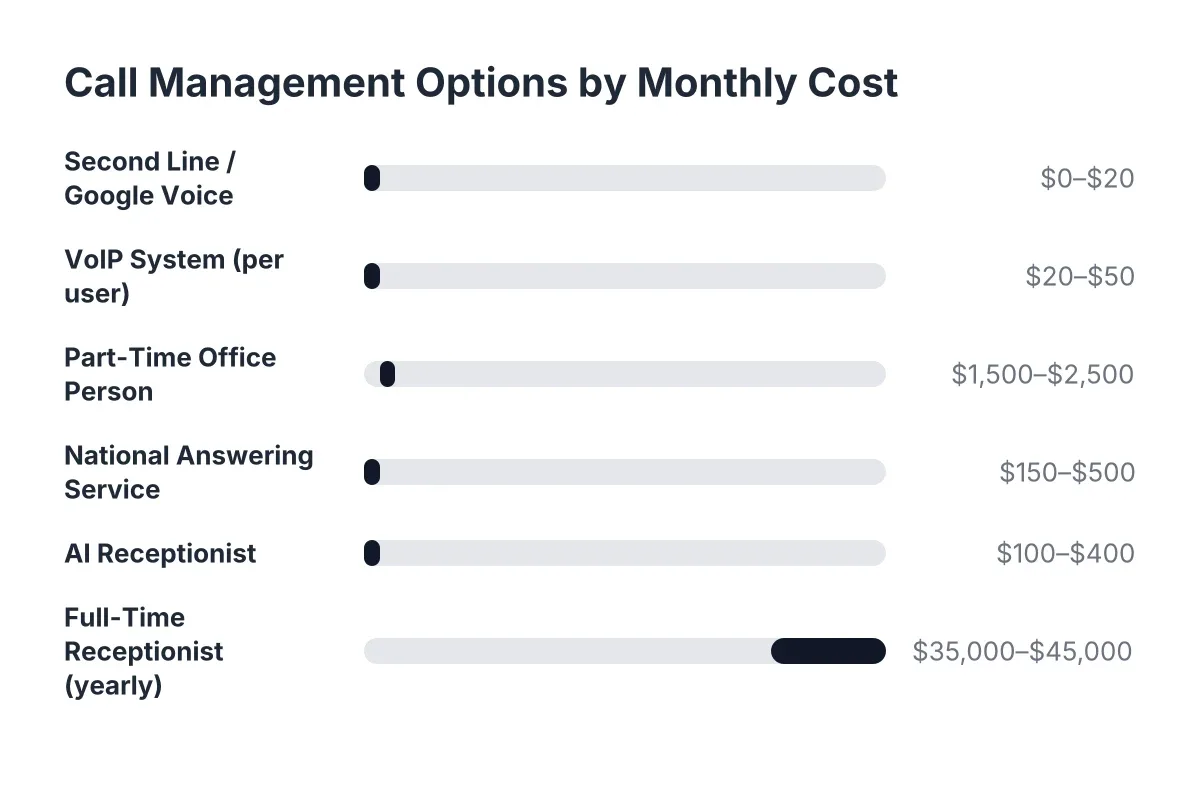
Small business call management for a bilingual customer base comes down to five realistic options. Each one trades cost against surge capacity and quality of intake. Here they are, cheapest first, with an honest read on where each breaks.
Option 1: Google Translate and goodwill (free, breaks immediately)
Answering yourself and muddling through with translation apps costs nothing and fails fast. It can work for a single simple call, a caller confirming an appointment time, for example. It cannot handle a claim intake, where you need the date of loss, the insurance carrier, the damage description, and a callback window captured accurately.
Worse, it signals to the caller that your shop is not set up for them. Many bilingual households will push through a clumsy call for an emergency plumber at 2 a.m. Few will do it when three of your competitors advertise "Se habla español" on the same search results page.
Option 2: Call forwarding to a bilingual family member or crew lead ($0, burns people out)
Forwarding calls to your one Spanish-speaking crew lead is the default move for most small shops, and it works until it does not. On a normal week, it covers you. In a post-storm surge when call volume spikes in the 48 hours after a storm, that person is also on a roof, and every call they take is a tarp they are not installing.
However, this option has a hidden cost beyond burnout. One phone can hold one conversation. Ten simultaneous callers get nine busy signals, and busy signals during a surge are lost insurance contracts, not delayed ones.
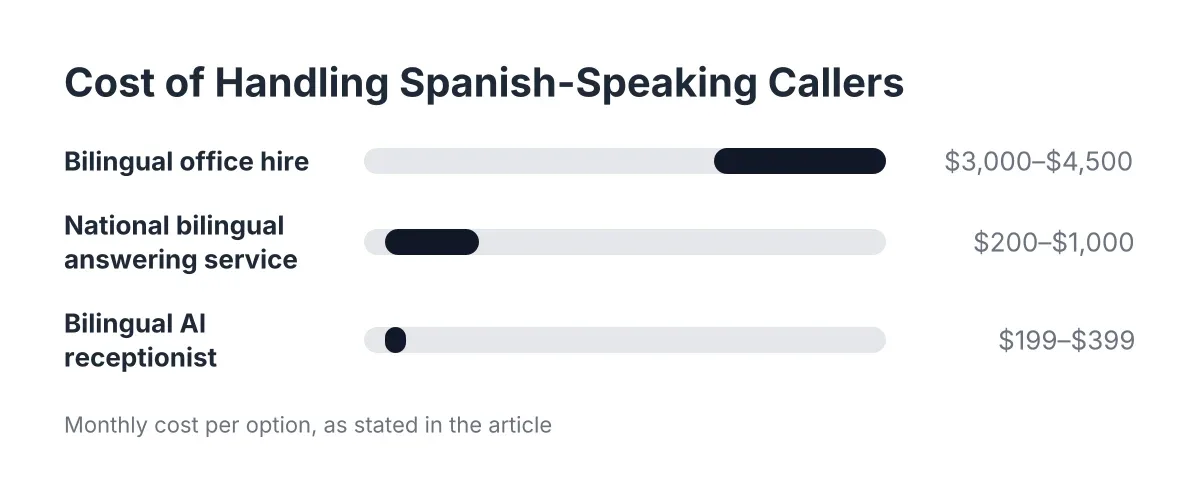
Option 3: Hiring a bilingual office person ($3,000 to $4,500 per month, does not scale to surges)
A dedicated bilingual receptionist is a genuine solution for the steady-state business, and if you are past $500K in revenue with consistent daily volume, it deserves consideration. The problems for a storm-driven or emergency shop are hours and concurrency. One person works about 40 of the week's 168 hours, and a large share of emergency trade calls, pest control especially, come in after hours.
One person also still answers one call at a time. When the freeze hits and 15 burst-pipe calls land in an hour, your $4,000-a-month hire captures one of them and the other 14 roll to voicemail. You pay for full-time coverage and still miss the exact calls the position was created to catch.
Option 4: National bilingual answering services ($200 to $1,000+ per month, generic intake)
National call centers solve the hours problem and usually the language problem. What they do not solve is quality of intake for the trades. Their agents read from generic scripts. They do not know that Cedar Park and Georgetown are in your service area but a Fort Worth caller needs different routing, or that "hail damage on a metal roof" is a different conversation than "shingles in the yard."
For insurance work this matters concretely. A message that says "Maria called about roof damage" is close to useless. You need the address, the carrier, whether a claim number exists, the damage description, and how urgent the tarp situation is. Per-minute pricing also punishes you in the exact weeks you need coverage most; a surge month can triple your bill.
Option 5: A bilingual AI receptionist ($199 to $399 per month, built for concurrency)
An AI receptionist answers every call in English or Spanish, 24/7, and takes unlimited simultaneous calls. That last part is the one that matters most for a storm operator. Concurrency is the single capability no human option offers at any price a 1-to-10-person shop can pay. Thirty callers at once after a hail event all get answered on the first ring, in the language they open with.
Modern AI call handling captures structured intake, qualifies the lead, books the appointment or sends a booking link, and pushes a summary to your phone or CRM. Consumer expectations have caught up too; a Five9 and TEAM LEWIS survey found 84% of consumers already know companies use AI for customer service. The same survey found 75% still prefer talking to a human for support, which is worth taking seriously; the honest framing is that an AI receptionist beats voicemail and busy signals, not that it beats you. It captures the lead so a human, you, calls back fast with full context.
Setting Up Bilingual Call Capture: A Step-by-Step Implementation Plan
You have picked your approach. Here is how to stand it up so it survives contact with a real surge. The steps below assume an AI receptionist, but steps 1, 2, and 5 apply no matter which option you chose.
-
Write your intake script in both languages before you configure anything. Decide exactly what a complete lead looks like for your trade. For a roofer doing insurance work, that means name, phone, property address, insurance carrier, claim status, damage description, and access notes. Do not translate word for word; have a native speaker confirm the Spanish version sounds like a person, not a form.
-
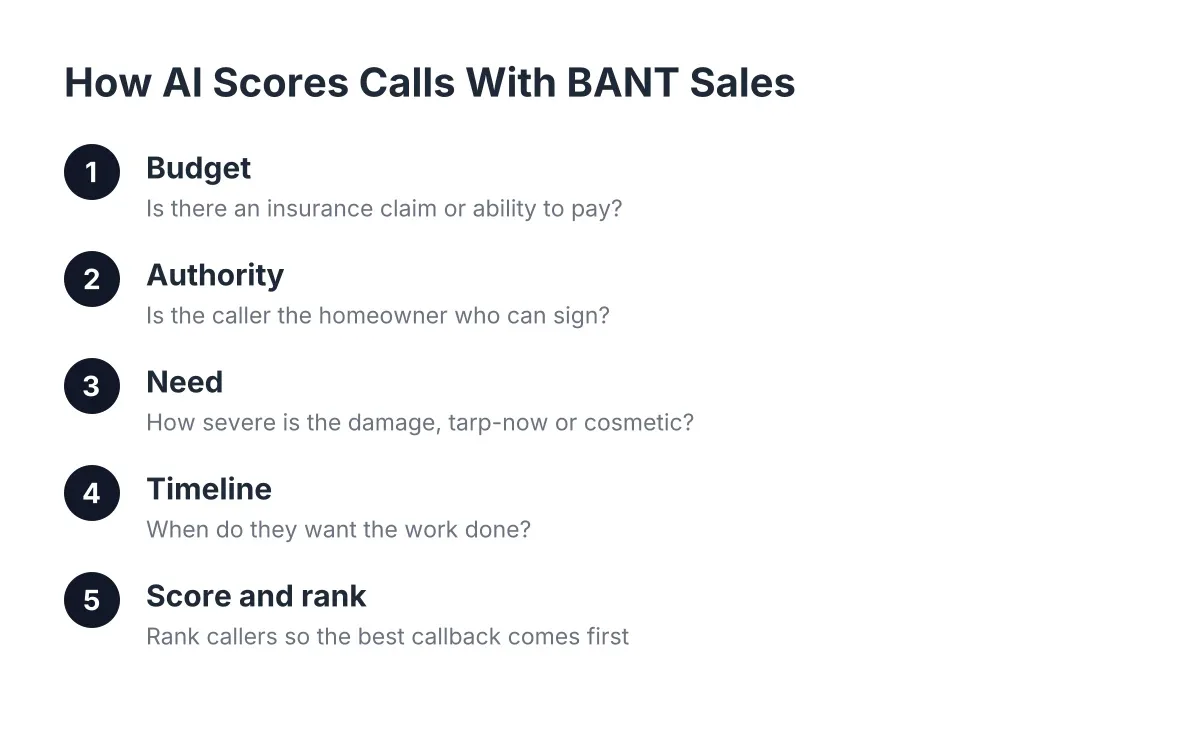
Build a lead qualification checklist and rank the fields. Not every field is equal. Carrier and claim status separate a $7,500 insurance job from a $300 repair estimate. Mark which answers make a lead high-priority so triage is automatic, not a judgment call you make from a ladder.
-
Define your emergency triage rules in writing. List the phrases, in both languages, that should trigger a live transfer to your cell: active leak, ceiling coming down, water near electrical, no heat during a freeze. Everything else gets booked or queued for callback. Opt-in live transfer for urgent calls means the 2 a.m. burst pipe still reaches a human, and the 2 a.m. estimate request does not.
-
Connect intake to wherever your leads live. Webhooks or CRM sync into HubSpot, Zoho, Salesforce, or a Zapier flow means every Spanish-language intake lands in the same pipeline as your English ones, with the summary in English so nothing gets siloed. If you run your business from a spreadsheet, sync to the spreadsheet. The rule is one pipeline, both languages.
-
Test it in Spanish yourself, or draft a bilingual friend. Call your own line and try to stump it. Open in Spanish, switch to English mid-call, describe hail damage in slang, give a Round Rock address and then a Leander one. If your setup cannot survive your own hardest test call, it will not survive a Wednesday morning after a storm. A good local provider will invite this test rather than dodge it.
-
Set your callback discipline. The MIT Sloan and InsideSales.com numbers make the target clear: callbacks inside 5 minutes for high-priority leads whenever you can manage it. One-click call bridging from a dashboard helps here; you see the summary, tap once, and you are talking to the caller with their claim details already in front of you.
Expect setup to take days, not weeks. The script writing in step 1 is the real work; the configuration is the easy part.
How Lead Qualification Works Across Two Languages
A lead qualification framework works in Spanish the same way it works in English: the AI receptionist asks the questions on your checklist, scores the answers, and flags the high-value calls for immediate callback. The language of the call changes nothing about the structure; it only changes the words. That is the whole point of building the checklist before you configure anything.
Lead qualification AI adds a layer a human note-taker cannot match during a surge. Every call gets scored and summarized the same way, whether it is call 3 of the morning or call 73. Human intake quality collapses under volume; the fortieth message of the day is two words and a phone number. Machine intake quality is flat, which is exactly what you want when you are triaging 200 calls for the 25 that are full-scope insurance jobs.
For example, here is an illustrative post-freeze morning for a small Austin plumbing crew. Between 6 and 9 a.m., 41 calls come in; 14 open in Spanish. The AI receptionist answers all 41, captures address, symptom, and urgency on each, and flags nine as active-leak emergencies, three of them from Spanish-speaking callers. The owner works the emergency list top-down by score, in one language of summary, while the rest are booked into afternoon and next-day slots. Setting up systems that deliver great results for Spanish-speaking callers means those leads get identical triage to the English ones, which is the standard to hold any solution to.
One trade-off deserves honesty here. An AI receptionist handles intake, qualification, and booking; it does not close a nervous homeowner on a $15,000 restoration contract, and it should not diagnose a gas smell over the phone. Calls involving possible gas leaks, structural collapse, or electrical fire risk should route to a human or to 911 guidance immediately, and your triage rules in step 3 should say so explicitly.
Keeping Spanish-Speaking Customers After the First Call
Capturing the lead is the start; the recurring customer is the payoff. A Spanish-speaking homeowner whose burst pipe got answered at 2 a.m. in their own language becomes the family that calls you for the water heater next year and refers a cousin in Georgetown the year after. Lifetime value in the trades is built on exactly this kind of trust, and language is a large part of trust.
Therefore, extend the bilingual standard past the first phone call:
- Confirmations and booking links in the caller's language. If the intake happened in Spanish, the text confirmation should not arrive in English.
- Match the callback language. If you are not conversational in Spanish, have your bilingual crew member make the callback for Spanish-opened leads, with the AI summary translated into English so you both know the details.
- Website coverage too. A share of Spanish-speaking customers will hit your site before they call; a bilingual chatbot on the site catches the ones who prefer typing to talking, especially for non-emergency estimates.
- Review the split weekly. A Monday morning report that shows how many calls came in per language, and how many booked, tells you whether your Spanish-language capture rate matches your English one. If it lags, the script needs work, not the market.
In addition, be consistent about where you advertise the capability. "Se habla español" on your truck, your Google profile, and your ads only pays off if the phone actually delivers on it 24/7. The gap between advertising bilingual service and providing it is where reputations get dented in tight-knit communities.
What Happens During the Next Surge If You Do Nothing
Skipping a plan for Spanish-speaking customers calling your shop means conceding the Spanish-speaking share of every future surge to whichever competitor set one up first. The next hail event in Central Texas is a when, not an if, and the 2026 pattern of severe weather plus February freeze risk gives you at least two surge windows a year to win or lose.
Consider what "do nothing" costs in one hypothetical event. Say 300 calls hit your line in 48 hours after a storm sweeps Round Rock. Your current setup answers maybe 60 before voicemail and busy signals take over, and none of your intake works in Spanish. If a third of those 300 callers preferred Spanish, nearly all of them are gone within one ring of hitting your voicemail. At even a 15% close rate on $7,500 jobs, the Spanish-language calls alone were an $80,000 to $100,000 pool you never entered.
The operators who win surge markets share one trait: every call gets answered, first ring, in the caller's language, with intake detailed enough to move an insurance claim forward the same day. That standard used to require a staffed office. It no longer does. Whether you get there with a bilingual hire, a hybrid of forwarding plus AI, or a full AI receptionist depends on your volume and budget, but the standard itself is now the price of competing in this market.
Set it up before the sky turns green, test it in both languages, and the next storm becomes the best two weeks of your year instead of the most frustrating.
If you're losing revenue to missed calls, NeverMiss ATX can help.
Prefer to talk it through? Call (512) 980-9267 — a quick call is usually the fastest way to get a straight answer for your situation.