BANT Sales for Trades: How AI Call Scoring Finds Your $7,500 Jobs First
Ask any roofer in Central Texas what happens after a hail storm and you will hear the same story. The phone lights up, every line at once, and somewhere in that flood of calls sits a year's worth of insurance jobs. The problem is not answering the phone. Additionally, the problem is knowing which caller is a $7,500 insurance claim ready to move and which one is a tire-kicker asking about a gutter guard. That is a lead qualification problem, and the classic answer to it is BANT sales, a framework big companies have used for decades to sort serious buyers from window shoppers. The twist for 2026 is that AI call scoring can now run that same qualification on every inbound call automatically, while you are still on a roof in Pflugerville.
This guide walks through what BANT actually is in plain trade language, why it matters most during a storm surge, and how AI call intelligence applies it to your phone line so the highest-value leads rise to the top of your callback list. No corporate jargon, no theory you cannot use Monday morning.
The Real Problem: Every Call Sounds the Same When You Cannot Answer Any of Them
Suppose a hail storm rolls through Round Rock on a Tuesday evening. By Wednesday morning, a typical roofing or restoration operator sees call volume spike 300 to 400 percent in 48 hours. If you run a crew of three, you physically cannot answer that. So calls go to voicemail, and voicemail after a storm is where insurance jobs go to die.
Here is what makes it worse. The caller with a full roof replacement claim and a State Farm adjuster already assigned sounds exactly like the caller who wants a free inspection "just to check." Both leave a 20-second voicemail. Both say "hail damage." You have no way to tell them apart until you call back, and by then the serious one has already booked with the competitor who picked up.
The numbers on speed are brutal. According to MIT Sloan School of Management / InsideSales.com, the odds of contacting a lead drop 100-fold, and the odds of qualifying that lead drop 21-fold, when the callback happens at 30 minutes instead of within 5 minutes. Post-storm, 30 minutes is a fantasy. Most solo and small-crew operators are calling voicemails back at 9 p.m., twelve hours late.
So the real job is not "answer more calls." It is answer every call, pull the qualifying details out of each one, and rank them so your first callback is your best callback. That is exactly what the BANT framework was built to do.
What Is BANT Sales, in Plain Trade Language?
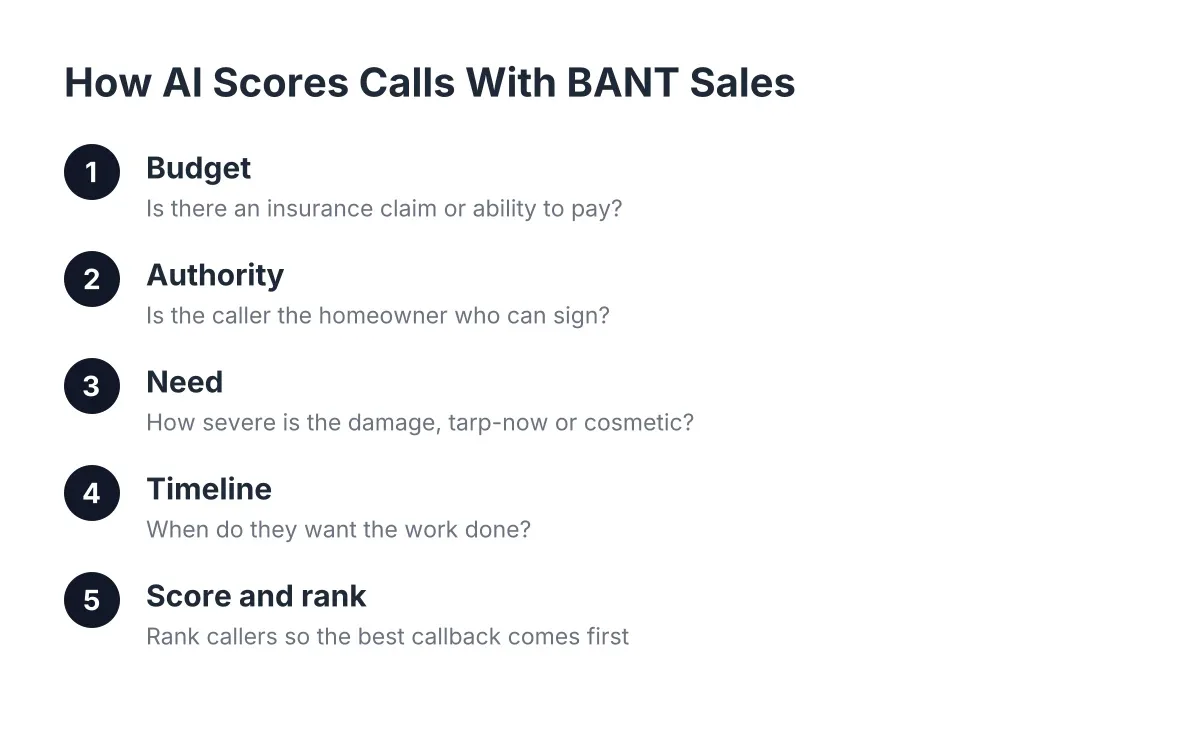
BANT sales is a lead qualification method that scores a prospect on four things: Budget, Authority, Need, and Timeline. IBM developed it decades ago, and sales teams still use the BANT sales framework because it answers one question fast: is this person likely to buy, and how soon? For a trade business, it separates the booked job from the endless "maybe."
Here is what each letter means when the caller is a homeowner in Georgetown, not a Fortune 500 procurement office:
- Budget: Can they pay? For storm work, this usually means: is there an insurance claim? A caller who says "my adjuster comes Thursday" has budget. A caller asking "what would something like this run?" may not, yet.
- Authority: Are they the decision-maker? The homeowner who owns the property can sign a contract. A renter, a house-sitter, or one spouse who "needs to check with" the other cannot, at least not today.
- Need: How bad is the damage? A tarp-now, water-coming-in situation is a different lead than cosmetic dings on a metal carport.
- Timeline: When do they want the work done? "The adjuster meeting is Friday and I need a contractor there" is a this-week job. "Sometime this spring, probably" is a follow-up list entry.
A caller who is strong on all four is a hot lead. A caller strong on two is worth a callback tomorrow. Furthermore, a caller strong on none goes on the drip list. That ranking is the entire value of the BANT sales method, and it is why national sales teams have run on it for fifty years.
Why BANT Beats Gut Feel During a Storm Surge
Gut feel works fine when you get eight calls a week. It collapses when you get eighty calls in two days. Under surge pressure, most operators call back in the order voicemails arrived, which means the 7 a.m. tire-kicker gets your energy before the 2 p.m. full-replacement claim. First-in, first-out is fair; it is also how you lose the market opportunity a storm hands you.
BANT gives you a triage system instead. Restoration crews already think this way about damage: you tarp the active leak before you quote the fence. Applying the same triage logic to your call list is the single highest-leverage change a storm-driven operator can make, and it costs nothing but discipline.
The catch, of course, is that BANT only works if someone actually asks the questions. Which brings us to the real bottleneck.
The Bottleneck: You Cannot Run BANT Questions From a Ladder
Knowing the framework is easy. Running it on every inbound call is the hard part, because BANT qualification requires a conversation. Somebody has to ask "Do you have a claim number yet?" and "Are you the homeowner?" and "When is the adjuster scheduled?"Notably, and write the answers down accurately enough to act on.
For a one-to-eight-person shop, your options have always looked like this:
- Answer everything yourself. Impossible during a surge, and dangerous on a roof. You also interrupt paid work to take unpaid calls.
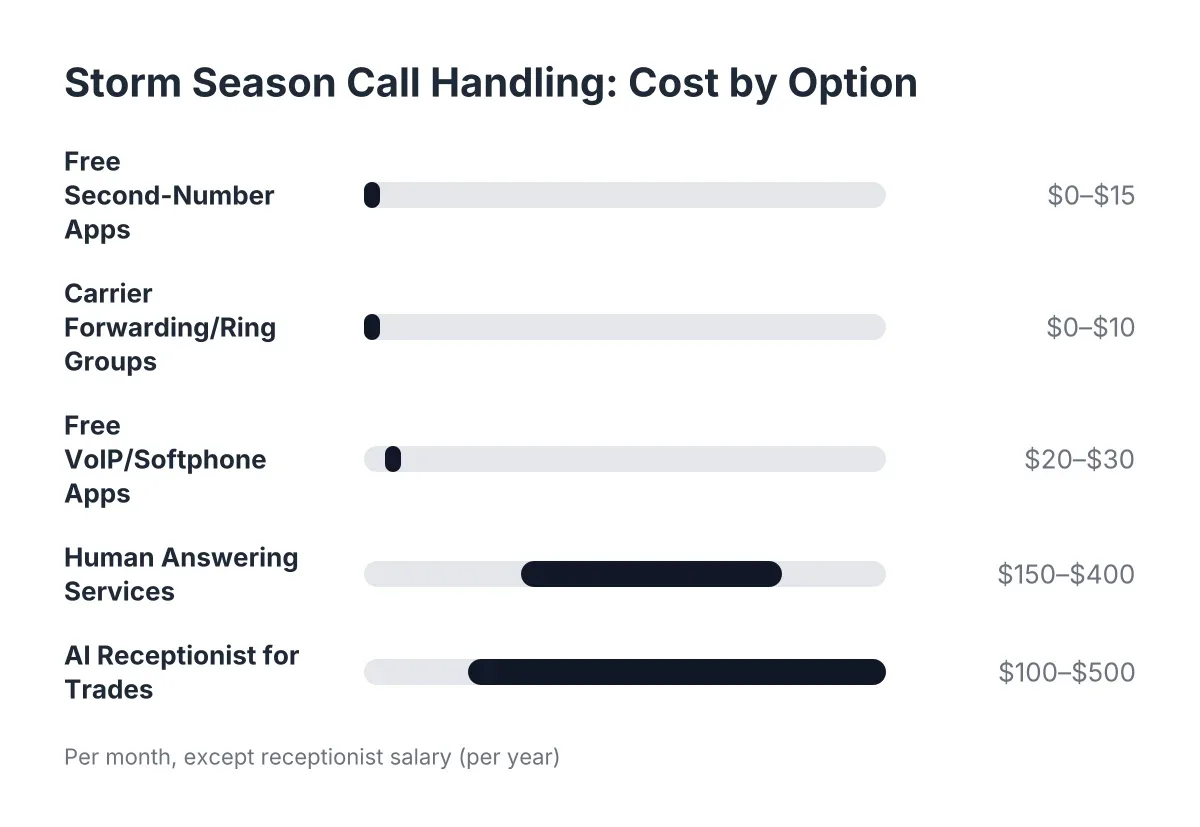
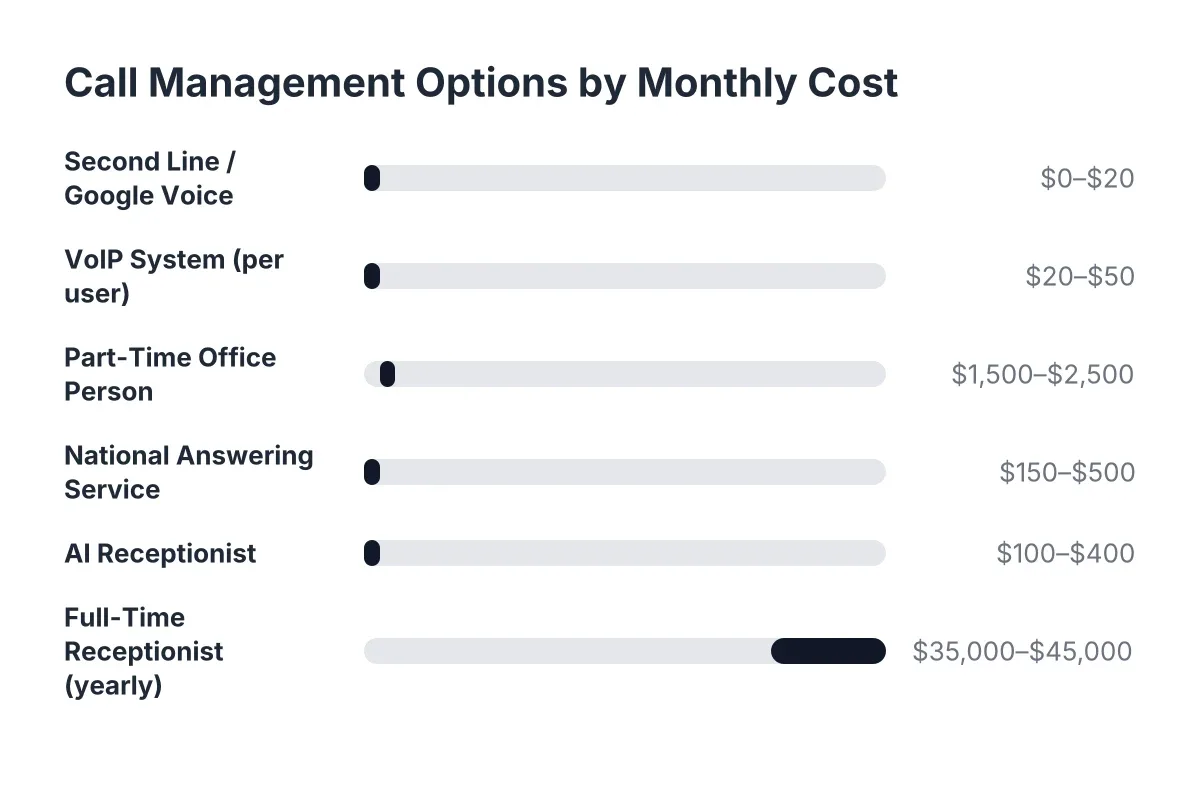
- Hire an office person. A full-time hire runs roughly $35,000 to $45,000 a year in Central Texas as an illustrative estimate, and storm surges do not respect a 9-to-5 schedule. The 8 p.m. Sunday call after a hail event still hits voicemail.
- Use a national answering service. They answer, but most take a name and number and stop there. A generic operator in another state does not know that "hail damage in Cedar Park" plus "adjuster Thursday" equals drop-everything, and they rarely capture claim details with any consistency.
- Let voicemail catch overflow. After a storm, industry lore and every roofer's lived experience agree: a large share of callers who hit voicemail simply dial the next company on the list.
None of these run BANT sales qualification on every call. The first two do not scale to surge volume. The second two scale but do not qualify. This gap in small business call management is exactly where AI call scoring earns its keep, and it is worth understanding how it actually works before you trust it with insurance-grade leads.
How AI Call Scoring Applies the BANT Sales Framework Automatically
AI call scoring works by having an AI receptionist hold a natural conversation with every caller, ask the qualifying questions a trained office manager would ask, then score and summarize the call so the owner sees ranked leads instead of raw voicemails. In effect, it runs the BANT sales process on 100 percent of inbound calls, simultaneously, at 2 a.m. or 2 p.m.
Here is the sequence on a real inbound call:
- The call gets answered on the first ring, every time. No busy signal, no voicemail, no hold queue, because an AI receptionist handles unlimited simultaneous calls. Forty callers at once after a hail event all get a live answer.
- The AI asks the qualifying questions. What happened, where, are you the property owner, is there an insurance claim open, do you have a claim number, when does the adjuster come, is water actively getting in. These map directly onto Budget, Authority, Need, and Timeline.
- The AI captures the answers as structured lead data. Not a scribbled note; actual fields. Address, damage type, claim status, urgency, callback window. That structure is what makes claim intake usable when you finally sit down at 8 p.m.
- Each call gets a score and a summary. A caller with an open claim, homeowner authority, active leak, and a Friday adjuster meeting scores at the top. A "just curious about pricing" call scores lower. You open your dashboard and the list is already sorted by value.
- Urgent calls can transfer live. For the genuine emergencies, water pouring through a ceiling, an opt-in live transfer puts the caller through to you or your crew lead immediately instead of waiting in a queue.
The practical result: your first callback of the day is your highest-value lead, not your oldest voicemail. Given the MIT Sloan / InsideSales.com finding that qualification odds fall 21-fold between a 5-minute and 30-minute response, answering instantly and ranking accurately is the difference between winning the surge and watching a competitor win it.
What a Scored Storm Day Looks Like
Say a severe hail cell hits Leander on a Saturday afternoon. In that hypothetical scenario, a two-crew roofing operation gets 63 calls between 4 p.m. Saturday and noon Sunday. Every call gets answered. By Sunday morning the owner's dashboard shows something like this, as an illustrative breakdown:
- 11 callers with open or imminent insurance claims, homeowner on the line, adjuster dates within the week. These are the estimated $7,500-average jobs. Top of the list.
- 19 homeowners with confirmed damage but no claim filed yet. Warm; they need guidance on the claims process, which is itself a booking opportunity.
- 24 callers wanting an inspection "to be safe." Real leads, lower urgency, booked into next week's inspection slots automatically.
- 9 out-of-area, spam, or non-fit calls, flagged and filtered out.
The owner spends Sunday morning making 11 phone calls instead of 63. One click from the dashboard bridges each call, no digging for numbers. That is surge capacity without a single hire, and it is the difference between capturing the storm's market opportunity and drowning in it. In addition, several of those 63 callers in a Central Texas market will prefer Spanish; a bilingual AI receptionist qualifies those callers with the same BANT questions in their language, so those leads score alongside everyone else instead of hanging up.
Where BANT Scoring Falls Short, and What to Do About It
No qualification framework is perfect, and honest operators should know the edges. BANT was designed for corporate sales cycles, so a few of its assumptions bend when the buyer is a homeowner with a hole in their roof.
First, Budget is fuzzy in insurance work. A homeowner may not know their deductible, their coverage limits, or whether their policy covers cosmetic hail damage until the adjuster rules. A strict BANT score would downgrade them; a smart one treats "claim filed, adjuster pending" as budget-probable and keeps them high on the list. Good AI call scoring is tuned for this trade reality rather than a textbook BANT sales technique.
Second, Authority gets complicated with landlords, property managers, and HOAs. The caller reporting the damage may not sign the contract. The fix is capturing both contacts during the call, which structured lead capture handles and a rushed voicemail never does.
Third, some sales teams argue frameworks like MEDDIC beat BANT for long, complex deals. That debate matters for enterprise software; it does not matter for a roof. For a trade business with a two-week sales cycle, BANT's four questions cover what you need, and anything heavier just slows down claim intake.
Finally, AI scoring ranks leads; it does not close them. The inspection, the adjuster meeting, the handshake on the driveway, that is still you, and it should be. The technology answers and qualifies so the human relationship starts warmer, not so it disappears. For complex claim disputes or coverage questions, callers should still talk to their insurance carrier or a licensed public adjuster; no receptionist, human or AI, should be interpreting policy language.
Common Questions About Call Scoring and Qualification
Can an AI Receptionist Really Capture Insurance Details Accurately?
An AI receptionist captures insurance details more consistently than a rushed human because it asks the same structured questions on every call and records answers as fields, not memory. Claim numbers, carrier names, adjuster dates, and damage descriptions land in a summary you can read in 30 seconds.
Consistency is the underrated part. A human answering call 40 of the day skips questions; software does not. Every summary includes the same claim intake fields, so nothing depends on whether the person answering remembered to ask. Skepticism here is reasonable, which is why the honest test is empirical: call the line yourself, describe a fake hail claim, and read the summary it produces. If the details are wrong, you have your answer in five minutes.
Do Callers Hang Up When AI Answers?
Most callers stay on the line when the AI answers naturally and gets them help fast, because the alternative they fear is voicemail, not conversation. Awareness of AI answering is already mainstream; according to Five9, 84 percent of consumers know some companies use AI for customer service interactions.
That said, preference for humans is real. The same Five9 research found 75 percent of consumers prefer talking to a real person for support. The practical read for a storm operator: AI answering is not competing with your personal touch, it is competing with your voicemail. A caller with active roof damage would rather give details to an AI that books an inspection than leave a message and start dialing your competitor. Live transfer for genuine emergencies covers the cases where a human voice matters immediately.
Does This Replace Hiring, or Change What You Hire For?
AI call scoring changes what you hire for rather than cutting jobs. According to the National Federation of Independent Business (NFIB), 98 percent of small employers using AI report no change in employee headcount. The same NFIB survey found only 24 percent of small employers use AI tools at all, which means the storm operator who adopts call scoring in 2026 is still ahead of three quarters of the field.
In practice, owners who stop losing evenings to voicemail triage put those hours into estimates, adjuster meetings, and crew management. If you eventually hire office help, that person starts each day with a scored, summarized lead list instead of a full voicemail box. The hire gets more valuable, not obsolete.
Putting BANT Sales Scoring to Work Before the Next Storm
The worst time to build surge capacity is 48 hours after the hail hits, when every roofer in Travis and Williamson counties is scrambling for the same market share. The operators who win storm seasons set up their qualification system in the quiet weeks, then let it run.
Here is a practical pre-storm checklist for a one-to-ten-person trade shop:
- Write down your own BANT questions. What five things do you need to know to prioritize a callback? Claim status, ownership, damage severity, adjuster date, and address is a strong start.
- Get every call answered live, 24/7. Storm calls do not respect business hours, and after-hours callers are often the most motivated. An AI receptionist gives you first-ring answering without a payroll line.
- Make sure answers become structured data. A summary you can scan in 30 seconds beats a voicemail you have to replay twice. Push leads into your CRM through webhooks or Zapier so nothing lives only in your head.
- Set your emergency rules in advance. Decide now which situations trigger a live transfer to your cell, so triage happens automatically during the chaos.
- Test it before the season. Call your own line, play the difficult customer, mix in Spanish, and try to stump it. If it holds up under your worst caller impression, it will hold up under a storm.
The framework is old; the leverage is new. BANT told sales teams what to ask for fifty years. AI call scoring means a solo operator in Austin can now ask it on every single call, at any hour, in English or Spanish, while standing on a roof. The storms will keep coming. The question is whether your phone system sorts the $7,500 claims to the top of your list, or leaves them buried in voicemail for the next company to find.
If you're losing revenue to missed calls, NeverMiss ATX can help.
Prefer to talk it through? Call (512) 980-9267 — a quick call is usually the fastest way to get a straight answer for your situation.