Small Business Call Management Terms Explained: A Plain-English Glossary
If you run a home service business and you've started shopping for help with your phones, you've probably hit a wall of jargon: live transfer, IVR, webhooks, per-minute billing. This small business call management glossary breaks down the terms you'll see in quotes and sales pages, in plain English. Use it to read a proposal line by line, ask sharper questions, and spot the difference between a service that captures leads and one that just takes messages. Every entry here is written so you can understand it in under thirty seconds, even if you're reading it on a ladder between jobs.
- AI Receptionist
- Answering Service
- After-Hours Answering
- Missed Calls
- Live Transfer
- Call Bridging
- Bilingual Support
- Lead Capture
- Lead Qualification
- Call Scoring
- Booking Link
- Recurring Customer
- Call Summary
- IVR (Interactive Voice Response)
- Webhook
- CRM Sync
- Website Chatbot
- Per-Minute Billing
- Onboarding
Answering and Reception Terms
AI Receptionist
An AI receptionist is software that answers your business phone, talks with callers in natural language, and handles tasks like lead capture and booking without a human on the line. Unlike voicemail, it holds a real conversation: it can ask what the caller needs, collect their details, and send them a booking link. For a trades business, this means the 2 p.m. call that comes in while you're under a sink still gets answered, qualified, and booked. If a provider says "AI receptionist," ask whether it works 24/7 and whether it can handle callers in more than one language.
Answering Service
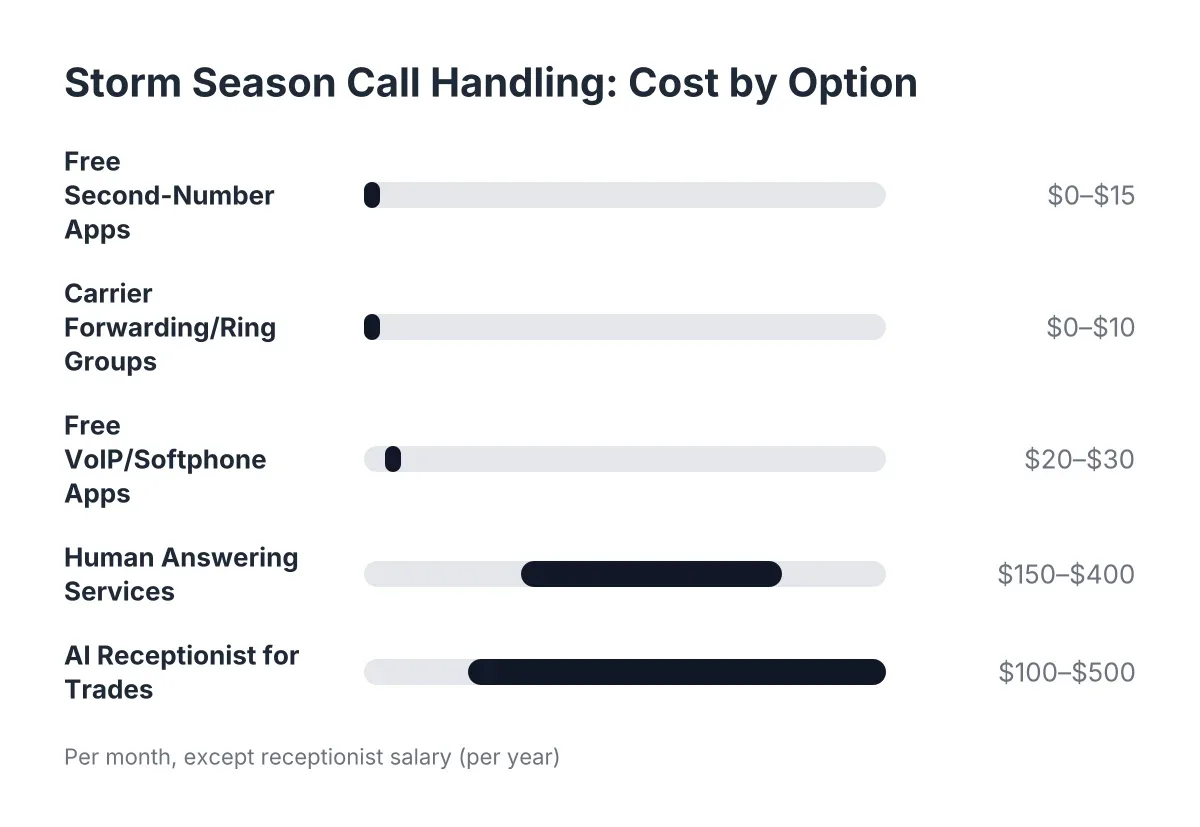
An answering service is a company that picks up your calls when you can't, traditionally using human operators at a call center. National answering services usually charge by the minute and read from a script, which can feel generic to callers who expect someone familiar with their area. Modern alternatives use an AI receptionist instead, which answers instantly and doesn't put callers on hold during busy hours. When comparing quotes, ask whether the people or software answering your phone know anything about your trade and your market.
After-Hours Answering
After-hours answering means your calls get picked up outside normal business hours, including nights, weekends, and holidays. This matters in the trades because burst pipes and dead AC units don't wait for Monday. A caller with an emergency at 11 p.m. will usually dial the next company on the list if the first one goes to voicemail. If a provider charges extra for after-hours coverage, that's a scope question worth pinning down before you sign, since some services include 24/7 answering on every plan.
Missed Calls
A missed call is any inbound call your business doesn't answer live, whether it goes to voicemail or just rings out. In home services, a missed call often means a lost job, because many callers won't leave a message; they call your competitor instead. Most call management services exist to shrink this number to zero. When a provider quotes you, ask how they handle overflow: what happens when two calls come in at once, or when a call arrives at 3 a.m.
Live Transfer
A live transfer is when the person or system answering your phone connects the caller directly to you in real time, instead of taking a message. It's most useful for genuine emergencies, like a flooded kitchen, where the customer needs to hear your voice now. Good services make live transfer opt-in, so you decide which situations are urgent enough to interrupt you on site. Ask a provider how their system decides what counts as an emergency, because bad triage means either missed emergencies or constant interruptions.
Call Bridging
Call bridging means connecting two phone lines together through a system, so you can call a lead back with one click from a dashboard instead of dialing manually. In practice, you see a new lead come in, tap a button, and the system rings your phone and the lead's phone and joins them. It sounds like a small convenience, but calling a fresh lead back within minutes instead of hours is often the difference between winning and losing the job.
Bilingual Support
Bilingual support means your calls get answered in more than one language, most commonly English and Spanish. In Central Texas, a Spanish-speaking homeowner who reaches an English-only line often hangs up and keeps dialing. If bilingual answering matters for your customer base, confirm whether it's included on every plan or sold as an add-on, and whether the system switches languages naturally mid-call.
Leads, Booking, and How Call Management Handles Follow-Up
Lead Capture
Lead capture means collecting a caller's name, contact information, and job details so you can follow up and win the work. It's the core job of any call management service: a call that gets answered but produces no callable lead didn't help you. Strong lead capture happens on every channel, phone and website chat alike, and lands somewhere you'll actually see it. Ask a provider exactly what information they collect on a typical call and where it goes afterward.
Lead Qualification
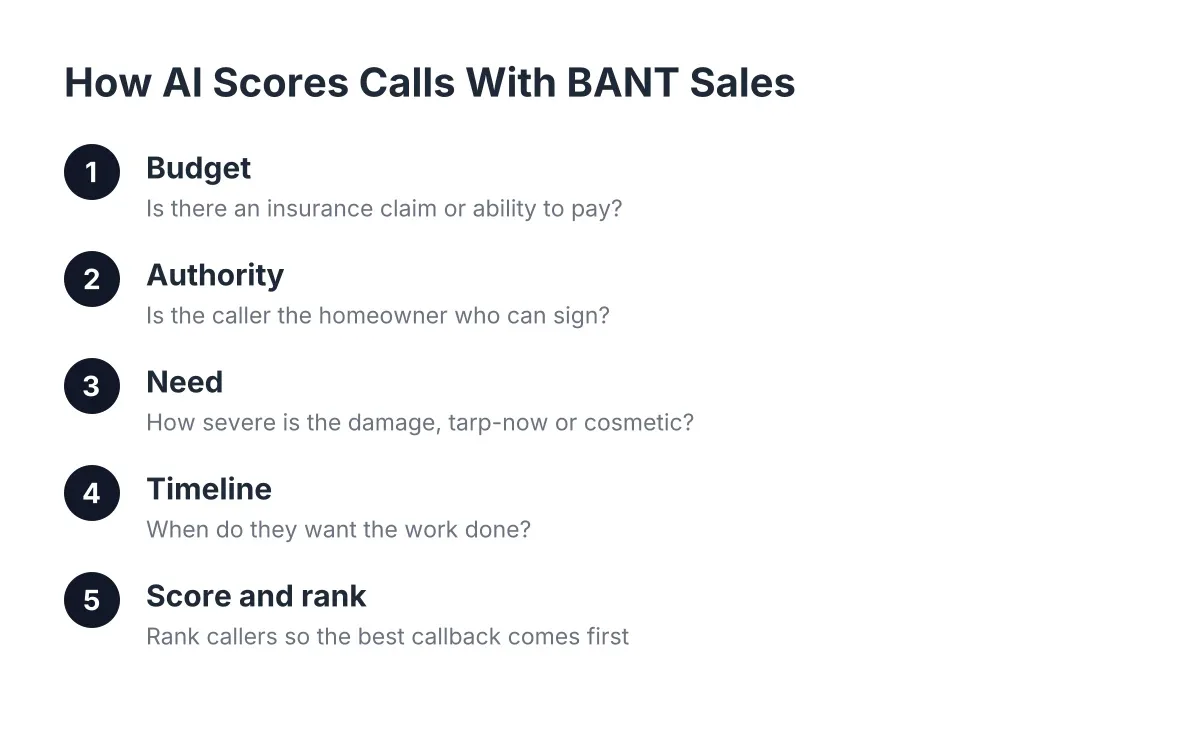
Lead qualification means sorting callers by how likely they are to become paying customers, based on questions asked during the call. A qualified lead has told you what they need, where they are, and how urgent the job is, so you know whether to call back first or last. Without qualification, every message in your inbox looks the same, and you waste callbacks on tire-kickers while a ready-to-book customer waits. A service that qualifies leads is doing more than answering; it's triaging your pipeline for you.
Call Scoring
Call scoring means rating each call, usually automatically, on how valuable the lead is or how well the call went. AI call intelligence can score and summarize every conversation, so you can scan a list and see which callbacks matter most. For a busy owner, this turns twenty voicemail-length recordings into a ranked list you can act on in five minutes. Ask whether scoring comes with a written summary, because a score without context still makes you listen to the recording.
Booking Link
A booking link is a web link, usually sent by text, that lets a caller pick an appointment time from your real availability. Instead of phone tag, the customer books themselves while the conversation is still fresh. This is how an AI receptionist gets jobs booked without you touching your phone: the caller gets qualified, receives the link, and picks a slot. If a provider mentions booking link delivery, ask whether it connects to the calendar you already use.
Recurring Customer
A recurring customer is one who comes back for repeat work, like seasonal AC tune-ups or annual plumbing inspections, instead of hiring you once and disappearing. Recurring customers are where the real money in the trades lives, because you earn their business once and keep it for years. Every well-handled call in a small business call management system raises the odds a first-time caller becomes one. When you weigh the cost of small business call management, measure it against the lifetime value of the customers it captures, not just the first ticket.
Call Summary
A call summary is a short written recap of what happened on a call: who called, what they needed, and what happens next. Summaries let you skip listening to recordings and still know everything that matters. Some services also bundle summaries into a regular digest, like a weekly Monday morning report, so you start the week knowing exactly what came in. Ask how fast summaries arrive after each call; a summary you get Friday about Tuesday's emergency isn't much use.
Technology and Integrations
IVR (Interactive Voice Response)
IVR means the automated phone menu that tells callers to "press 1 for service, press 2 for billing." It routes calls by keypad or simple voice commands, but it doesn't hold a conversation or capture lead details on its own. Many callers hate menus and hang up before reaching a person. An AI receptionist is different: it talks with the caller instead of making them navigate a tree. If a quote mentions IVR, ask whether it's the whole product or just the front door to something smarter.
Webhook
A webhook is an automatic message one piece of software sends to another the moment something happens, like a new lead coming in. In call management, webhooks push a fresh lead straight into your CRM or notification tools the second the call ends, with no copying and pasting. You don't need to understand the plumbing; you just need to know the lead shows up where you work. Ask a provider which tools their webhooks connect to before assuming yours is on the list.
CRM Sync
CRM sync means your call management system automatically sends lead details into your customer relationship management software, the database where you track customers and jobs. Common connections run through tools like Zapier or directly into platforms like HubSpot, Salesforce, or Zoho. Without sync, someone has to retype every lead by hand, and hand-typed leads get lost. If you already use a CRM, make sync a dealbreaker question, not an afterthought.
Website Chatbot
A website chatbot is an automated chat window on your site that greets visitors, answers questions, and captures their contact details. It catches the customers who research at midnight and would rather type than call. A good one does the same job as your phone line: engage, capture the lead, and deliver a booking link. If your website currently just sits there, a chatbot turns it into a second intake channel that never sleeps.
Pricing and Plans
Per-Minute Billing
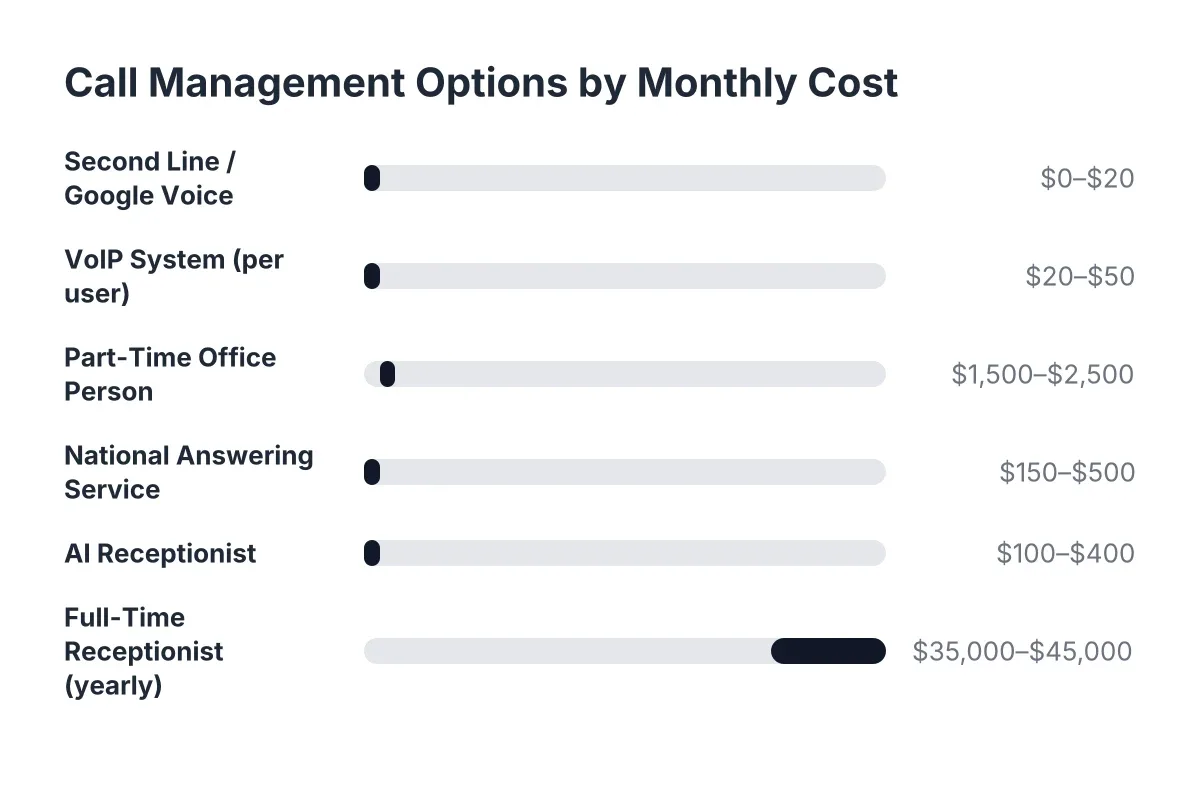
Per-minute billing means you pay for every minute an operator or system spends on your calls, which is the standard model for traditional call centers. It sounds cheap until a chatty month arrives and your bill doubles. Flat-rate plans trade that uncertainty for a predictable monthly cost. Before signing anything, ask for a realistic monthly estimate based on your call volume, and read this guide to small business call management cost guide so you know what a fair quote looks like.
Onboarding
Onboarding is the setup process that gets a call management service answering your phones correctly, including your services, service area, pricing rules, and scheduling. This is where you should probe hardest, because a service is only as good as what it knows about your business. Ask how long setup takes, who does the work, and how you make changes later, like adding a new service or updating your hours. Simple onboarding is a sign the provider built the product for owners, not IT departments.
Using These Terms
You now have enough of this small business call management glossary in your head to read any quote line by line and ask the questions that matter: is it 24/7, is bilingual included, where do my leads land, and what does a busy month cost. If a provider can't answer plainly, that tells you something too. And if you want to test an AI receptionist for yourself, call one and try to stump it; you'll learn more in three minutes than any sales page can tell you.
If you're losing revenue to missed calls, NeverMiss ATX can help.
Prefer to talk it through? Call (512) 980-9267 — a quick call is usually the fastest way to get a straight answer for your situation.