Free Phone Apps vs. Business-Grade Call Management: What Storm-Season Trades Need
When a hail storm rolls through Cedar Park at 6 p.m. on a Tuesday, your phone becomes the most valuable tool in your business. The question a lot of roofing and restoration owners ask is whether free phone apps or business-grade storm season call handling will hold up when 80 homeowners call in the same hour. This article ranks every real option, from free call-forwarding tricks to a full AI receptionist, by cost and by how each one performs during a post-storm surge.
Here is the honest framing up front. Free apps are built for one conversation at a time. Storm work is built on hundreds of conversations in 48 hours, each one worth an average of $7,500 in insurance work. The gap between those two realities is where jobs get lost. Below are eight options, ordered roughly from cheapest to most capable, with a straight assessment of where each one fits a one-to-ten-person Central Texas crew.
1. Your Personal Cell With Smart Voicemail (Free)
The baseline setup is your existing cell phone with a rewritten voicemail greeting. It costs nothing, and a better greeting genuinely helps: state your business name, ask callers to leave their address, describe the damage, and say whether they have filed an insurance claim yet.
However, voicemail is where storm leads go to die. After a weather event, homeowners are calling five companies down a Google list. The one that answers wins; the four that go to voicemail rarely get a callback opportunity. According to a foundational study by MIT Sloan School of Management / InsideSales.com, the odds of contacting a lead drop 100-fold when the callback happens at 30 minutes instead of within 5 minutes. In a surge, 30 minutes is optimistic.
Best for: A solo operator in the slow season who can answer most calls live. Fails when: Any simultaneous call volume hits, which is the whole storm business.
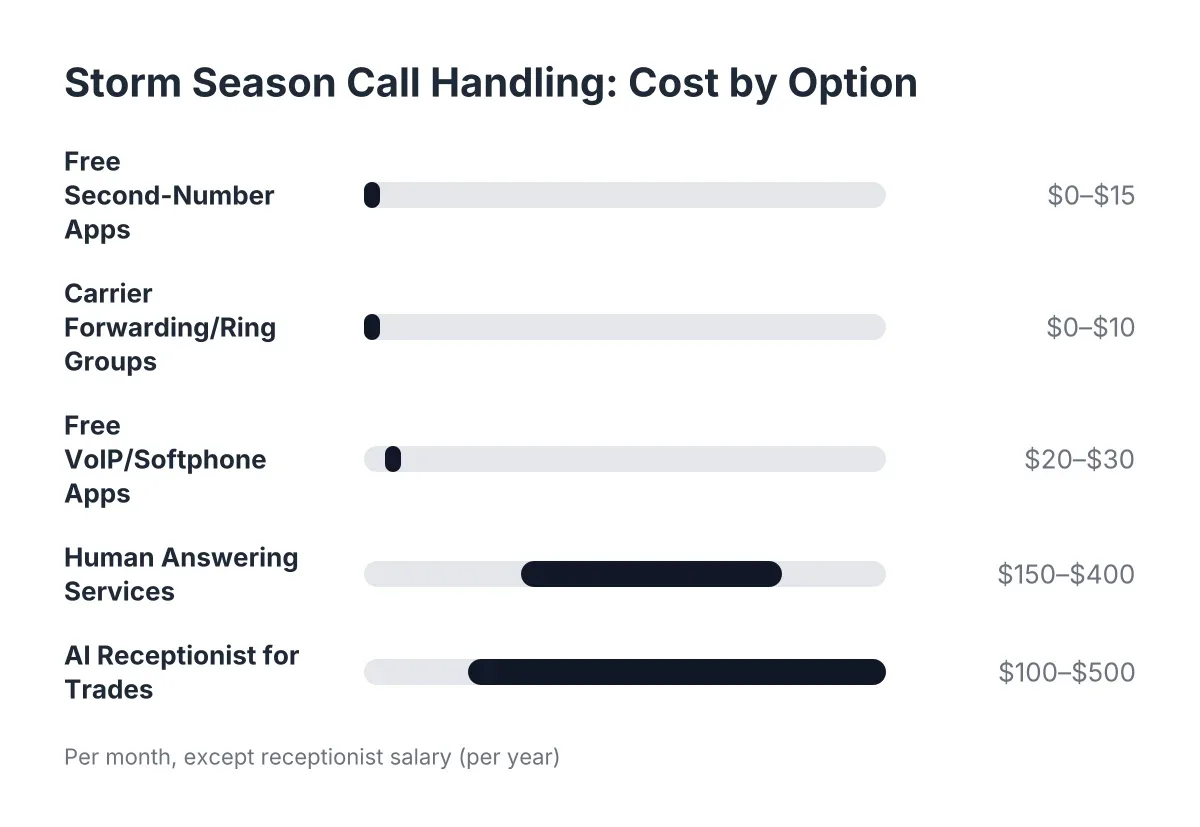
2. Free Second-Number Apps (Free to $15/month)
Second-number apps give you a separate business line on your personal phone. You keep your personal number private, you can set business hours, and some apps offer basic auto-replies to missed calls. For a new operation that just needs to look professional on a yard sign, this is a reasonable first step.
The limitation is structural, not a missing feature. These apps still ring one phone, held by one person, who is usually on a roof. They handle one call at a time, and their voicemail transcription cannot ask a homeowner follow-up questions about hail size, roof age, or claim status. Free phone apps and business-grade systems split exactly here: apps receive calls, systems work them.
Best for: Separating personal and business lines cheaply. Fails when: You need anyone or anything to actually answer while you are on site.
3. Carrier Call Forwarding and Ring Groups (Free to $10/month)
Most carriers let you forward calls to another number, or ring two or three phones at once. Suppose you run a four-person restoration crew in Round Rock; you could ring your phone and your lead tech's phone simultaneously, doubling the odds someone picks up. Setup takes ten minutes with carrier codes or a quick call to support.
That said, forwarding only redistributes the problem. Both phones can be mid-job, mid-drive, or mid-crawlspace at the same moment. During a surge, simultaneous forwarding means two people ignoring the same ring instead of one. There is no queue, no message capture beyond voicemail, and no record of what the caller needed.
Best for: Small crews smoothing out normal-day coverage. Fails when: Call volume exceeds the number of free hands, which post-storm it always does.
4. Free VoIP and Softphone Apps (Free tier, $20 to $30/month paid)
Free VoIP tiers add real phone-system features: an auto-attendant menu, extensions, business texting, and desktop apps. For a shop with an office lead, this starts to resemble a phone system. Callers can press 1 for new damage inspections and 2 for existing jobs, which triages traffic before a human touches it.
Even so, the free tiers cap users, minutes, or both, and the auto-attendant only routes calls; it does not answer them. A homeowner with a tarp-worthy roof leak who presses 1 and reaches voicemail is still a missed call, just a better-organized one. Paid tiers fix the caps but not the fundamental issue: someone still has to pick up.
5. Business-Grade Call Handling for Storm Season
Business-grade call management means the system itself answers, captures the lead, and moves it forward without waiting on a person. The dividing line between free phone apps and systems built for effective storm season call handling is not price; it is whether a call that nobody can physically answer still turns into a booked inspection with damage details and insurance status attached.
A business-grade setup for a storm-driven trade should handle these things without you touching your phone:
- Unlimited simultaneous answering, so caller 40 gets the same pickup as caller 1
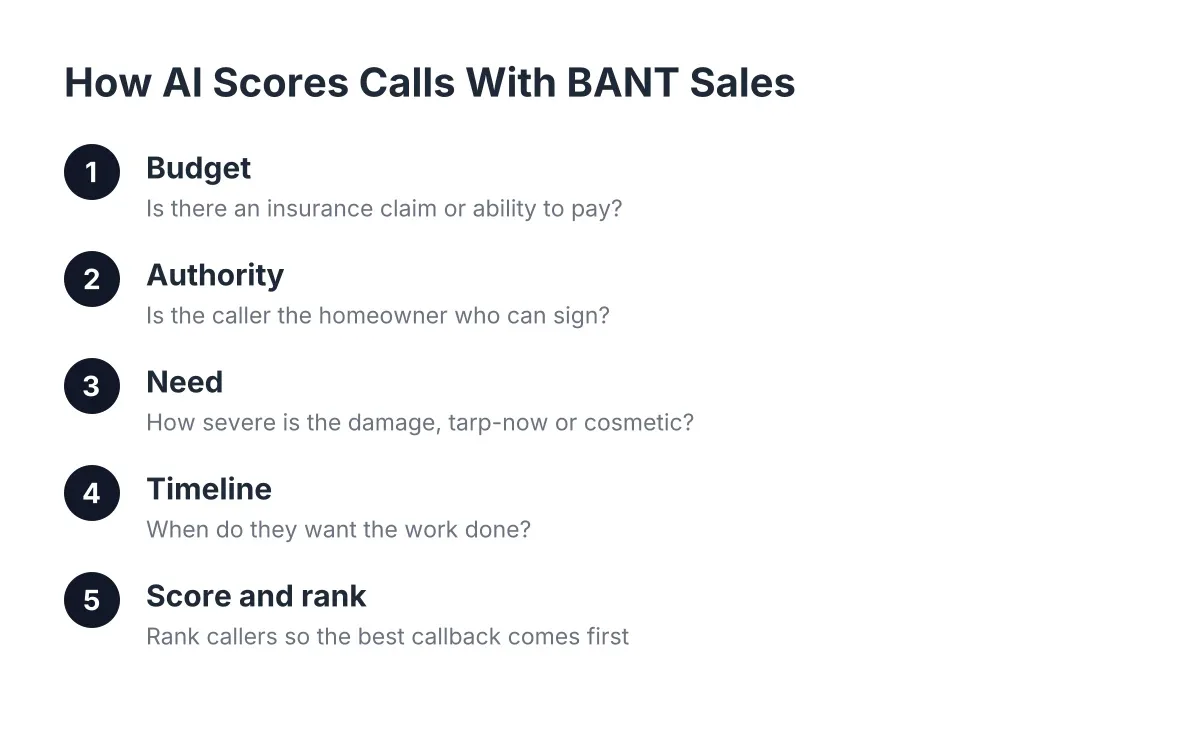
- Structured claim intake, capturing address, damage type, roof age, and whether an insurance claim is open
- Lead scoring, so a full roof replacement with an open claim outranks a gutter question
- Booking, sending the homeowner an inspection slot instead of a promise to call back
- Bilingual answering, because a meaningful share of Central Texas homeowners will explain hail damage in Spanish
- After-hours coverage, since storms do not respect business hours
Measure any option, free or paid, against that list. Most free phone apps check zero boxes; business-grade systems should check all six.
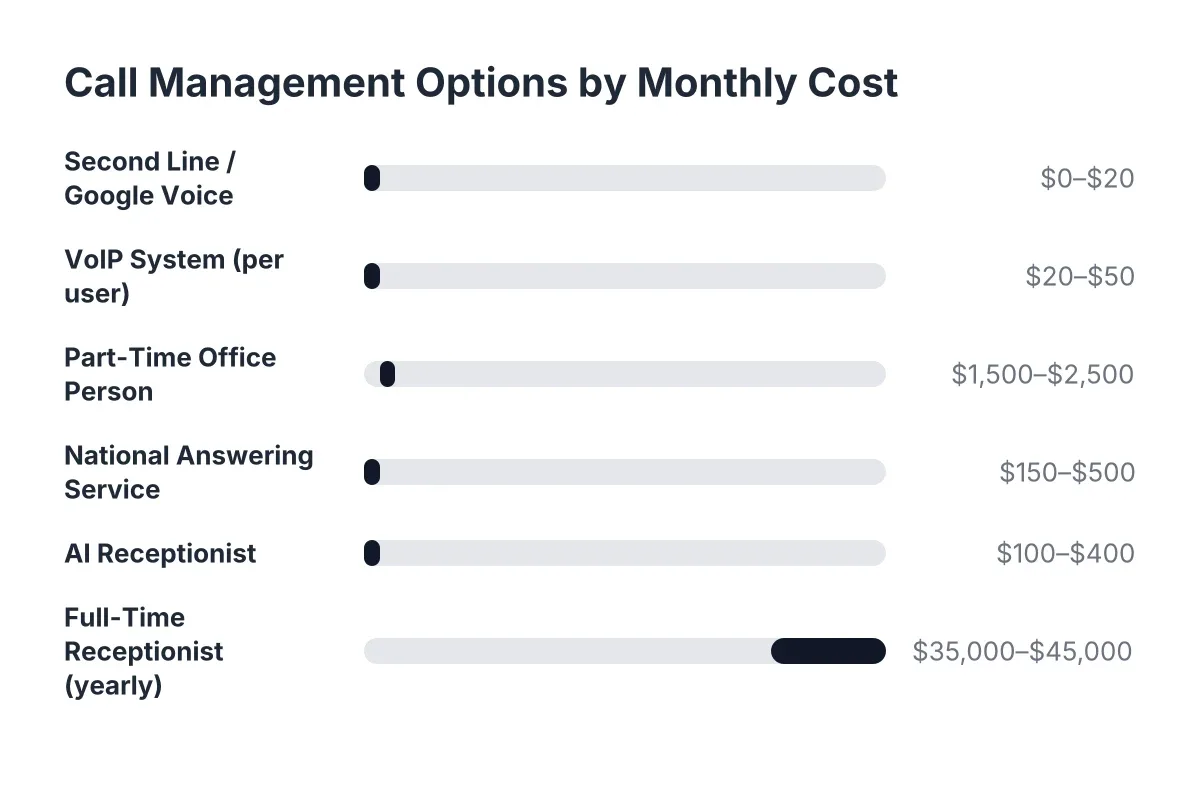
6. Human Answering Services ($150 to $400+/month, per-minute overages)
Traditional answering services put a live person on your line. That matters, because a Five9 survey of 4,000 consumers found 75% prefer talking to a real human for support. Professional storm season call handling and management from a skilled operator have genuine value, and for complex, emotional restoration calls, a human is hard to beat.
The catch for storm work is capacity and knowledge. National services staff for average volume, so a 300 to 400% call spike in 48 hours means your callers sit in the same queue as every other client's. Operators reading a generic script also cannot credibly discuss hail patterns in Georgetown or the difference between an inspection and an adjuster meeting. Per-minute overage pricing turns your best week of the year into your most expensive phone bill.
Best for: Steady, moderate call volume with complex conversations. Fails when: Surge volume swamps shared operators and per-minute costs stack up.
7. An AI Receptionist Built for Trades ($100 to $500/month, typical range)
An AI receptionist answers every call, in English and Spanish, and handles unlimited simultaneous conversations. That last part is the storm-work difference: when 60 Pflugerville homeowners call in one hour after a hail event, all 60 get answered, qualified, and offered a booking link at the same time. No queue, no busy signal, no voicemail.
Skepticism about AI call quality is fair, and the honest answer is to test it. Call one before you buy it and try to stump it with a real scenario: a Spanish-speaking caller, a confused homeowner who does not know their deductible, an active ceiling leak at 11 p.m. A well-built AI receptionist captures the address, damage description, and claim status, scores the lead, books the inspection, and flags urgent calls for live transfer to you. A weak one will expose itself in two minutes. Worth noting: only 24% of small employers currently use AI tools, according to the National Federation of Independent Business, so answering every surge call this way is still a real edge over the competitor down the road.
One trade-off to state plainly. An AI receptionist captures and qualifies leads; it does not close insurance jobs or negotiate scope with an adjuster. You, or your office lead, still own the relationship. NFIB's same survey found 98% of small employers using AI reported no change in employee headcount, which matches how trades actually use it: coverage for the calls nobody was answering, not a substitute for the crew.
Best for: Storm and event-driven trades where simultaneous volume, claim intake detail, and speed decide the year. Fails when: Your call volume is tiny and every conversation needs an owner's judgment from the first hello.
8. Hiring a Full-Time Receptionist ($35,000 to $45,000+/year)
A dedicated office person answers calls with full context, manages your schedule, and knows your customers. For a 10 to 20 tech operation with steady year-round volume, this hire can pay for itself in retained recurring customers alone.
For storm-driven work, though, the math gets rough. One person still answers one call at a time, and the other 39 simultaneous callers hit voicemail during the exact 48-hour window that funds your year. A receptionist also works roughly 40 of the 168 hours in a week, and severe weather has a habit of landing in the other 128. Many established shops pair a receptionist with an AI receptionist for overflow and after-hours, which covers both the relationship side and the surge side.
How to Choose: Match the Tool to Your Surge, Not Your Average Week
Small business call management decisions usually get made based on a normal Tuesday, and that is the mistake for weather-driven trades. Your phone system should be sized for the 48 hours after a hail storm, because that window can carry 30 to 40% of annual revenue for a roofing or restoration shop. Missing calls on a quiet Tuesday costs one job; missing them post-storm costs the season.
Here is a simple sizing rule as an illustrative estimate. If your worst-case hour is 3 to 5 calls, forwarding plus a strong crew culture of answering can work. If your worst-case hour is 20-plus calls at $7,500 average job value, only unlimited simultaneous answering protects that revenue, and no free app on any list delivers it. For businesses with heavy regulatory or legal exposure in their intake, such as certain restoration claims, it is also worth having your insurance agent or attorney review what your intake process documents.
Managing Storm Season Call Handling: The Quick Decision Table
Run your shop through these questions in order and stop at the first no:
- Do you get more than 10 calls a day, or any surge events? If no, a free second-number app plus a tightened voicemail greeting is honestly enough for now.
- Can someone on your crew answer live during business hours? If no, you need answering, not routing; skip straight to options 6 or 7.
- Do calls come after-hours or in Spanish? If yes, you need 24/7 bilingual coverage, which rules out apps and most forwarding setups.
- Does your revenue spike after weather events? If yes, simultaneous capacity is your deciding criterion, and an AI receptionist is the only option on this list that scales instantly with the storm.
The pattern across all eight options is consistent. Free phone apps against business-grade call management is not a features debate; it is a question of whether your phone setup earns money while you are on a ladder. For a storm-driven trade in Central Texas, the answer needs to be yes 24/7, in both languages, for caller number 1 and caller number 61 alike.
If you're losing revenue to missed calls, NeverMiss ATX can help.
Prefer to talk it through? Call (512) 980-9267 — a quick call is usually the fastest way to get a straight answer for your situation.