Bilingual Call Answering vs. Hiring a Bilingual Receptionist: Real Cost Math for Texas Trades
If you run a lawn care, HVAC, or pest control crew anywhere in Central Texas, you already know the problem: a Spanish-speaking homeowner calls, nobody on the crew can take it, and that job goes to the competitor down the road who answered in their language. The fix used to mean one thing, a bilingual call answering hiring decision that put a $37,000-plus salary on your books before you booked a single extra job. In 2026, that is no longer the only option, and for most crews running 1 to 15 people, it is no longer the best one. This guide lays out the real bilingual receptionist cost comparison between hiring a full-time bilingual receptionist and using a bilingual answering option that works 24/7, so you can run the numbers for your own business instead of guessing.
Why Spanish-Speaking Callers Are a Revenue Decision, Not a Nice-to-Have
Start with the market you are actually serving. According to the City of Austin, working from Census American Community Survey data, 29.6% of Austin residents age 5 and older are bilingual, and 10.3% speak English less than "very well." That second number is the one that should get your attention. One in ten potential customers in your service area is uncomfortable finishing a phone call in English.
Now think about what happens when one of those callers reaches your voicemail, or reaches an English-only greeting and hangs up. They do not leave a message and wait. They call the next lawn crew, the next AC company, the next pest control outfit on the list. In seasonal trades, that first call often decides who gets the recurring customer, not just the one-time job.
Run the lifetime value math on a single lost caller. A recurring lawn care customer at $180 a month is worth over $2,100 a year. An HVAC maintenance agreement plus the eventual system replacement can run $8,000 to $12,000 over the relationship. Quarterly pest control at $120 a visit is close to $500 a year, and those customers stay for years. Losing even one Spanish-speaking caller a week to a language barrier is not a rounding error. Over a year, that is tens of thousands of dollars walking to a competitor who simply answered in the caller's language.
Speed compounds the problem. Research from MIT Sloan School of Management and InsideSales.com found that the odds of contacting a lead drop 100-fold, and the odds of qualifying that lead drop 21-fold, when the callback happens at 30 minutes instead of within 5 minutes. A Spanish-speaking caller who hits a language wall does not wait 30 minutes. They are already dialing someone else.
What Bilingual Call Answering Hiring Actually Costs
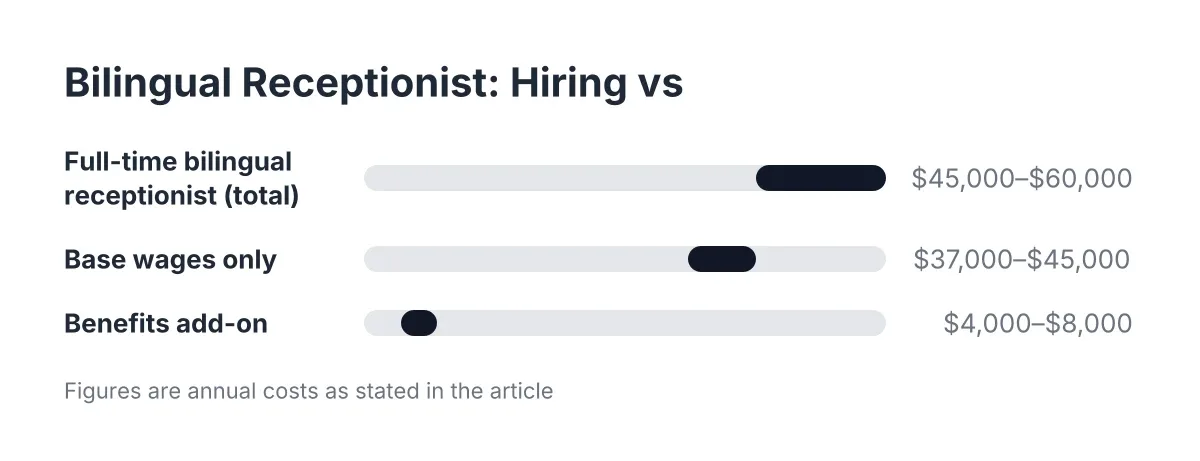
Hiring a full-time bilingual receptionist in Texas costs $45,000 to $60,000 per year once you account for wages, payroll taxes, benefits, equipment, and coverage gaps. The U.S. Bureau of Labor Statistics puts the median receptionist wage at $17.90 per hour, about $37,230 per year, and bilingual candidates in the Austin market command a premium above that median.
Break the full cost down honestly, because the salary line is only the start:
- Base wages: $37,000 to $45,000 for a bilingual hire in the Austin metro, where you are competing with call centers, medical offices, and law firms for the same candidates.
- Payroll taxes and workers' comp: Add 10% to 15% on top of wages.
- Benefits: Even a modest health contribution and PTO adds $4,000 to $8,000 a year.
- Equipment and software: Phone, computer, desk, and a seat on your scheduling software.
- Hiring and turnover: Recruiting, interviewing, and training time you spend off the tools, then repeating it when the person leaves. Front-desk roles turn over often.
Then there is the coverage problem that no salary fixes. A full-time receptionist works about 40 hours a week. Your phone rings across all 168. Summer AC failures in 95° heat, post-storm roof calls, and pest emergencies do not respect business hours. In peak season, after-hours and weekend calls can make up a third of your inbound volume, and your $50,000 hire is not answering any of them.
One more honest point about the hiring route: a great bilingual receptionist who knows your business is a real asset, and if your call volume justifies a full-time front desk anyway, the language skill is a bonus worth paying for. The comparison here is for owners whose call volume does not justify a full-time seat, which describes most crews under 15 people.
The Hidden Cost of Relying on One Bilingual Employee
Plenty of Central Texas crews solve the language question informally. A tech or crew lead speaks Spanish, so calls get forwarded to his cell when a Spanish-speaking customer phones in. It works until it does not.
For example, picture a six-person landscaping crew in Pflugerville during spring booking season. The one Spanish-speaking crew member is running a mower or up on a retaining wall when the phone rings. He either stops billable work to take a sales call, or the call goes to voicemail. Either way, the business loses money. When he takes a week off, or takes a better offer, the entire Spanish-speaking side of the customer base has no one to talk to.
That is the trap with informal bilingual coverage: it ties a revenue channel to one person's availability and employment. Any answering plan that depends on a single human being on shift will have gaps, and the gaps always land during peak season, when call velocity is highest and every missed call costs the most.
The Alternatives: Answering Service Companies, Phone Interpreter Services, and AI
Before comparing costs, it helps to know what the market actually offers, because "bilingual answering" covers three different things.
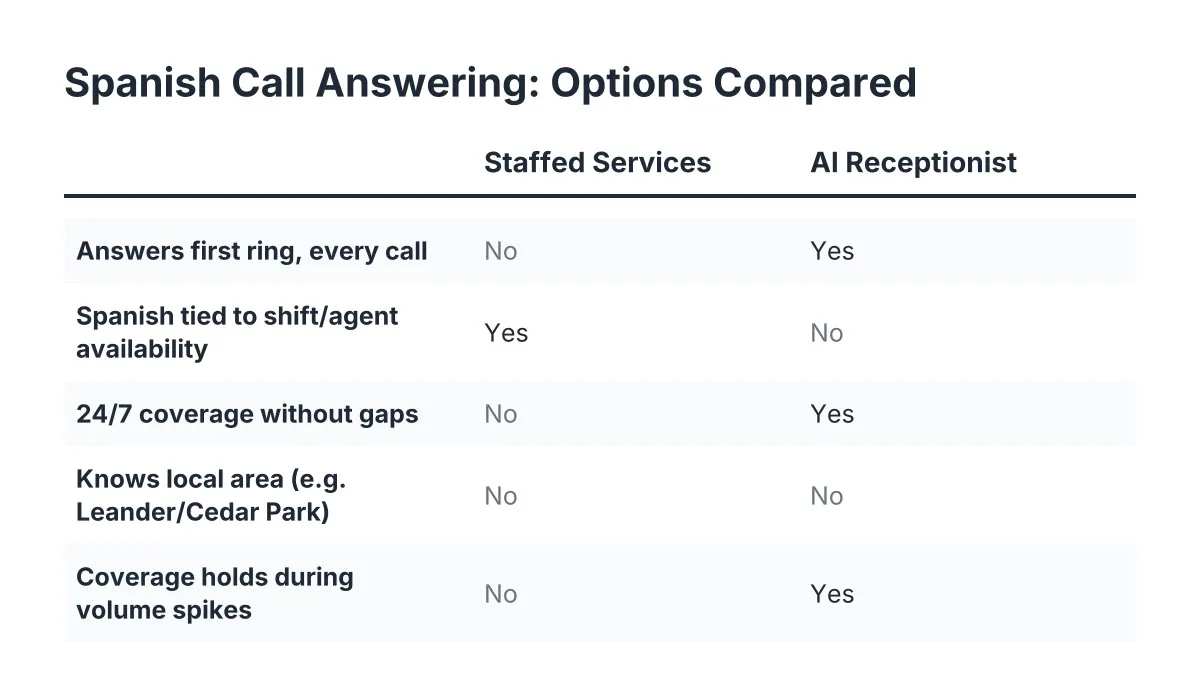
Traditional answering service companies. These are the national call centers. You pay per minute or per call, and a live agent, somewhere in the country, answers with your business name from a script. Bilingual coverage usually costs extra, and Spanish-speaking agents may only be available on certain shifts. The bigger issue for a Central Texas trade: the agent has never heard of Pflugerville, does not know that a July AC call is an emergency, and cannot tell a $200 mow-and-go from a $15,000 landscape install. You get a message, not a qualified lead.
Phone interpreter services. These connect a third-party interpreter to a live call, and they are the right tool for complex conversations like contract negotiations or dispute resolution. However, they solve a different problem. An interpreter only helps if someone on your team answered the phone in the first place, and per-minute interpreter rates make them expensive for routine booking calls. They do nothing for the after-hours call that rings while your whole crew is on site.
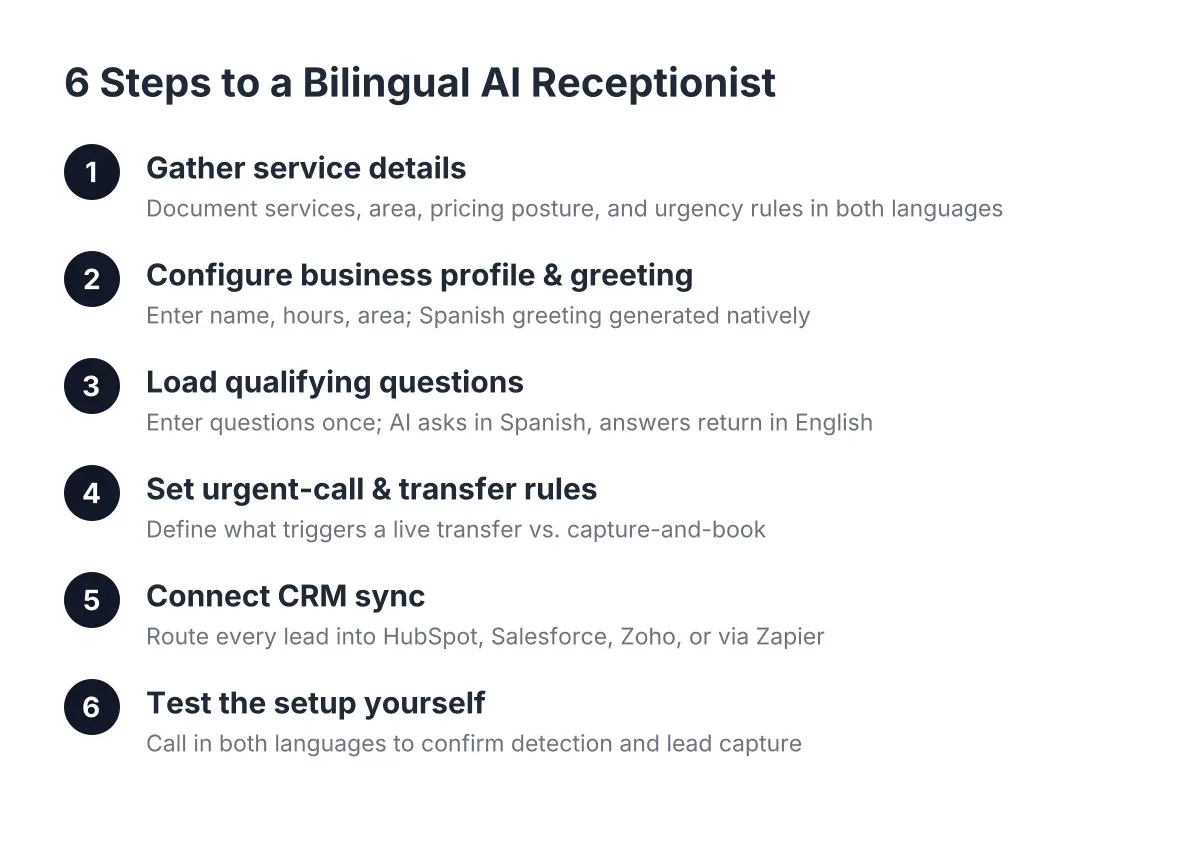
An AI receptionist with bilingual support built in. This is the newer option: software that answers every call instantly, detects whether the caller is speaking English or Spanish, and carries the whole conversation in that language. It captures the lead, asks your qualification questions, sends a booking link, and delivers a summary to you. Because it is software, it answers at 2 a.m. on a Sunday the same way it answers at 10 a.m. on a Tuesday, and the bilingual capability is not tied to who is on shift.
A note on "free" options, since the search results are full of them. A free AI answering service exists mostly as a trial tier or a stripped-down voicemail replacement. If it does not qualify leads, book appointments, and handle Spanish as fluently as English, it is not solving the problem this article is about. Test any option, free or paid, by calling it yourself in both languages before you route real customers to it.
How AI Bilingual Call Answering Works on a Real Call
Here is what a Spanish-speaking caller actually hears, because this is where most owners are rightly skeptical. The AI answers on the first ring with your business name. If the caller opens in Spanish, "Hola, tengo un problema con mi aire acondicionado," the AI detects the language within the first sentence and responds in natural, conversational Spanish. No menu. No "press 2 for Spanish." Additionally, no awkward handoff.
From there, the conversation runs the same qualification logic you would want a receptionist to run: What is the problem? Is the AC out completely or just underperforming? What is the address? Is this a home you own? When works for a visit? The AI captures the lead, books the appointment or sends a booking link by text, and scores the call so you know whether you are looking at an emergency repair or a maintenance tune-up before you call back.
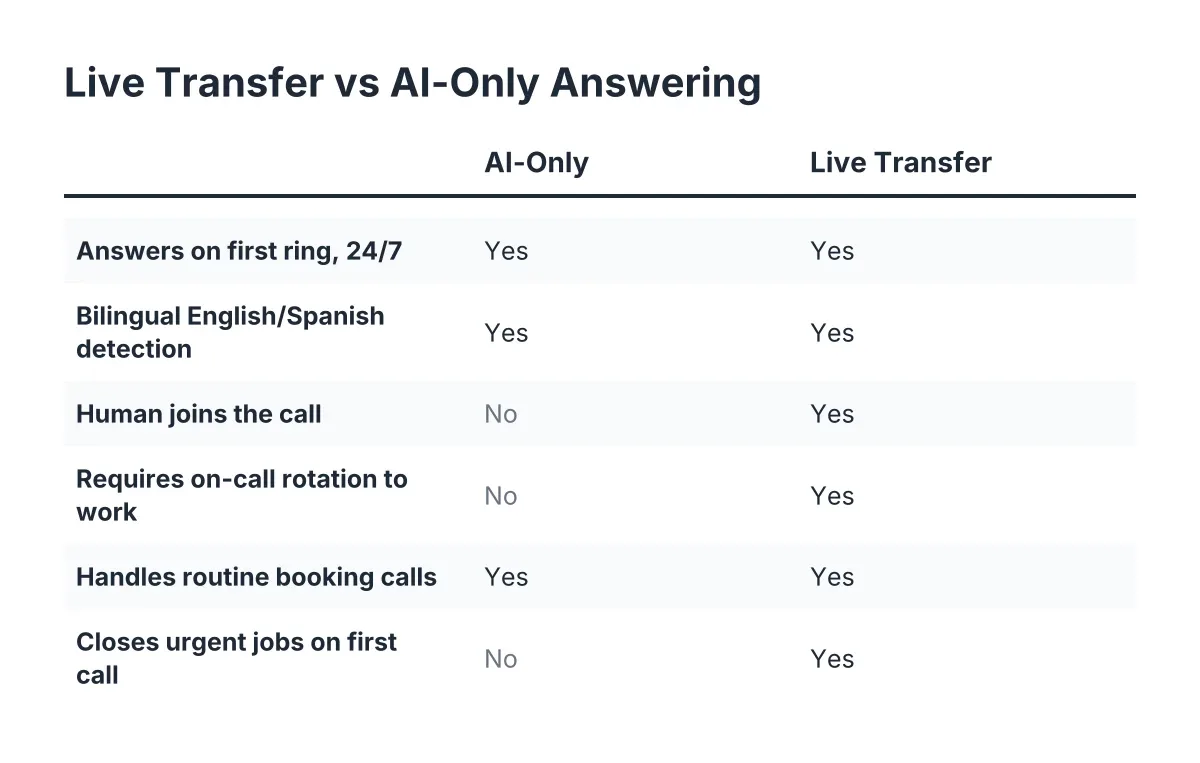
For urgent calls, a burst pipe or a full AC outage during an August heat wave, the right setup includes an opt-in live transfer, so genuine emergencies bridge straight to your cell while routine calls get booked without interrupting you on the job. That triage matters: an AI receptionist that treats every call the same will either wake you up for a mowing quote or make an emergency customer wait until morning.
Two honest caveats. First, most consumers still prefer talking to a human; a Five9 survey found 75% prefer a real person for customer support, though the same survey found 84% already know companies use AI for customer service. The practical takeaway is that an AI answering instantly in the caller's language beats a voicemail or a language barrier every time, but it augments your human relationship with customers rather than replacing it. You still make the follow-up call, show up on site, and build the relationship. Second, no AI handles every edge case; a complex commercial bid or a legally sensitive dispute still belongs with you or a professional interpreter.
Bilingual Receptionist Costs: Hiring vs. AI and How Costs Compare
The cost gap between hiring a full-time bilingual receptionist and using an AI receptionist runs about 10 to 20 times, before you count coverage hours. A full-time hire costs $45,000 to $60,000 a year for 40 hours a week of coverage. The bilingual receptionist cost comparison shows AI receptionist plans for small home service businesses typically run $200 to $500 a month, or $2,400 to $6,000 a year, for all 168 hours.
Put the options side by side on the factors that actually decide jobs won and lost:
- Annual cost. Full-time bilingual hire: $45,000 to $60,000 all-in. National answering service with bilingual add-on: $6,000 to $15,000 a year at typical trade call volumes, often with per-minute Spanish surcharges. AI receptionist: $2,400 to $6,000 a year with English and Spanish on every plan.
- Hours covered. Hire: 40 of 168 hours, minus lunch, PTO, and sick days. Answering service: 24/7, but bilingual agents may not staff every shift. AI: 24/7 in both languages, every call.
- Answer speed. Hire: fast during shift, voicemail otherwise. Answering service: hold times spike during storms, exactly when your callers spike too. AI: first ring, every time, which matters given how sharply lead contact odds fall after the first five minutes.
- Local knowledge. A local hire knows the area. A national call center does not know Cedar Park from Corpus Christi. An AI receptionist built for Central Texas trades can be configured with your service area, your seasonal services, and your qualification questions.
- Lead quality. A trained hire qualifies well. Most answering service companies take messages rather than qualify. An AI with call intelligence scores and summarizes every lead, so Monday morning you know which callbacks are worth making first.
- Scaling through peak season. A hire handles one call at a time; overflow calls hit voicemail during the summer rush. AI answers concurrent calls, so a storm surge of 15 calls in an hour gets 15 answers.
The pattern is clear. The full-time hire wins on human warmth and deep business knowledge, and loses badly on cost, coverage, and peak-season overflow. Furthermore, the national services win on hours but lose on language consistency, local credibility, and lead qualification. Notably, the AI option wins on cost and coverage, and its main historical weakness, sounding robotic, has closed to the point where the fair test is calling one yourself in Spanish and trying to stump it.
A Season in Numbers: One Round Rock HVAC Crew
To make the comparison concrete, walk through an illustrative peak season for a four-tech HVAC maintenance company in Round Rock doing about $600,000 a year.
June through August, the phone rings about 25 times a day. Techs are in attics; the owner is running quotes. Before any answering solution, suppose roughly 60% of calls go unanswered during work hours and everything after 6 p.m. hits voicemail. Say one call in eight comes in Spanish, and those callers almost never leave messages.
With a full-time bilingual receptionist at roughly $50,000 a year, weekday coverage improves dramatically. However, the 7 p.m. "AC just died and it is 98 degrees inside" calls still hit voicemail, and July's overflow still stacks up whenever two calls arrive at once. If after-hours and overflow represent even five missed booked jobs a week at an average $450 ticket, that is $2,250 a week left on the table during a 12-week peak, about $27,000 a season, on top of the salary.
With an AI receptionist at roughly $300 a month, every call gets answered in English or Spanish, around the clock, with emergencies bridged live and routine tune-ups booked automatically. The trade-off is real: no human at a front desk, and the owner still handles the relationship side personally. For a crew this size, that trade-off costs about $3,600 a year against $50,000, and captures the after-hours and Spanish-speaking revenue the hire structurally cannot.
How to Decide: A Checklist Before You Commit Either Way
Neither answer is universal, so score your own situation before deciding on bilingual call answering hiring or software. Work through these questions with your actual numbers, not gut feel:
- Count your missed calls for two weeks. Check your phone logs, including after-hours. If more than a third of inbound calls go unanswered, coverage is your bottleneck, not language alone.
- Estimate your Spanish-speaking caller share. In the Austin metro, if it is under 5% of your calls, ask whether the language barrier or the missed-call rate is costing you more. It is usually both.
- Calculate one recurring customer's lifetime value. Multiply monthly or per-visit revenue by realistic retention. This is the real price of each lost first call.
- Check whether a full-time seat is justified without the language skill. If you would hire a receptionist anyway at your call volume, hire bilingual and treat the language capability as compounding value.
- Test before you buy. Call any AI receptionist or bilingual answering service yourself, in Spanish, at 9 p.m., with a weird scenario. If it stumbles on "my system is frozen but the house is hot," keep looking.
- Confirm the plumbing. Whatever you choose should push leads into your CRM or at least text you a summary. A perfectly answered call that dies in someone's notepad is still a missed call.
If you are an established multi-location operation with a full office staff, the calculus changes and a human front desk plus interpreter backup may serve you better. For the solo operator through 15-person crew running $150,000 to $800,000 a year, the math above points one direction for most.
The Bottom Line for Central Texas Trades in 2026
The bilingual question was never really about language. It is about who answers first, in the words the caller trusts, at the moment they decide who gets their business and every recurring visit after it. In a market where nearly a third of Austin residents are bilingual, answering only in English during only business hours means competing for a fraction of your own market during a fraction of the week.
A full-time bilingual receptionist solves the language problem for 40 hours a week at $45,000 to $60,000 a year. An AI receptionist with bilingual support on every plan solves it for all 168 hours at a tenth of the cost, and answers the July overflow no single human can. The hire buys you a person; the software buys you coverage. For a growing Central Texas crew that cannot yet justify the salary but cannot afford another season of missed calls, the coverage is the revenue decision, and the numbers make it before the sales pitch does.
If you're losing revenue to missed calls, NeverMiss ATX can help.
Prefer to talk it through? Call (512) 980-9267 — a quick call is usually the fastest way to get a straight answer for your situation.