After-hours Call Answering Terms Explained: A Plain-English Glossary
If you run a home service business in Central Texas and you've started shopping for someone to answer your phone at night, you've probably hit a wall of jargon fast. This after hours call answering glossary breaks down the terms you'll see in quotes, sales calls, and comparison pages, in plain English. Use it to read a proposal line by line, ask sharper questions, and spot the difference between a real answering setup and glorified voicemail. Every entry stands on its own, so skip around freely.
- AI Receptionist
- Answering Service
- Virtual Receptionist
- After-hours Coverage: The Basics
- 24/7 Answering
- Lead Capture
- Lead Qualification
- Call Scoring
- Call Summary
- Live Transfer
- Emergency Triage
- Call Bridging
- Bilingual Answering
- Per-Minute Billing
- Call Forwarding
- CRM Sync
- Webhook
- Booking Link
- Missed Call Rate
The Basics: Who or What Answers the Phone
AI Receptionist
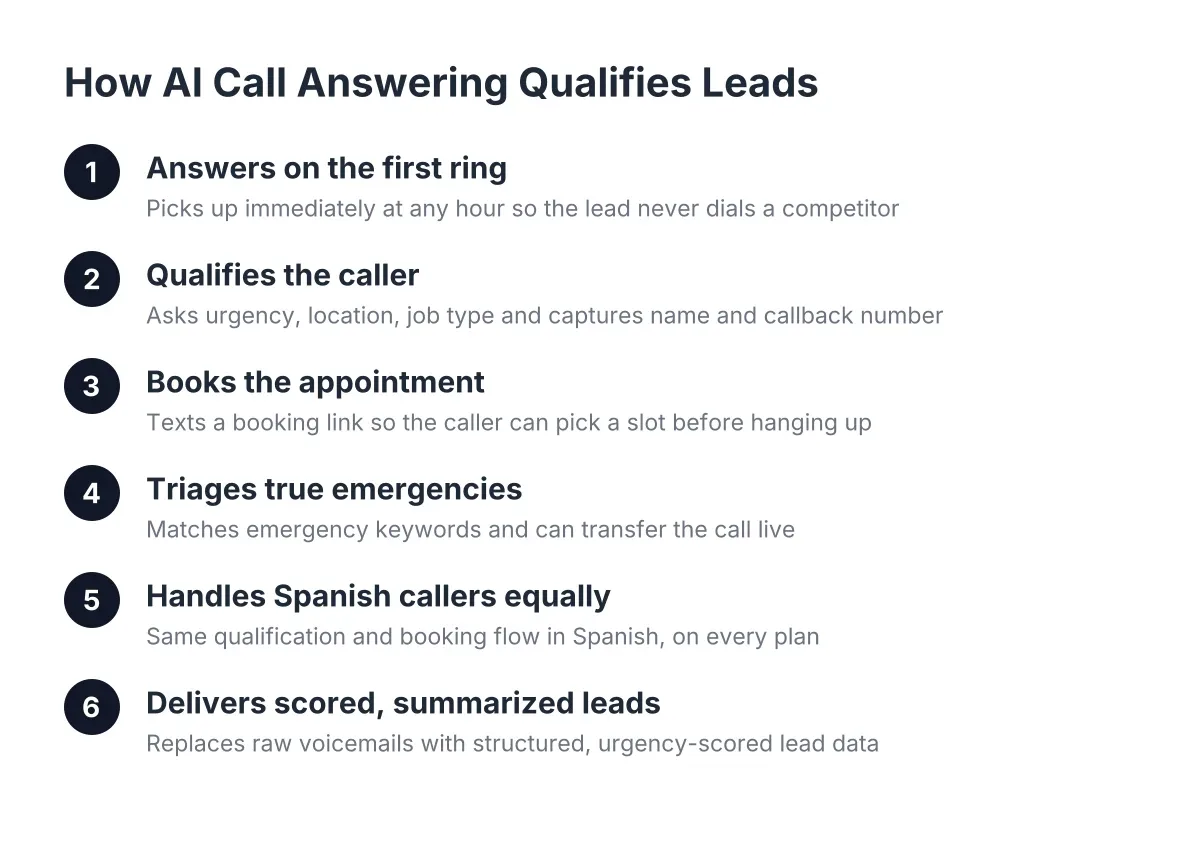
An AI receptionist is software that answers your business phone, holds a real conversation with the caller, and takes action, like capturing their contact details or booking an appointment. Unlike voicemail, it responds to what the caller actually says, so a homeowner with a burst pipe at 2 a.m. talks to something that understands "burst pipe" and acts on it. When a provider says "AI receptionist," ask what actions it can take beyond talking; answering is table stakes, but capturing the lead and booking the job is where the value lives. You can read more about how AI receptionists answer calls 24/7 if you want the full picture.
Answering Service
An answering service is a company that picks up your calls for you, traditionally with human operators working from a call center. National answering services usually charge by the minute and read from a script, which means the person answering may not know your trade, your service area, or your pricing. If a quote mentions "per-minute billing," that is your cue to ask what happens on long calls and what counts as billable time.
Virtual Receptionist
A virtual receptionist is a remote human who answers your calls as if they sat in your office, without actually being on your payroll. They cost less than a full-time hire but more than most software options, and their hours often have limits. If you see this term in a quote, check whether coverage is truly 24/7 or only during extended business hours, because "virtual" does not automatically mean "always on."
After-hours Coverage: The Basics
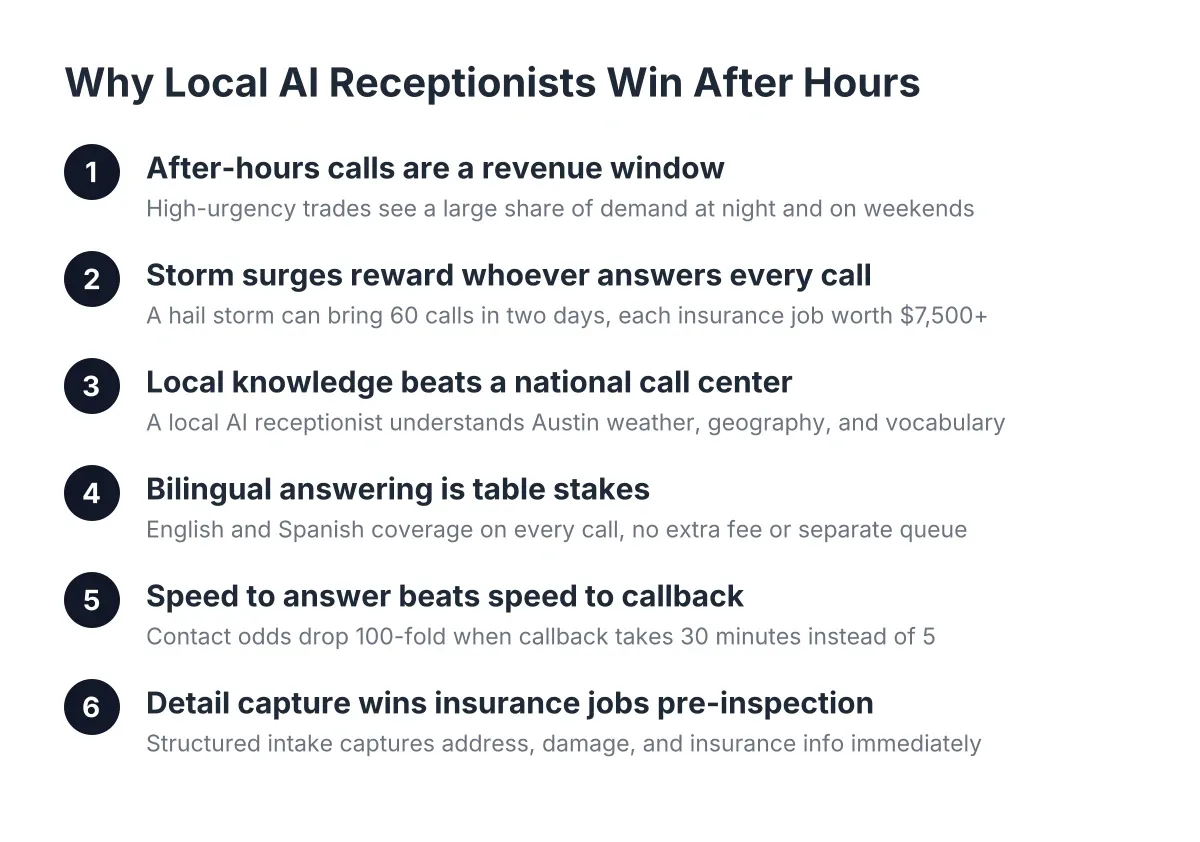
After-hours coverage means someone or something answers your phone outside your normal working hours, typically evenings, weekends, and holidays. This matters because a lot of home service emergencies, think AC failures during a 95° Austin summer or a water heater giving out on a Sunday, happen exactly when you're off the clock. When comparing providers, pin down exactly which hours are covered and whether after-hours call answering costs extra or comes standard.
24/7 Answering
24/7 answering means every call gets picked up around the clock, every day of the year, with no gaps. It sounds like the same thing as after-hours coverage, but it is stronger: no lunch-hour dead zones, no holiday blackouts, no "our operators are busy" hold queues. If a provider claims 24/7, ask what happens during their peak call volume, because a busy signal at midnight is still a missed call.
How Calls Get Handled
Lead Capture
Lead capture means collecting a caller's name, phone number, and job details so you can follow up and win the work. It is the whole point of answering the phone: a call that ends without contact details is a missed call wearing a costume. A good glossary of after hours call answering terminology would be incomplete without this term, because "we answer your calls" and "we capture your leads" are two different promises. Ask any provider to show you exactly what information lands in your inbox after a call.
Lead Qualification
Lead qualification means asking a caller the right questions to figure out whether the job is real, urgent, and worth your time before you ever call back. A qualified lead tells you the problem, the location, and the timeline, so you know whether to drop what you're doing or slot it in next week. Providers that qualify leads save you from driving across town for a job that was never going to book.
Call Scoring
Call scoring means rating each call, usually automatically, on how valuable or urgent it is, so the hottest leads rise to the top of your list. Instead of scrolling through twenty messages after a day on site, you see at a glance which three callers are ready to book. If a provider offers scoring, ask what signals feed the score, like job type, urgency, or caller intent.
Call Summary
A call summary is a short written recap of what happened on a call: who called, what they need, and what happens next. Summaries let you skim ten calls in the time it takes to listen to one voicemail, which matters when you climb off a ladder at 6 p.m. with a full inbox. Look for summaries that arrive by text or email right after the call ends, not in a report you have to log in to find.
Live Transfer
A live transfer means the answering service connects an urgent caller directly to you, in real time, instead of taking a message. It is the safety valve for true emergencies: a flooded kitchen should ring your cell, while a quote request for next month should not. Good setups make live transfer opt-in and rules-based, so you decide which calls break through and which wait until morning.
Emergency Triage
Emergency triage means sorting incoming calls by urgency, so genuine emergencies get escalated and routine requests get booked normally. For trades, this is the difference between waking up for a gas smell and waking up for a dripping faucet. Ask any provider how their system decides what counts as an emergency, and whether you can set those rules yourself.
Call Bridging
Call bridging means connecting you to a lead with one action, typically a click from a dashboard, so you don't have to copy a number and dial it manually. It shrinks the gap between "lead came in" and "you're talking to them," and speed matters, since callers who don't hear back quickly call the next company on the list. If you follow up from a truck between jobs, bridging removes friction where it hurts most.
Bilingual Answering
Bilingual answering means calls get handled in more than one language, most commonly English and Spanish in Central Texas. If a Spanish-speaking homeowner calls and gets an English-only greeting, that lead often hangs up and calls a competitor. Check whether bilingual support comes standard on every plan or costs extra, and whether the caller can switch languages mid-call.
Pricing, Paperwork, and Plumbing (the Technical Kind)
Per-Minute Billing
Per-minute billing means you pay for the time an operator or system spends on each call, metered by the minute. It is the standard pricing model for traditional call centers, and it makes long, chatty calls expensive even when they don't turn into jobs. Flat monthly pricing is the common alternative; the after-hours call answering cost guide walks through how the models compare. Whatever the model, get the overage rules in writing.
Call Forwarding
Call forwarding means routing calls from your existing business number to the answering service, so you keep your number and customers notice nothing. It usually takes a few minutes to set up through your phone carrier, no new hardware needed. If a provider makes setup sound complicated, ask them to walk you through the forwarding step; for most trades it is one setting on your phone plan.
CRM Sync
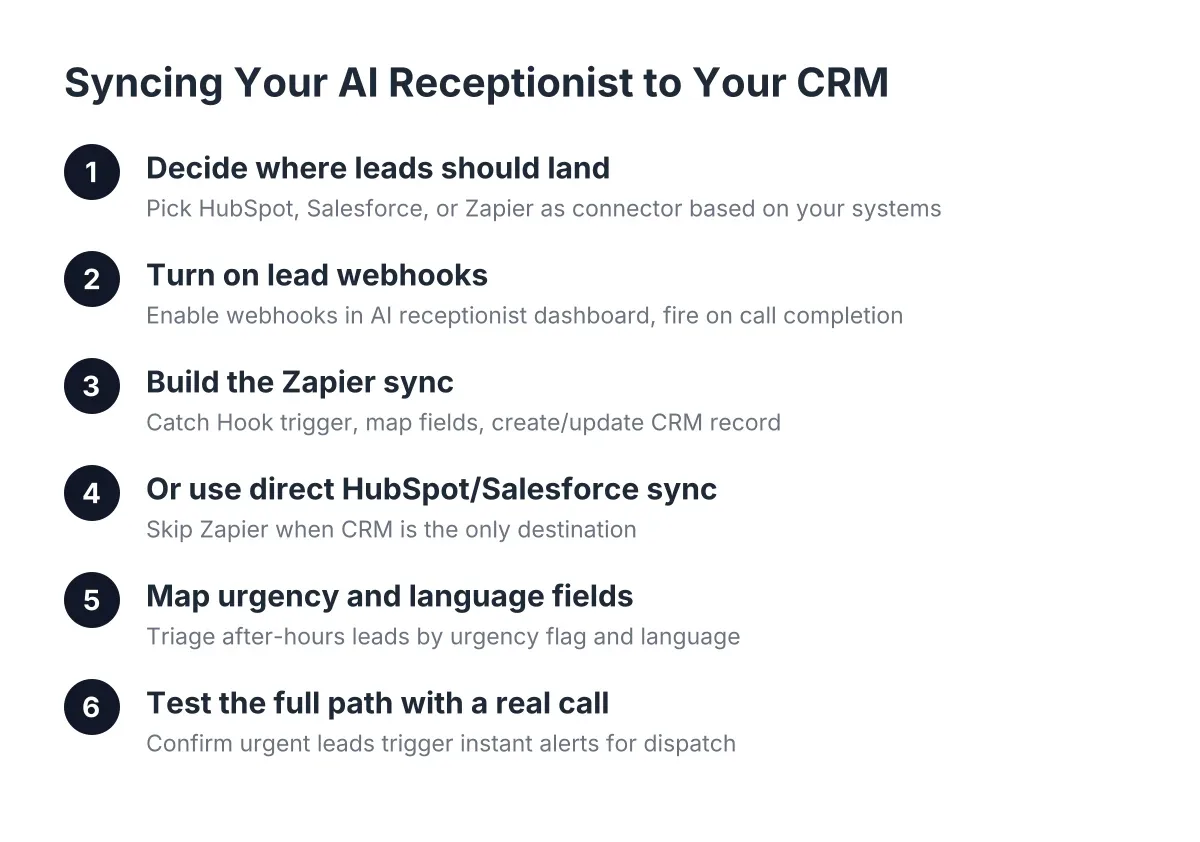
CRM sync means new leads flow automatically from the answering service into your customer database, the software where you track jobs and contacts. Without it, someone has to retype every lead by hand, and retyped leads get lost. If you already use a tool like HubSpot, Salesforce, or Zoho, confirm the provider connects to it directly; if you don't use a CRM yet, email or text delivery works fine to start.
Webhook
A webhook is an automatic message one piece of software sends to another the moment something happens, like a new lead arriving. In practice, it means your lead can trigger a text to your phone, a row in a spreadsheet, or a card in your job board without anyone lifting a finger. You don't need to understand the plumbing; you just need to know webhooks are how "the call ended" becomes "the lead is in your system" instantly.
Booking Link
A booking link is a web link the caller receives, usually by text, that lets them pick an appointment time from your available slots. It turns a phone conversation into a booked job without back-and-forth phone tag. Providers that send booking links during or right after the call convert more leads, because the homeowner commits while the problem is still fresh.
Missed Call Rate
Your missed call rate is the share of incoming calls that go unanswered, whether they hit voicemail, ring out, or get a busy signal. Most home service owners underestimate theirs, because you never see the calls that came in while you were under a sink. Before signing with any provider, ask how they'll show you the calls you used to miss; a weekly report of answered-versus-missed calls makes the value concrete.
Using These Terms
You now speak enough of the language to read any quote without getting steamrolled. When a provider throws a term at you, you can ask the follow-up that matters: which hours, which languages, what happens to the lead after the call. Keep this after hours call answering glossary handy, and if you want to test how well an AI receptionist actually handles your trade, the fastest way is to call one and try to stump it.
If you're losing revenue to missed calls, NeverMiss ATX can help.
Prefer to talk it through? Call (512) 980-9267 — a quick call is usually the fastest way to get a straight answer for your situation.