Why Local AI Receptionists Win for Austin Home Service Businesses After Hours
Austin home service businesses lose their most valuable calls at the worst possible times: 2 a.m. during a hard freeze, Saturday afternoon after a hail storm rolls through Cedar Park, or Sunday night when a slab leak floods someone's kitchen in Round Rock. Those calls are not edge cases. For emergency trades, they are a predictable revenue window, and the data on lead response time shows exactly why answering them first wins the job. This piece lays out why after-hours calls are disproportionately valuable for Central Texas trades, and why a local AI receptionist beats both voicemail and a national call center at capturing them during Austin storm surge calls and other emergencies.
Here is the core argument up front. Emergency calls cluster around nights, weekends, and weather events. A homeowner with water pouring through the ceiling calls down a list and hires the first company that answers. According to a foundational MIT Sloan / InsideSales.com study, the odds of contacting a lead drop 100-fold when the callback happens at 30 minutes instead of within 5 minutes, and the odds of qualifying that lead drop 21-fold. After hours, "30 minutes later" usually means "tomorrow morning." That is the whole game.
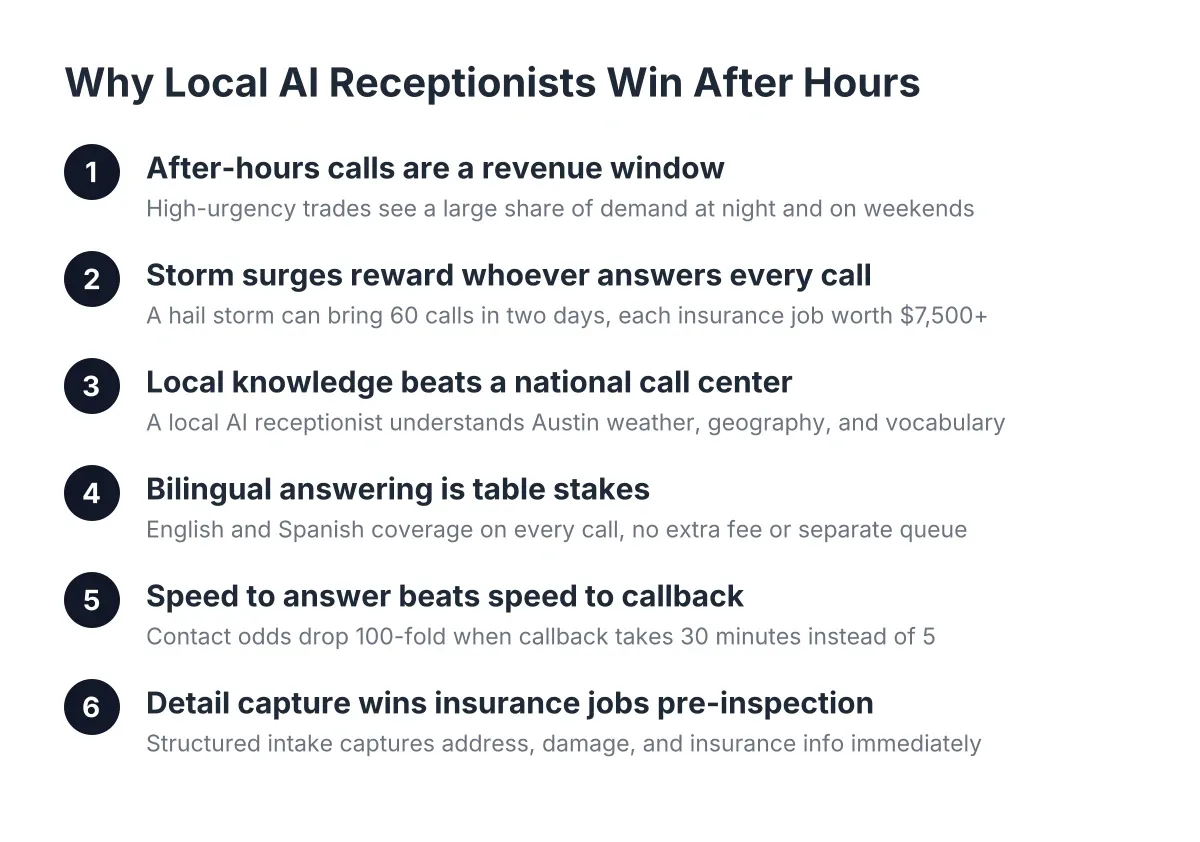
What follows is a list of eight reasons the local approach wins, built around the call patterns of Austin trades.
1. After-Hours Calls Are a Revenue Window, Not an Interruption
Emergencies do not respect business hours, and for high-urgency trades a large share of demand lands at night and on weekends. In pest control, for example, a meaningful portion of calls comes in after hours; plumbing and electrical emergencies skew the same way. Treating those calls as noise to be handled by voicemail means treating your highest-intent leads as an afterthought.
Think about who calls a plumber at 11 p.m. It is not someone comparison shopping for a water heater install next quarter. It is someone with an active problem, a credit card, and zero patience for phone tag. That caller converts at a higher rate and tolerates emergency pricing. The business that answers wins; the one that sends them to voicemail donates the job to a competitor.
2. Storm Surges and Austin Storm Surge Calls Reward Whoever Answers Every Simultaneous Call
Post-storm demand can surge dramatically within 48 hours, and no owner-operator or small crew can answer that many phones. Suppose a hail storm hits Georgetown and Pflugerville on a Tuesday evening. A typical roofing operator might see 60 calls before Thursday, many arriving in the same two-hour window while the crew is on a ladder inspecting the first roofs. Every busy signal in that window is a potential insurance job, often worth $7,500 or more, walking to whoever picked up.
Voicemail cannot handle surge capacity. Neither can one office manager. An AI receptionist answers unlimited simultaneous calls, captures damage details and insurance information on each one, and hands you a queue of qualified claim intakes instead of a mailbox full of hangups. In that scenario, surge capacity is not a nice-to-have; it is the difference between a normal month and a year's worth of booked work.
3. A Local AI Receptionist Knows Austin; a National Call Center Does Not
A national answering service treats a hard freeze in Leander the same as a mild Tuesday in Ohio. An AI receptionist built in Austin for Austin trades understands the local context: which neighborhoods just got hit, what a burst pipe means during a February freeze, and why a caller from Fort Worth mentioning "hail damage" is a high-value claim intake, not a routine inquiry. Local knowledge changes how calls get qualified and prioritized.
There is also the trust factor. Central Texas homeowners can tell when they have reached an out-of-state script reader. A locally built system, tuned to the vocabulary of Austin trades and the rhythms of Central Texas weather, sounds like it belongs on your phone line because it does. That matters when your brand is your name on the truck.
4. Bilingual Answering Is Table Stakes in Central Texas, Not an Add-On
A large share of Austin-area homeowners prefer to describe an emergency in Spanish, and a panicked 1 a.m. caller will not struggle through a second language to report a flooded bathroom. Most national services charge extra for Spanish coverage or route those calls to a separate queue with longer waits. Either way, the caller feels the friction and hangs up.
An AI receptionist with English and Spanish on every call, by default, captures the lead either way. For emergency trades in Round Rock, Pflugerville, and East Austin, that is not a feature comparison line item. It is a meaningful slice of after-hours revenue that voicemail and monolingual services never see.
5. Speed to Answer Beats Speed to Callback, Every Time
The MIT Sloan / InsideSales.com finding is worth restating because it drives the whole strategy: contact odds collapse 100-fold between a 5-minute response and a 30-minute one. The practical lesson for trades is that the callback model is structurally broken after hours. By the time you check voicemail at 6:30 a.m., the 11 p.m. caller hired someone else at 11:09.
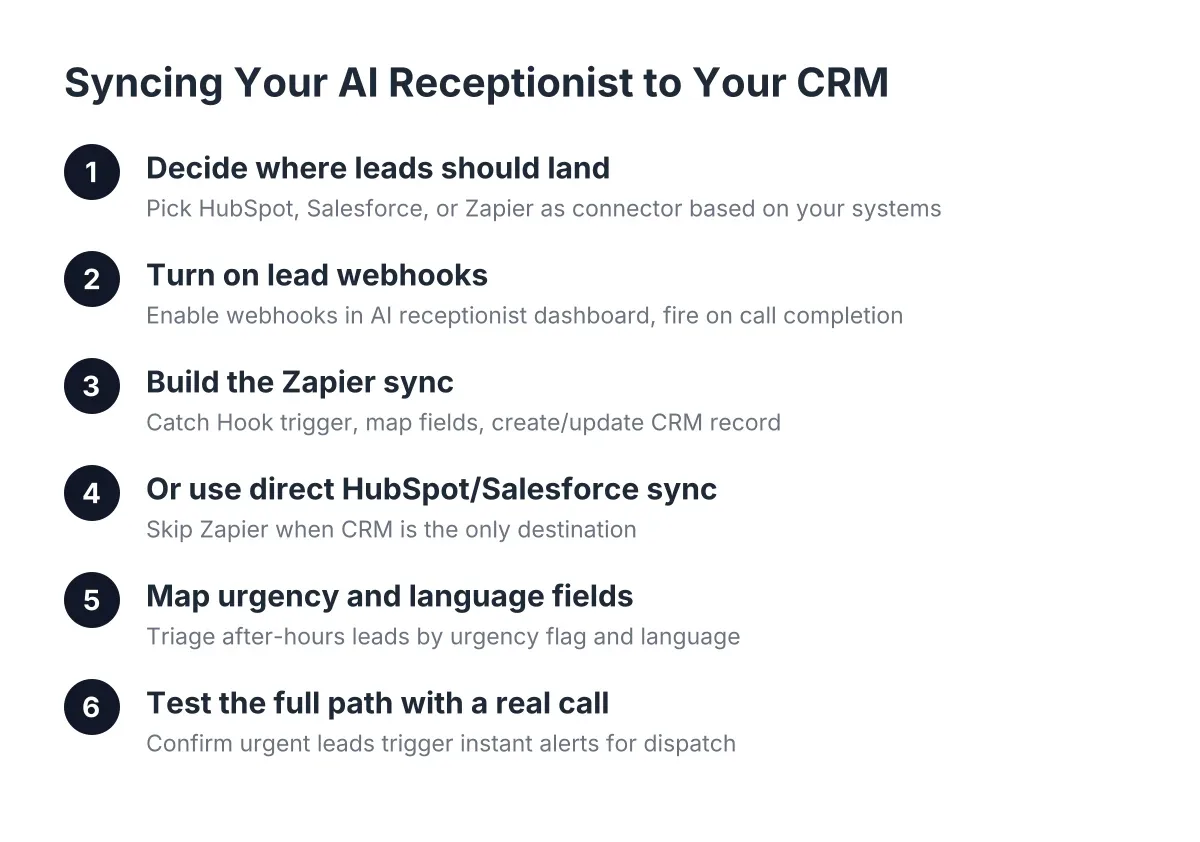
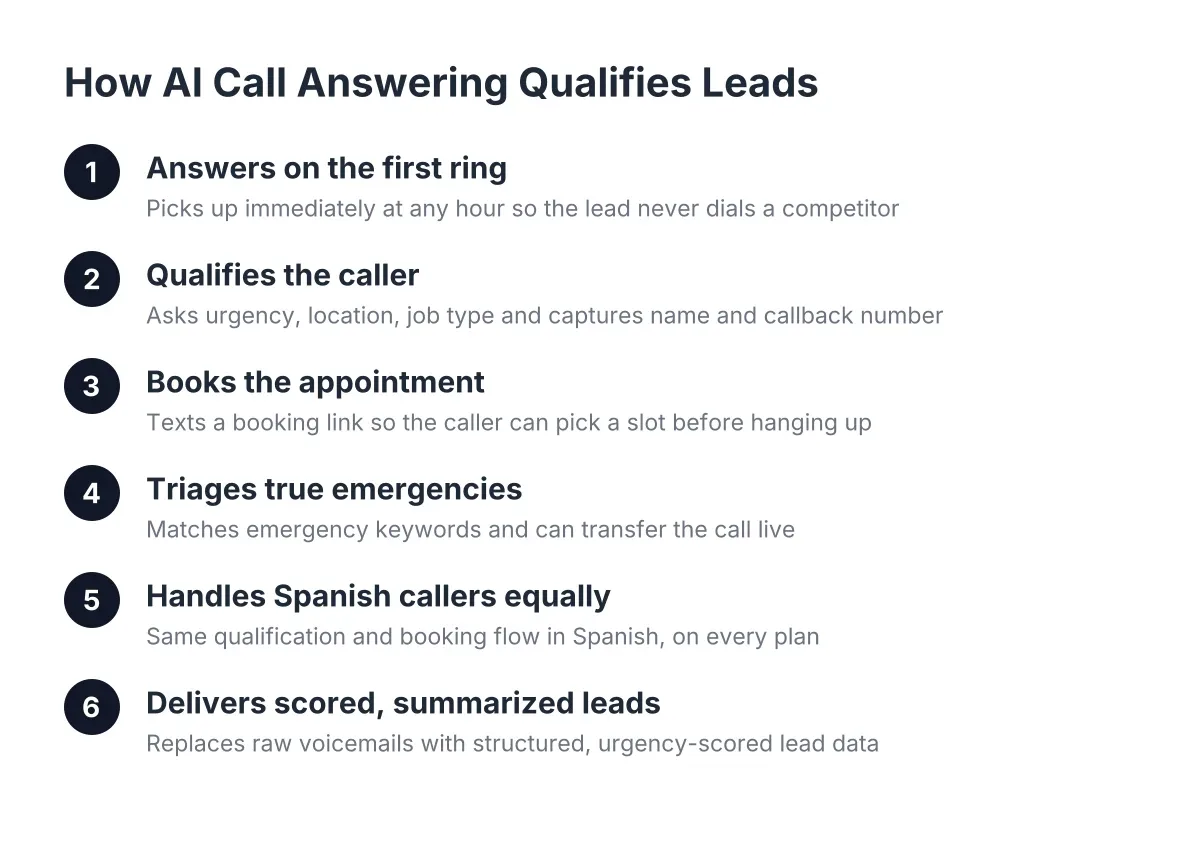
The fix is answering in real time, not calling back faster. An AI receptionist picks up on the first rings, qualifies the caller, captures the job details, and books the appointment or sends a booking link while the caller's urgency is at its peak. For genuine emergencies, opt-in live transfer bridges the caller straight to you or your on-call tech. The lead never enters the callback lottery at all.
6. Detail Capture Wins Insurance Jobs Before the Inspection
High-value insurance work lives or dies on intake quality. A voicemail that says "call me back about my roof" is worthless for triage. A structured intake that captures the address, damage description, insurance carrier, and whether the homeowner has filed a claim lets you rank 40 post-storm leads by value and route your inspections to the biggest jobs first.
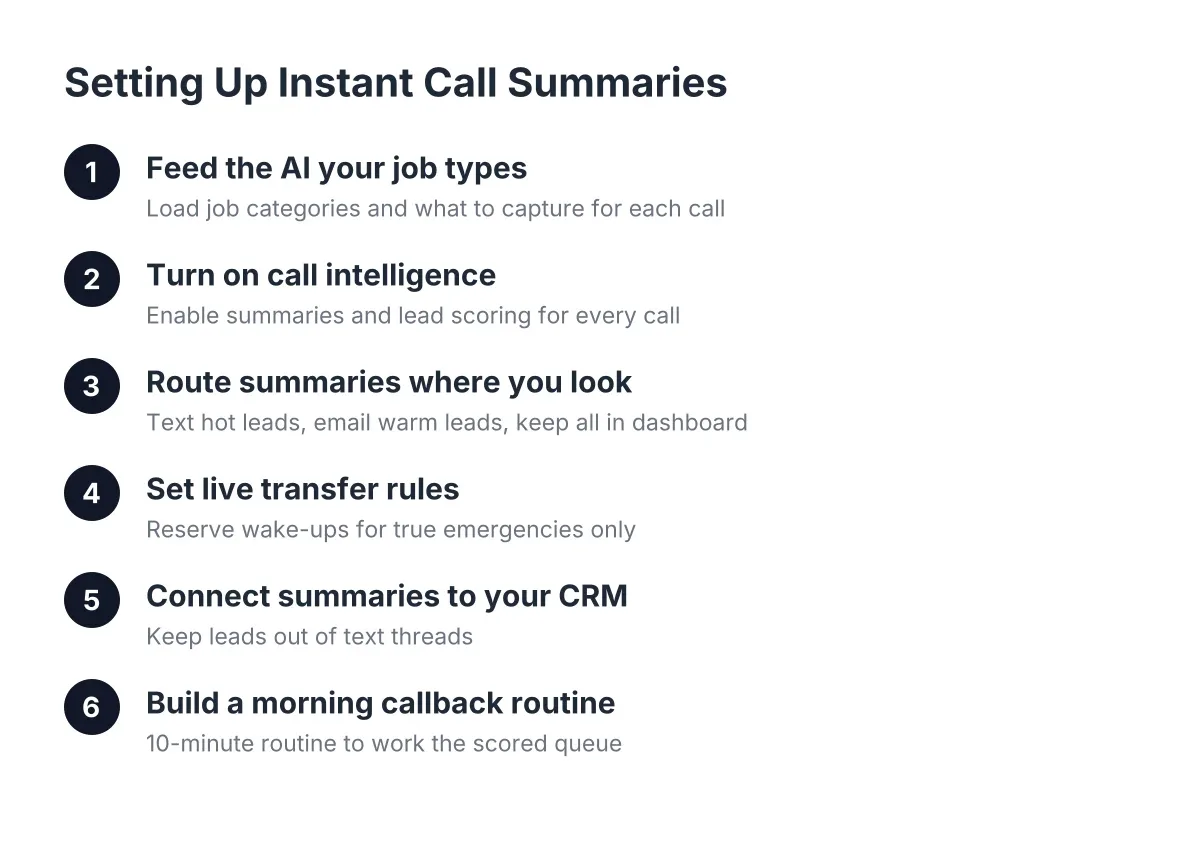
However, most owners cannot do that intake at scale during a surge, and a generic answering service takes messages rather than qualifying claims. AI call intelligence scores and summarizes every call, so Monday morning you are reading a ranked list, not replaying voicemails from a ladder. That triage speed is how small crews win market share from bigger competitors during the 48-hour window that decides the season.
7. You Do Not Need a Night Shift to Cover Nights
The traditional answers to after-hours coverage all have real costs. Consider the options a solo operator or small crew actually faces:
- Hire evening staff: payroll, training, and turnover for coverage you only need in bursts
- Contract a national answering service: per-minute billing, generic scripts, and no local knowledge
- Answer it yourself: interrupted sleep, missed calls while on site, and burnout by August
- Let voicemail catch it: the cheapest option on paper and the most expensive in lost jobs
After-hours call answering with an AI receptionist sidesteps that whole trade-off. It answers every call 24/7, books the job, and syncs the lead to your CRM without adding headcount. Notably, an NFIB survey found 98 percent of small employers using AI reported no change in employee headcount; the point is capturing missed calls, not cutting the team. It answers the phone so your people can stay on the job.
8. Skepticism About AI Is Fair, So Test It Before You Trust It
Plenty of owners doubt an AI can handle a frantic caller describing a sewage backup, and that skepticism is earned; plenty of phone bots are terrible. A Five9/TEAM LEWIS survey found 75 percent of consumers prefer talking to a real human for support, which is exactly why the AI has to be good enough that callers stay on the line, get helped, and get booked. The same Five9 research found 84 percent of consumers already know companies use AI for customer service, so the technology is not a surprise to your callers; bad execution is.
The honest test is direct. Call the AI receptionist yourself, in English and then in Spanish, and try to stump it with a real scenario from your worst storm week. There is also a fair limitation to name: an AI receptionist captures, qualifies, and books, but complex insurance negotiations and final scope decisions still belong to you and, where claims are involved, a licensed adjuster or public adjuster. The AI's job is making sure that conversation happens with you instead of a competitor.
What This Means for Austin Home Service Businesses in 2026
The pattern across all eight points is the same. After-hours and storm-surge calls are the highest-intent, highest-value leads Austin home service businesses receive, and they are the calls most likely to hit voicemail. Meanwhile, adoption is still low enough to be an edge: an NFIB survey found only 24 percent of small employers currently use AI tools at all. As of 2026, the operator who answers every call, in both languages, at 2 a.m. during a freeze, is competing against voicemail most of the time.
The playbook is short. Stop treating nights, weekends, and storm weeks as coverage gaps and start treating them as your most predictable revenue window. Put something on the line that answers instantly, captures the details insurance jobs require, triages the high-value claims, and books the work while you sleep. Local beats national because Central Texas emergencies are local events, and the receptionist answering them should understand exactly what a hard freeze in Leander means.
How Austin Home Service Businesses Can Pressure-Test Coverage for Storm Surge Calls
Before changing anything, run a simple audit for one week. Count the calls that arrive outside business hours, note how many reached voicemail, and estimate the average job value for your trade. For an emergency plumber averaging illustrative tickets of $400 to $900, even three missed after-hours calls a week is a five-figure annual leak. For a storm-driven roofer, one missed surge window can outweigh an entire quarter. Once you see the number, the question stops being whether to cover after hours and becomes how, and the answer no longer requires hiring a night shift.
If you're losing revenue to missed calls, NeverMiss ATX can help.
Prefer to talk it through? Call (512) 980-9267 — a quick call is usually the fastest way to get a straight answer for your situation.