Does AI Call Answering Qualify Leads and Book Jobs Automatically? 8 Proof Points for Austin Trades
If you run an emergency trade in Central Texas, the question is not whether you miss calls after hours; you already know you do. The real question is: does AI call answering actually qualify leads and book appointments on its own, or does it just take messages like a fancy voicemail? Short answer: a purpose-built AI receptionist does both, and the after-hours window is where it earns its keep. Below are eight specific things AI call answering does automatically, with the details a decision-ready owner in Austin, TX needs: how qualification works, what booking looks like, how emergencies get triaged, and where the limits are. When you implement AI lead qualification proof, you ensure that every after-hours call is handled with the same rigor as an office manager would bring to the phone.
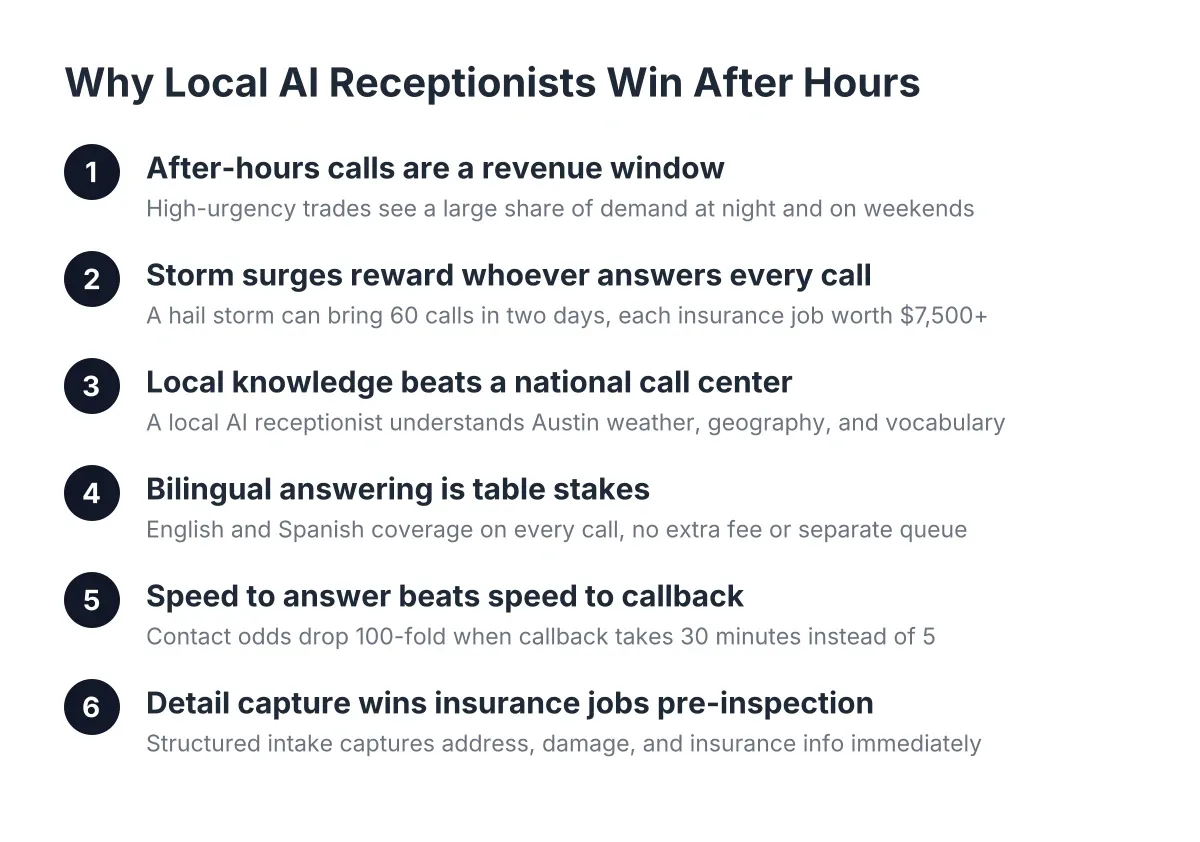
One data point frames everything that follows. According to MIT Sloan School of Management / InsideSales.com, the odds of contacting a lead drop 100-fold, and the odds of qualifying that lead drop 21-fold, when the callback happens at 30 minutes instead of within 5 minutes. A burst pipe at 11pm does not wait 30 minutes. It calls the next plumber on the list.
1. It answers on the first ring, which is where qualification actually starts
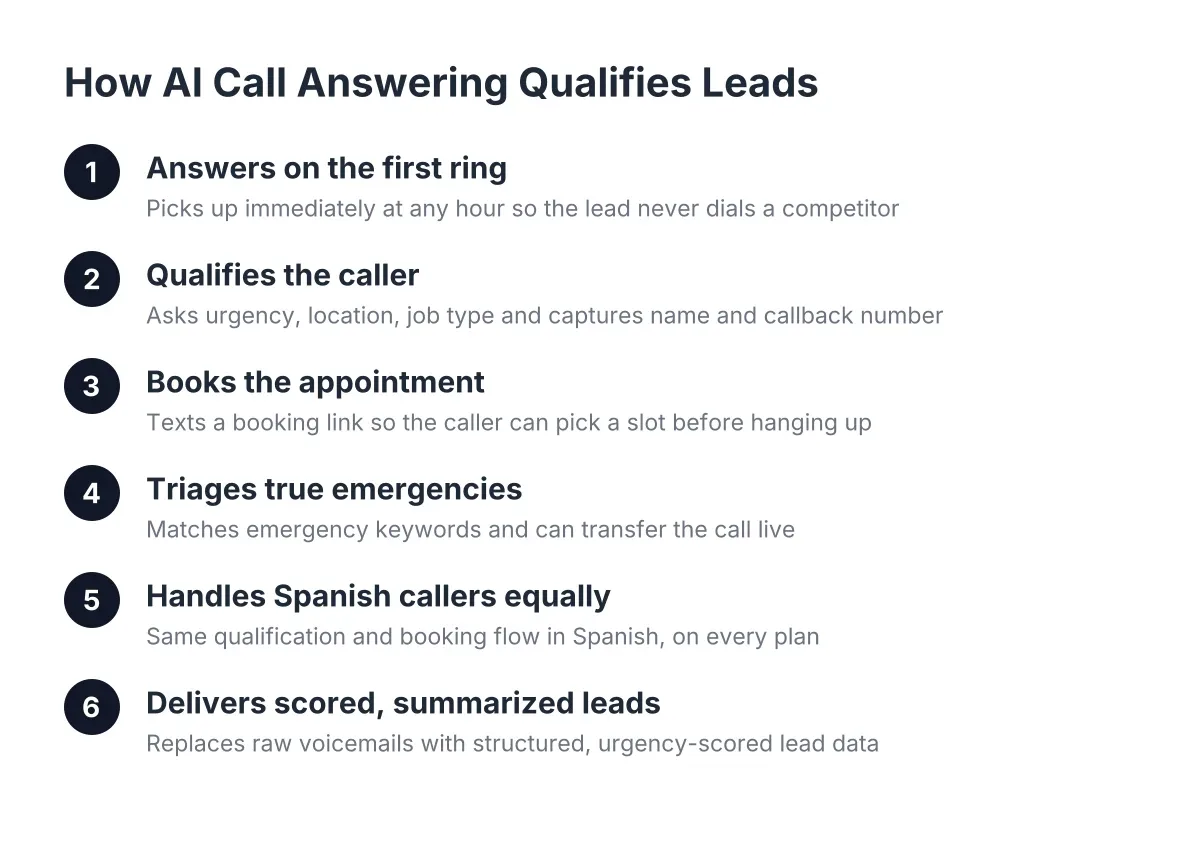
Qualification does not begin with questions; it begins with picking up. An emergency caller with water spreading across the kitchen floor abandons a ringing line faster than any routine caller. When the AI receptionist answers immediately, at 2am on a Tuesday or during a Sunday Cowboys game, the lead stays on your line instead of dialing your competitor.
For a general construction or multi-trade shop running a crew of one to eight, this matters most evenings and weekends, when everyone is on site or off the clock. The call gets answered whether you are on a ladder, under a house, or asleep. That first ring is the difference between a lead you can qualify and a voicemail nobody leaves.
2. How does AI call answering demonstrate AI lead qualification proof in a real conversation?
AI call answering qualifies leads by asking the same questions a sharp office manager would: what is the problem, where is the property, how urgent is it, and are you the property owner or decision maker. It captures name, callback number, address, and job type, then scores the lead based on urgency and fit before the call ends.
Here is how that plays out. The AI receptionist is loaded with your service list during setup, so it knows a "no-cool" call in August is urgent for an HVAC shop, and a "small bathroom remodel" question for a general contractor is a quote request, not a dispatch. It routes each one differently: urgent calls get flagged or transferred, quote requests get captured with details and a booking link.
The qualification questions are configurable to your trade. A pest control operator can have the AI ask what the caller is seeing and where; a plumber can have it ask whether the water is shut off. You define what a qualified lead means for your business, and the AI applies it on every call, consistently, at any hour.
3. It books the appointment before the caller hangs up
Capturing a lead is half the job; booking it is the other half. During the call, the AI receptionist sends the caller a booking link by text, so a qualified lead can pick a slot on your calendar while they are still motivated. No phone tag the next morning, no "I'll call you back" that never happens.
For non-emergency work, say a fence repair request that comes in Saturday at 7pm, this means Monday morning starts with a booked job instead of a callback list. For a solo operator, that is the closest thing to hiring an evening scheduler without actually hiring one. This represents solid AI lead qualification proof that your system captures value from every after-hours interaction.
4. It recognizes true emergencies and can transfer them live
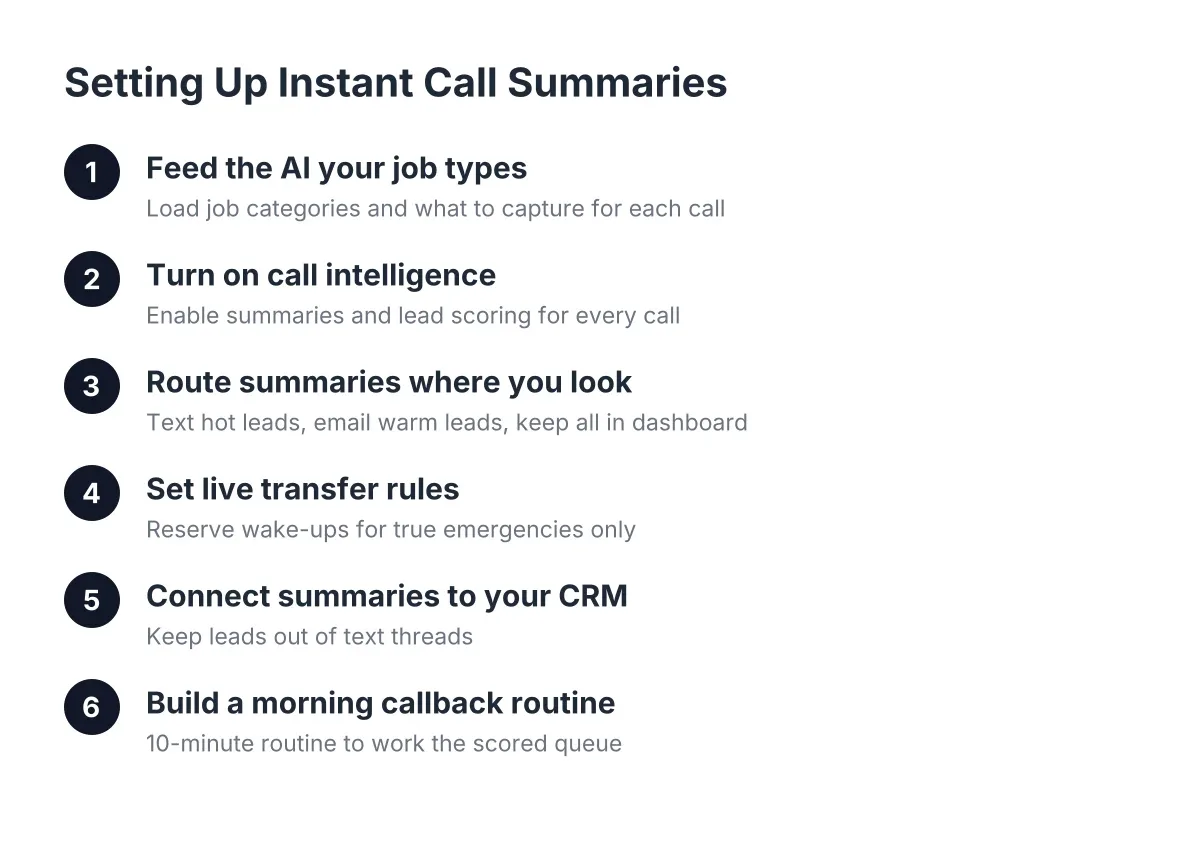
The biggest fear for emergency providers is fair: what if the AI treats a flooding house like a routine inquiry? A well-configured AI receptionist triages on the keywords and context you define. Flooding, sparks, gas smell, sewage backup, no power. When a call matches your emergency criteria, opt-in live transfer bridges the caller straight to your phone or your on-call tech.
You control the rules. Maybe electrical fires and active flooding transfer live, while a roach sighting books a next-morning slot with a calm, reassuring explanation. In that scenario, panic callers get a human fast, routine after-hours callers get booked, and you stop getting woken at 3am for jobs that could wait until 8. If a transfer goes unanswered, the AI captures the full details and flags the lead urgent, so nothing falls through.
One honest limitation: an AI receptionist triages and dispatches, but it does not diagnose. For anything involving gas, structural risk, or live electrical hazards, the caller still needs a licensed professional on site, and your emergency protocols should say so explicitly.
5. It handles Spanish callers the same as English callers, on every plan
In the Austin, Round Rock, and Pflugerville service area, a meaningful share of after-hours emergency calls come in Spanish. An AI receptionist that is bilingual by default answers, qualifies, and books those callers in their language, with no separate line, no premium add-on, and no "press 2" maze that a panicked caller will abandon.
For a multi-trade business, that is not a nice-to-have. It is a lead source your English-only voicemail has been quietly losing for years. Every Spanish-language call gets the same qualification questions, the same booking link, and the same urgency triage as an English call.
6. It delivers scored, summarized leads instead of raw voicemails
Voicemail gives you a garbled 20-second message you replay three times. AI call intelligence gives you a summary of each call, a lead score, and the structured details: name, number, address, job type, and urgency. Suppose a typical crew wraps a remodel at 6pm and three calls came in during the pour; the owner scans three summaries in under a minute and calls the flooded-laundry-room lead first.
That prioritization is where after-hours call answering pays off in practice. You are not just capturing every lead; you are triaging your morning before you finish your coffee. A weekly Monday morning report shows the pattern over time: how many calls came in nights and weekends, how many booked, and what they were worth.
7. It pushes every lead into the tools you already use
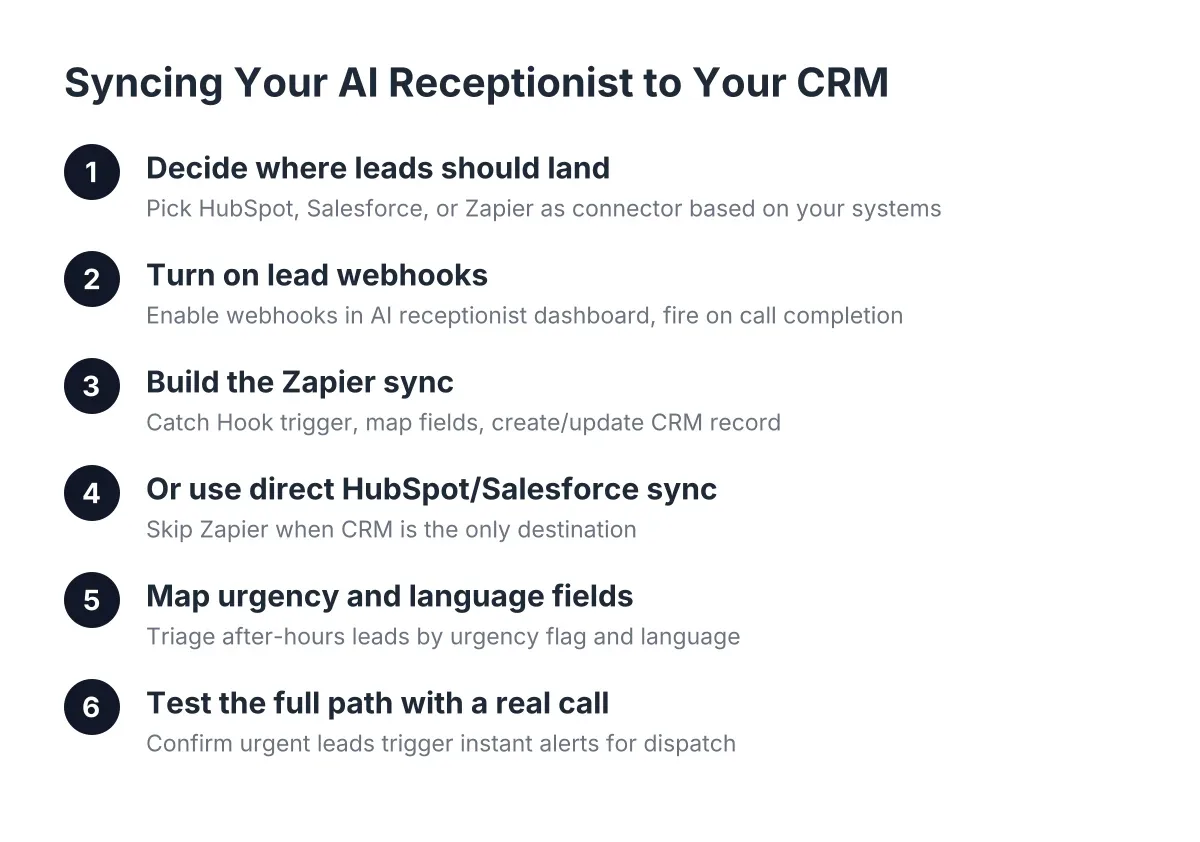
Automation only works if the lead lands somewhere you will see it. Webhooks and CRM sync push captured leads into HubSpot, Salesforce, Zoho, or anything reachable through Zapier, the moment the call ends. One-click call bridging from the dashboard means following up on a hot lead is a single tap, not a copy-paste job.
For an owner-operator doing $150K to $600K a year without office staff, this is the piece that keeps leads from dying in a notebook. Setup does not require an enterprise scheduling system; if you run your business from a phone and a Google Calendar, that is enough.
8. It does all of this without you hiring a night shift
The alternative to AI call answering after hours is either paying a national answering service that reads a generic script, or staffing evenings yourself. Both are expensive, and neither knows the difference between a Cedar Park slab leak and a Georgetown deck quote. Worth noting: according to the National Federation of Independent Business (NFIB), 98% of small employers using AI tools report no change in employee headcount. The point is not cutting staff; it is capturing calls no one was awake to answer.
There is also a competitive angle. NFIB found only 24% of small employers currently use AI tools at all. If you are the plumber in Leander who answers at midnight and your two nearest competitors are voicemail, you win the emergency call and the follow-on water damage work behind it.
So, does AI call answering replace a human touch after hours?
No, and it should not try to. AI call answering answers, qualifies, and books; the relationship still belongs to you and your crew. A Five9/TEAM LEWIS survey found 75% of consumers prefer talking to a real human for support, which is exactly why live transfer exists for genuine emergencies and why every captured lead includes a callback number for you to follow up personally.
The same Five9 research found 84% of consumers already know companies use AI for customer service. Callers are not shocked by it; they are shocked by voicemail at 11pm when their water heater is dumping into the garage. Answered beats perfect, and answered-plus-booked beats everything.
What should you verify before choosing a provider in Austin, TX?
Before you commit, test the specifics against your own call patterns. A short checklist:
- Call the AI yourself, after hours, and try to stump it with a real scenario from your trade.
- Confirm live transfer rules are configurable, and test one during setup.
- Verify bilingual answering is included on every plan, not an upsell.
- Check that leads sync to your CRM or inbox in real time, not in a daily digest.
- Ask how service knowledge gets captured for a multi-trade business, since a handyman shop needs wider job-type handling than a single-trade operation.
- Ask whether the team knows the Central Texas market, because a national call center will not know what a July heat wave does to your call volume.
The decision comes down to a simple comparison. Every after-hours call you miss is a lead qualified 21 times less often once it goes cold, per the MIT Sloan / InsideSales.com research. An AI receptionist built for Austin trades answers on the first ring, asks your qualification questions, books the job, and hands you a scored summary by morning. That is not a message-taking service. That is your night shift, without the night shift.
If you're losing revenue to missed calls, NeverMiss ATX can help.
Prefer to talk it through? Call (512) 980-9267 — a quick call is usually the fastest way to get a straight answer for your situation.