Call Answering Service ROI: How to Measure Lead Capture After Hours
If you run a lawn care, pest control, or HVAC maintenance business in Central Texas, you already suspect the calls you miss at 7:45 p.m. are costing you money. What most owners have never done is put a number on it. Call answering ROI calculation is not a mystery formula; it is a simple measurement of what your after-hours calls are worth, how many you currently capture, and what it costs to capture the rest. This guide walks through that math, using the call patterns Austin trades actually see, and shows you how to measure lead capture and conversion well enough to make a confident decision.
Here is the argument up front: after-hours calls are not edge cases. For recurring service businesses, they are a predictable revenue window that shows up every single week, and they are disproportionately valuable because the caller is often a brand-new customer worth years of recurring revenue. Miss the first call and you rarely get a second chance.
Why After-Hours Calls Are a Revenue Window, Not an Edge Case
Think about when your customers actually decide to call you. A homeowner in Round Rock does not notice her lawn needs weekly service while she is at work. She notices it Saturday morning. A Pflugerville family does not find the ant trail across the kitchen counter at 10 a.m. on a Tuesday; they find it at 9 p.m. while making dinner. Pest control operators consistently report that a large share of their inbound calls land outside business hours, and the pattern makes sense: pests, dead AC units, and overgrown yards get discovered when people are home.
Meanwhile, your side of the equation runs on the opposite schedule. Your crew is out on jobs all day, phones in pockets, hands full. By the time the office closes at 5, you are catching up on invoicing, not sitting by the phone. The result is a structural mismatch: your customers' peak calling window overlaps with your worst answering window.
This mismatch is predictable, which is exactly why it is fixable. If after-hours calls arrived randomly, once a month, you could shrug them off. However, they arrive in patterns tied to your season: spring booking season for lawn care, the first 95° week for HVAC maintenance, post-rain weekends for mosquito and pest calls. A revenue window that opens on schedule deserves a plan, not a voicemail greeting.
What Happens to Customer Calls When Your Office Is Closed?
When your office is closed, an unanswered call typically goes to voicemail, and most new customers do not leave one. They hang up, return to their search results, and call the next lawn care or pest control company on the list. The first business to answer usually wins the job, and often the recurring contract behind it.
This is the part owners underestimate. You picture the missed caller waiting patiently for your 8 a.m. callback. In reality, a homeowner searching "pest control near me" at 8:30 p.m. is in buying mode right then. She has three tabs open. If you do not answer and your competitor in Cedar Park does, the decision is made before you finish breakfast.
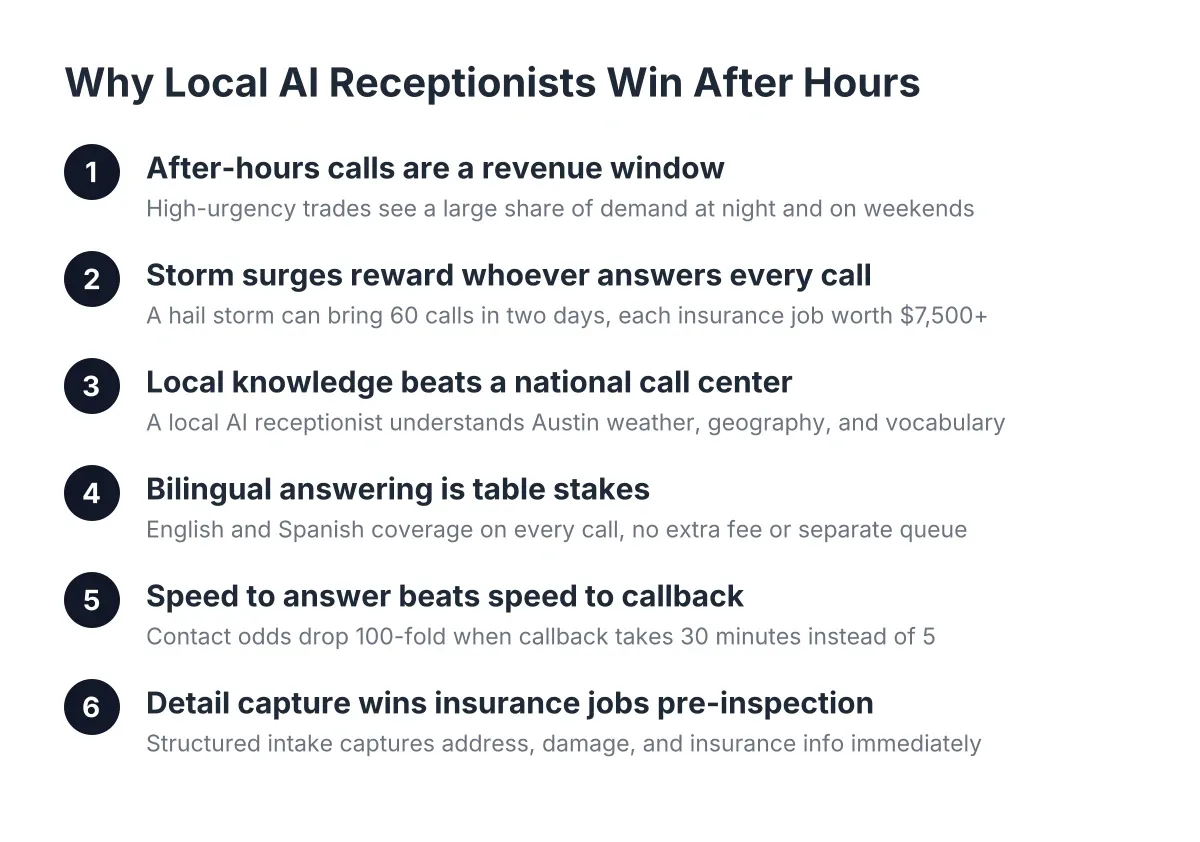
The research on speed backs this up hard. According to MIT Sloan School of Management / InsideSales.com, the odds of contacting a lead drop 100-fold, and the odds of qualifying that lead drop 21-fold, when the callback happens at 30 minutes instead of within 5 minutes. Thirty minutes. An overnight voicemail is not a 30-minute delay; it is a 12-hour delay. At that point you are not returning a call, you are cold-calling someone who already hired your competitor.
Understanding the Mathematics of Call Answering ROI Calculation
Call answering service ROI comes down to three numbers: the value of a new customer, the number of after-hours calls you miss, and the share of those callers you could convert if someone answered. Multiply them together, subtract the cost of the service, and you have your return. No spreadsheet wizardry required.
Let's build it piece by piece, using figures a recurring service owner can pull from their own books.
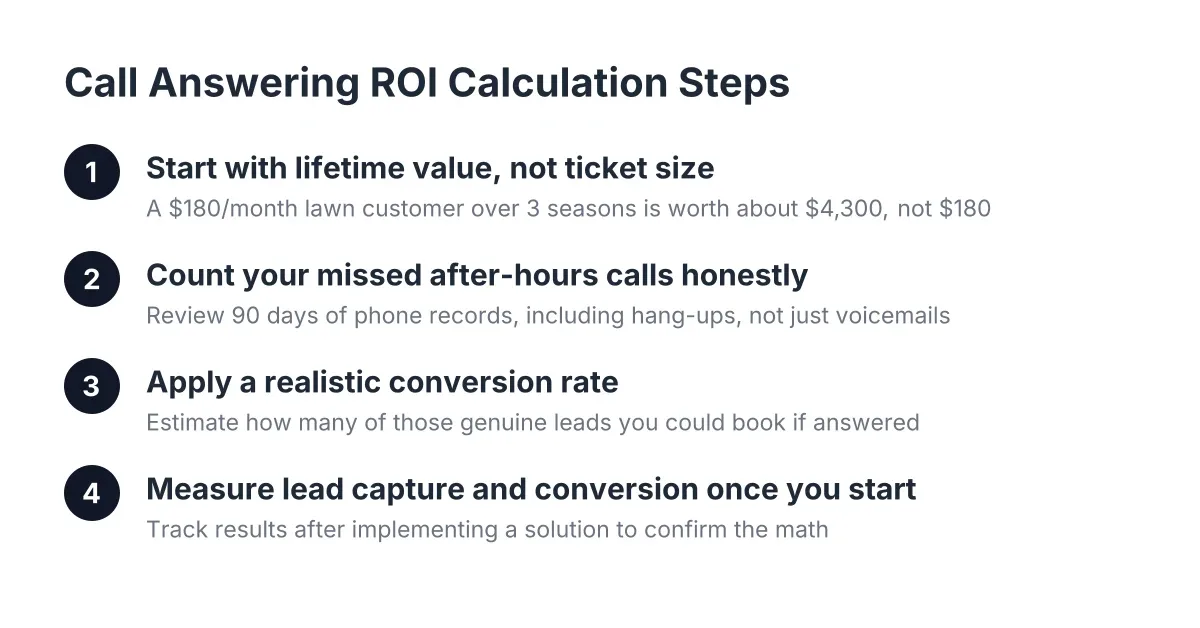
Start with lifetime value, not ticket size
Recurring service businesses have a superpower that one-time trades do not: a single answered call can be worth years of revenue. If your average lawn customer pays $180 a month and stays three seasons, that first call is worth roughly $4,300, not $180. A quarterly pest control contract at $120 a visit is close to $1,500 a year, and good recurring customers stay far longer than a year.
This is why the first call matters so much more in your business than in a one-and-done trade. A missed call for a handyman is one lost job. A missed call for a recurring service is a lost customer relationship, easily five times the value of a single visit. Understanding how to calculate call answering ROI depends fundamentally on this lifetime value principle.
Count your missed after-hours calls honestly
Next, look at your actual phone records for the last 90 days. Most owners have never done this and are surprised by what they find. Count every call that arrived outside business hours or rang out while the crew was on site. Do not count only voicemails; count the hang-ups too, because those are the callers who moved on fastest.
Suppose a typical two-crew pest control operation in Georgetown finds 25 after-hours or missed calls a month during season. That is not unusual; during spring booking season for lawn care, the number often runs higher. Assume conservatively that 60 percent are real prospects rather than vendors or wrong numbers. That leaves 15 genuine leads a month currently going to voicemail or nowhere.
Apply a realistic conversion rate
You will not close every answered call, and honest math should not pretend otherwise. However, answered calls convert at multiples of voicemail callbacks, because you reach the caller in the moment of intent. If you book even 4 of those 15 leads, and each is a recurring customer worth an illustrative $1,500 a year, that is $6,000 in new annual recurring revenue from a single month of after-hours answering.
Now run the illustrative worksheet:
- Missed after-hours calls per month: 25
- Genuine prospects (60 percent): 15
- Booked as customers (conservative 25 to 30 percent): 4
- Estimated first-year value per recurring customer: $1,500
- New annual recurring revenue captured: about $6,000 per month of answering
- Monthly cost of an AI receptionist: typically a low three-figure sum
In that scenario, the service pays for itself with the first booked customer of the month. Everything after that is return. Even if you cut every assumption in half, the return stays firmly positive. That is the core of call answering service ROI for a recurring trade: lifetime value makes the break-even bar low, and after-hours volume makes the upside repeatable.
How to Measure Lead Capture and Conversion Once You Start
Measuring call answering service ROI after you adopt a solution requires tracking four numbers: calls answered after hours, leads captured with usable contact details, appointments booked, and customers converted to recurring contracts. Compare those against a 90-day baseline from before you started. If the answered-and-booked numbers do not beat your voicemail-era baseline, the service is not earning its keep.
The trap is measuring activity instead of outcomes. A hundred answered calls means nothing if none of them turn into booked work. Therefore, set up your measurement before you start, not three months in when the memory of your baseline has gone fuzzy.
Track these four stages as a simple funnel:
- Answered: every after-hours or overflow call picked up, in English or Spanish
- Captured: calls where you got a name, callback number, address, and reason for calling
- Booked: callers who received a booking link and locked in a first appointment
- Converted: first appointments that became recurring weekly, monthly, or quarterly service
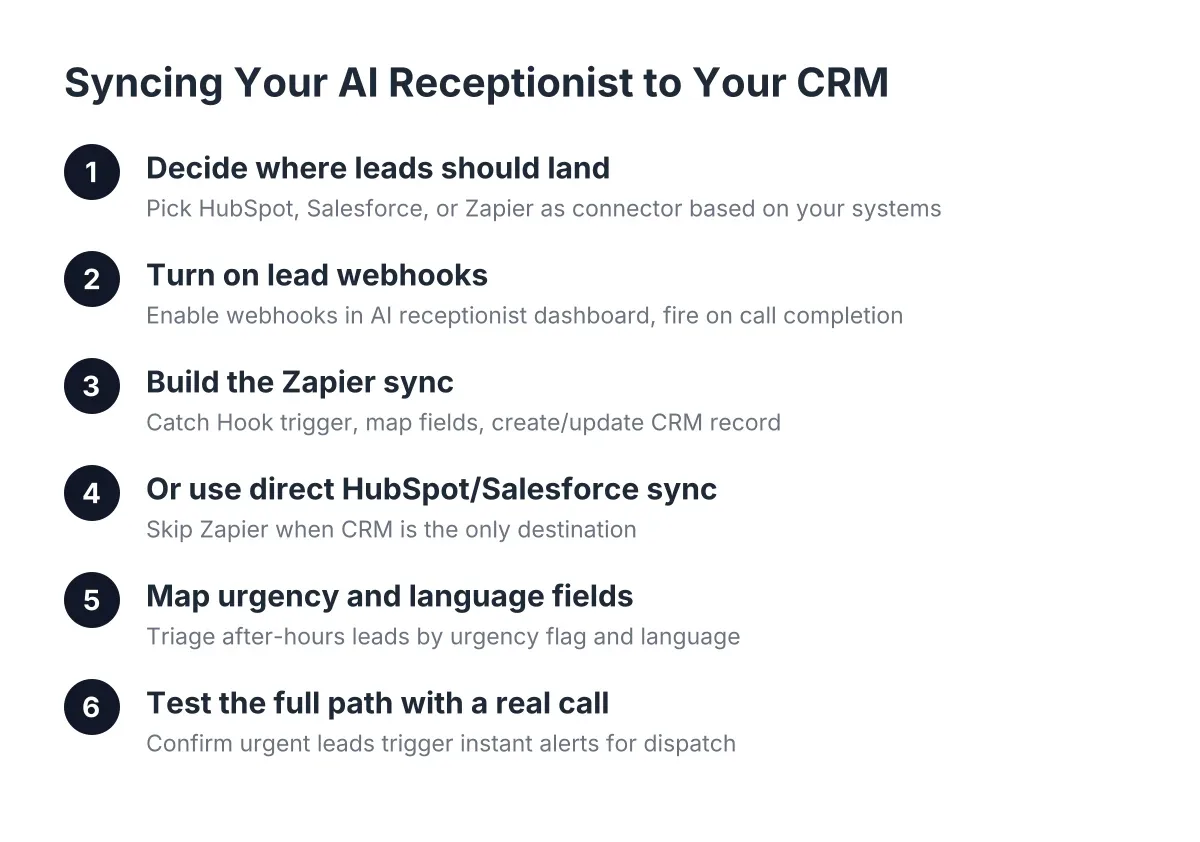
A modern AI receptionist makes this easier than a traditional service because every call comes with a summary, a lead score, and a record you can push straight into your CRM through Zapier, HubSpot, Salesforce, or Zoho. A weekly Monday morning report that lists calls answered, leads captured, and jobs booked turns ROI from a guess into a habit. You should be able to look at one page each Monday and know whether last week's after-hours window made you money.
One honest caveat: attribution gets messy when a caller reaches you through multiple channels, say a website chatbot conversation Tuesday and a phone call Thursday. Do not double-count that lead. If your books are complex or you are weighing this against hiring, a session with your accountant on customer acquisition cost is worth the hour.
Should You Hire Evening Staff or Use an Automated System?
For a business with 1 to 15 crew members, an automated AI receptionist beats hiring evening staff on cost, coverage, and consistency. Hiring a part-time evening receptionist covers a few hours a night; an AI receptionist covers nights, weekends, and holidays without shift schedules, sick days, or turnover. The staffing math is hard to argue with at this size.
According to the U.S. Bureau of Labor Statistics, the median receptionist wage was $17.90 an hour in May 2024, about $37,230 a year before benefits or overtime. Covering evenings and weekends realistically means more than one hire, and night-shift phone work has brutal turnover. For a $300K lawn care operation, that is not a line item; that is a crew member's salary spent on answering the phone.
However, do not confuse "automated" with "voicemail with better manners." The bar for an after-hours system in the trades is high, and you should hold any option to it:
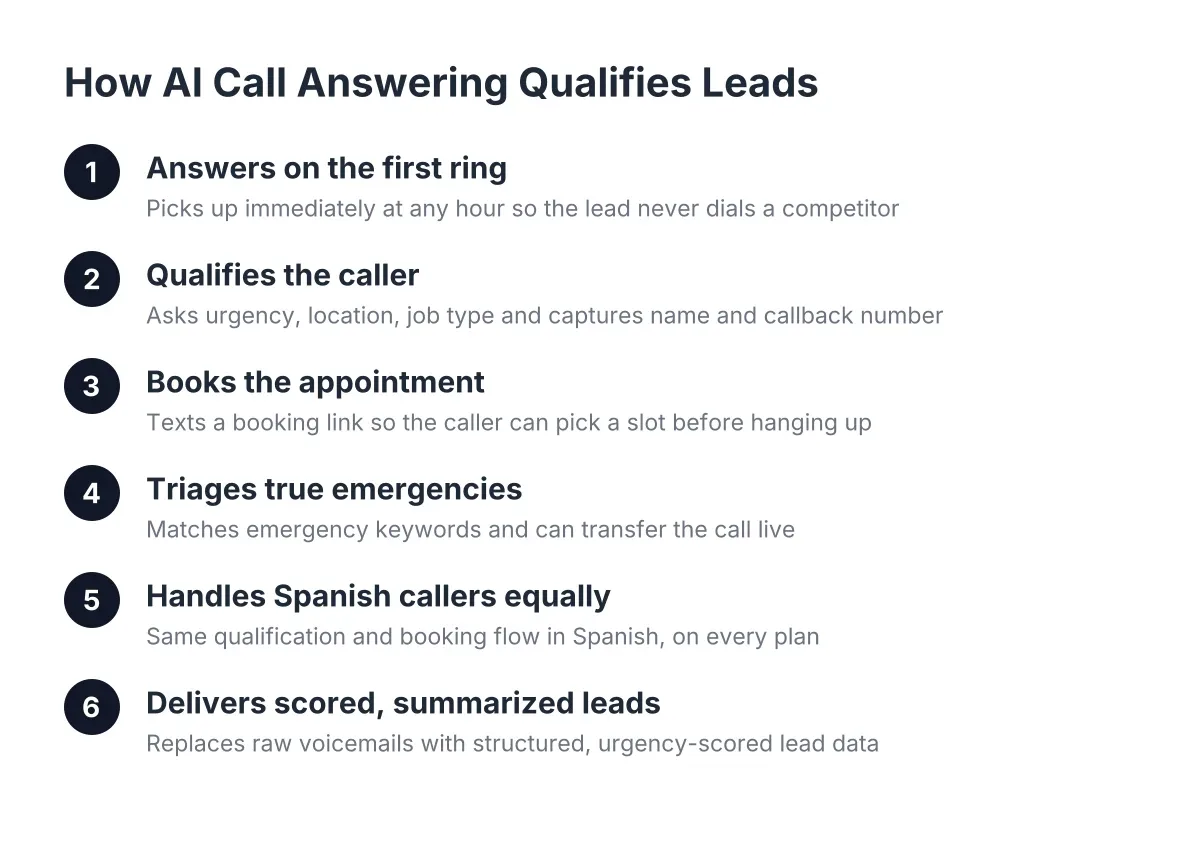
- Answers in seconds, every time. The MIT Sloan / InsideSales.com data shows speed is the whole game; a system that answers on the second ring beats any callback plan.
- Qualifies, not just records. It should capture whether the caller wants recurring weekly service or a one-time job, because those leads deserve different follow-up.
- Books on the spot. Sending a booking link during the call converts intent into a calendar slot before the caller opens the next tab.
- Handles both languages. In Central Texas, English-and-Spanish answering is table stakes, not a premium add-on. A Spanish-speaking homeowner in Leander should get the same first impression as anyone else.
- Triages real emergencies. A burst pipe or a gas smell is not a lead to capture; it is a call to transfer. Opt-in live transfer for urgent calls keeps the AI honest about what it should and should not handle alone.
Skepticism about AI call quality is fair, and the honest answer is to test it yourself. Call one, try to stump it, ask it something weird in Spanish, describe an emergency, and see what it does. Consumer research supports the skepticism: a Five9 survey found 75 percent of consumers prefer talking to a real human for support, while 84 percent already know companies use AI for customer service. The takeaway is not "avoid AI." It is that the AI has to be good enough that the 8 p.m. caller gets booked instead of frustrated, and that urgent calls still reach a human. The goal is capturing calls your team physically cannot answer, not replacing the relationship you build on site.
There is also a competitive angle most owners miss. According to the National Federation of Independent Business (NFIB), only 24 percent of small employers currently use AI tools for business activity. In a market where three in four competitors still send after-hours callers to voicemail, being the company that answers at 9 p.m. is a durable local advantage, at least for now.
What Weak After-Hours Coverage Costs an Austin Trade
Skipping after-hours call answering costs an Austin recurring service business in three compounding ways: lost lifetime value from new customers who call a competitor, wasted marketing spend on ads that generate calls nobody answers, and seasonal revenue that cannot be recovered once the booking window closes. Each one alone justifies fixing the problem; together they make voicemail an expensive default.
The lifetime value loss is the biggest and the least visible. A one-time job you miss shows up as a quiet week. A recurring customer you miss never shows up at all; you simply grow slower than the competitor who answered, and you never learn why.
The marketing waste stings in a different way. If you spend $800 a month on Google ads to make the phone ring, every after-hours ring that hits voicemail is ad spend you paid for and then threw away. Fixing lead capture is usually cheaper than buying more leads, and it raises the return on every marketing dollar you already spend.
Seasonality makes both problems worse. Spring booking season for lawn care lasts a handful of weeks; the recurring contracts you sign in March and April carry you through the year. A summer heat wave fills HVAC maintenance calendars in days. Miss those calls and you do not get a makeup window in November. The revenue is not delayed; it is gone to whichever company in Round Rock or Fort Worth picked up.
Turning the Math Into a Monday Morning Habit
Run your own numbers before you buy anything. Pull 90 days of phone records this week and count the calls that arrived after 5 p.m., before 8 a.m., or on weekends. Multiply the genuine prospects by your real customer lifetime value, not your average ticket. Most recurring service owners who do this exercise find the annual number lands somewhere between "uncomfortable" and "that is a truck payment."
Then hold whatever solution you choose, whether an AI receptionist, a virtual answering service, or an office hire, to the same four-stage funnel: answered, captured, booked, converted. Review it weekly. The owners who win their local market are not the ones with the best AI or the biggest ad budget. They are the ones who treat the after-hours window as what it is: a scheduled, measurable, recurring source of new customers that shows up every night whether or not anyone answers the phone.
You cannot be on a ladder and on the phone at the same time. You can, however, make sure the phone gets answered anyway, and know down to the dollar what that answer is worth.
If you're losing revenue to missed calls, NeverMiss ATX can help.
Prefer to talk it through? Call (512) 980-9267 — a quick call is usually the fastest way to get a straight answer for your situation.