How to Set Up Bilingual Call Answering for After-Hours Jobs in Austin
You already know the after-hours phone is where money leaks out of your business. What most Austin trades have not done yet is set up bilingual call answering that catches those calls in both English and Spanish, books the job, and captures the lead while the crew sleeps. A bilingual after-hours setup Austin trades are missing is the ability to answer these calls live in the customer's preferred language. That gap is not a rounding error. In a city where nearly a third of residents are bilingual, an English-only voicemail after 6 p.m. quietly hands work to whoever answers next. This guide walks you through the setup, step by step, so you can have bilingual after-hours coverage live before your next surge.
Why After-Hours Calls Are a Predictable Revenue Window, Not an Edge Case
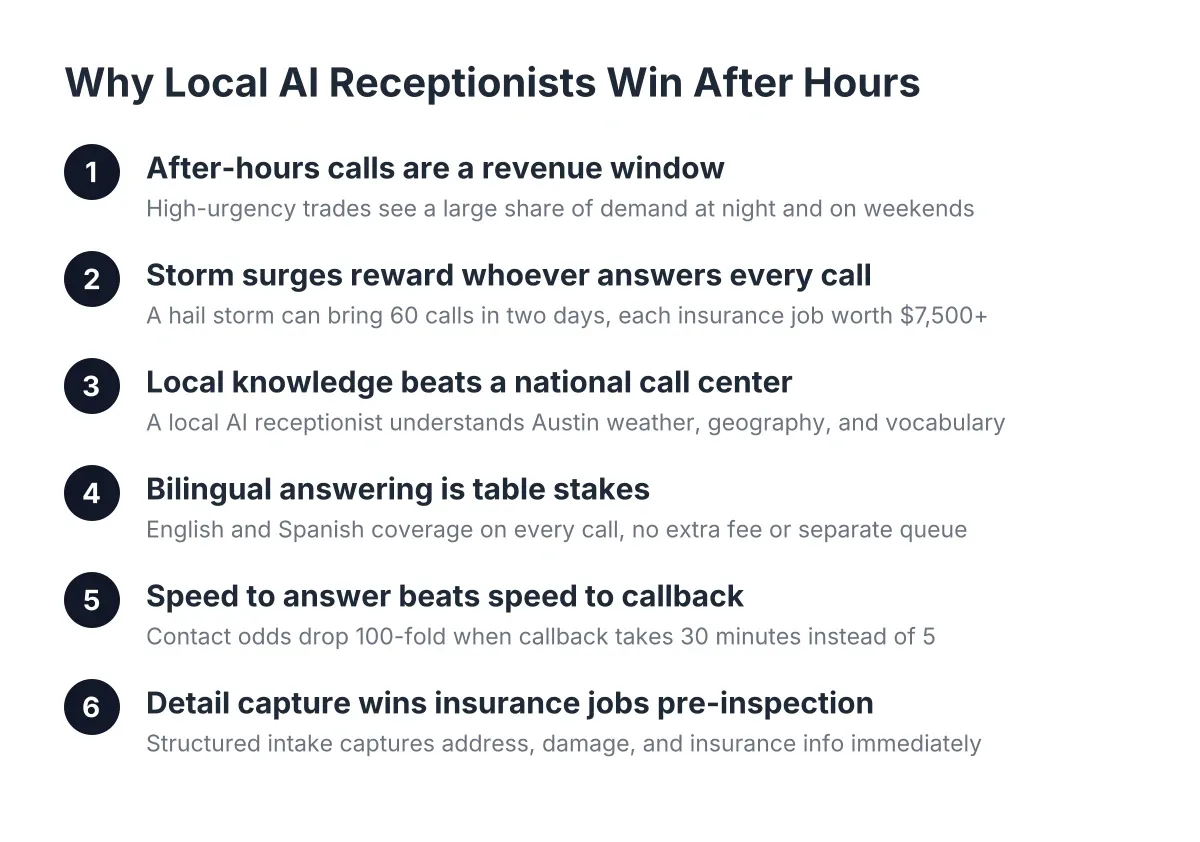
After-hours calls follow patterns you can plan around. Pipes burst overnight during a freeze. Hail hits at 8 p.m. and homeowners start dialing roofers before the stones melt. AC units die on Friday evening in July, and the family calling at 9 p.m. is not browsing; they are buying.
For storm and event-driven operators, this is the whole game. A single hail event over Round Rock or Cedar Park can multiply call volume inside 48 hours, and a single insurance job can run into the thousands. However, the surge does not respect business hours. Homeowners call the moment they see the damage, which is often that same evening, and they call down a list until someone picks up.
Speed decides who wins those jobs. According to MIT Sloan School of Management / InsideSales.com, the odds of contacting a lead drop 100-fold, and the odds of qualifying that lead drop 21-fold, when the callback happens at 30 minutes instead of within 5 minutes. Voicemail at 10 p.m. with a callback at 8 a.m. is not a 10-hour delay in practice. It is usually a lost job, because a competitor answered live at 10:05.
The same math applies to recurring service businesses. A lawn care or pest control call answered live on the first ring often becomes a recurring customer worth thousands over several years. A missed call becomes someone else's recurring customer. First call, lifetime value; it is that direct.
Why Bilingual Coverage Doubles the Value of After-Hours Answering
Bilingual after-hours setup in Austin matters because a large share of your market prefers Spanish, especially in a stressful moment like storm damage or a burst pipe. In Austin, 29.6% of residents age 5 and older are bilingual, and 10.3% speak English less than "very well," according to City of Austin data drawn from the U.S. Census Bureau ACS. Statewide, about 28.5% of Texans, nearly 7.8 million people, speak Spanish at home, per U.S. Census Bureau estimates reported via KXAN.
Now put those numbers next to an emergency. A homeowner in Pflugerville watching water come through the ceiling at midnight is going to explain the problem in whichever language comes fastest under stress. If your answering setup only handles English, you are not just missing calls. You are missing a specific, predictable slice of high-value calls that your English-only competitors are also missing. That is a market opportunity sitting in plain sight.
For storm operators, this cuts even deeper. Claim intake requires detail: the address, the type of damage, when it happened, the insurance carrier, the policy status. If the caller cannot give you those details comfortably in their preferred language, you get a thin lead instead of a workable claim file. Bilingual call handling is the difference between "someone called about a roof" and a qualified insurance job ready for inspection scheduling.
What You Need Before You Set Up Bilingual Call Answering
Gathering your business details before setup takes about an hour and determines how good your answering actually is. An AI receptionist is only as sharp as the information you feed it. Before you flip anything on, write down the following.
First, define your service scope in both directions. What do you do, and just as important, what do you not do? A roofer who does not handle flat commercial roofs should say so, because after a storm the AI will get asked.
Second, map your service area precisely. Austin, Round Rock, Cedar Park, Georgetown, Pflugerville, and Leander is a different footprint than "Central Texas." If you will drive to Fort Worth for a large insurance job but not for a repair estimate, spell that out.
Third, write your qualification questions. For a storm operator, that means claim intake essentials:
- Property address and best callback number
- Type and extent of damage (hail, wind, water intrusion, tree strike)
- When the damage occurred
- Whether a claim has been filed and with which carrier
- Whether the roof or property is currently leaking (this drives urgency)
- Owner-occupied or rental, since that changes who signs
For a recurring service business like HVAC maintenance or pest control, the questions shift toward intent: one-time fix or ongoing plan, size of property, and how soon they want service. Capturing recurring versus one-time intent on the first call tells you which leads are lifetime-value multipliers.
Fourth, decide your escalation rules. Which calls justify waking you up? A live transfer for a genuine emergency, active water intrusion, or a gas smell might be worth it. A quote request at 11 p.m. can be booked for a morning inspection without your phone ringing. Write both lists.
Finally, get your booking link ready. If you use a scheduling tool, the AI receptionist can text the link during the call so the homeowner books the inspection while they are still motivated. Booked beats promised.
How to Set Up Bilingual Call Handling, Step by Step
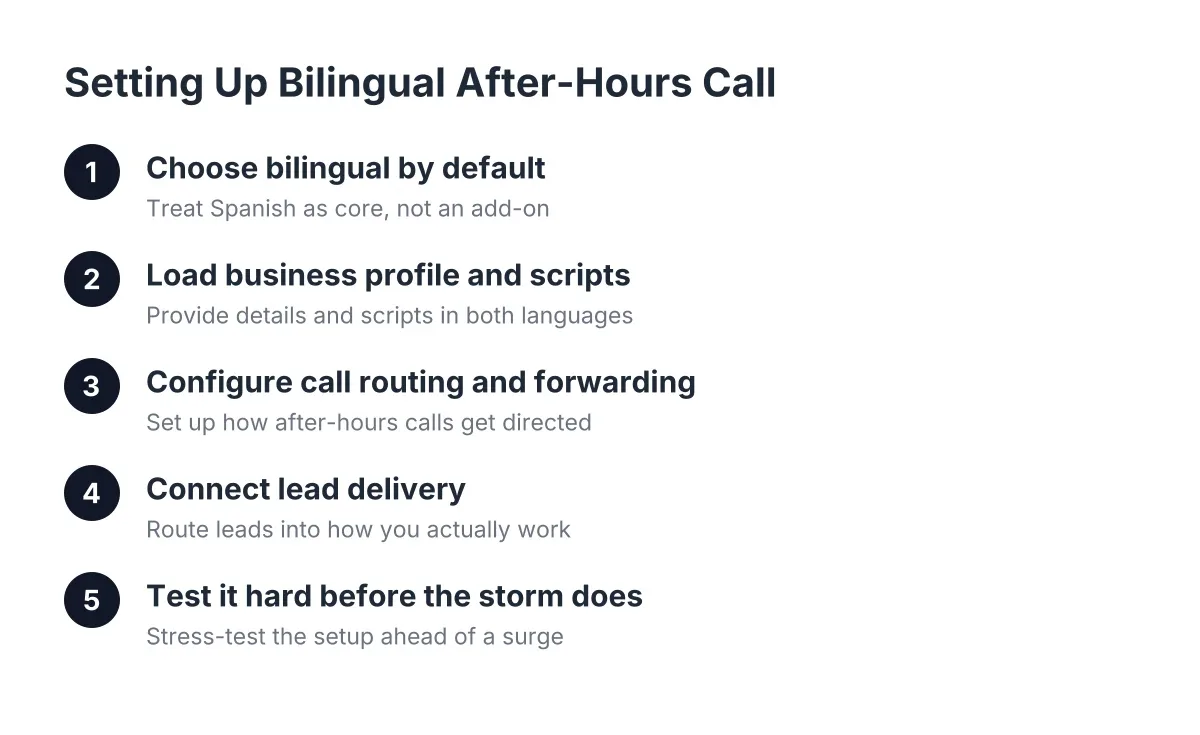
Setting up bilingual call handling with an AI receptionist takes most Austin home service businesses an afternoon, not a migration project. Here is the sequence that works.
Step 1: Choose bilingual by default, not as an add-on
Some national answering services charge extra for Spanish or route Spanish callers to a separate queue with longer waits. Both approaches lose calls. In this market, bilingual should be the baseline on every plan, with the AI detecting the caller's language and switching mid-conversation if the caller does. When you evaluate any service, call it in Spanish yourself, or have someone on your crew do it. If the experience feels second-class, your callers will feel it too.
Step 2: Load your business profile and scripts in both languages
Feed the system everything from your prep hour: services, service area, qualification questions, and escalation rules. Then verify the Spanish side carries the same substance, not a thin translation. "Granizo" needs to trigger the same hail-damage intake flow as "hail." Trade vocabulary matters here; a homeowner describing "goteras" (leaks) after a storm should get the same urgency handling as one saying "my ceiling is dripping."
In addition, check that your intake questions read naturally in Spanish. A stilted script signals a call center in another state. A natural one signals a local business that serves the whole neighborhood.
Step 3: Configure call routing and forwarding
Decide when the AI receptionist answers. Three common setups:
- After-hours only. Your office phone rings normally 8 to 6; calls forward to the AI on nights, weekends, and holidays.
- Overflow. The AI picks up whenever your line is busy or rings past three or four rings, which matters when you are on a ladder or on site.
- Full-time. The AI answers everything, and you or dispatch work from summaries and lead notifications.
Storm operators should strongly consider overflow plus after-hours. During a surge, your office line will be busy constantly, and unlike a human receptionist, an AI receptionist answers unlimited simultaneous calls. Forty homeowners calling at once after a hailstorm all get a live answer, in their language, with full intake. That is surge capacity no night-shift hire can match.
Step 4: Connect lead delivery to how you actually work
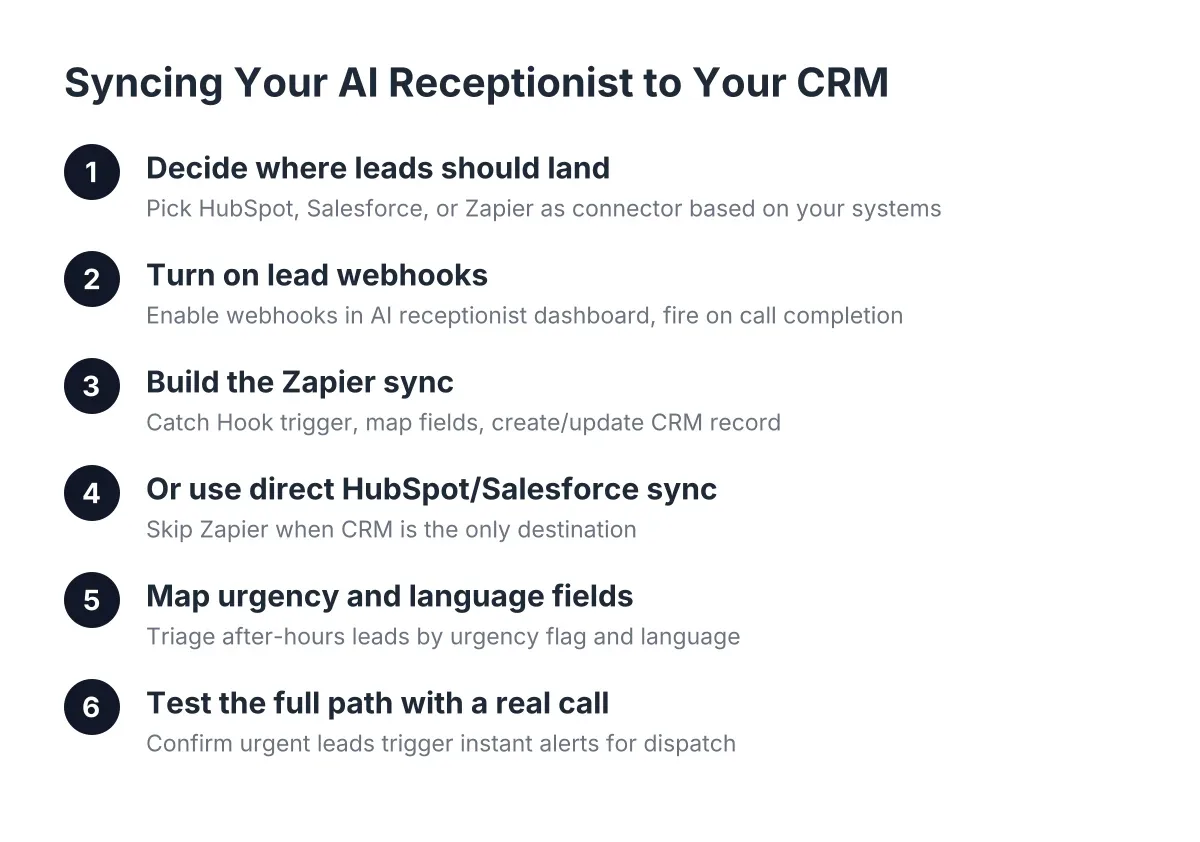
A captured lead you see 12 hours later is barely better than voicemail. Wire the output to your workflow: webhooks or CRM sync to HubSpot, Salesforce, Zoho, or through Zapier; instant text or email summaries for every call; call scoring so a $7,500 insurance job surfaces above a warranty question. During a post-storm morning, you want to open a dashboard, sort by claim value and urgency, and start bridging calls to the highest-value leads first, one click at a time.
Step 5: Test it hard before the storm does
Do not wait for a weather event to find the gaps. Call your own number after hours. Call it in Spanish. Describe hail damage vaguely and see whether the intake questions pull out the details an adjuster will want. Have your crew lead try to stump it. Then fix the scripts where it stumbled and test again. An hour of adversarial testing on a quiet Tuesday saves you real jobs on a chaotic Saturday.
Set Up Bilingual Call Coverage That Handles a Storm Surge
Suppose a severe hail cell moves over Georgetown at 7:40 on a Thursday evening. By 8:15, say your line has taken 31 calls; 9 of them are in Spanish. In that scenario, an English-only voicemail setup captures perhaps 4 or 5 callbacks by morning, and the Spanish-speaking homeowners have already booked with someone else.
With bilingual coverage live, the same illustrative evening looks different. All 31 calls get answered live, no busy signals. Each caller answers the claim intake questions in their preferred language. High-urgency calls, say active leaks, get flagged or transferred per your rules. Everyone else gets a booking link by text and picks an inspection slot for Friday or Saturday. By 7 a.m., you have a scored, summarized list: 12 likely insurance jobs, 6 already booked for inspection, addresses mapped, carriers noted.
Contrast that with the alternatives. Hiring evening staff means paying a receptionist a median of $17.90 an hour, roughly $37,230 a year before benefits, according to the U.S. Bureau of Labor Statistics, and one person still handles one call at a time. A national live answering service for small business needs can take messages, but agents reading a generic script do not know that Leander and Liberty Hill are different service zones, and they cannot answer 31 simultaneous calls either. After-hours call answering built for Austin trades, bilingual by default, is the setup that matches how demand actually arrives here.
One honest trade-off: some homeowners will always prefer a person. A Five9 survey found 75% of consumers prefer talking to a real human for customer support. The practical answer is not either-or. The AI receptionist answers instantly at 2 a.m. and captures the lead; you bring the human relationship on the callback and the inspection. It augments your team; it does not replace the handshake in the driveway.
Common Questions About Bilingual After-Hours Setup
How quickly can bilingual after-hours answering pick up my calls?
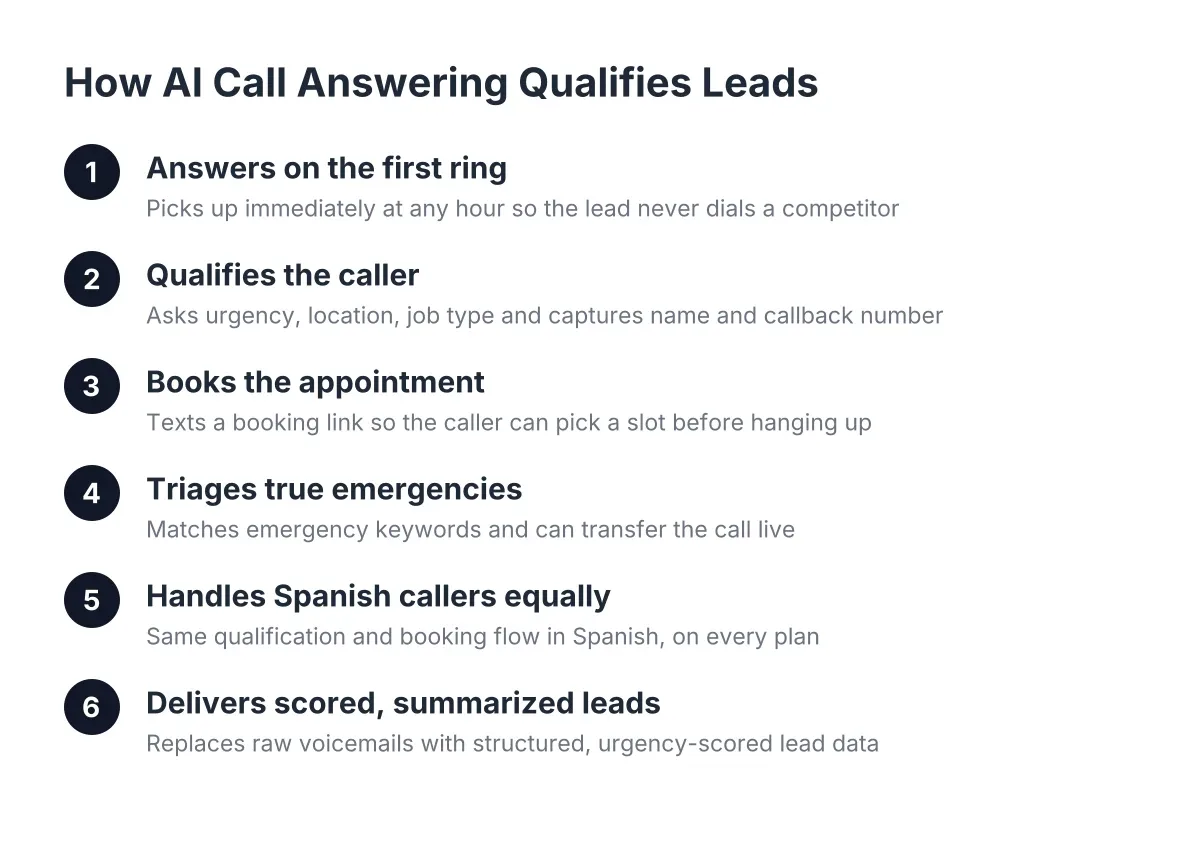
An AI receptionist answers on the first ring, in English or Spanish, at any hour, including when 20 other calls are already in progress. There is no queue and no hold music, because the system is not limited by headcount. Given the MIT Sloan / InsideSales.com finding that contact odds fall 100-fold at the 30-minute mark, first-ring answering is where the money is.
What information should I provide about my business during setup?
Provide your services and exclusions, exact service area by city, qualification and claim intake questions, escalation and live-transfer rules, booking link, and pricing guidance you are comfortable sharing. In addition, list trade-specific terms in both languages so a caller saying "granizo" or "plaga" gets routed correctly. The setup checklist earlier in this guide covers each item; most owners finish it in about an hour.
What happens to customer calls when my office is closed?
With bilingual after-hours coverage in place, every closed-hours call gets answered live, qualified with your questions, and either booked through your scheduling link or flagged for callback by priority. Without coverage, closed-hours calls hit voicemail, and most callers hang up and dial the next name in the search results. During a storm surge, that next name gets your year's worth of jobs.
Should I hire evening staff or use an automated system?
For solo to mid-size operations in the $150K to $800K revenue range, automated bilingual answering usually wins on both cost and capacity. A hired evening receptionist costs tens of thousands per year, handles one call at a time, and probably is not fluent in both languages. However, if you already run a full-time receptionist and a large answering service across multiple locations, your calculus differs, and it is worth reviewing your call data with an advisor before changing systems. For everyone else, the setup in this guide covers nights, weekends, holidays, and surges without adding payroll.
Make It Live Before the Next Weather Event
The window to set up bilingual call answering is now, while the sky is clear. Every setup step in this guide, the prep hour, the script loading, the routing rules, the adversarial testing, is work you can finish this week. When the next hail cell or hard freeze hits Central Texas, the operators who answer every call, in both languages, on the first ring, will book the inspections while everyone else returns voicemails.
You cannot control when the storm comes. You can control whether your phone is ready for it.
If you're losing revenue to missed calls, NeverMiss ATX can help.
Prefer to talk it through? Call (512) 980-9267 — a quick call is usually the fastest way to get a straight answer for your situation.