How Much Does After-hours Call Answering Cost?
How much does after-hours call answering cost? The honest answer depends on three things: whether a human or an AI receptionist picks up the phone, how many calls you get once the trucks are parked for the night, and what happens after the call, meaning lead capture, booking, and CRM sync versus a bare message slip. Any page that hands you one flat answering service cost number without asking about your call volume is guessing. By the end of this guide, you will know exactly what drives the price, which levers you control, and how to walk away with a real quote instead of a made-up figure.
What Drives the Cost of After-hours Call Answering
Five factors do most of the work in any answering service pricing model. Know where you stand on each one and you can predict which end of a provider's range you will land on.
Human operators vs. an AI receptionist
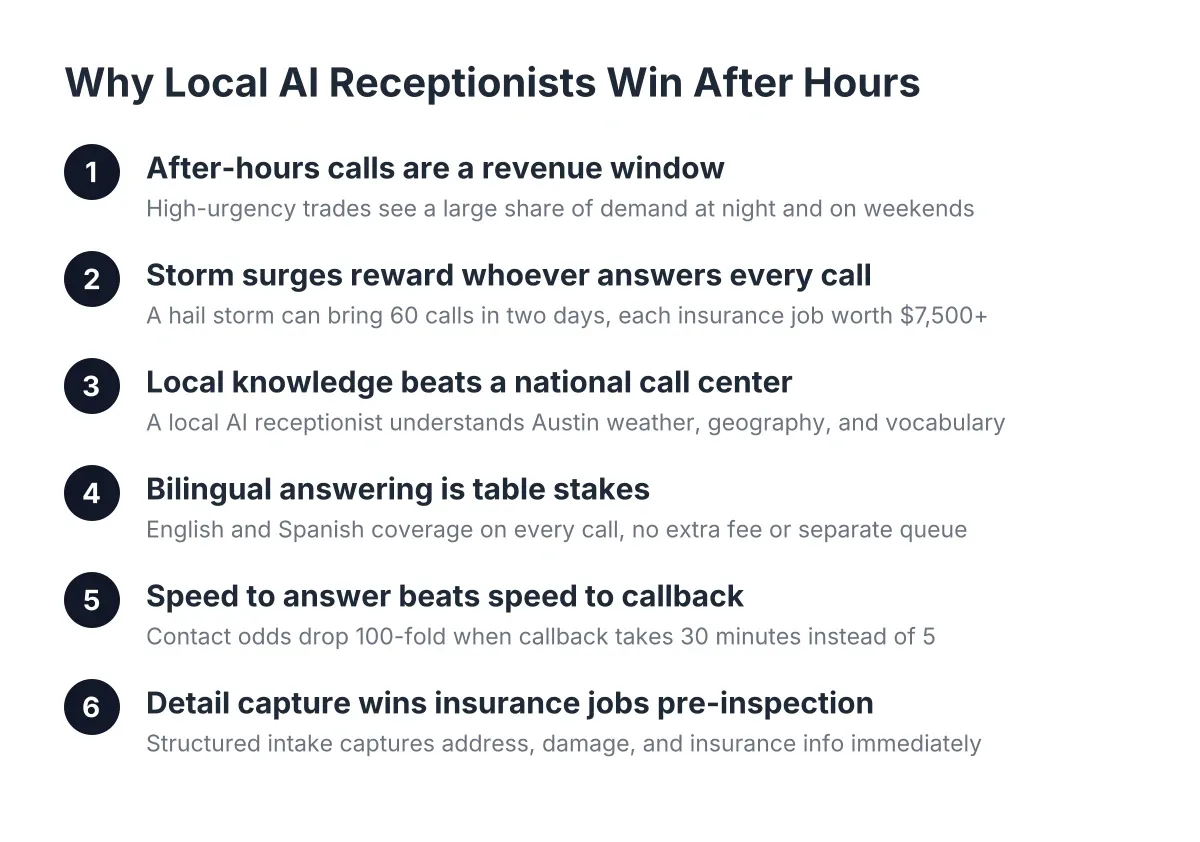
This is the biggest fork in the road. Traditional national answering services staff live operators around the clock, and you pay for that labor whether the phone rings or not. Overnight and weekend shifts cost those companies more to staff, and that cost lands on your bill. An AI receptionist answers every call the same way at 2 p.m. or 2 a.m., so there is no overnight premium built into the price. If you are comparing quotes, ask each provider directly: is a person answering, and does after-hours coverage cost extra? For a lot of Austin trades, that one question explains most of the price gap between bids.
Your call volume
Most human-staffed services bill by the minute or by the call, so a busy week costs more than a slow one. If a summer heat wave has your phone ringing off the hook with AC calls, a per-minute bill spikes right when you can least afford surprises. Flat-rate and AI-based pricing tends to hold steady regardless of volume. Check your phone records for a typical month, then check July. The difference between those two numbers tells you how much billing risk you are carrying with per-minute pricing.
What happens on the call
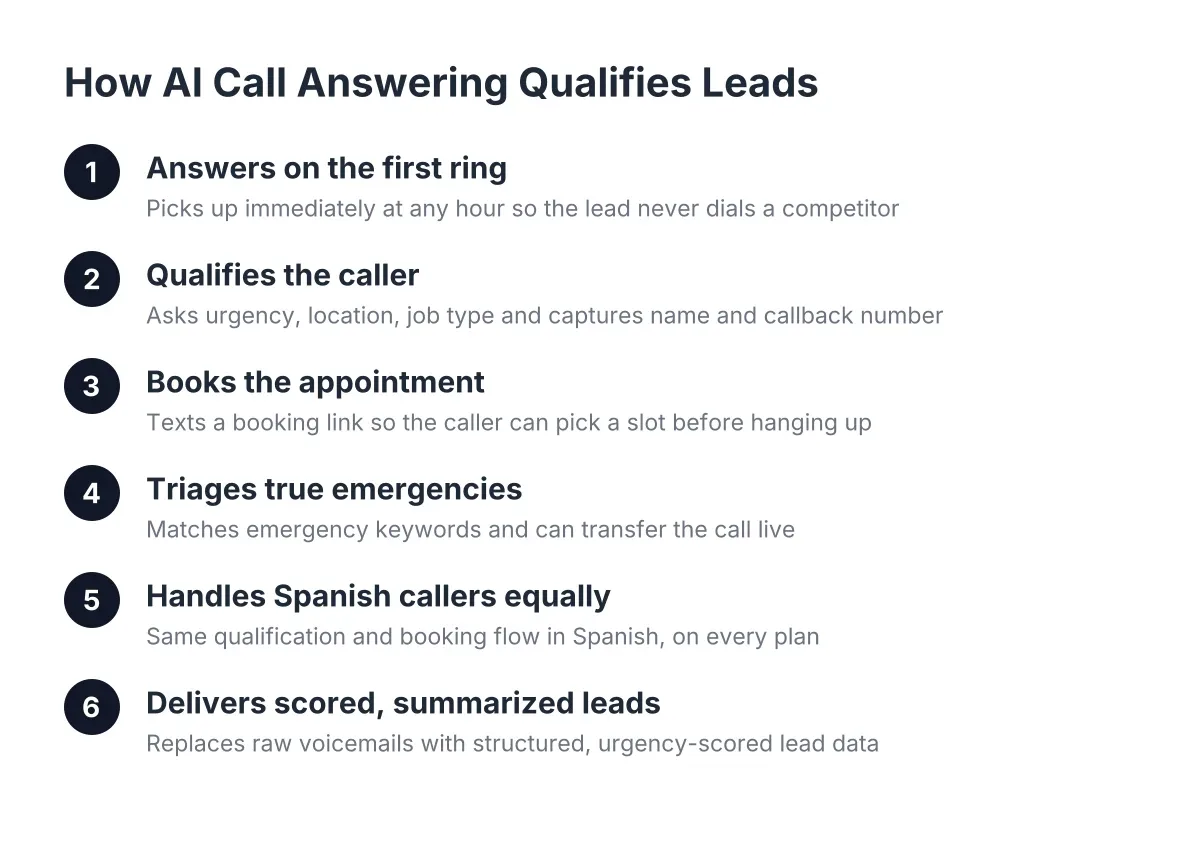
A basic service takes a message. That is the cheap end, and it is barely better than voicemail. The price climbs as the call does more: qualifying the lead, sending a booking link, delivering a call summary, scoring the lead so you know which callback to make first. Here is the thing to watch, though. A message-only service that loses you one water heater replacement a month is not cheap. It is expensive coverage that happens to have a low sticker price. When you compare the cost of after-hours call answering across providers, compare what the call produces, not just what the call costs.
Bilingual coverage
Central Texas runs on two languages, and a service that only answers in English misses a real share of your callers. National call centers often charge extra for Spanish-speaking operators, or route those calls to a smaller overnight team with longer hold times. Ask whether bilingual answering is included or billed as an add-on. With our AI receptionist, English and Spanish come standard on every plan, so this factor never touches your bill. With other providers, it can move the price meaningfully.
Integrations and urgent-call handling
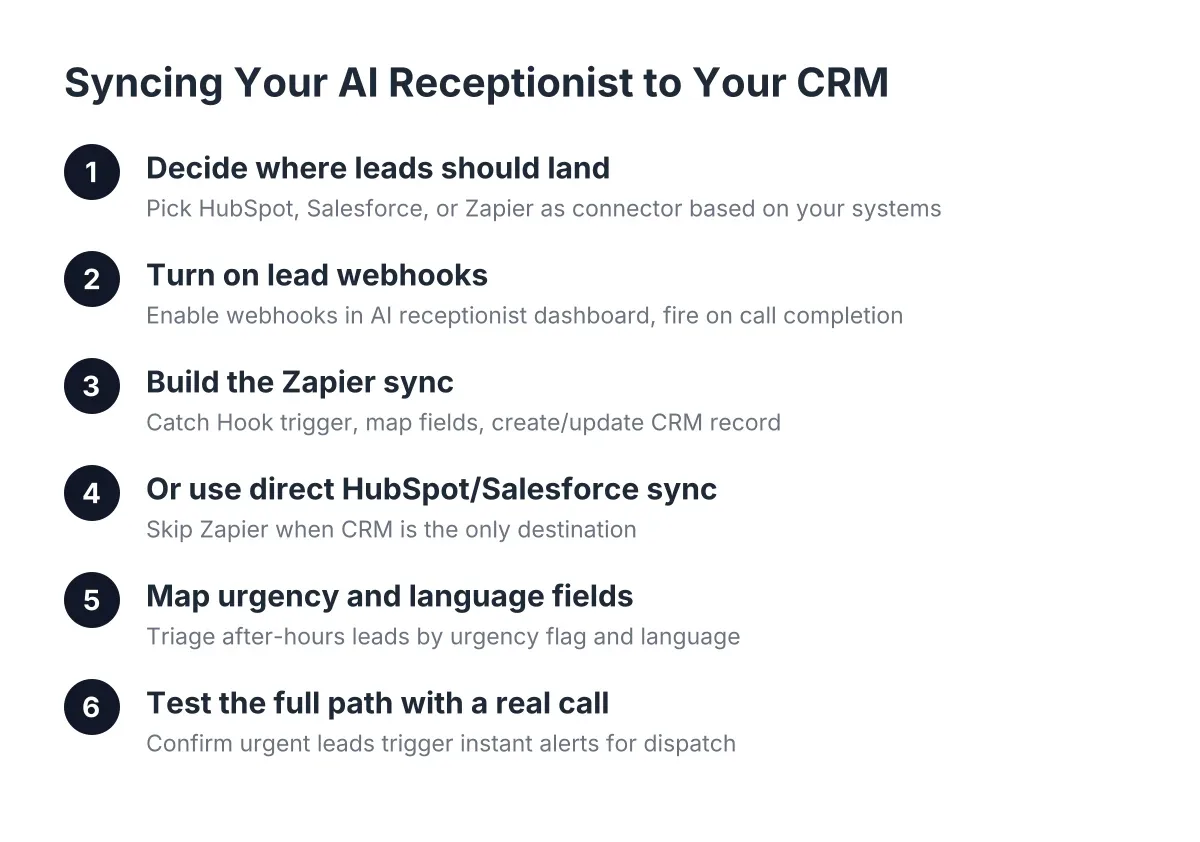
The last factor is what happens after the call ends. Pushing leads into HubSpot, Salesforce, Zoho, or a Zapier workflow saves you retyping every job, but some providers price CRM sync as a premium tier. Same story with live transfer for urgent calls: if a customer has a burst pipe at midnight, can the service patch that call through to you or your on-call tech? That capability is worth paying for in the trades, but confirm whether it is included, opt-in, or an upcharge. It varies a lot between providers.
Cost Factor Table
| Factor | Pushes the price down when… | Pushes it up when… |
|---|---|---|
| Who answers | An AI receptionist handles calls with no overnight staffing premium | Live operators cover nights, weekends, and holidays |
| Call volume | Your volume is steady or you are on flat-rate pricing | You bill per minute and hit a busy season spike |
| Call depth | You only need messages taken | Every call includes qualification, booking, and summaries priced as add-ons |
| Bilingual support | English and Spanish are included by default | Spanish coverage is a separate line item or premium tier |
| Integrations and transfers | Leads land in your inbox and you dial back manually | CRM sync, webhooks, and live transfer are billed as extras |
How to Get an Accurate Cost Estimate
You can get a real number in one phone call if you show up with the right information. Have these four things ready:
- Monthly call volume, including your busiest month. Pull it from your phone records. Providers price on volume, so a guess here means a guess on the quote.
- What you need each call to accomplish. Message only? Lead qualification? A booked appointment with a link sent by text? Be specific, because this is where quotes diverge the most.
- Language needs. If a meaningful share of your customers speak Spanish, say so up front and ask whether bilingual coverage changes the price.
- Your tech stack. Name your CRM or scheduling tool and ask whether syncing to it is included.
A good quote comes back itemized: the base rate, what counts as billable time or a billable call, every add-on with its price, and any setup fee. If a provider will not put after-hours coverage in writing as included, assume it is not.
Estimates differ between providers because their cost structures differ. A national call center is pricing labor, shift differentials, and turnover. An AI receptionist provider is pricing software, which is why the quotes often are not close. Neither number is wrong; they are pricing different things. Your job is to figure out which model fits your call volume and your tolerance for a bill that moves month to month.
One more test that costs nothing: call the service and act like a customer. Ask about a weekend water heater install. Ask in Spanish. Try to stump it. You will learn more in five minutes than any pricing page tells you, and we invite that test on our own AI receptionist any time.
Ways to Keep the Cost Down
- Match the pricing model to your volume. If your call volume swings with the seasons, flat-rate pricing protects you from a July bill that doubles. Per-minute pricing only wins if your phone is genuinely quiet.
- Skip paying for a graveyard shift. With human-staffed services, overnight coverage is the expensive part. An AI receptionist prices 3 a.m. the same as 3 p.m., so 24/7 coverage stops being a premium tier.
- Buy outcomes, not add-ons you will not use. If you already have a dispatcher handling daytime calls, you may only need coverage for evenings and weekends. But do not trim lead capture or booking to save money; a captured lead pays for the service, and a recurring customer pays for it many times over.
- Get two or three itemized quotes. Ask each provider the same questions: what is included, what triggers overage charges, and what after-hours coverage costs. Line the answers up side by side. Vague quotes hide fees; itemized ones cannot.
- Count the missed calls first. Before deciding what coverage is worth, estimate what one missed emergency call costs you in lost revenue. That number, from your own price book, is the honest benchmark for any quote you receive.
What Impacts After-hours Answering Service Costs
Before you compare quotes, understand that your specific situation—how many calls arrive per month and what those calls require—shapes what you will actually pay. An answering service cost is never a fixed number across the industry, and blanket pricing claims should raise a red flag.
Is an answering service cheaper than hiring someone?
Almost always, yes, and the gap widens after hours. A part-time hire covers set shifts and needs breaks, sick days, and payroll taxes; covering nights and weekends with staff means multiple people. An answering service, human or AI, covers 24/7 for a fraction of one salary. The real comparison is not service versus employee, though. It is service versus the jobs you lose to voicemail.
Why do quotes for the same coverage vary so much?
Because the providers are selling different cost structures. Live-operator services pay people to sit by the phone overnight, and that labor shows up in your rate. AI-based services do not carry that cost, so their quotes often look like a different product category entirely. Read the itemization, not just the bottom line, and confirm what each quote includes for nights, weekends, and Spanish-language calls.
Do I pay more for nights, weekends, and holidays?
With many traditional services, yes. Overnight and holiday shifts cost more to staff, and some providers pass that through as premium rates or after-hours surcharges. With an AI receptionist there is no shift differential to pass along, so a burst-pipe call on Christmas morning costs the same to answer as a Tuesday afternoon estimate request. Ask every provider this question in writing before you sign.
What hidden fees should I watch for?
The common ones: setup fees, per-minute overages past your plan, charges for patching calls through to you, fees for texting summaries, and premium rates for Spanish-speaking operators. None of these are scandalous on their own, but stacked together they can double a teaser rate. An itemized quote surfaces all of them; a one-line quote hides them.
The Bottom Line
The price of after-hours coverage comes down to who answers, how many calls you get, and what each call produces, and only a quote built on your actual numbers is worth trusting. Pull your call volume, decide what you need each call to accomplish, and get two or three itemized quotes side by side. And test before you buy: call our AI receptionist, ask it about a weekend job in English or Spanish, and see for yourself what the money gets you.
If you're losing revenue to missed calls, NeverMiss ATX can help.
Prefer to talk it through? Call (512) 980-9267 — a quick call is usually the fastest way to get a straight answer for your situation.