How AI Receptionists Answer Calls 24/7 So You Never Miss an After-Hours Job
The 9 PM burst pipe call is worth more than the 2 PM quote request. The homeowner already has water on the floor, they are calling down a list, and the first business that picks up wins the job. That is the whole problem for a solo tradesperson: you cannot answer a phone from under a sink or off a ladder, and hiring evening staff to sit by the phone makes no financial sense. This is exactly where an AI receptionist for tradesmen answers calls, qualifies the caller, and books the job while you finish the work in front of you or sleep before a 6 AM start. Here are seven things every Central Texas trade owner should know before picking a way to cover nights and weekends.
1. After-Hours Calls Are a Predictable Revenue Window, Not a Fluke
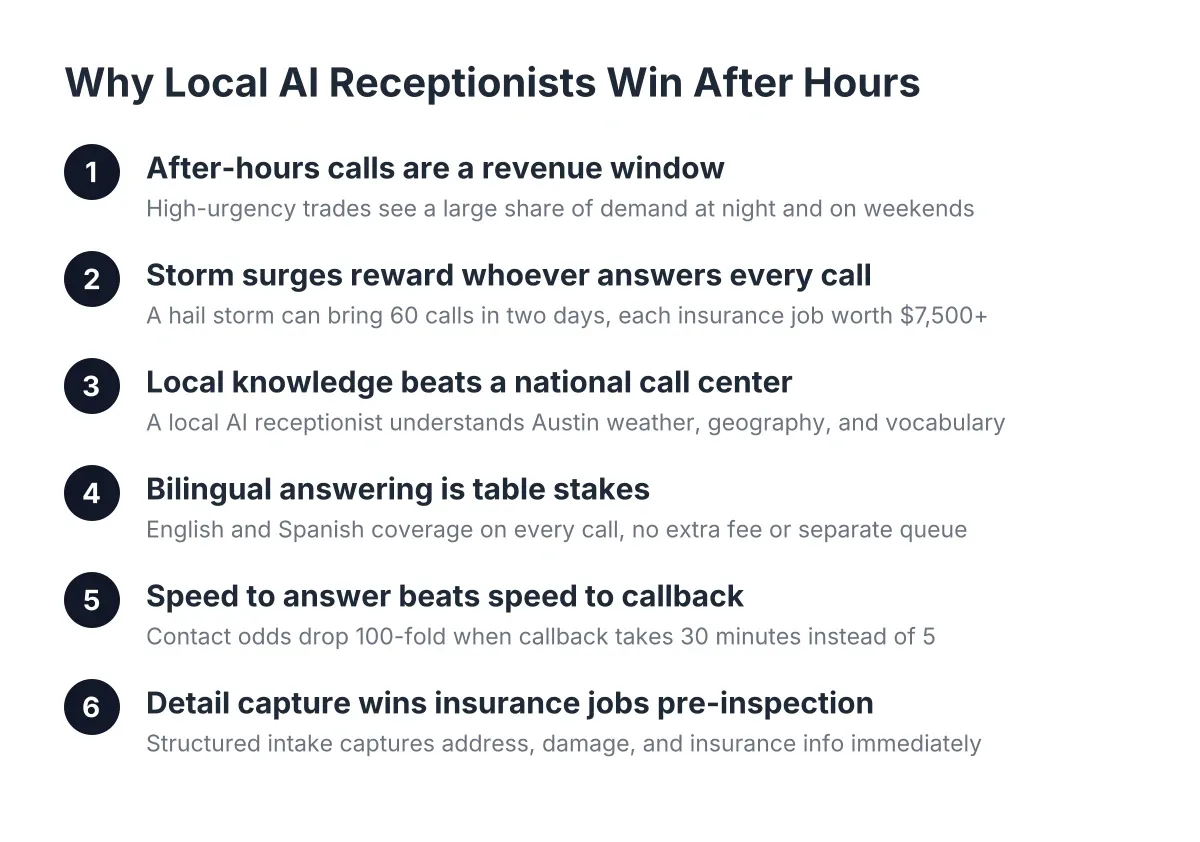
Emergencies do not respect business hours. Pipes burst at midnight, breakers trip during Sunday dinner, and wasps show up when the family gets home at 6 PM. In pest control, industry patterns show a large share of inbound calls land after hours; for plumbing and electrical, the after-hours caller is usually the highest-urgency, highest-ticket lead you will get all week.
Run the math on your own phone log. If you take 60 calls a month and a third of them come in evenings or weekends, that is 20 leads a month riding on whether anything picks up. With Austin emergency plumbing tickets often in the $400 to $800 range, missing even half of those calls is a five-figure hole in your year. The after-hours window is not an edge case; it is a schedule you can plan for.
2. Voicemail Is Where After-Hours Leads Go to Die
A homeowner with water pouring through a ceiling does not leave a voicemail and wait. They hang up and dial the next name in the search results. Many emergency callers never leave a message at all, which means your voicemail box shows two missed calls while five actual leads went to a competitor in Round Rock.
Voicemail also tells the caller something about your business: nobody is home. For emergency trades, that first ring is the sales pitch. An answered call says you are reachable when it matters; an unanswered one says keep dialing.
3. Your Real Options for After-Hours Coverage, Compared
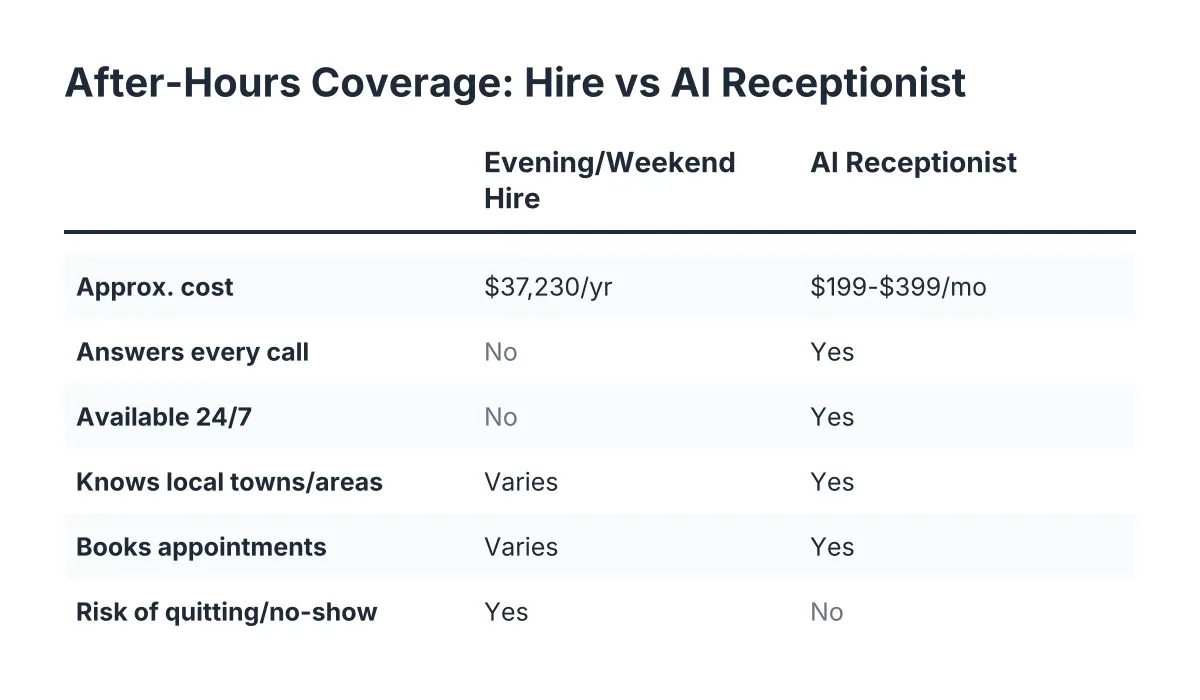
You have four realistic ways to handle after-hours call answering as a one-person operation, and each has a genuine trade-off. Weigh them against your call volume and your budget, not against a sales pitch.
- Answer everything yourself. Free, but physically impossible when you are on site, and brutal when the phone rings at 2 AM before a full day of jobs.
- Hire evening or weekend help. According to the U.S. Bureau of Labor Statistics, the median receptionist wage was $17.90 an hour in May 2024, about $37,230 a year before benefits. That is a full salary to cover hours when you might get three calls a night.
- Contract a national answering service. Live humans, but they read from a generic script, rarely know Pflugerville from Georgetown, and per-minute billing adds up fast during a busy storm week.
- Use an AI receptionist. Typically $199 to $399 a month, answers every call in seconds, books appointments, and does not call in sick. The trade-off is that it is software; you should test it on your own hardest calls before you trust it.
For most solo operators doing $200K to $500K a year, the decision comes down to the second and fourth options. One costs more than most truck payments combined; the other costs about what you spend on fuel in a week.
4. How an AI Receptionist for Tradesmen Works Without You Hiring Anyone
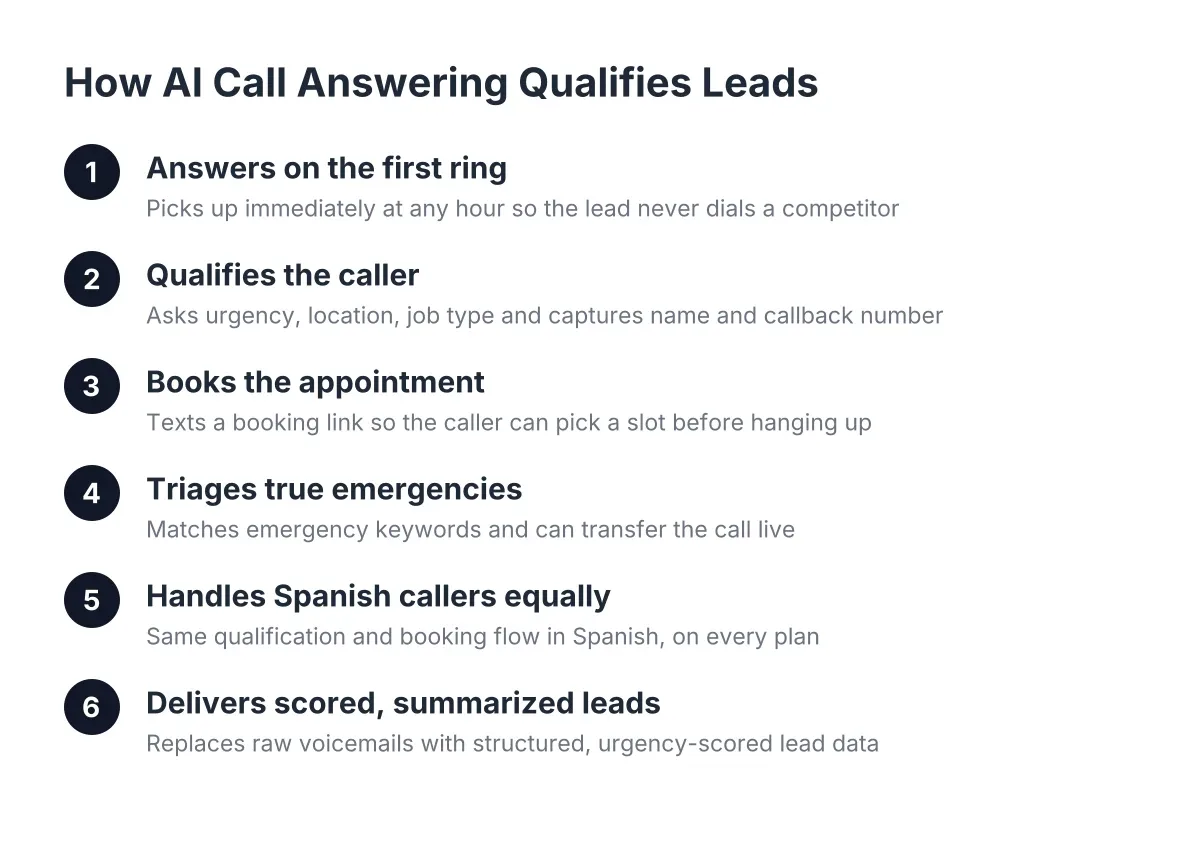
An AI receptionist picks up your line 24/7, greets the caller by your business name, asks qualifying questions, captures the lead, and books the appointment or sends a booking link. No night shift, no payroll, no training a new hire who quits in March. You get a summary of every call, so you start the morning knowing exactly who called, what they need, and how urgent it is.
Interestingly, the fear that automation means cutting people does not match what small businesses report. According to the National Federation of Independent Business (NFIB), 98% of small employers using AI said it caused no change in employee headcount. For a solo tradesperson, there is no headcount to change anyway; the AI covers hours you were never going to staff.
Skeptical about whether a machine can handle a panicked caller? Fair. The honest answer is that modern voice AI handles the common cases well, which is most of them: what is wrong, where are you, how soon do you need someone, here is when we can be there. The right way to evaluate any AI call answering service is to call it yourself and try to stump it with your weirdest real customer scenarios.
5. Emergency Triage Is the Feature That Separates Good From Useless
For plumbing, electrical, and pest work, not every after-hours call can wait until morning. A good AI receptionist sorts a gas smell from a dripping faucet, books the routine job for tomorrow, and live-transfers the true emergency to your cell if you opt in. That triage step is the difference between a tool built for trades and a generic phone bot.
For example, picture a Tuesday at 11:40 PM. A Cedar Park homeowner calls about a water heater leaking onto the garage floor. The AI receptionist for tradesmen confirms the address, asks whether the water shutoff is accessible, flags the call as urgent, and either bridges it to you or books the first slot tomorrow with full notes waiting in your dashboard. You never touched your phone, and the lead never touched a competitor's.
One honest caveat: AI triage guides the conversation, but it does not replace your professional judgment on safety. Anything involving gas leaks, sparking panels, or flooding near electrical should still route to you or emergency services, and a well-configured system is set up to do exactly that.
6. Bilingual Answering Doubles Your Reachable Market in Central Texas
A large share of Austin-area homeowners are more comfortable describing a plumbing emergency in Spanish. If your after-hours coverage only speaks English, you are handing those jobs to whoever answers en español. An AI receptionist that handles both languages on every call, without a separate line or an upcharge, captures leads a national call center's overflow desk will fumble.
This matters more after hours than during the day. A stressed caller at midnight defaults to their first language. When the AI switches naturally and books the job, that caller becomes a recurring customer who tells their neighbors you actually picked up when nobody else did.
7. When AI Receptionists Answer Calls, the Data Should Come Back to You
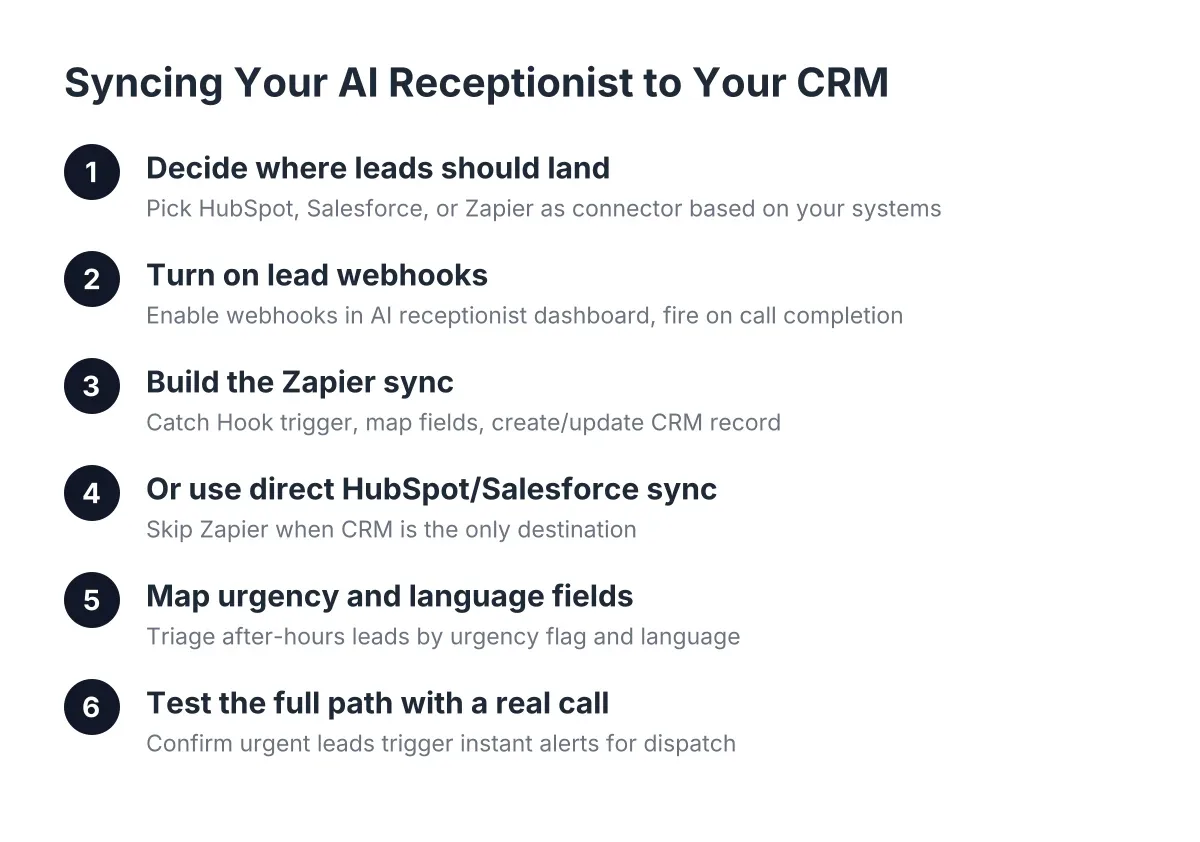
Answering the phone is half the job; the other half is what happens to the lead afterward. Look for call summaries, lead scoring, and sync into whatever you already use, whether that is a full CRM like HubSpot or a spreadsheet fed by Zapier. A Monday morning report showing every call, every booking, and every missed opportunity from the weekend turns your phone line into something you can actually manage.
Consumer expectations support this shift too. According to Five9, 84% of consumers already know companies use AI for customer service. The same Five9 research found 75% still prefer a human for support, which is exactly why the AI should capture and qualify the lead, then get you on the phone fast through one-click call bridging. The AI handles the 2 AM intake; you handle the relationship.
What About Free Call Screening Apps?
Free tools like Google Assistant call screening or a call app free from your phone's app store can filter spam and transcribe a message, and for a hobby business that may be enough. However, they do not book appointments, qualify emergencies, speak Spanish on demand, or answer when your phone is in the truck and you are in a crawlspace. Screening tells you who called; a receptionist wins the job.
The gap shows up in outcomes. A screened call still ends with the homeowner talking to a robot that takes a message, which is voicemail with better manners. An AI receptionist ends the call with a booked appointment on your calendar and a summary in your inbox.
Run Your Own Numbers Before You Decide
Strip the decision down to arithmetic you can do in the truck between jobs.
- Count your after-hours and missed calls from last month; your phone's call log has the data.
- Multiply by your average ticket. For emergency trades in Austin, $400 to $800 per job is a realistic range.
- Assume you convert even 40% of answered after-hours calls into booked jobs.
- Compare that recovered revenue against roughly $199 to $399 a month for an AI receptionist, or $3,000-plus a month for part-time evening staff.
For most solo operators in plumbing, electrical, or pest control, the recovered revenue from a single after-hours emergency call covers the month. Everything after that is money that used to go to voicemail.
Only 24% of small employers use AI tools at all, according to the National Federation of Independent Business (NFIB). In practical terms, that means the plumber across town probably still sends after-hours callers to voicemail. Being the business that picks up at 11 PM, in English or Spanish, with a booked slot by 11:04, is an advantage most of your competitors have not claimed yet. The calls are already coming in. The only question is what answers them.
If you're losing revenue to missed calls, NeverMiss ATX can help.
Prefer to talk it through? Call (512) 980-9267 — a quick call is usually the fastest way to get a straight answer for your situation.