How 24/7 AI Call Answering Recovers Missed Calls Before Competitors Grab Them
The math after a Central Texas hail storm is brutal. Demand spikes 300 to 400 percent in 48 hours, your phone rings while you are on a roof in Round Rock, and every call that hits voicemail is a $7,500 insurance job dialing your competitor next. This guide walks through how 247 AI storm surge call answering catches those calls the moment they come in, what it captures for claim intake, and how to set it up so the next storm surge fills your pipeline instead of theirs. You have already decided you need surge capacity on the phones. Now the job is making it work.
Why Missed Calls Hurt Most When You Are Busiest
A missed call on a slow Tuesday stings. A missed call the morning after a hail event costs you the year. Storm-driven work compresses months of demand into a two-day window, and the operators who answer every call during that window take market share the rest of the market never gets back.
Here is the mechanism. A homeowner in Pflugerville wakes up to dented gutters and a leaking ceiling. She calls the first roofer she finds. Busy signal. She calls the second. Voicemail. She calls the third, gets a live answer, books an inspection, and stops calling. The first two roofers never knew she existed. Their phones logged a missed call; their pipelines logged nothing.
Speed compounds the problem. According to MIT Sloan School of Management / InsideSales.com, the odds of contacting a lead drop 100-fold, and the odds of qualifying that lead drop 21-fold, when the callback happens at 30 minutes instead of within 5 minutes. After a storm, 30 minutes is generous. You are on a ladder, then driving to the next inspection, then on another ladder. By the time you check voicemail at 7 p.m., the morning's callers signed with someone else.
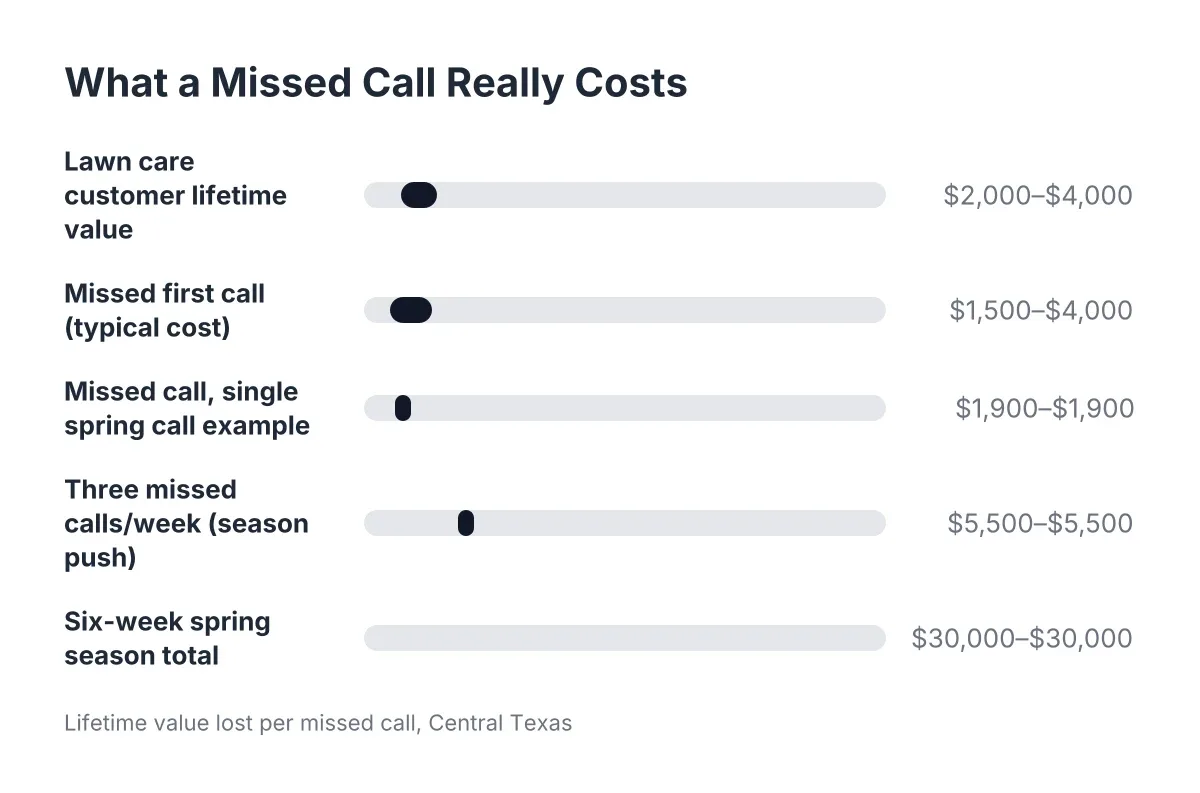
The dollar figures make it undeniable. Suppose a typical hail event drives 40 inbound calls to your line in the first 48 hours. Say your crew answers 15 while working. That leaves 25 missed calls. If half of those were qualified insurance jobs averaging $7,500, you left about $93,000 on the table in two days. That estimate ignores lifetime value entirely; a homeowner who becomes a recurring customer for gutters, fencing, and remodel work is worth several times the first job.
What Is 24/7 AI Call Answering and How Does It Work?
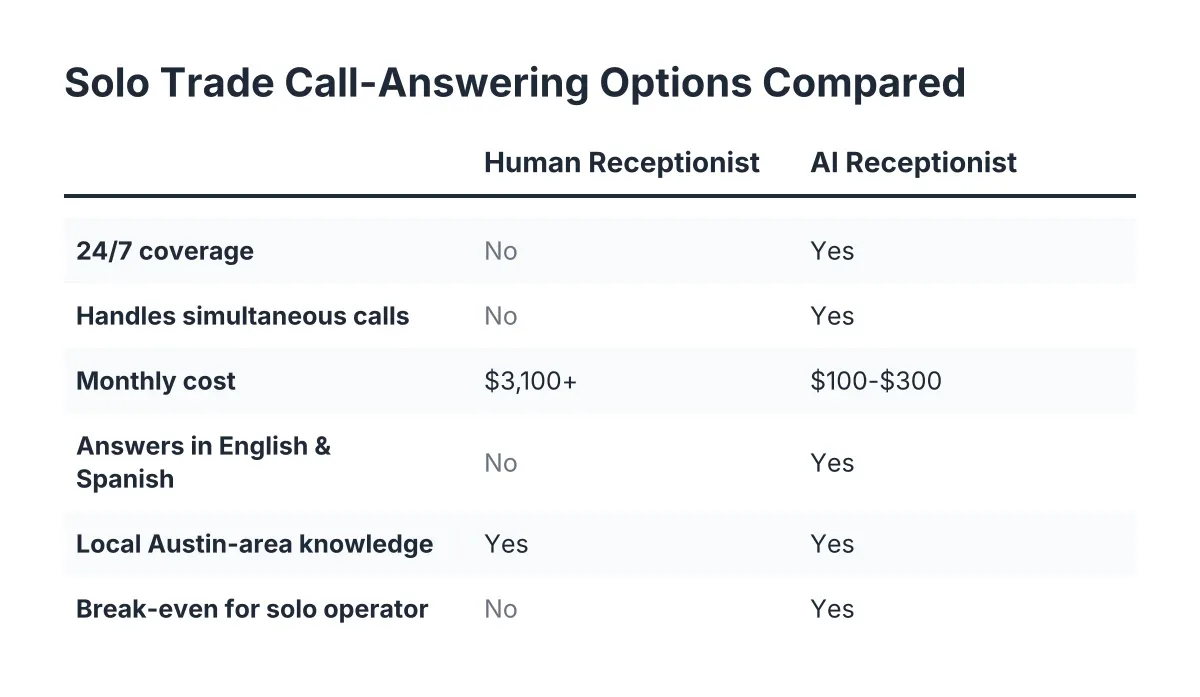
24/7 AI call answering is an AI receptionist that picks up every inbound call to your business line, day or night, holds a natural conversation with the caller, captures their details, qualifies the job, and books the appointment or sends a booking link. Unlike voicemail, it engages the caller in real time. Unlike a national call center, it answers from a script built around your trades, your service area, and your pricing questions.
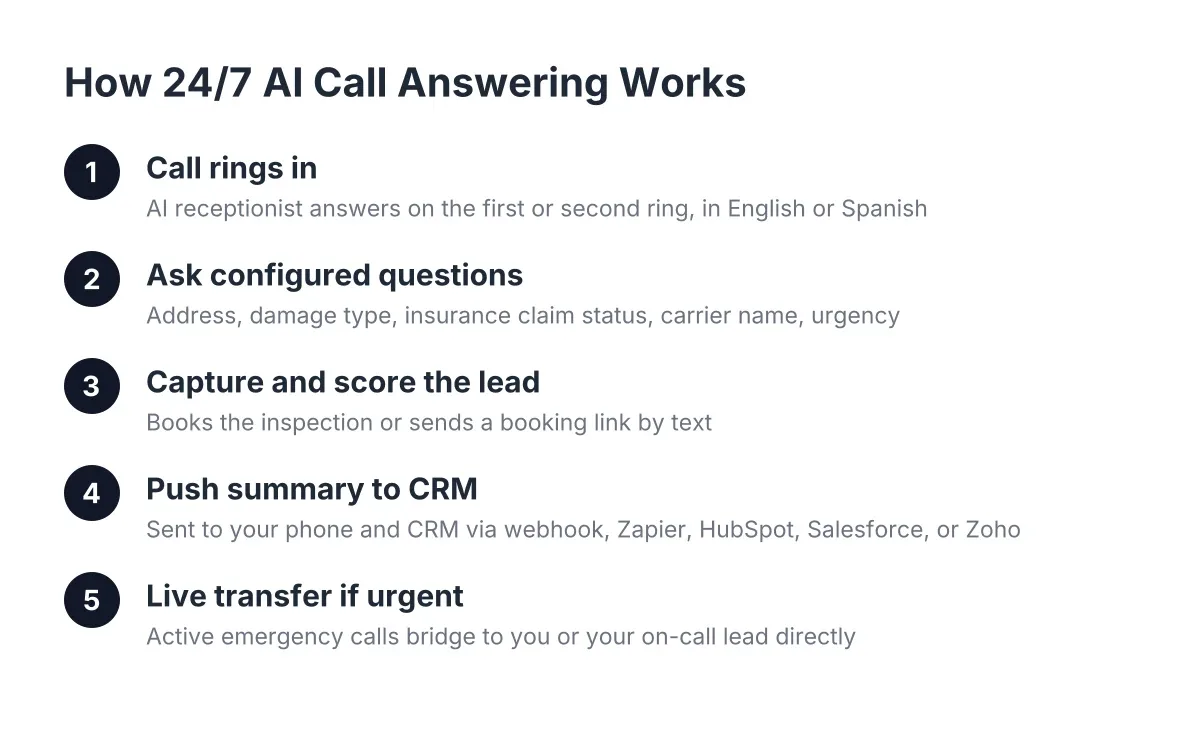
The flow works like this on a live call:
- The call rings your business number and the AI receptionist answers on the first or second ring, in English or Spanish depending on the caller.
- It asks the questions you configured: address, type of damage, whether an insurance claim is open, carrier name, and how urgent the situation is.
- It captures the lead, scores it, and books the inspection or sends a booking link by text.
- You get a summary pushed to your phone and your CRM through a webhook or a Zapier, HubSpot, Salesforce, or Zoho sync.
- If the caller reports an active emergency and you have opted into live transfer, the call bridges to you or your on-call lead directly.
The critical difference from voicemail is concurrency. Voicemail handles one message at a time and most callers hang up before the beep. An AI receptionist answers unlimited simultaneous calls. When 12 homeowners in Cedar Park call within the same ten minutes after a storm cell passes, all 12 get answered, qualified, and booked. No busy signals. No queue.
Worth naming honestly: most consumers still prefer people. A Five9 survey found 75 percent of consumers prefer talking to a real human for support, and 84 percent know companies use AI for customer service, per Five9. That is exactly why the standard to hold your AI receptionist to is not "as good as you on the phone." The standard is "as good as the alternative the caller actually gets," which during a surge is voicemail or a busy signal. Against that bar, a fast, competent AI answer wins the job.
Set Up Your AI Receptionist Before the Storm Surge Arrives
You cannot configure claim intake questions while your phone melts down. The setup below takes an afternoon, and it should happen during a calm week, not the morning after the hail.
Build your claim intake script around insurance detail
The value of a post-storm call lives in the details. A voicemail that says "call me back about my roof" is worth a fraction of a structured claim intake. Configure your AI receptionist to ask for:
- Property address and best callback number
- Type of damage: hail, wind, water intrusion, fallen tree, or multiple
- Whether a claim is already filed, and if so, the carrier and claim number
- Whether the damage is active (water coming in now) or contained
- Roof age and material if the caller knows it
- How they heard about you, so you can track which channel the surge came from
Each answer feeds the lead summary. When you review 25 captured leads at the end of a surge day, you can sort by claim status and damage severity instead of returning calls blind.
Define your triage rules in advance
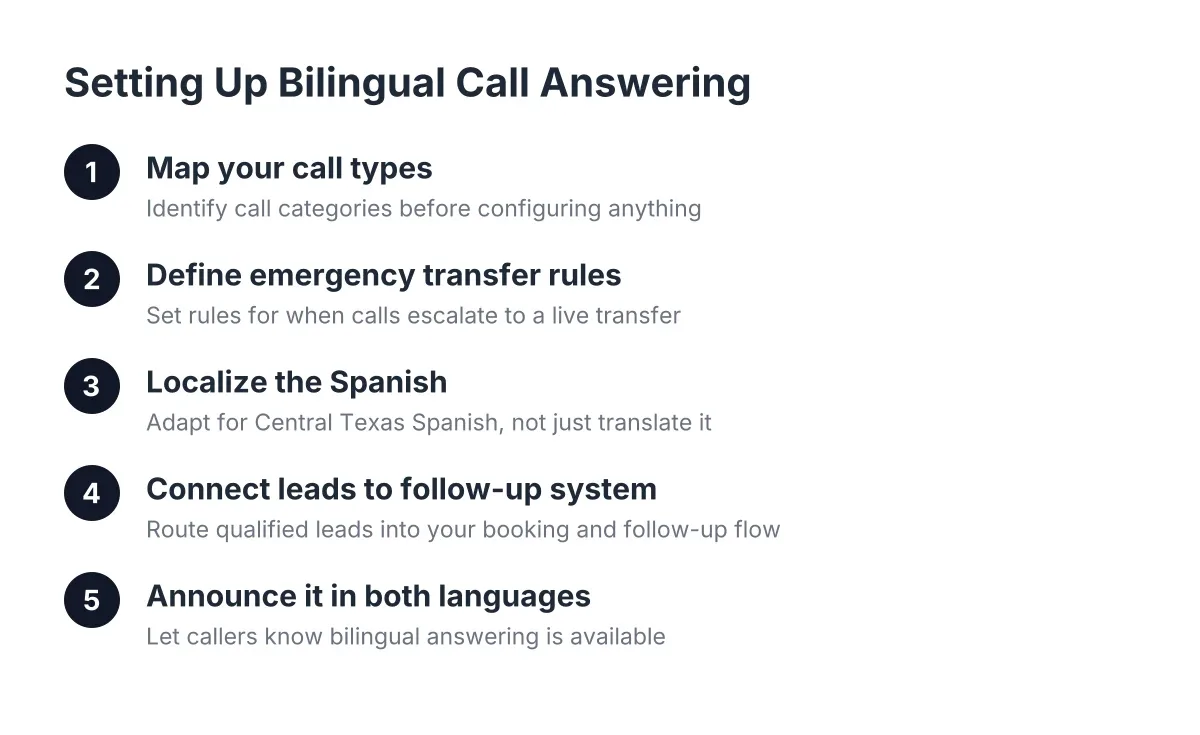
Not every post-storm call deserves the same response speed. Decide now which situations trigger a live transfer to your phone and which get booked for inspection. A workable split for a general construction or multi-trade operation looks like this: active water intrusion or structural danger bridges to you immediately; filed insurance claims with confirmed damage get booked into your next-day inspection slots; everything else gets a booking link and a callback within your stated window.
Write these rules down and load them into the AI's configuration. During chaos, the system triages so you do not have to. That is the difference between working your highest-value claims first and working whoever happened to call most recently.
Turn on bilingual answering from day one
Central Texas is a bilingual market, and storm damage does not check which language the homeowner speaks. An AI receptionist that handles English and Spanish on every call captures the leads a monolingual answering setup drops silently. You never see those missed calls in your log as lost revenue; they show up as your competitor's trucks in the neighborhood.
Connect your CRM and test the webhook
Lead capture only pays off if the lead lands where you work. Connect the webhook or native sync to whatever you use, whether that is HubSpot, a Zoho pipeline, or a Zapier flow into a spreadsheet. Then place a test call, run through the full intake as a fake caller, and confirm the lead appears with every field populated. Do this before the storm, and repeat it after any script change.
Running 247 AI Call Answering During a Storm Surge
Setup gets you ready. Surge days are where the system earns its keep, and how you operate it during those 48 hours decides how many of the captured leads convert.
Work from the lead dashboard, not your voicemail
During a surge, your call log becomes noise. Your lead dashboard becomes the plan. Every answered call arrives as a scored, summarized lead with the intake details attached. Between inspections, open the dashboard, sort by score and claim status, and use one-click call bridging to reach the highest-value callers first.
The MIT Sloan / InsideSales.com finding applies here too. Even with the AI receptionist holding the lead's information, your personal follow-up call still converts better in the first minutes than the first hours. The AI buys you time by engaging the caller instantly; spend that time on the right leads instead of dialing down a voicemail list in the order calls arrived.
Use call summaries to prep every inspection
Before you knock on a door in Georgetown, read the AI call summary. You will know the damage type, the carrier, whether the claim is filed, and what the homeowner said about urgency. Walking in with that context shortens the inspection, sharpens your scope conversation, and signals competence to a homeowner who is fielding pitches from six roofers that week.
Review the pattern after the surge
Once the surge settles, run the numbers. How many calls came in, how many the AI answered after-hours, how many booked, and how many converted to signed contracts. A weekly Monday morning report makes this review a habit instead of a project. Over two or three weather events, you will see which intake questions predict signed jobs and can tighten the script accordingly.
What Happens to Callers Who Hit Voicemail Instead?
Callers who reach voicemail after a storm mostly do not leave a message, and most who leave one do not wait for a callback before dialing the next company on their list. Post-storm homeowners are calling down a search results page under stress, often with water coming in. The first live answer usually wins.
This is the quiet failure mode of relying on voicemail during a surge. Your phone shows 25 missed calls and 6 messages. You call all 6 back that evening and reach 2. The other 19 callers left no trace at all. From your side it looks like a busy, productive storm week. From the market's side, you were invisible for two days while the operators with surge capacity booked a season's worth of inspections.
Missed call recovery is the discipline of closing that gap: answering every ring, capturing every caller's details, and following up fast enough that the lead is still yours to win. Voicemail is not a recovery system; it is a record of the revenue that got away. An AI receptionist converts the same rings into structured, workable leads while you stay on site.
How 24/7 AI Call Answering Handles After-Hours and Overflow Beyond Storms
Storm surges are the extreme case, but the same missed-call leak runs year-round for a multi-trade operation. Evening calls about a remodel quote, Saturday morning calls about a fence repair, and lunchtime calls that arrive while you are under a sink all follow the same pattern: no answer means the caller moves on. A storm surge call answering system stops that leak during emergencies, but the same system runs every evening and weekend when no disaster is occurring, recovering calls that regular staffing cannot catch.
After-hours answering matters more than most owners assume. For a solo operator or a crew of eight anywhere from Leander to Fort Worth, a meaningful share of inbound calls land outside working hours or during jobs when nobody can pick up. Each of those is a quote request, a repair, or a renovation lead that either gets captured or evaporates. The 24/7 part of 247 AI call answering is not a feature checkbox; it is where a large share of the recovered revenue actually comes from, because those are the calls no human setup was going to answer anyway.
Adoption is still low among small operators, which is the opportunity. An NFIB survey found only 24 percent of small employers currently use AI tools for business activity. In a market where three in four of your competitors still let after-hours calls hit voicemail, answering every call is a durable edge, not table stakes. Notably, the same NFIB research found 98 percent of small employers using AI reported no change in employee headcount. The AI receptionist answers the phone; it does not restructure your crew or take over the customer relationship. You still run the inspections, write the scopes, and shake the hands.
Common Setup Mistakes That Cost Jobs During a Surge
Even a well-chosen system underperforms if it is configured casually. These are the failure modes to check before severe weather season:
- Generic intake questions. "How can we help you?" captures less than a structured claim intake. Build the script around insurance jobs specifically.
- No triage rules. If every call gets identical handling, your $15,000 full-replacement lead waits behind a gutter-cleaning inquiry.
- Untested CRM sync. A broken webhook discovered mid-surge means leads pile up in a dashboard nobody is watching. Test with a live call quarterly.
- Live transfer left off entirely. Active water intrusion calls deserve a human voice fast. Opt into emergency transfer and define what qualifies.
- Never calling your own line. You should hear what your callers hear. Call your number after hours, in English and in Spanish, and try to stump the intake. Fix whatever trips it.
One honest limitation: an AI receptionist captures and qualifies the lead, but it does not scope a roof or negotiate with an adjuster. Complex claims, disputed scopes, and anything involving structural safety still need you or a licensed professional on site, and your follow-up speed on high-value leads remains the biggest conversion lever you control.
The Surge Playbook, Condensed
Everything above compresses into a sequence you can run before the 2026 storm season starts. First, build a claim-focused intake script and load your triage rules. Second, turn on bilingual answering and emergency live transfer. Third, connect and test your CRM sync with a live call. Fourth, when the storm hits, work from the scored lead dashboard and call your highest-value claims back within minutes, not hours. Fifth, review the numbers after each event and tighten the script.
The storm will come; Central Texas guarantees it. When it does, every roofer and restoration operator in the metro gets the same 48-hour window. The ones whose phones answer every single ring, at 2 p.m. and 2 a.m., in English and Spanish, walk away with the year's book of business. The ones running voicemail get a log of missed calls and no way to know what each one was worth. Set the system up now, on a quiet week, and the next surge works for you instead of against you.
If you're losing revenue to missed calls, NeverMiss ATX can help.
Prefer to talk it through? Call (512) 980-9267 — a quick call is usually the fastest way to get a straight answer for your situation.