AI Receptionist ROI for Solo Trades in Austin, TX: The Break-Even Math
If you run a one-person plumbing, electrical, lawn care, or pest control operation in Austin, TX, the ai receptionist roi solo question comes down to one calculation: how much revenue walks past your voicemail while you are on the job, versus what an AI receptionist costs per month. This article does that math with real Austin trade numbers, then compares your three realistic options side by side so you can see exactly when each one pays for itself.
The short version: for most solo operators in Central Texas, an AI receptionist breaks even on the first recovered job of the month. Everything after that is margin. But the honest answer depends on your average ticket, your call volume, and how much of your revenue comes from recurring customers. Let's work through it.
What Missed Calls Actually Cost a Solo Operator in Austin, TX
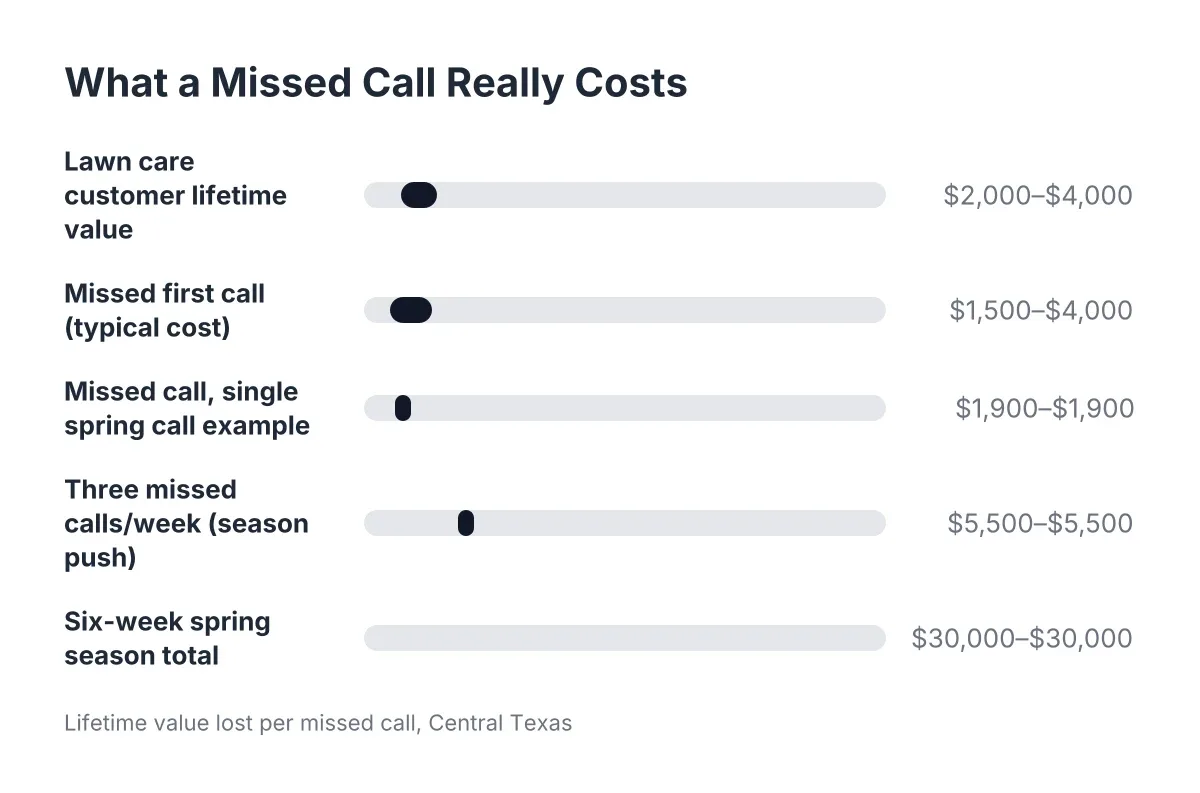
A missed call costs a solo home service operator in Austin between $150 and $7,500 in immediate revenue, depending on the trade, plus the lifetime value of the customer if they sign a recurring contract elsewhere. For recurring services like lawn care or pest control, that lifetime value multiplies the loss by five or more.
Here is why the number gets big fast. Suppose you run a solo pest control route in Round Rock. A new customer calls at 6:40 pm on a Thursday about carpenter ants. You are still on your last stop with your phone in your pocket. That caller wanted a quarterly plan, roughly $120 per quarter, so about $480 a year. If they stay three years, which is typical for a satisfied recurring customer, that one missed ring cost you around $1,440.
Now scale it. Say you miss just five new-customer calls a month during spring booking season, and two of them would have converted. At $1,440 in lifetime value each, that is $2,880 a month leaking out of a business you built yourself.
Storm and event-driven trades face an even sharper version of this. A roofer or restoration operator after an Austin hailstorm sees call volume spike for 48 to 72 hours, then it is gone. With average jobs around $7,500 and time-sensitive insurance claims in play, one unanswered afternoon can cost more than most solos gross in a month.
The callback window makes it worse. According to MIT Sloan School of Management / InsideSales.com, the odds of contacting a lead drop 100-fold, and the odds of qualifying that lead drop 21-fold, when the callback happens at 30 minutes instead of within 5 minutes. When you are under a house or up a ladder, 30 minutes is optimistic. By the time you call back, that homeowner has booked the next name on Google.
The Three Ways a Solo Trade Can Answer Every Call
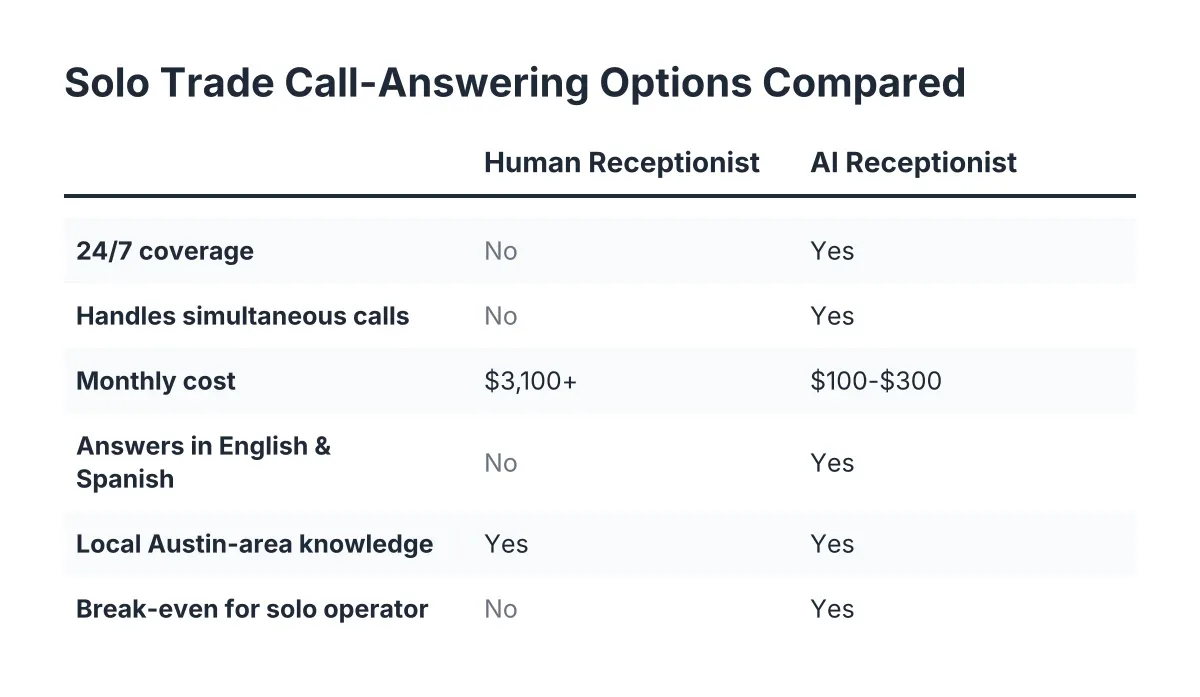
You have three realistic options, and each one has a legitimate case. Here is the side-by-side comparison before we get into the ai receptionist roi solo break-even timeline.
Option 1: Hire a Part-Time or Full-Time Receptionist
A human receptionist is the traditional answer, and humans have real strengths. A Five9/TEAM LEWIS survey of 4,000 U.S. and U.K. consumers found 75% prefer talking to a real human for customer support. A good hire builds relationships, reads tone, and handles messy situations.
The problem is the price tag against solo-operator revenue. The median hourly wage for receptionists in the U.S. was $17.90 in May 2024, roughly $37,230 per year before benefits, taxes, or overtime, according to the U.S. Bureau of Labor Statistics. In the Austin labor market, expect to pay at or above that median to attract someone reliable.
And that buys you 40 hours a week, not 168. Your receptionist goes home at 5 pm. A meaningful share of pest control calls come in after hours, and burst pipes in a February freeze do not check business hours. You are paying $37,000-plus a year and still missing the calls most likely to be urgent, high-intent, and high-ticket.
Break-even reality: a solo operator needs to attribute about $3,100 a month in recovered revenue to a full-time hire just to cover wages. That is achievable for a busy multi-crew shop. For a solo, it usually is not.
Option 2: A National Answering Service
National answering services cost less than a hire, typically $200 to $600 a month depending on call minutes. They answer 24/7, which solves the after-hours gap. For some businesses, that is enough.
However, the trade-offs show up in the details. Most national services work from generic scripts. The person answering may be in another state, has never heard of Pflugerville, and cannot tell a Cedar Park caller whether you service their area. Overage minutes stack up fast during a spring surge or a post-storm spike, and per-minute billing punishes you in exactly the weeks you need coverage most.
Capacity is the other ceiling. During a hail event, when 100-plus homeowners in Georgetown are calling roofers in the same afternoon, a shared national call center queues your callers behind everyone else's. Callers who hit hold music behave like callers who hit voicemail. They dial the next number.
Break-even reality: at $400 a month, a national service pays for itself on one recovered lawn care contract or a fraction of one roofing job. The ROI math works. The lead quality and local credibility are where it wobbles.
Option 3: An AI Receptionist Built for Austin Trades
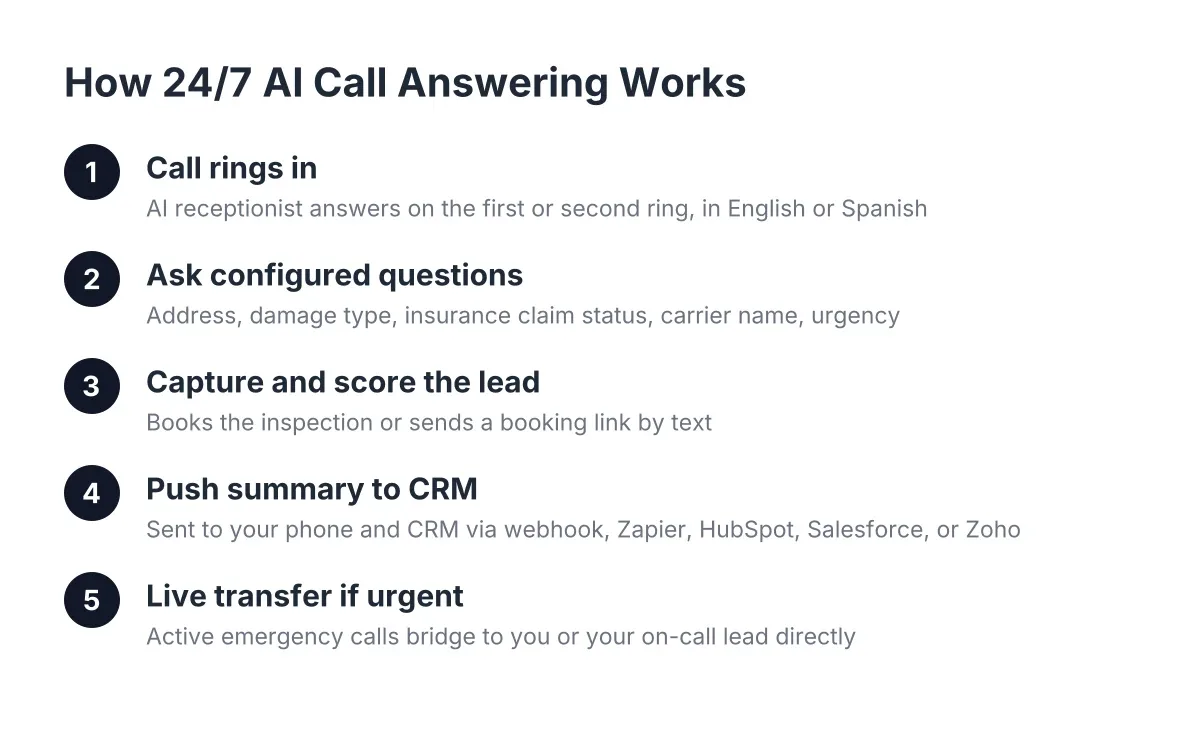
An AI receptionist answers every call in about one ring, 24/7, in English and Spanish, and handles unlimited simultaneous calls. It captures the lead, qualifies the job, sends a booking link, and texts you a summary you can read between stops. Plans for solo operators typically run $100 to $300 a month as of 2026, less than a week of a human receptionist's wages.
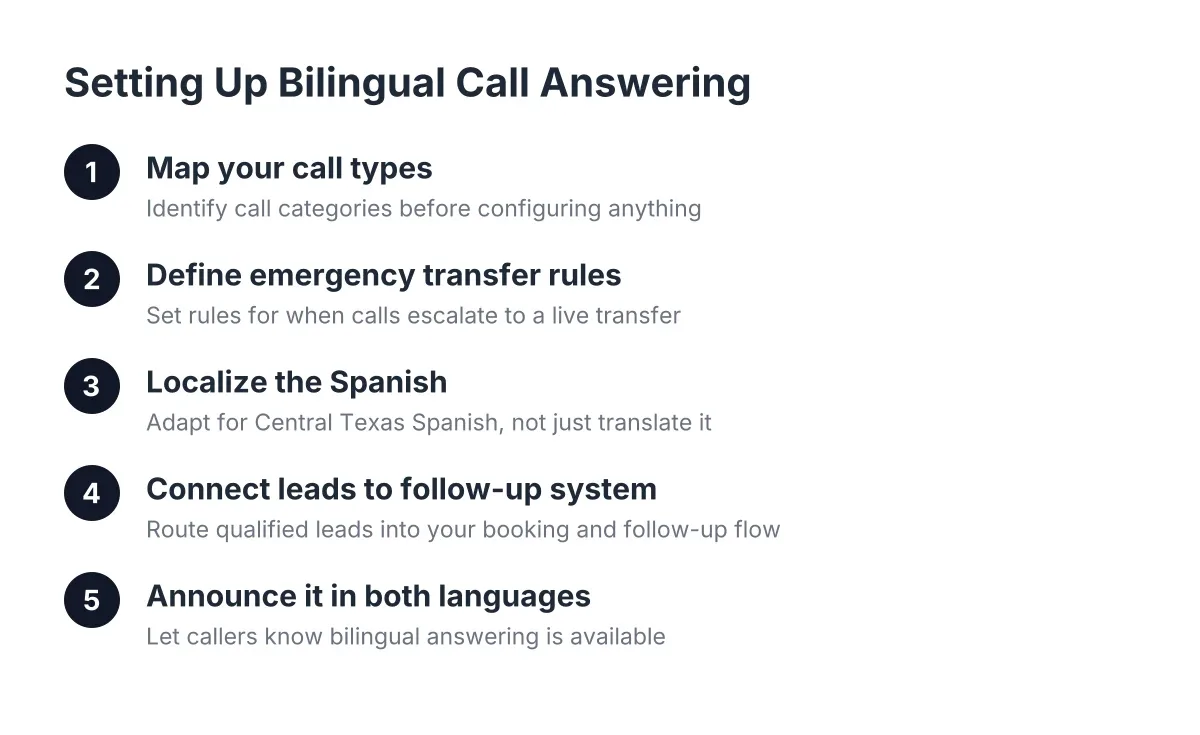
The concerns solos raise are fair, so let's address them directly. Call quality: modern AI receptionists hold natural conversations, and the honest test is to call one and try to stump it before you buy. Bilingual capability: Spanish support should be built into every plan, not a paid add-on, because a large share of Central Texas homeowners prefer to book in Spanish. Emergencies: look for opt-in live transfer, so a burst-pipe call at 2 am rings your cell while a quote request waits politely in your morning summary.
Setup complexity is the other worry, and it is mostly outdated. A trades-focused AI receptionist deploys in days, not weeks, forwards from your existing number, and syncs leads to whatever you already use, whether that is Zapier, HubSpot, or a spreadsheet.
One more data point for owners worried about what AI means for future hiring: 98% of small employers using AI reported no change in employee headcount, according to the National Federation of Independent Business. The tool answers calls you were already missing. It does not change your plans to build a crew later.
Comparing AI Receptionist ROI for a Solo Operator: The Break-Even Table
The break-even timeline for an AI receptionist on a solo operation is measured in jobs, not months. At $150 to $300 a month, one recovered job in most trades covers the cost, and everything after is profit. Here is how the three options compare across the criteria that matter to a one-person shop.
- Monthly cost: Full-time hire, about $3,100 plus taxes and benefits. National answering service, $200 to $600 plus overages. AI receptionist, roughly $100 to $300 flat.
- Coverage: Hire, 40 hours a week. National service, 24/7 but shared queues. AI receptionist, 24/7 with unlimited simultaneous calls.
- Break-even: Hire, several recovered jobs per month, every month. National service, about one recurring contract. AI receptionist, typically one job, often in the first week.
- Bilingual: Hire, only if you find and pay for a bilingual candidate. National service, often an upcharge. AI receptionist, English and Spanish on every call by default.
- Surge handling: Hire, one call at a time. National service, queues during regional spikes. AI receptionist, answers a hailstorm's worth of calls at once.
- Local knowledge: Hire, excellent if local. National service, none. AI receptionist, depends on the vendor; one built in Austin for Austin trades knows the service areas and the seasonality.
Run your own numbers with a simple formula: missed calls per month, times your close rate, times average job value, and for recurring services, times expected contract length. If that figure clears $300, and for nearly every Austin trade it clears it several times over, the ai receptionist roi solo case closes itself.
For example, take a hypothetical solo electrician in Leander. Average service call: $350. Panel upgrades: $2,500. Missing eight calls a month and converting even two of them at the low end means $700 recovered against a $200 tool. That is break-even in the first week of the first month, with the panel upgrade calls as upside.
Do Customers Call Back After Voicemail?
Most customers do not call back after reaching a home service business's voicemail; they call the next company on their list. A homeowner with standing water or a wasp problem wants confirmation now, and voicemail offers none. This is why missed call recovery matters more than callback speed alone; the goal is to never let the lead go cold in the first place.
Consumer expectations also shifted. A Five9 survey found 84% of consumers are aware that companies use AI for customer service. Reaching a capable, polite AI receptionist that captures their issue and books them in beats a beep and a dead end. The comparison a caller makes at 9 pm is not AI versus your voice. It is answered versus unanswered.
Where the AI Receptionist ROI Case Gets Weaker for a Solo
Honesty builds trust, so here is where the math softens. If your calendar is booked solid for six weeks, every call answered, and you have no interest in growing, recovered leads have nowhere to go, and the ROI shrinks. Similarly, complex insurance negotiations, technical scoping, and pricing judgment calls still need you; an AI receptionist captures and qualifies the lead, but it does not close a $7,500 roofing contract for you.
There is also a relationship layer no tool covers. Your longtime recurring customers like hearing your voice, and keeping that connection alive is on you. The AI receptionist handles the first-contact moment so you can spend your phone time where the relationship already exists.
How to Choose for Your Solo Operation
Match the option to your revenue model and your call pattern.
- Choose a human hire if you are past solo, running three or more crews, and need someone handling parts orders, invoicing, and scheduling beyond the phone. The $37,000-plus salary needs a business that size to justify it.
- Choose a national answering service if you only need basic overflow message-taking, your callers are all English-speaking, and you never face regional call surges. Watch the overage billing.
- Choose an AI receptionist if you are solo or small-crew, your revenue depends on winning the first call, you get after-hours or Spanish-language calls, or your trade spikes with weather and seasons. Break-even is one job, and the coverage is 24/7.
Whatever you pick, test it before you commit. Call the service yourself, ask about a Pflugerville address, throw a Spanish-language question at it, and describe a slab leak at midnight. The option that handles all four is the one that will hold your line while you are on site earning the money the phone brings in.
If you're losing revenue to missed calls, NeverMiss ATX can help.
Prefer to talk it through? Call (512) 980-9267 — a quick call is usually the fastest way to get a straight answer for your situation.