Virtual Receptionist ROI: How Many Recovered Leads Justify the Monthly Cost?
If you run a one-person trade business in Central Texas, the math on a virtual receptionist ROI comes down to one question: how many recovered leads break-even each month? For most Austin trades, the answer is one. Sometimes less than one. This guide walks you through the calculation step by step, then prices every option side by side, hiring a full-time receptionist, using a national answering service, going with a live virtual receptionist, or setting up an AI receptionist, so you can run the numbers yourself without sitting through a sales call.
The virtual receptionist ROI question gets muddy because most articles talk in percentages and vague "savings." You do not care about percentages. You care about whether the thing pays for itself when you are on a ladder in July and the phone rings three times.
Follow the steps below with your own call log open. By the end you will have a real number, not a guess.
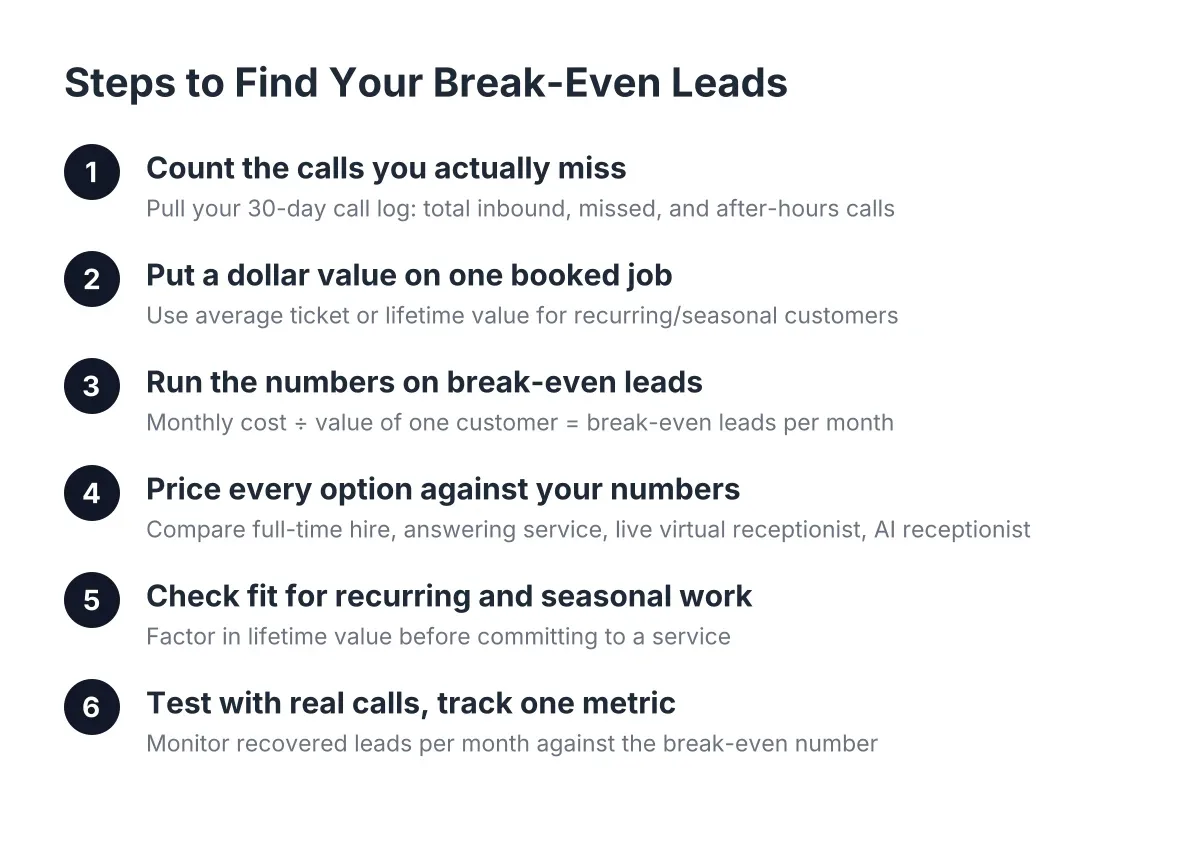
Step 1: Count the Calls You Actually Miss
Pull up your phone's recent call list and count missed calls from the last 30 days. Do not estimate from memory; owners consistently guess low because they only remember the calls they noticed missing.
For a solo tradesperson, missing a third or more of inbound calls is normal, not a personal failure. You physically cannot answer while you are mid-install, running a mower, or elbow-deep in a condensate drain. The phone is in your pocket, the engine is running, and the caller is already dialing the next name on Google.
Write down three numbers:
- Total inbound calls last month
- Calls you missed entirely (no answer, no timely callback)
- Calls that came in after-hours or on weekends
Suppose you run a solo lawn care route in Round Rock. Say you got 60 inbound calls in April, missed 22 while on the clock, and another 8 came in after 6 p.m. That is 30 calls, half your inbound volume, that either went to voicemail or went nowhere. Keep that hypothetical in mind; we will price it out in Step 3.
Step 2: Put a Dollar Value on One Booked Job
Next, figure out what a single new customer is worth to you. This is where recurring and seasonal businesses have a huge advantage in this math, and where most ROI calculators sell you short by only counting one job.
For a one-time repair trade, use your average ticket. For recurring work, use lifetime value:
- Lawn care: a $50 weekly mow from March through October is roughly $1,600 a year, and a recurring customer often stays two to three seasons
- HVAC maintenance: a $200 seasonal tune-up plan customer is also your first call when the system dies in August, which can mean a $6,000 to $12,000 replacement
- Recurring pest control: a quarterly plan at $120 a visit is about $480 a year, typically for multiple years
These are illustrative ranges, not quotes, but they match what Central Texas owners see. The point stands either way: the first answered call is a lifetime value multiplier, not a single ticket. If your average recurring customer is worth $1,200 over their lifetime, every missed first call is a $1,200 coin flip you did not get to take.
Speed matters too. According to MIT Sloan School of Management and InsideSales.com, the odds of contacting a lead drop 100-fold when the response comes at 30 minutes instead of within 5 minutes, and the odds of qualifying that lead drop 21-fold. Calling back at lunch is not the same as answering. By then, the Georgetown homeowner has booked your competitor.
Step 3: Run the Numbers on How Many Leads Break Even
Here is the core calculation, and it takes about two minutes. Divide the monthly cost of the service by the value of one new customer. The result is how many recovered leads per month justify the cost. For most Austin home service businesses, recovering just one lead per month often means you break even on the expense.
The formula:
- Monthly service cost ÷ value of one new customer = break-even leads per month
- Missed calls per month × your typical close rate = leads realistically recoverable
- If line 2 is bigger than line 1, the service pays for itself; everything above break-even is recovered revenue
Back to our hypothetical Round Rock lawn care operator. Say an AI receptionist runs $250 a month as a realistic 2026 estimate. One recurring mowing customer is worth about $1,600 a season. Break-even is 0.16 leads per month, one recovered customer roughly every six months. He missed 30 calls last month. Even if only a third were real prospects and he closes half of those, that is five new customers, about $8,000 in seasonal value, against a $250 bill.
That is why the "is it worth it" framing misses the point for trades. The honest question is not whether the ROI is positive; it is which option delivers the most recovered leads per dollar. That is Step 4.
Step 4: Price Every Option Against Your Numbers
Now compare the four realistic paths side by side. Each one answers your missed calls; they differ wildly in cost, hours covered, and what happens to the lead after hello.
Hiring a full-time receptionist
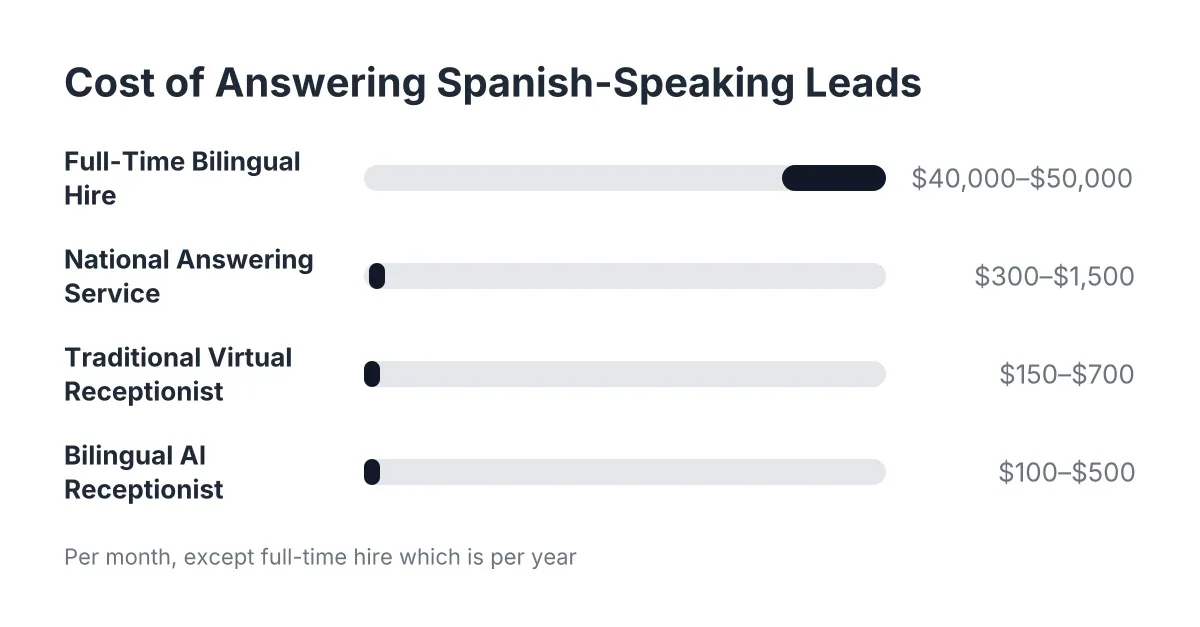
According to the U.S. Bureau of Labor Statistics, the median receptionist wage was $17.90 an hour in May 2024, about $37,230 a year before payroll taxes or benefits. That buys you roughly 40 hours of coverage a week. Nights, weekends, and lunch breaks stay uncovered, which is exactly when Pflugerville homeowners call about a dead AC.
At $3,100 a month, a solo operator would need two to three new recurring customers every month just to cover the salary. If you are running crews of 10 to 15 and your office phone rings constantly during business hours, a live hire can make sense. For a one-person operation, the math rarely closes.
National answering service
National services typically charge per minute, often landing between $200 and $500 a month at trade call volumes as a rough 2026 estimate. A human answers, reads a script, and takes a message. The trade-offs: the operator does not know Cedar Park from Corpus Christi, usually cannot book the job, and per-minute billing spikes during your spring rush, exactly when you can least predict the bill.
Message-taking also reintroduces the callback delay from Step 2. A message you return at 7 p.m. is a lead you have mostly already lost.
Live virtual receptionist services
Virtual receptionist services put a remote human on your line, usually with better scripting and sometimes light booking, at roughly $300 to $1,000 a month depending on minutes. This is a real step up from message-taking. The limits are hours and depth: 24/7 coverage costs extra, bilingual coverage often costs extra, and qualification is only as good as the script you wrote.
AI receptionist
An AI receptionist answers every call in seconds, 24/7, qualifies the caller, captures the lead, and sends a booking link, typically at a flat monthly rate in the $150 to $400 range as a 2026 estimate. Good ones built for Central Texas trades handle English and Spanish on every call, score and summarize each conversation, and sync leads to your CRM. Some offer opt-in live transfer, so a burst-pipe emergency at 2 a.m. rings through to you while a routine quote request gets booked without waking you.
Fair concern: will callers accept talking to AI? A Five9 survey found 75% of consumers prefer talking to a human for support, and 84% already know companies use AI for customer service. In practice, the comparison for a solo tradesperson is not AI versus you answering. It is AI versus voicemail, and voicemail loses to almost anything. Worried about staffing implications instead? According to NFIB's Small Business and Technology Survey, 98% of small employers using AI reported no change in employee headcount. It answers the calls you were already missing; it does not touch the relationship you build on site.
Step 5: Check Fit for Recurring and Seasonal Work Before You Commit
Break-even math is necessary but not sufficient. Before you sign anything, verify the option you are leaning toward can handle the specifics of seasonal Central Texas work:
- Seasonal overflow: Can it absorb the March lawn rush or the first 100° week without per-minute overage surprises?
- Recurring versus one-time intent: Does it ask whether the caller wants weekly service or a one-off, so your best leads get flagged?
- Booking, not just messages: Does the caller leave with a booked appointment or a booking link, or do you inherit a callback list?
- Bilingual by default: A meaningful share of Austin homeowners prefer Spanish; a service that cannot switch languages mid-call is dropping leads you paid to capture.
- Emergency triage: Can urgent calls transfer live to you while routine ones get booked?
One honest limitation: no AI receptionist should diagnose a gas smell or an electrical hazard over the phone. The right behavior is to flag it urgent and get the caller to you or to emergency services immediately. If a vendor claims their system handles emergencies without a human escalation path, walk away.
Also worth stating plainly: if you already employ a full-time receptionist who answers well, or you run a multi-location operation with a dispatch team, an AI receptionist solves a problem you do not have.
Step 6: Test It With Real Calls, Then Track One Simple Metric
Do not buy from a demo video. Call the service yourself and try to stump it. Ask about pricing in Spanish, describe a leaking water heater at 11 p.m., and ask for an appointment Thursday morning in Leander. If it stumbles on calls you actually get, it will stumble with your customers.
After you pick one, track a single number for 60 days: booked jobs from calls you would previously have missed, meaning after-hours calls and calls that came in while you were on a job. Multiply by your customer value from Step 2 and set it against the monthly bill.
How Many Recovered Leads Settle the ROI Question?
For a typical Central Texas recurring service business, recovered leads reaching break-even happens when one new customer books from a call you would previously have missed each month, and many owners need only one every few months to reach that threshold. A solo operator missing 20 to 30 calls monthly, with recurring customers worth $500 to $1,600 or more, clears that bar in the first week of a busy season.
The comparison across options is just as clear when you anchor it to your own numbers. A full-time hire costs about $3,100 a month for 40 hours of coverage. A national call center takes messages you still have to chase. Additionally, a live virtual receptionist covers more ground at a higher and less predictable price. An AI receptionist answers 24/7, books the job, and speaks both languages your customers speak, usually at the lowest flat cost of the four.
Run Steps 1 through 3 with your own call log tonight. It takes ten minutes, and the number you get will tell you more than any calculator page ever will.
If you're losing revenue to missed calls, NeverMiss ATX can help.
Prefer to talk it through? Call (512) 980-9267 — a quick call is usually the fastest way to get a straight answer for your situation.