Bilingual AI Receptionist: Capturing Spanish-Speaking Leads for Austin Trades
If you run a one-person trade operation in Austin, TX, you already know the math: you cannot hold a phone and a nail gun at the same time. Now add a second layer. Roughly a third of Central Texas households speak Spanish at home, and after a hailstorm those callers are dialing every roofer and restoration company in Round Rock, Cedar Park, and Pflugerville until someone answers in their language. A bilingual AI receptionist capturing those calls, in English and Spanish, 24/7, is the difference between booking that $7,500 roof replacement and hearing about it later when your competitor's yard sign goes up next door. Spanish speaking storm leads—calls from homeowners who initiate contact in Spanish right after a weather event—represent thousands of dollars in job value that most solo operators miss simply by not answering in the caller's language. This article lays out the full comparison, every option priced against real Austin call volumes, so you can decide without sitting through a sales call.
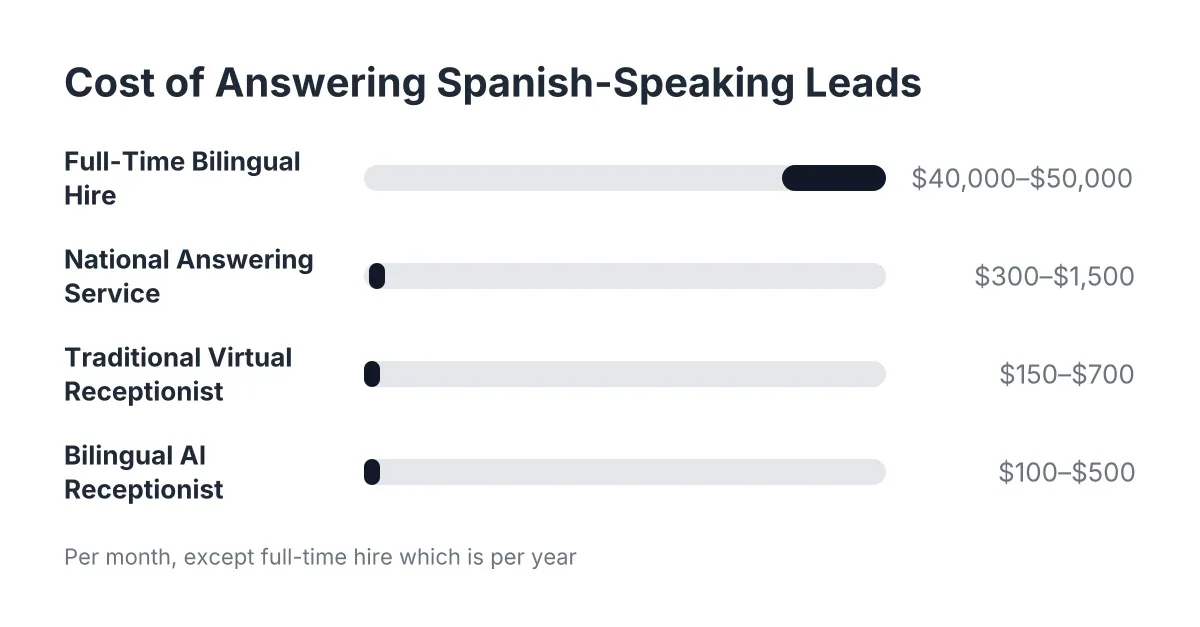
Here is the short version of what you are comparing in 2026:
- Full-time bilingual hire: roughly $40,000 to $50,000 per year with payroll costs, covers about 40 hours a week
- National answering service: often $1.50 to $2.50 per minute or $300 to $1,500 per month, bilingual usually costs extra, scripts read from a screen
- Traditional virtual receptionist: $150 to $700 per month for a set number of minutes, business hours in most plans, one call at a time
- Bilingual AI receptionist: typically $100 to $500 per month, answers every call at once, both languages on every call, no overtime
Now the details, one decision point at a time.
1. Run the Real Cost of a Full-Time Hire First
Hiring a live bilingual receptionist in Austin costs more than most solo operators expect. According to the U.S. Bureau of Labor Statistics, the median receptionist wage was $17.90 per hour in May 2024, about $37,230 per year before benefits, taxes, or overtime. Bilingual candidates in the Austin market command more, and you still only get 40 hours of coverage out of 168 hours in a week.
For a solo tradesperson billing $500,000 a year, that hire is a serious slice of revenue for coverage that ends at 5 p.m. Storm calls do not end at 5 p.m. Neither do burst pipes.
2. What a Bilingual AI Receptionist Does When Spanish-Speaking Leads Call
A bilingual AI receptionist answers every inbound call in the caller's language, English or Spanish, without a transfer, a hold, or a callback promise. It greets the caller, asks qualifying questions, captures the lead's name, address, and job details, and sends a booking link so the appointment gets booked before you climb down the ladder.
That last part matters more than the language itself. However, the two combine into one outcome: a Spanish-speaking homeowner in Georgetown with hail damage does not get voicemail, does not get an English-only menu, and does not hang up and dial the next roofer. The lead lands in your dashboard with a summary, a score, and a callback number.
Skeptical about whether the AI actually holds a conversation in Spanish? Fair. The honest answer is to call the line yourself, switch languages mid-call, and try to stump it. That test takes five minutes and settles the question better than any comparison table.
3. National Answering Services Answer Calls; They Rarely Capture Bilingual Leads Well
A national answering service gives you a human voice, but usually one reading a script from a screen in another state. Bilingual coverage often costs extra per minute, and the agent taking your storm calls does not know that Leander and Liberty Hill got the worst of last night's hail, or that insurance claim windows drive urgency.
Per-minute pricing also punishes you exactly when you need coverage most. Suppose a spring storm rolls through Williamson County and your line takes 60 calls in 48 hours, averaging four minutes each. At $2 per minute, that is $480 in two days, on top of your base fee, for message-taking. The messages still need callbacks, and by then many of those leads have moved on.
There is also a capacity ceiling. Most services queue calls when agents are busy, which is precisely the failure mode in a post-storm surge. An AI receptionist built for Austin trades answers 100 simultaneous calls the same way it answers one.
4. Speed to Contact Decides Who Gets the Job After a Storm
Fast answers win storm work, and the research on lead response backs this up hard. A foundational MIT Sloan / InsideSales.com study found the odds of contacting a lead drop 100-fold, and the odds of qualifying that lead drop 21-fold, when the callback happens at 30 minutes instead of within 5 minutes.
Thirty minutes is nothing when you are on a roof in 95° heat. Therefore the practical question is not whether you return calls, it is whether anything useful happens in the first five minutes. An AI receptionist answers on the first ring, qualifies the lead, and sends the booking link inside that window, in whichever language the caller speaks. You call back when you are on the ground, and the appointment is already booked.
For high-ticket, insurance-driven work, this is where the ROI shows up in days, not months. One captured $7,500 roof job covers a year of service at typical 2026 pricing. When you capture Spanish speaking storm leads at that speed, the break-even is immediate.
Where Live Transfer Still Belongs
Some calls should reach a human immediately. A good setup includes opt-in live transfer for urgent calls, so a genuine emergency, say active water intrusion, bridges straight to your cell while routine estimate requests get booked without interrupting you. AI handles triage; you handle the crisis. That is augmenting the relationship, not removing it.
5. Compare What Each Option Costs Per Captured Lead, Not Per Month
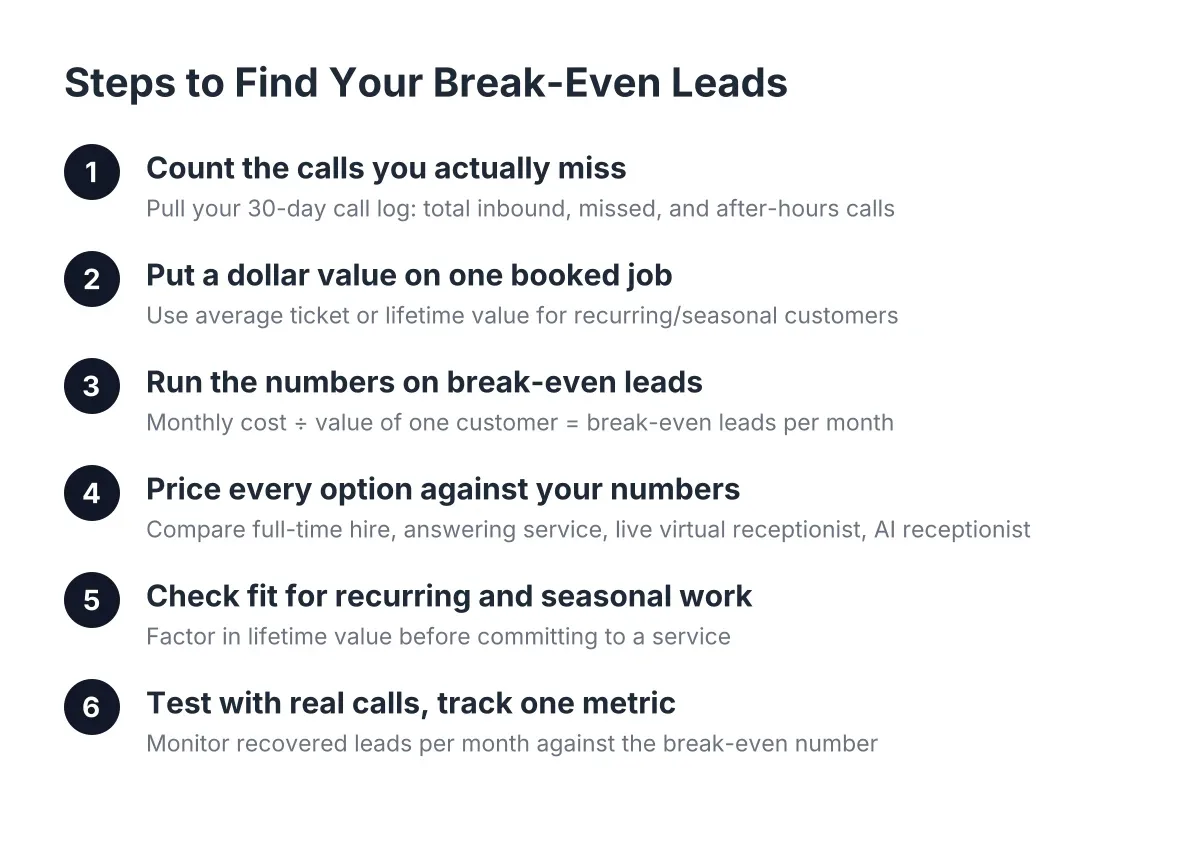
Monthly price is the wrong denominator; cost per captured lead is the right one. A solo operator missing a third of inbound calls is not saving money by skipping coverage, because each missed storm-season call in the Austin market can carry thousands in job value.
Here is an illustrative week for a hypothetical solo roofer in Pflugerville after a hail event. Say 40 calls come in. On his own, he answers 25 and misses 15, and 5 of the missed callers spoke Spanish first. If even 3 of those 15 would have booked at a $7,500 average ticket, that is $22,500 in walked-away revenue in one week.
Run the same week through each option:
- Full-time hire: captures business-hours calls, misses nights and weekends, costs about $800 or more that week loaded
- National service: takes messages at per-minute rates, bilingual surcharge applies, callbacks still fall on you
- Traditional virtual receptionist services: cover the calls their minute bundle allows, one at a time, mostly during business hours
- AI receptionist: answers all 40, books the qualified ones, flags the urgent ones, at a flat monthly rate under $500
The comparison is not close once you price it against real call volume instead of a feature list. For operators who receive Spanish speaking storm leads regularly, the math becomes even clearer.
6. Booking, Not Message-Taking, Is the Standard to Hold
Can a virtual receptionist handle appointment booking and customer inquiries? A traditional one can capture details and sometimes access your calendar, but many plans stop at message-taking, which leaves the booking step, the step that actually earns money, back on your plate. An AI receptionist qualifies the caller and delivers a booking link during the call itself.
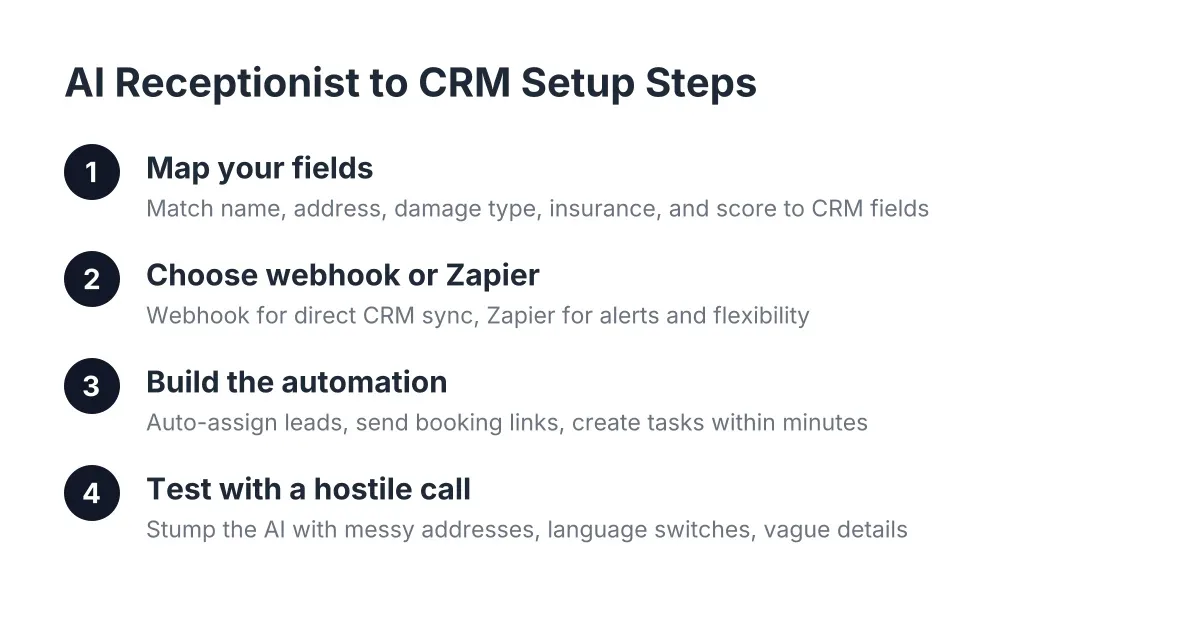
In addition, look at what happens after the call. Lead webhooks and CRM sync push every captured lead into Zapier, HubSpot, Salesforce, or Zoho automatically, and one-click call bridging lets you dial the lead straight from the dashboard between jobs. AI call intelligence scores and summarizes each conversation, so a Monday morning report tells you which of the weekend's 30 storm calls are insurance-backed jobs worth chasing first.
Message-taking gives you homework. Booking gives you revenue.
7. Setup Should Take a Day, Not a Month
Setting up an AI receptionist for an Austin trade business takes hours, not weeks, and requires no new hardware or staff. You forward your existing business number, confirm your services and service area, connect your calendar or booking link, and the line goes live, bilingual by default, the same day.
This matters for storm-driven work because the deployment window is brutal. However fast you sign up with a national service, agent training and script approval can eat the exact 48 to 72 hours when call volume spikes. If a system cannot go live before the surge fades, it fails the storm test regardless of price.
Cost-cautious is reasonable here; only 24% of small employers currently use AI tools, according to the National Federation of Independent Business, so most owners evaluating this are doing it for the first time. A month-to-month plan with a test line you can call before committing removes most of that risk.
8. Local Knowledge Is a Feature, Not a Slogan
An AI receptionist built in Austin for Austin trades handles Central Texas calls differently than a national platform tuned for everyone and no one. It recognizes local place names in both languages, understands that a February freeze call and an April hail call carry different urgency, and asks intake questions that match how insurance-driven storm work actually flows here.
Callers notice too. According to Five9, 84% of consumers are aware that some companies use AI for customer service, so nobody is fooled or offended by an AI answering. What loses callers is an AI that mangles "Manchaca," stumbles on Spanish, or clearly does not know the market.
9. The Trade-Off a Bilingual AI Receptionist Capturing Your Calls Won't Fix
An AI receptionist captures leads, books appointments, and triages emergencies, but it does not close complex insurance negotiations or replace your judgment on a claim. A Five9/TEAM LEWIS survey found 75% of consumers still prefer talking to a real human for customer support, which is exactly why the model works: the AI wins the first five minutes, and you win the relationship.
Two more honest limits. First, if your work involves legally sensitive intake, disputed claims or liability questions, loop in your insurance professional or attorney on how those calls should be scripted and routed. Second, an AI receptionist recovers missed calls; it cannot fix underpriced jobs or a marketing pipeline that produces no calls to answer.
The Decision, Priced Out
For a solo tradesperson or a storm-driven crew in Austin, TX, the comparison lands like this in 2026. A full-time hire costs $40,000-plus for 40-hour coverage. A national answering service bills by the minute, surges in cost exactly when storms surge your call volume, and treats bilingual coverage as an upsell. Additionally, a traditional virtual receptionist covers limited minutes, one call at a time.
A bilingual AI receptionist capturing every English and Spanish call, around the clock, at a flat rate under $500 a month, is the only option on the list that scales with a storm instead of against it. The break-even is one captured job. Everything after that is revenue you were previously losing to voicemail.
You do not have to take the comparison on faith. Call the AI, switch to Spanish halfway through, describe a hail claim in Cedar Park, and see what lands in the summary. That test costs nothing, and it answers the only question that matters: would this thing have booked the last call you missed?
If you're losing revenue to missed calls, NeverMiss ATX can help.
Prefer to talk it through? Call (512) 980-9267 — a quick call is usually the fastest way to get a straight answer for your situation.