Bilingual Call Answering in Austin: How Trades Capture English and Spanish Leads 24/7
Here is a number worth sitting with: in Austin, 29.6% of residents age 5 and older are bilingual, and 10.3% speak English less than "very well," according to City of Austin data compiled from the 2022 Census American Community Survey. If your plumbing, electrical, or pest control business only answers the phone in English, you are competing for roughly two-thirds of the market and conceding the rest. A strong bilingual call answering Austin system is not a nice-to-have feature for trades here; it is the difference between capturing a Spanish-speaking homeowner's burst-pipe emergency at 11 p.m. and losing that job, plus every future job from that household, to whoever picks up in their language. This guide walks through how to set up bilingual answering the right way, how English and Spanish lead qualification actually works, and how to measure whether it is recovering the revenue you have been leaking.
You have already decided you need something better than voicemail. Good. Now the job is making bilingual answering work for your specific operation: your service area, your emergency triage rules, your crew's follow-up habits, and your booking flow. That is what the rest of this guide covers.
Why Bilingual Answering Is a Revenue Issue, Not a Language Issue
Start with the market math. About 28.5% of Texans, nearly 7.8 million people, speak Spanish at home, according to U.S. Census Bureau estimates covering 2018 to 2022. In Central Texas specifically, that translates to a large share of homeowners in Round Rock, Pflugerville, Georgetown, and East Austin who will call a trade business and open the conversation in Spanish.
Now think about what happens on your end. Suppose a Spanish-speaking homeowner in Pflugerville has a slab leak on a Saturday morning. She calls three plumbers. The first goes to voicemail. The second answers, but the tech on the phone cannot follow her description of the problem, and the call ends awkwardly with a promise to "call back with someone who speaks Spanish."Additionally, the third answers in Spanish, confirms she is in the service area, asks whether water is actively flowing, and books an emergency slot. In that scenario, the third plumber did not win on price, reviews, or years in business. He won on the first thirty seconds of a phone call.
Speed compounds the language problem. A foundational MIT Sloan / InsideSales.com study found that the odds of contacting a lead drop 100-fold, and the odds of qualifying that lead drop 21-fold, when the callback happens at 30 minutes instead of within 5 minutes. A Spanish-speaking caller who hits your voicemail is not waiting 30 minutes. She is already dialing the next number on the list, and she is filtering that list for businesses that can talk to her.
So the stakes are not abstract. For an Austin trade doing $200K to $500K a year, the Spanish-speaking segment of your service area can represent a quarter or more of your addressable emergency calls. Answering those calls in the caller's language, instantly, at any hour, is missed call recovery applied to the segment most likely to slip away silently.
What Bilingual Call Answering Means for Austin Trades
Bilingual call answering for Austin home service businesses means every inbound call gets answered in the caller's language, English or Spanish, with full lead qualification in that language, not just a greeting. The caller describes the problem, gets qualifying questions, and receives a booking link or live transfer without ever switching languages or waiting for a translator.
That definition matters because a lot of what gets sold as "bilingual" is thinner than it sounds. There are three common versions, and only one of them captures leads reliably:
- Greeting-only bilingual. The phone tree says "para español, oprima dos," then routes to a queue with long waits or a voicemail box nobody checks. The caller hangs up.
- Translator-relay bilingual. A national call center puts the caller on hold while they find a Spanish speaker, or relays through a third party. Every hold is another chance to lose the call, and the notes you receive are secondhand.
- Native bilingual qualification. The system or person answering conducts the entire conversation, including problem description, address confirmation, urgency triage, and booking, in the caller's language from the first ring.
For emergency trades, only the third version works. A homeowner describing sparking from an outlet or sewage backing into a tub does not have patience for a language menu. An AI receptionist that handles English and Spanish natively on every call removes the menu entirely; the conversation simply happens in whatever language the caller uses.
There is a local dimension too. Central Texas Spanish is not textbook Spanish. Callers mix English and Spanish mid-sentence, use regional terms for fixtures and pests, and reference neighborhoods and landmarks a national script will not recognize. Answering built for Austin handles "el AC no está aventando aire frío" and knows that Manor and Del Valle are inside a reasonable service radius while a caller from Waco probably is not.
How English and Spanish Lead Qualification Works Call by Call
Qualification is where bilingual answering earns its keep. Answering the phone in Spanish is table stakes; qualifying the lead in Spanish is what turns the call into a booked job your crew can act on.
A well-configured bilingual qualification flow does the same work in both languages:
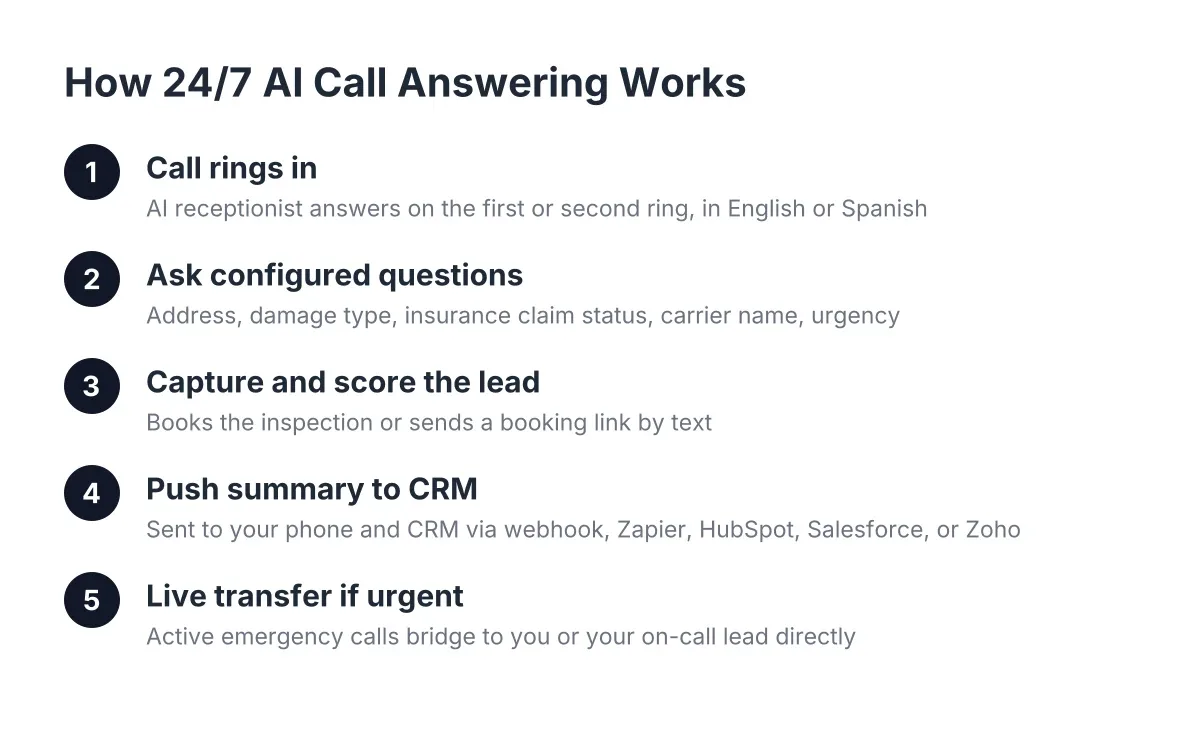
- Detect and match the language. The caller speaks first; the AI receptionist responds in the same language, no menu, no button press.
- Capture the problem in the caller's own words. What is happening, where in the home, and for how long. For pest control, that means distinguishing "cucarachas" from "hormigas locas" without confusion. For plumbing, it means knowing "la llave del agua" can mean the shutoff valve.
- Triage urgency. Active water flow, no power to the panel, or a wasp nest by the front door gets flagged as an emergency. Everything else gets booked into a standard slot.
- Confirm the essentials. Name, callback number, address, and whether the caller is the homeowner or a renter who needs landlord approval.
- Book or transfer. Urgent calls can live-transfer to you or your on-call tech. Standard calls get a booking link by text, in the caller's language.
- Summarize in English for your crew. This step gets missed constantly. Your techs need the summary in the language they work in, with the caller's language noted, so whoever calls back or shows up knows what to expect.
Step six deserves emphasis. If your crew lead opens a lead summary and finds raw Spanish notes he cannot read, the qualification work is wasted. The right setup gives the caller a full Spanish conversation and gives you a clean English summary with an urgency score, so dispatch decisions take seconds.
Notice also what qualification filters out. A Spanish-speaking caller asking about a $99 drain special in a zip code you do not serve gets a polite answer and does not burn a callback. Qualification in both languages means your follow-up time goes to real jobs regardless of which language they arrived in.
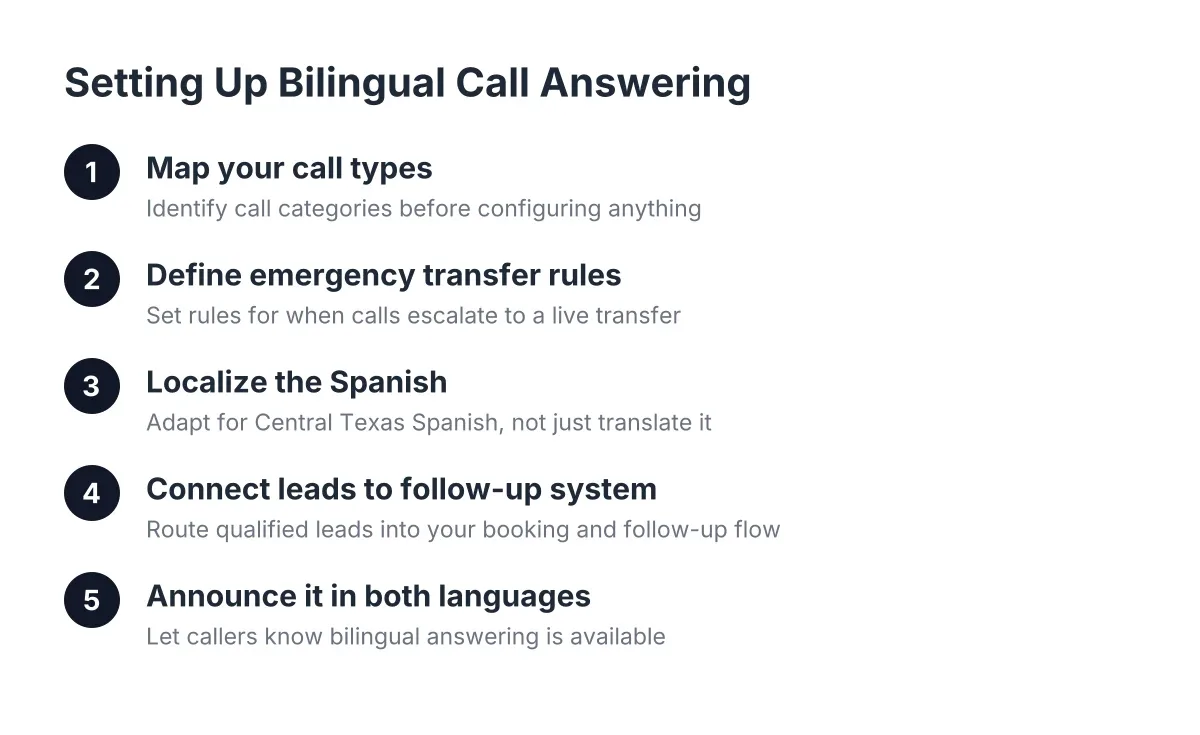
Setting Up Bilingual Call Answering for Your Austin Business
You have chosen to do this. Here is the setup sequence that gets a small crew from signup to answering every call in both languages, typically inside a week.
Step 1: Map your call types before you configure anything
List the five to ten call types your business actually gets. For a plumber, that might be water heater failure, slab leak, clogged main, running toilet, remodel quote, and price shopper. For pest control, think active infestation, recurring service signup, one-time treatment, and termite inspection request. Each type needs a qualification path and an urgency rating, and each path needs to work identically in English and Spanish.
Write down the two or three questions that tell you whether each call type is an emergency. "Is water actively leaking right now?" is a triage question. "How old is the water heater?" is a follow-up question. Keep triage short; a panicked caller in either language will not sit through eight questions.
Step 2: Define your emergency transfer rules
Decide which calls should live-transfer to a human and which should book into the next available slot. Most small crews set it up like this: active water, gas smell, or electrical hazard transfers immediately to the on-call phone; everything else gets booked. If the transfer goes unanswered because you are under a house in Buda, the AI receptionist captures the full details and texts you the summary so nothing evaporates.
Be honest about your capacity here. If you run a two-person crew and cannot take live transfers after 10 p.m., configure the AI to book the first morning slot for late-night non-hazards and reserve transfers for true hazards. Overpromising 2 a.m. dispatch you cannot staff damages trust faster than a booked 7 a.m. slot ever will.
Step 3: Localize the Spanish, not just translate it
Review the Spanish-language scripts with someone who knows how your customers actually talk. Confirm the AI handles Central Texas neighborhood names, mixed English-Spanish sentences, and trade-specific vocabulary. Then test it yourself: call the line, describe a fake emergency in Spanish (or have a Spanish-speaking tech or family member do it), and try to stump it. If the qualification feels off, adjust the scripts before launch, not after a real caller hits the gap.
Step 4: Connect the leads to your follow-up system
A captured lead that sits unread is a missed call with extra steps. Wire lead summaries into wherever you already work: text and email at minimum, and CRM sync through Zapier, HubSpot, Salesforce, or Zoho if you run one. Set a team rule that flagged emergencies get a callback within five minutes. The MIT Sloan / InsideSales.com finding cuts both ways; instant answering buys you the lead, but your callback speed still decides the qualification odds on anything that needed human follow-up.
Step 5: Announce it in both languages
Update your Google Business Profile, website, and truck signage to say you answer in English and Spanish, 24/7. Spanish-speaking homeowners in Cedar Park and Leander often skip businesses that look English-only. As of 2026, few Austin trades advertise true bilingual answering; saying it plainly is a cheap competitive edge while that remains true.
What Bilingual Answering in Austin Should Cost You
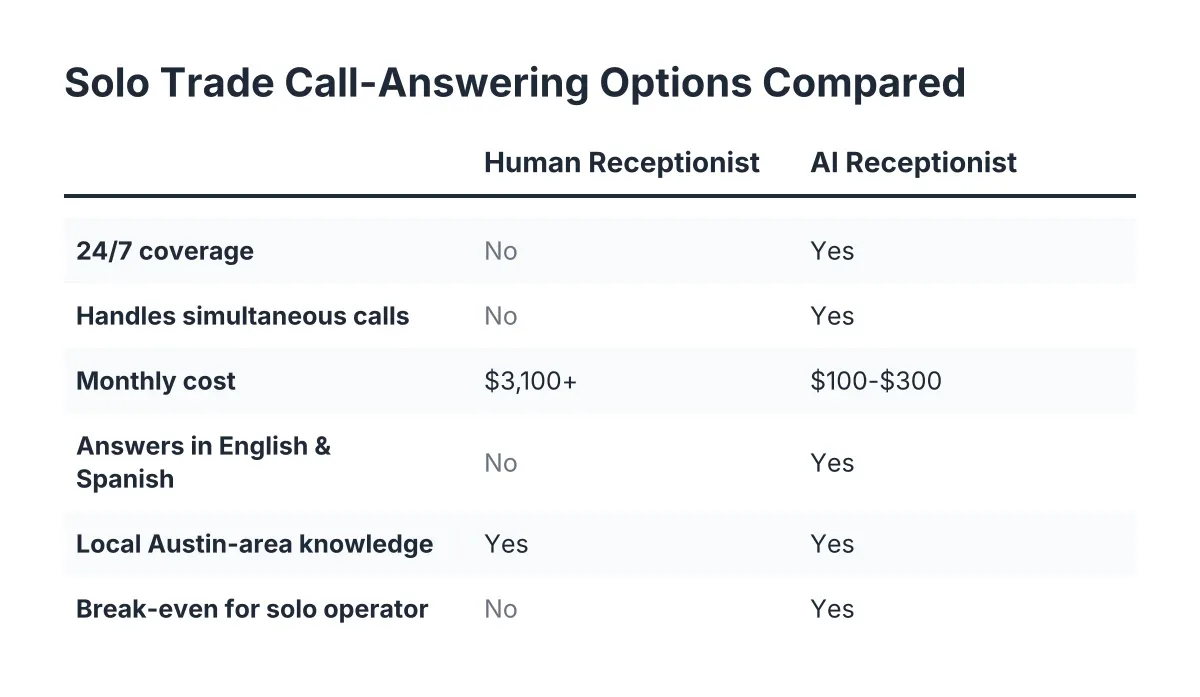
Expect to pay in the range of $199 to $399 per month for AI-based bilingual call answering with qualification and booking, as an illustrative 2026 estimate for the Austin market. Traditional bilingual answering services and national call centers usually price per minute or per call, which punishes you during peak season, exactly when call volume spikes.
Compare that against the alternatives a small crew owner actually weighs:
- A bilingual receptionist on payroll runs $35,000 to $45,000 a year as a rough estimate, covers one shift, and takes sick days during the summer rush.
- A national bilingual call center answers, but reads from a generic script, does not know Georgetown from Galveston, and hands you notes instead of booked appointments.
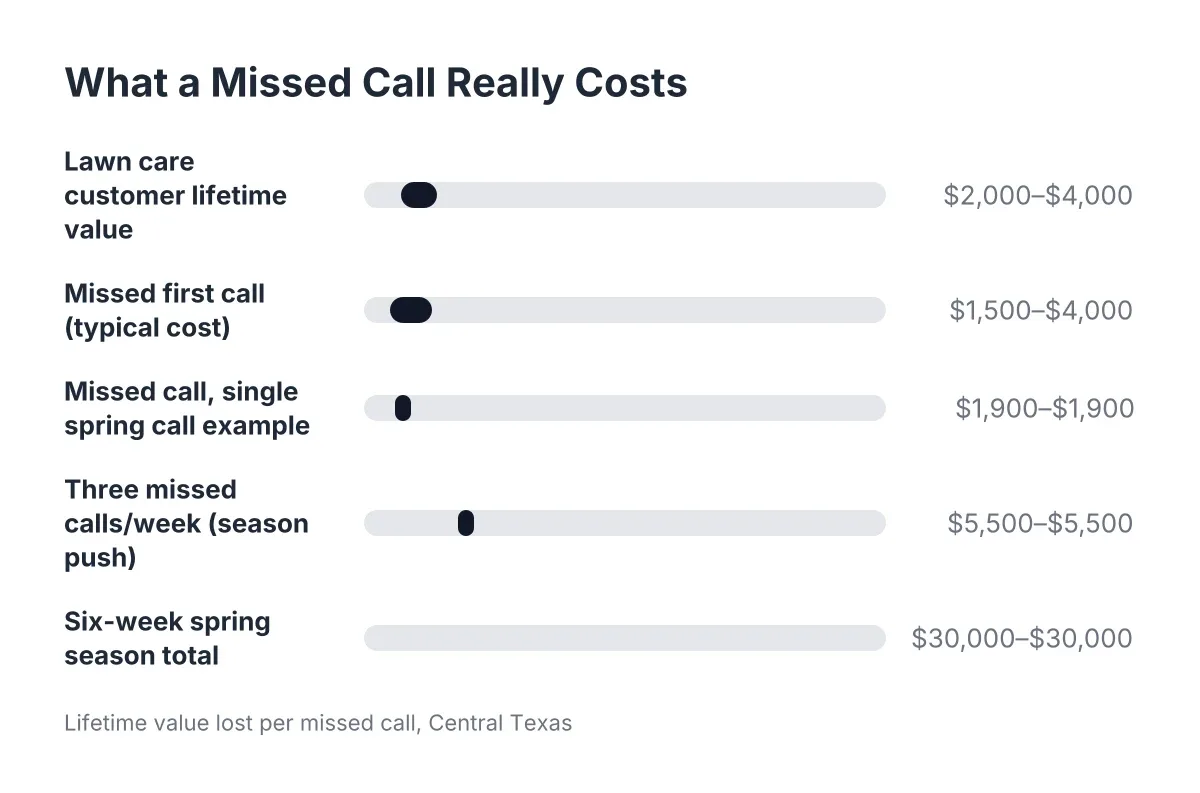
- Doing nothing costs whatever your missed after-hours and Spanish-language calls are worth. For an emergency trade, a single captured water heater replacement often covers a month of service by itself.
One honest trade-off: an AI receptionist qualifies and books, but it does not replace the relationship you build on site, and it should not diagnose. Complex jobs, commercial bids, and anything requiring code interpretation still need you or a licensed pro on the phone or in person. The right setup captures the lead, books the visit, and gets out of the way so the human relationship starts from a booked appointment instead of a missed call.
It is also fair to note that some consumers still prefer humans on the line. A Five9/TEAM LEWIS survey of 4,000 U.S. and U.K. consumers found 75% prefer talking to a real human for customer support, and 84% are aware companies use AI for customer service. The practical read for a two-truck plumbing crew: the comparison is not AI versus a human receptionist you do not have. It is AI answering in the caller's language versus voicemail in no language at all. Callers forgive an AI that solves their problem at midnight far faster than they forgive silence.
How to Tell Whether Bilingual Answering Is Working
Measure it, or you are guessing. Within the first 30 days, pull these numbers from your call summaries and weekly reports:
- Answer rate by hour. You should be at or near 100% answered, including the after-hours block where emergency trades get a heavy share of their calls.
- Spanish-language call share. Many Austin trades discover 15% to 30% of inbound calls involve Spanish once callers realize someone will understand them. If your share is near zero, your marketing still looks English-only; fix the profile and signage from Step 5.
- Booked rate on qualified calls. Qualified emergency calls should convert to booked appointments at a high rate in both languages. If Spanish-language calls book at a lower rate than English ones, the Spanish qualification flow has a gap; re-test it.
- Callback speed on transfers and flags. Track how fast your crew returns flagged calls. Five minutes is the target the contact-odds research points to.
- Revenue traced to after-hours and Spanish-language calls. Tag jobs by source. Within a quarter, you will know exactly what the bilingual line is worth, and whether those first-time emergency callers are converting into recurring customers.
For example, say a typical Round Rock pest control operator runs this analysis after 60 days and finds nine booked jobs that arrived in Spanish or after hours, averaging $280 each. That is about $2,500 in traced revenue against a monthly service cost in the low hundreds; the decision to keep it makes itself. Run your own version of that math rather than trusting anyone's brochure, including this one.
Making Bilingual Answering Stick as You Grow
The setup gets you answering; the habits keep it paying. Three practices separate crews that get compounding value from bilingual answering in Austin from crews that let it drift.
First, review the weekly report every Monday morning. Ten minutes over coffee tells you which call types spiked, which leads went unbooked, and whether your Spanish-language share is growing. Peak season patterns show up here weeks before they show up in your bank account.
Second, keep testing the line. Every quarter, call in with a new scenario in each language: a tenant with a landlord approval issue, a caller mixing languages mid-sentence, a price shopper fishing for a quote. Where the AI receptionist handles it cleanly, move on. Where it wobbles, tighten the script. Treat it like equipment maintenance, because that is what it is.
Third, close the loop on language in the field. Note which techs speak Spanish and route Spanish-language jobs to them when you can. The caller who got answered in Spanish at 11 p.m. and then met a tech who greeted her in Spanish the next morning is not a one-time job. She is a recurring customer, and she is telling her neighbors in the group chat which plumber to call. That referral chain is the real return, and it starts with never letting her call ring through to voicemail in the first place.
If you're losing revenue to missed calls, NeverMiss ATX can help.
Prefer to talk it through? Call (512) 980-9267 — a quick call is usually the fastest way to get a straight answer for your situation.