Missed Call Lead Capture: How to Book Appointments Without a Receptionist
Here is the math nobody wants to do. A recurring lawn care customer in Austin pays around $160 a month for weekly service. Keep them two years and that first phone call was worth roughly $3,800. Miss that call while your crew is on site in Pflugerville, and the caller dials the next company on Google. Missed call lead capture is the practice of catching that lead anyway, answering, qualifying, and booking the appointment even when nobody in your shop can pick up the phone. This guide walks through what missed calls actually cost a recurring service business, why voicemail does not save you, and how to book new customers without hiring a dedicated receptionist.
Why Missed Calls Hit Recurring Service Businesses Harder Than Anyone Else
A one-time job company loses one job when a call goes unanswered. A recurring service business loses a contract. That distinction changes the whole economics of the phone.
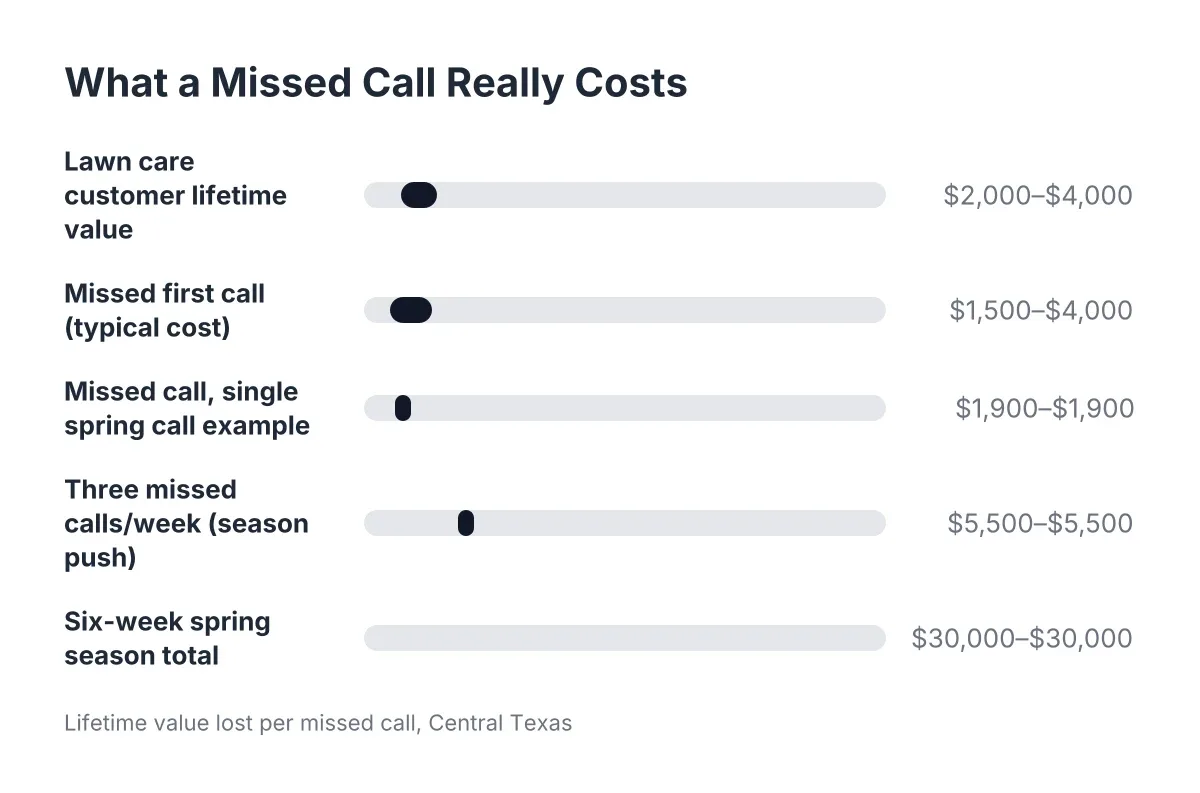
Say you run a pest control company in Round Rock. A new customer calling about a quarterly plan is not a $150 ticket; they are $600 a year, and the average recurring customer stays several years. A lawn care customer on weekly mowing through Central Texas's long growing season can be worth $2,000 to $4,000 over their lifetime. When the first call goes to voicemail, you are not losing a job. You are losing every job that customer would have booked with you for years.
The timing makes it worse. Recurring service businesses live and die on seasonal call velocity. Spring booking season for lawn care compresses months of new-customer acquisition into about six weeks. Pest control sees a heavy share of calls come in after hours, when someone finds ants in the kitchen at 8 p.m. and wants it handled now. Your call volume spikes exactly when your crew is most buried in work, which means your miss rate peaks at the same moment your leads are most valuable.
There is a compounding problem too. Every missed contract also removes the referrals, reviews, and route density that customer would have generated. In a route-based business, a new weekly customer three doors down from an existing one is more profitable than one across town. Missed calls quietly erode that density before you ever see it.
How Much Money Does a Missed Call Actually Cost?
For a recurring service business in Central Texas, a single missed first call from a new customer typically costs $1,500 to $4,000 in lifetime value, depending on your service and retention. That figure is the contract value the caller takes to a competitor, not the value of one visit.
Run your own numbers with three inputs:
- Average monthly contract value. For Austin-area lawn care, suppose $140 to $180 a month during the season. For quarterly pest control, about $50 a month equivalent.
- Average customer lifespan. Recurring service customers who make it past the first 90 days often stay two to four years.
- Close rate on answered first calls. Most owner-operators close 40 to 60 percent of new-customer calls they actually answer, because the caller has already decided to buy; they are choosing a vendor.
Multiply those together and one missed spring call at a 50 percent close rate on a $160-a-month, two-year customer costs you about $1,900 in expected value. Miss three calls a week during booking season, which is easy to do with a two-person crew running mowers all day, and that is over $5,500 a week in expected lifetime value walking to competitors. Over a six-week spring push, the quiet total clears $30,000. These are illustrative estimates, but plug in your own contract values and the shape of the problem does not change.
This is why generic missed-call stat sheets undersell the problem for trades like yours. They count the ticket. You should count the contract.
Do Customers Call Back After Voicemail?
Most new customers do not call back after reaching voicemail; they call the next company in the search results. A homeowner comparing three lawn services has no loyalty to your listing. Voicemail asks them to wait; your competitor's answered phone asks them to buy. The answered phone wins.
Speed is the mechanism here, and the research on lead response is blunt. According to a study from MIT Sloan School of Management and InsideSales.com, the odds of successfully contacting a lead drop 100-fold, and the odds of qualifying that lead drop 21-fold, when the callback happens at 30 minutes instead of within 5 minutes. Thirty minutes is optimistic for a crew that checks voicemail at lunch and again at 6 p.m.
However, this does not mean voicemail callbacks are worthless. Existing recurring customers will usually leave a message and wait, because switching providers is a hassle for them too. The calls you cannot afford to send to voicemail are the new ones, the first-touch calls where the customer is actively shopping. Those are won or lost in minutes, and that is exactly the gap missed call lead capture exists to close.
There is also a preference problem voicemail cannot solve. A Five9 survey of 4,000 U.S. and U.K. consumers found 75 percent prefer talking to a real human over the phone or in person for customer support. Voicemail is neither a human nor a conversation. It is a dead end that asks the buyer to do your follow-up work for you.
What Missed Call Lead Capture Looks Like Without Hiring Staff
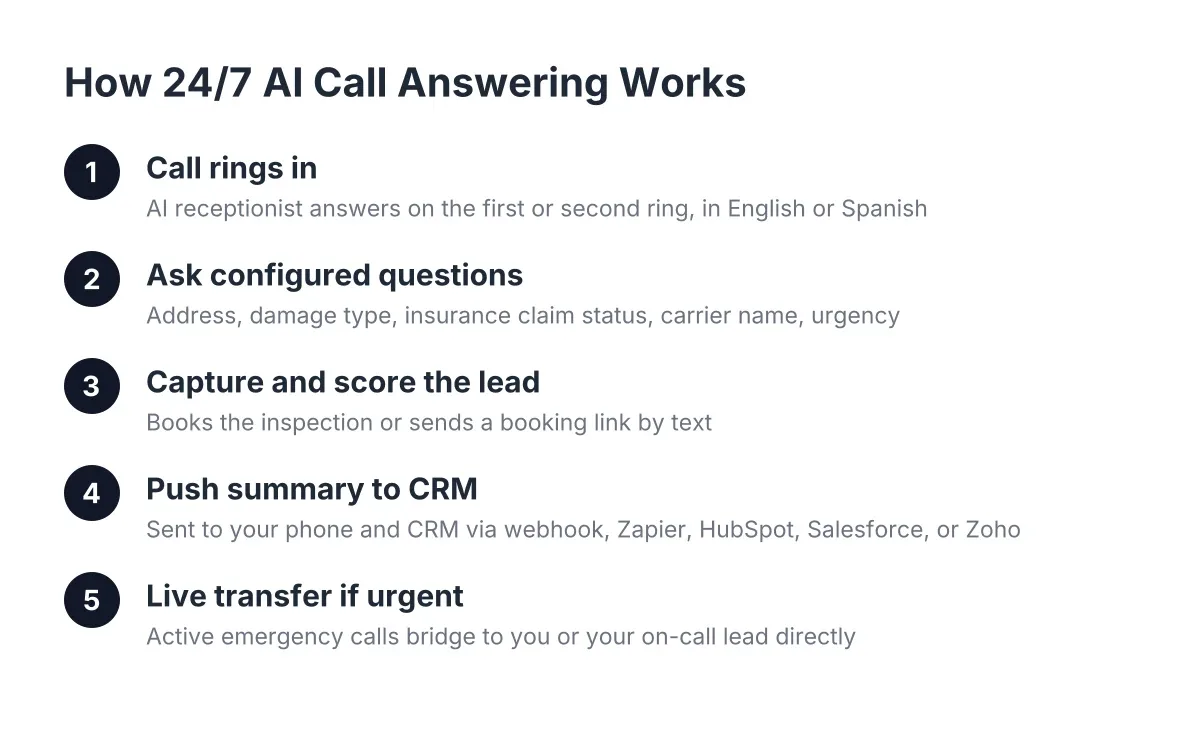
Missed call lead capture means having a system, not a person on payroll, that answers the calls you physically cannot take, collects the caller's need and contact details, qualifies the job, and books the appointment or delivers a booking link. Done well, the customer never experiences a missed call at all; they experience an answered one.
For a recurring service business, a capture system needs to do four specific things:
- Answer immediately, 24/7. Not a callback in an hour. The MIT Sloan and InsideSales.com numbers above make the case: the value of a lead decays in minutes, and after-hours calls, common in pest control, cannot wait until morning.
- Qualify recurring versus one-time intent. "Do you want weekly mowing or a one-time cleanup?" is the single most valuable question in your intake. A capture system should ask it, because it changes how you price, route, and prioritize the callback.
- Book, not just take a message. A message still requires you to win a game of phone tag. Booking the estimate or sending a booking link while the caller is still engaged closes the loop before a competitor gets a chance.
- Handle Spanish and English. In Central Texas, a meaningful share of your callers prefer Spanish. If your capture system only works in English, you are still missing calls; they just show up as short hang-ups instead of voicemails.
Notice what is not on that list: replacing you or your office manager on the calls you can take. The goal is capturing the overflow, the after-hours calls, and the mid-job rings, then handing you a qualified, booked lead instead of a blinking voicemail light.
Your Options for Missed Call Lead Capture, Compared
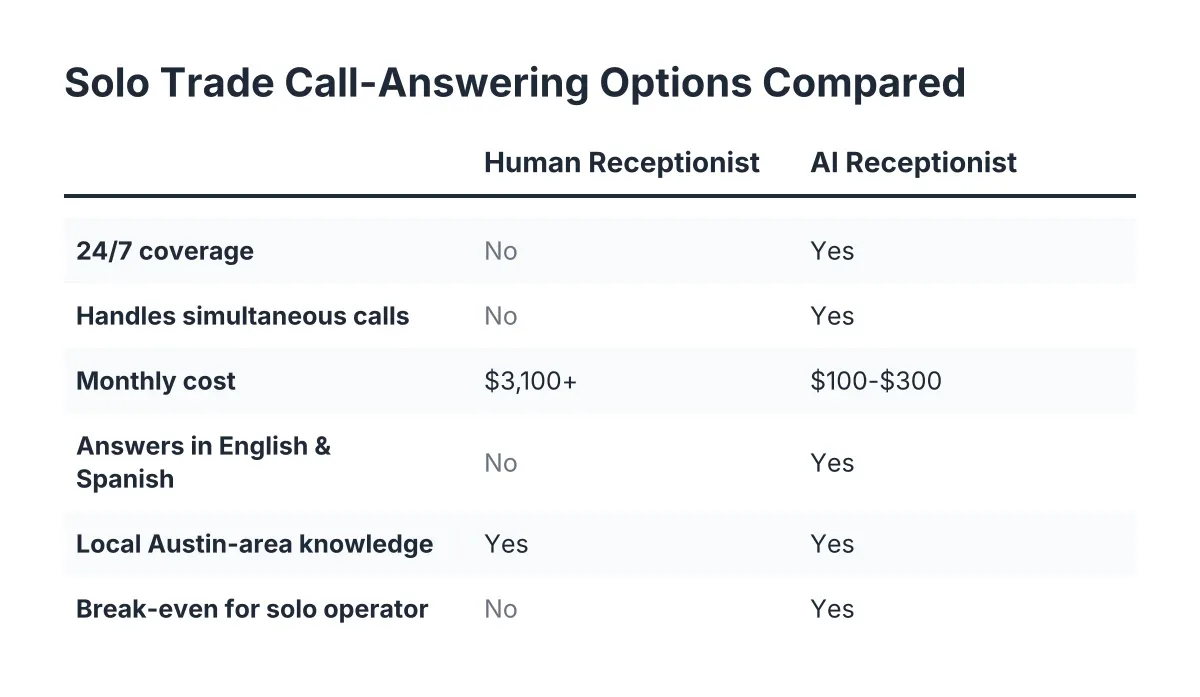
You have four realistic paths, and each trades cost against capture quality differently. If you are in consideration mode, this is the comparison that matters.
Hiring a full-time or part-time receptionist
A dedicated receptionist gives you the highest-touch experience: a person who learns your routes, your pricing, and your regulars. According to the U.S. Bureau of Labor Statistics, the median receptionist wage was $17.90 an hour in May 2024, about $37,230 a year before benefits, taxes, or overtime.
For a $150K to $800K revenue business, that is a heavy fixed cost for coverage that still only spans business hours. A receptionist does not answer the 8 p.m. pest call or the Saturday morning spring rush, and they take vacations during your season. If you already have a full-time receptionist earning their keep, adding a capture system may be redundant; this comparison is for owners who do not.
A national answering service
Traditional answering services put a human on every call, which is their strength. Their weakness is depth and locality. A national operator reading a generic script cannot tell a caller whether you service Leander, whether weekly or biweekly mowing makes sense for a St. Augustine lawn in July, or what your quarterly pest plan covers. Most take messages rather than book appointments, which puts you right back in the callback race you were trying to escape. Per-minute pricing also gets expensive during exactly the seasonal spikes you need covered.
DIY: missed call text back and call forwarding
The cheapest starting point is automation you set up yourself: an auto-text that fires when you miss a call ("Sorry we missed you, what do you need?"), or forwarding to your foreman's cell. This costs little and beats nothing. The trade-off is that text-back still depends on the customer doing the work, and forwarding just moves the missed call to a different pocket on a different ladder. It is a patch, not a capture system, and it tends to break down first during booking season when volume is highest.
An AI receptionist
An AI receptionist answers every call in seconds, around the clock, in English and Spanish, asks your qualification questions, and books the appointment or sends a booking link during the call. Modern systems also score and summarize each call, sync leads to your CRM, and let you bridge back to a hot lead with one click.
Two honest caveats. First, an AI receptionist is not a human relationship; it is the front door that keeps the relationship from dying at hello, and the actual selling and service still belong to you and your crew. Second, quality varies widely across providers, so test any AI on your real scenarios before you buy: an after-hours roach call, a Spanish-speaking caller asking about weekly service, a price shopper. If it cannot handle your Tuesday, it does not deserve your spring. For genuine emergencies, a system should also offer live transfer to a human, because some calls need a person immediately and no capture tool should pretend otherwise.
Adoption context matters here too. An NFIB survey found only 24 percent of small employers currently use AI tools for business activity. Meanwhile, the Five9 survey found 84 percent of consumers already know companies use AI for customer service. Your customers are more ready for this than most of your competitors are, which is precisely why early capture systems create a local edge.
Booking Appointments Without a Dedicated Receptionist: A Season in Practice
Here is an illustrative week to make this concrete. Suppose you own a two-crew lawn care company in Cedar Park. It is late March 2026, spring booking season, and your phone rings 40 times a week; historically you answer about 25 of those because you are on a mower or under a deck for most of daylight.
Without a capture system, those 15 unanswered calls split roughly like this: five existing customers who leave voicemails and wait, seven new prospects who hang up and call someone else, and three after-hours or weekend calls that go nowhere. At a 50 percent close rate and $1,900 expected lifetime value each, the seven lost prospects represent about $6,600 in expected value gone in one week.
With missed call lead capture in place, the same week looks different. Every ring gets answered within seconds. The five existing customers get their reschedule handled or a message routed to you with a summary. The seven prospects get qualified: four want weekly service, two want one-time cleanups, one is outside your service area. Six of those seven leave the call booked or holding a booking link, and you get a scored summary of each so you call the biggest contract first from the truck. In that scenario, the system did not sell anything; it kept the sale alive until you could.
This is also where missed call recovery differs from capture, and the distinction is worth knowing. Recovery is what you do after a call slips through, chasing the voicemail or firing a text-back. Capture prevents the miss from happening at all. Recovery is a safety net; capture is a front door that is never locked.
How to Reduce Missed Calls: A Practical Sequence
You do not need to buy anything to start. Work through these steps in order, and stop at the level that matches your call volume and season.
- Measure your miss rate first. Pull 30 days of call logs from your phone carrier. Count total inbound calls, answered calls, and voicemails left. The gap between missed calls and voicemails is your silent loss, the callers who left no trace.
- Assign your average lifetime value. Monthly contract value times average retention in months. Write it down; this number turns "we miss some calls" into a budget conversation.
- Fix the free leaks. Update your Google Business Profile hours, make sure your listed number rings the right phone, and set a voicemail that promises a specific callback window.
- Add text-back as a floor. An automatic "we saw your call, what do you need?" text recovers a slice of would-be losses for minimal cost.
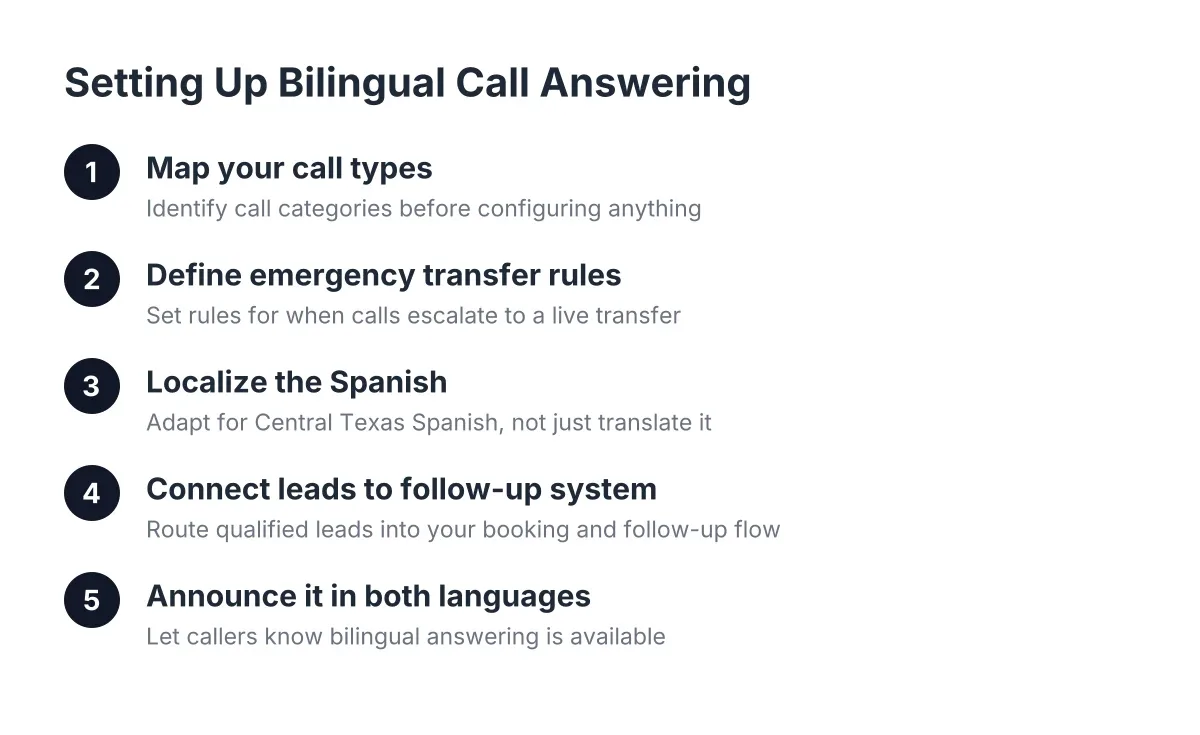
- Add a capture layer before your next season. Whether that is an AI receptionist or an answering service, get it live and tested before spring or summer volume hits, not during it. Confirm it books appointments rather than just taking messages, and confirm bilingual coverage.
- Close the loop weekly. Review call summaries or logs every Monday. Look for calls that were captured but not converted, and fix the follow-up gap, because capture without follow-through just produces politer losses.
One trade-off to weigh honestly: any capture system, human or AI, adds a monthly cost and a setup step. For a solo operator with ten calls a week in the off-season, text-back plus disciplined callbacks may genuinely be enough. The economics flip when seasonal volume, after-hours calls, or Spanish-speaking callers push your miss rate past a handful a week, because at recurring-contract values, a single captured customer per month typically covers the system.
The First Call Is the Whole Business
Recurring revenue businesses like to talk about retention, and retention matters. But retention only compounds customers you actually won, and in the trades, winning starts with an answered phone. Every weekly mowing route, every quarterly pest contract, every HVAC maintenance plan in your book traces back to one first call that somebody picked up.
The uncomfortable truth is that your competitors do not beat you on quality most of the time. They beat you on availability, at 7:45 p.m. on a Thursday, in Spanish, during the second week of March. Missed call lead capture is how a small crew competes with a bigger office without hiring one: every call answered, every lead qualified, every bookable job booked, while you stay on the job that is paying you today. Run your own numbers from your call logs and lifetime value. For most Central Texas recurring service businesses, the cost of doing nothing is the biggest line item they have never measured.
If you're losing revenue to missed calls, NeverMiss ATX can help.
Prefer to talk it through? Call (512) 980-9267 — a quick call is usually the fastest way to get a straight answer for your situation.