Why Austin Home Service Businesses Lose $500+ a Day to Missed Calls
A missed call is not a small annoyance. For Austin home service businesses in plumbing, electrical, and pest control, one unanswered ring can mean a $350 emergency job gone to the next name on Google, and the recurring customer that job would have created gone with it. If you are a solo operator who misses a third of your inbound calls because you are on a ladder, under a sink, or elbow-deep in a panel box, you could be leaving $500 or more on the table every single working day. Missed call cost trades are measured in thousands of dollars annually, which is why understanding the math of lost calls matters. Here is the math, why it happens, and eight practical ways to stop it.
First, the Math: What a Missed Call Actually Costs an Austin Trade
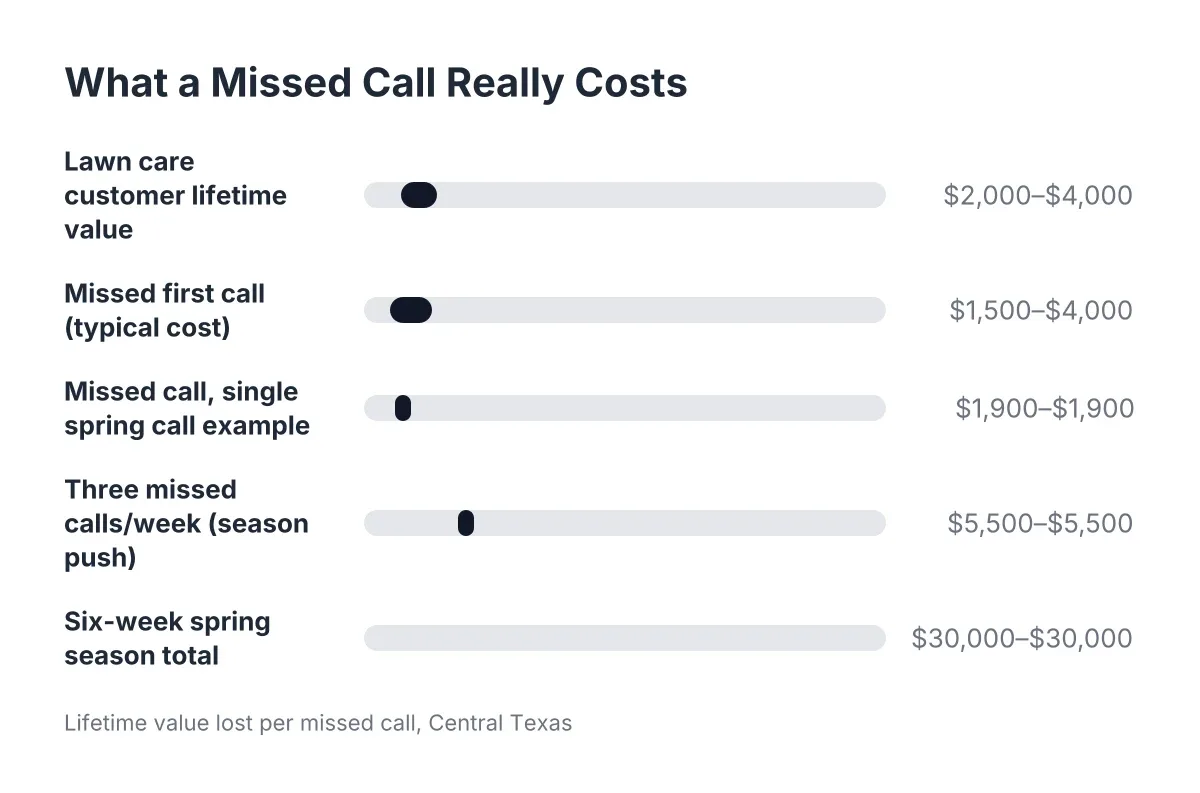
Start with real numbers, not a generic call-center stat sheet. Say you run a one-person plumbing operation in Round Rock and your average ticket is $350. A solo tradesperson working on site misses a third or more of inbound calls; if you get six calls a day and miss two, that is $700 in potential work ringing to voicemail daily.
Now layer in lifetime value. A homeowner who calls you for a burst pipe today calls you next year for a water heater, then refers a neighbor. If a typical Central Texas customer is worth $1,500 to $3,000 over five years, two missed calls a day is not $700 lost. It is closer to $3,000 to $6,000 in lifetime value walking to a competitor, every day you are too busy to pick up. Even discounting heavily for callers who were tire-kicking, $500 a day in lost revenue is a conservative floor for a busy emergency trade.
That is the number to hold in your head while you read the rest of this list.
1. Understand Why Callers Do Not Leave Voicemails, and Do Not Call Back
An emergency caller with water spreading across the kitchen floor does not leave a voicemail and wait. They hang up and dial the next plumber in the search results, and Austin has no shortage of them. Voicemail feels like a dead end when the problem is urgent, so the caller treats it like one.
Speed decides who wins the job. According to MIT Sloan School of Management / InsideSales.com, the odds of successfully contacting a lead drop 100-fold, and the odds of qualifying that lead drop 21-fold, when the callback happens at 30 minutes instead of within 5 minutes. If you call back after you climb down from the attic, the job is usually already booked with someone else.
2. Track Your Missed Call Rate Before You Try to Fix It
You cannot recover revenue you have not measured. Pull your phone log for the last 30 days and count three things: total inbound calls, calls answered live, and calls that went to voicemail. Then check how many voicemails actually turned into booked jobs.
Most solo operators who do this exercise find two uncomfortable truths. First, they miss more calls than they thought, especially between 10 a.m. and 3 p.m. when they are mid-job. Second, fewer than one in four voicemails becomes a customer. Multiply your missed calls by your average ticket and you have your personal version of the $500-a-day number, in your own handwriting.
3. Pay Attention to After-Hours Calls, Because That Is Where Emergency Trades Lose Most
After-hours is when high-urgency trades earn their best margins and lose their most calls. Pipes burst at 2 a.m. Breakers fail on Sunday. Pest problems get discovered when the family gets home at 7 p.m. For pest control operators, a large share of inbound calls land after normal business hours, exactly when nobody is answering.
Central Texas weather makes this worse. During the record summer of 2023, temperatures hit 107 degrees in Austin and Dallas, according to Texas 2036 and the Office of the State Climatologist at Texas A&M University. Heat like that drives surges of urgent service calls, and surges are precisely when a one-person operation physically cannot answer every ring.
4. Answer in Spanish, or Watch a Big Slice of the Austin Market Hang Up
A caller who reaches an English-only greeting when they need help in Spanish will not push through the language barrier during an emergency. They will call a competitor who answers in their language. In Austin, Pflugerville, and the wider Central Texas market, a meaningful share of homeowners prefer to describe a plumbing or electrical problem in Spanish.
Bilingual answering is not a nice-to-have here; it is a revenue line. Any fix you evaluate, whether it is an answering service, an AI receptionist, or a part-time hire, should handle English and Spanish on every call without transferring, delaying, or asking the caller to hold while someone finds a translator.
5. Compare Your Real Options: Voicemail, Hiring, Answering Services, and AI
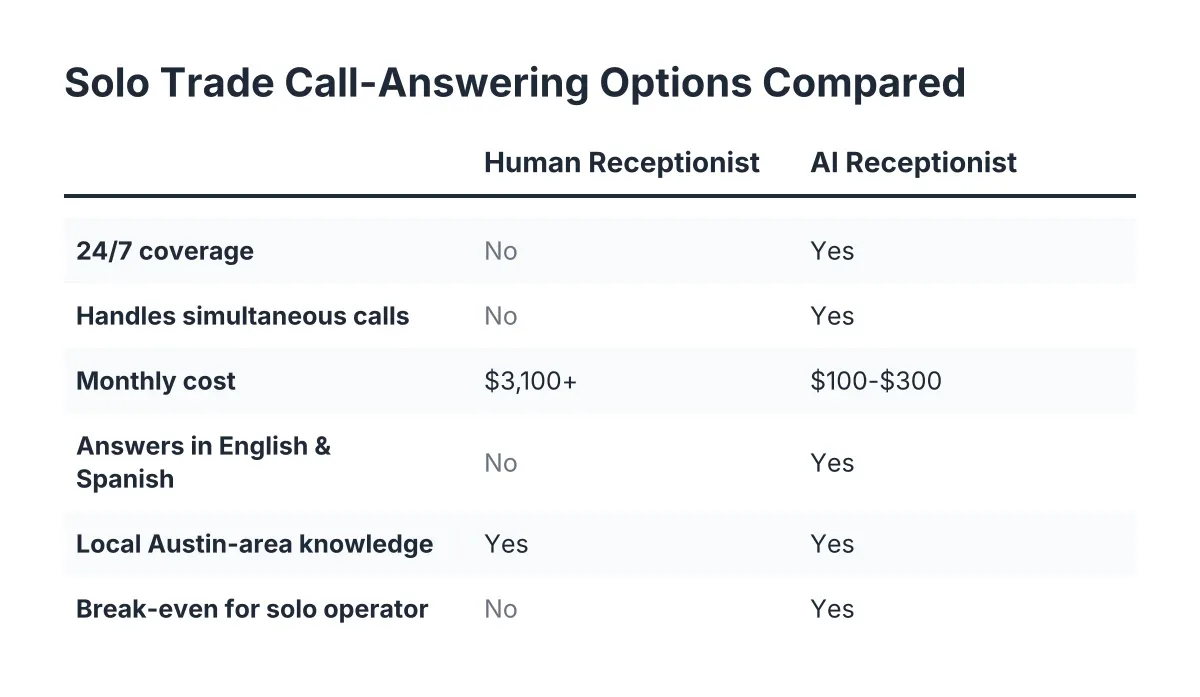
For a solo operator, there are four realistic ways to handle calls you cannot take. Each has a genuine trade-off, so weigh them against your call volume and budget rather than picking on price alone.
- Voicemail (free): Costs nothing upfront and costs the most overall. Emergency callers rarely leave messages, and even fewer wait for a callback.
- Hiring an office person ($3,000+ per month): A real human who knows your business is excellent, but the cost is hard to justify under $500K in annual revenue, and one person still cannot cover nights and weekends.
- National answering service ($200 to $600 per month): Covers the phone, but operators reading a generic script cannot tell a slab leak from a dripping faucet, and callers can hear the call-center distance. Per-minute pricing also punishes you in busy months.
- AI receptionist ($199 to $399 per month): Answers 24/7, captures every lead, qualifies the job, books the appointment, and handles English and Spanish. The trade-off is that AI handles structured conversations well; a rare, unusual call may still need you on the line, which is why live transfer for urgent calls matters.
Worth knowing: adopting AI still puts you ahead of most of your competition. According to the National Federation of Independent Business, only 24% of small employers currently use AI tools for business activity. The trades that move first on this capture the calls the other 76% are missing.
6. If You Evaluate an AI Receptionist, Test It Against Real Emergency Scenarios
Skepticism about AI call quality is fair, and the Five9 survey of 4,000 consumers backs it up: 75% of people prefer talking to a human for support. However, the same survey found 84% of consumers already know companies use AI for customer service. The practical question is not human versus AI. It is AI versus voicemail, because voicemail is what your callers actually get when you are on site.
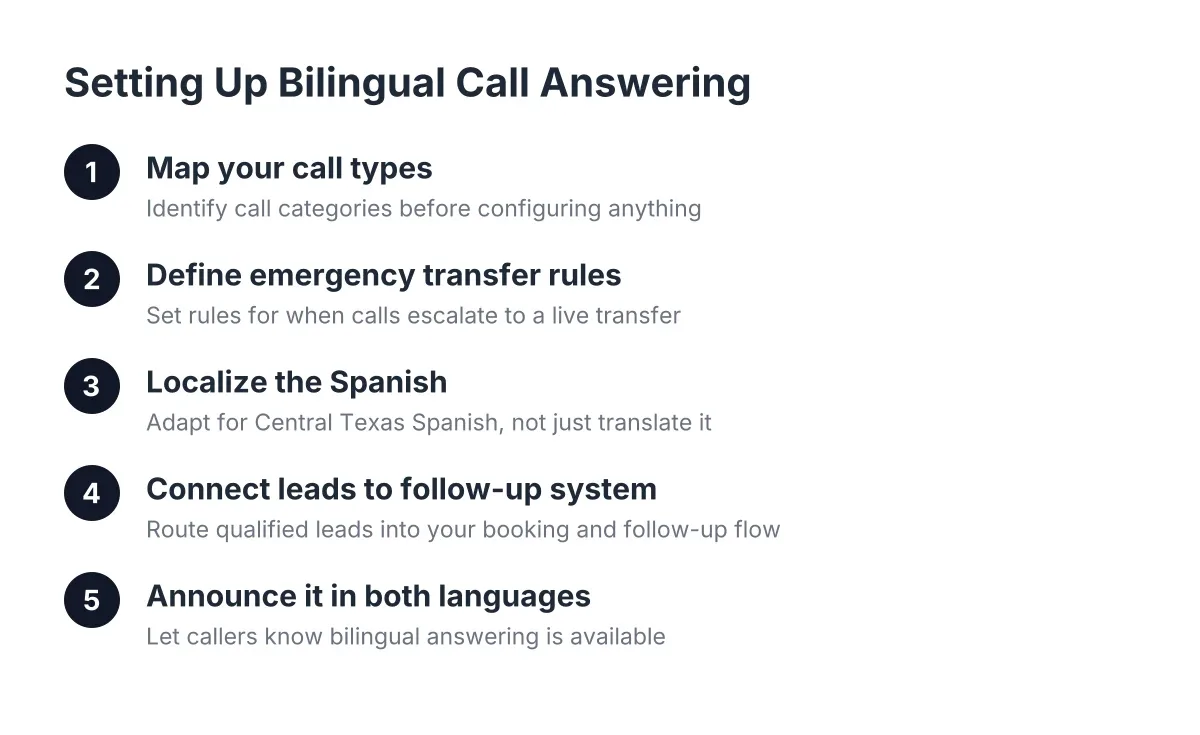
So test before you buy. Call the number yourself and try to stump it. Describe a water heater leaking through the ceiling and see whether it triages it as urgent. Switch to Spanish mid-call. Ask it to book you for Thursday morning. A good AI receptionist should qualify the job, capture the lead, book the appointment, and offer a live transfer for true emergencies. If it cannot handle your five most common call types, keep shopping.
7. Build a Missed Call Recovery Habit for the Calls That Still Slip Through
No system catches 100% of everything, so you need a fallback routine. Missed call recovery means every unanswered call triggers an immediate action instead of sitting in a voicemail box until dinner. The simplest version is an automatic text within 60 seconds: "This is Mike's Plumbing, I'm on a job. Reply with your issue and address and I'll confirm your slot within the hour."
That single text keeps the caller from dialing the next plumber, because they now have proof a real business saw them. Pair it with a rule for yourself: return any missed call within 5 minutes of finishing your current task, before loading the truck, before lunch. Remember the MIT Sloan / InsideSales.com finding: at 30 minutes, your odds of reaching that lead have collapsed 100-fold.
8. Connect Every Captured Call to a System, Not a Sticky Note
Capturing a lead only counts if it turns into a booked job. A caller's name scrawled on a receipt in the truck is a lead you will lose by Friday. Every call, answered or recovered, should land somewhere you can act on it: a simple CRM, a shared spreadsheet, or a dashboard that pushes leads to HubSpot, Zoho, or Zapier automatically.
At minimum, log four things for each lead: name, phone number, the problem in one line, and urgency. Then review the week's calls every Monday morning. Solo operators who do this spot patterns fast, like the fact that most of their calls go unanswered during peak afternoon hours, or that Spanish-language callers convert at a higher rate when answered live. One caveat: if you are evaluating tools that sync with your invoicing or accounting setup, it is worth a short conversation with your bookkeeper before wiring everything together.
What Missed Call Costs Mean for Austin Home Service Businesses in 2026
The missed call problem is not a character flaw; it is physics. You cannot hold a pipe wrench and a phone at the same time, and nobody expects you to. But in 2026, with search results crowded and homeowners expecting an answer on the first ring, Austin home service businesses that let calls hit voicemail are quietly funding their competitors' growth at $500 or more per day.
The fix does not require hiring staff or signing with a national call center that has never sweated through an Austin August. Measure your missed calls, cover your after-hours and Spanish-language gaps, pick the answering option that fits your revenue band, and route every captured lead into a system you actually check. Do those four things and the phone stops being the weakest part of a business that is otherwise built on showing up and doing the work right.
If you're losing revenue to missed calls, NeverMiss ATX can help.
Prefer to talk it through? Call (512) 980-9267 — a quick call is usually the fastest way to get a straight answer for your situation.