Why Home Service Businesses Miss Calls Daily and What Actually Fixes It
You're 20 feet up on a ladder replacing a panel in Round Rock heat, and your phone buzzes in your pocket. By the time you're back on the ground, the caller has already dialed the next electrician on Google. This is the daily reality behind why home service businesses experience missed calls home service situations: the work itself makes answering impossible. You cannot solder a pipe and qualify a lead at the same time, and no amount of hustle changes that.
This guide walks through why those calls slip away, what each missed call actually costs a solo or small-crew trade shop, and every realistic option you have for catching them. That includes free call-forwarding tricks, VoIP phone systems, answering services, hiring, and AI receptionists, ranked honestly by cost and real-world fit for a one-to-ten-person operation in Central Texas.
Why Home Service Businesses Miss So Many Calls
Home service businesses miss calls because the person who answers the phone is the same person doing the work. A solo plumber under a house in Pflugerville has no receptionist, no office manager, and no second set of hands. The phone rings whether or not those hands are free.
Break the problem down and it looks like this:
- You're physically occupied. On a ladder, under a sink, running a trencher. Gloves on, hands dirty, engine running. Answering is not an option even when you hear the ring.
- Calls cluster at the worst times. The busier you are, the more you get called, because busy season is busy for everyone. Peak demand and peak missed calls happen on the same afternoon.
- Emergencies don't keep business hours. Burst pipes, dead AC in 95 degree heat, breaker panels sparking at 11 p.m. In high-urgency trades like pest control, a large share of calls come in after hours, exactly when nobody is answering.
- Voicemail is where leads go to die. A homeowner with water spreading across the kitchen floor does not leave a message and wait. They hang up and call the next name in the search results.
- Language mismatch. Central Texas has a large Spanish-speaking customer base. If a caller gets English-only voicemail, that lead is gone before you ever knew it existed.
Notice that none of these are effort problems. You're not missing calls because you're lazy. You're missing them because answering a phone and running a one-person trade business are two full-time jobs occupying the same body.
What a Missed Call Actually Costs an Emergency Trade
A single missed call in an emergency trade can cost anywhere from a $150 service call to a $10,000 repipe, plus every future job that customer would have sent you. For plumbing, electrical, and pest control, the caller's urgency is your biggest advantage and your biggest risk. Urgent callers book fast, but they book the first person who answers.
Run the math on a realistic Austin scenario. Say your average job is $400 and you miss six calls a week while on site. Even if only half of those were real jobs, that's $1,200 a week walking to a competitor, or roughly $60,000 a year. For a shop doing $250K to $500K in annual revenue, that's not a rounding error. That's the difference between a good year and a grind.
Speed compounds the problem. According to MIT Sloan School of Management / InsideSales.com, the odds of contacting a lead drop 100-fold, and the odds of qualifying that lead drop 21-fold, when you call back at 30 minutes instead of within 5 minutes. Calling back after you finish the job, two hours later, is usually calling back a customer who already booked someone else.
Then there's the recurring customer you never meet. The homeowner whose emergency drain call you missed would have called you for the water heater next year and referred their neighbor the year after. Missed calls don't just cost the job on the phone. They cost the whole customer relationship behind it.
Every Real Option for Managing Calls Without an Office Person
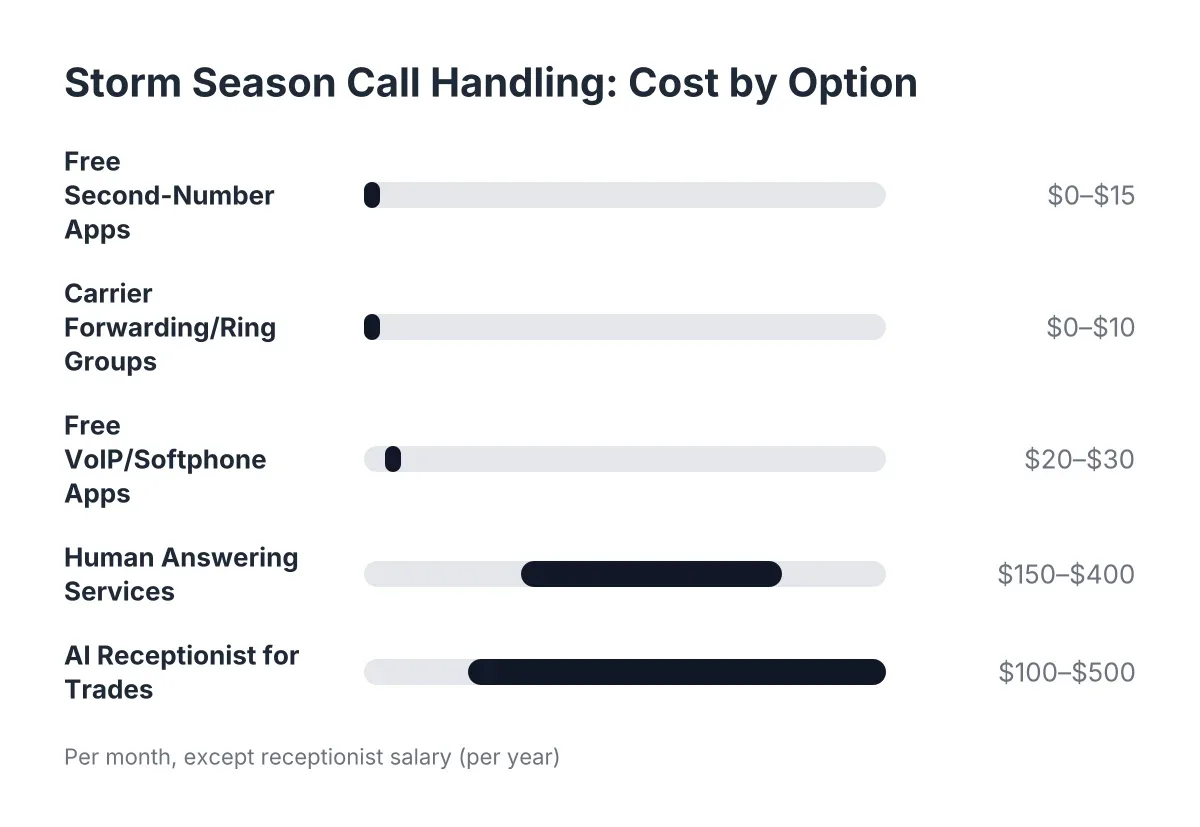
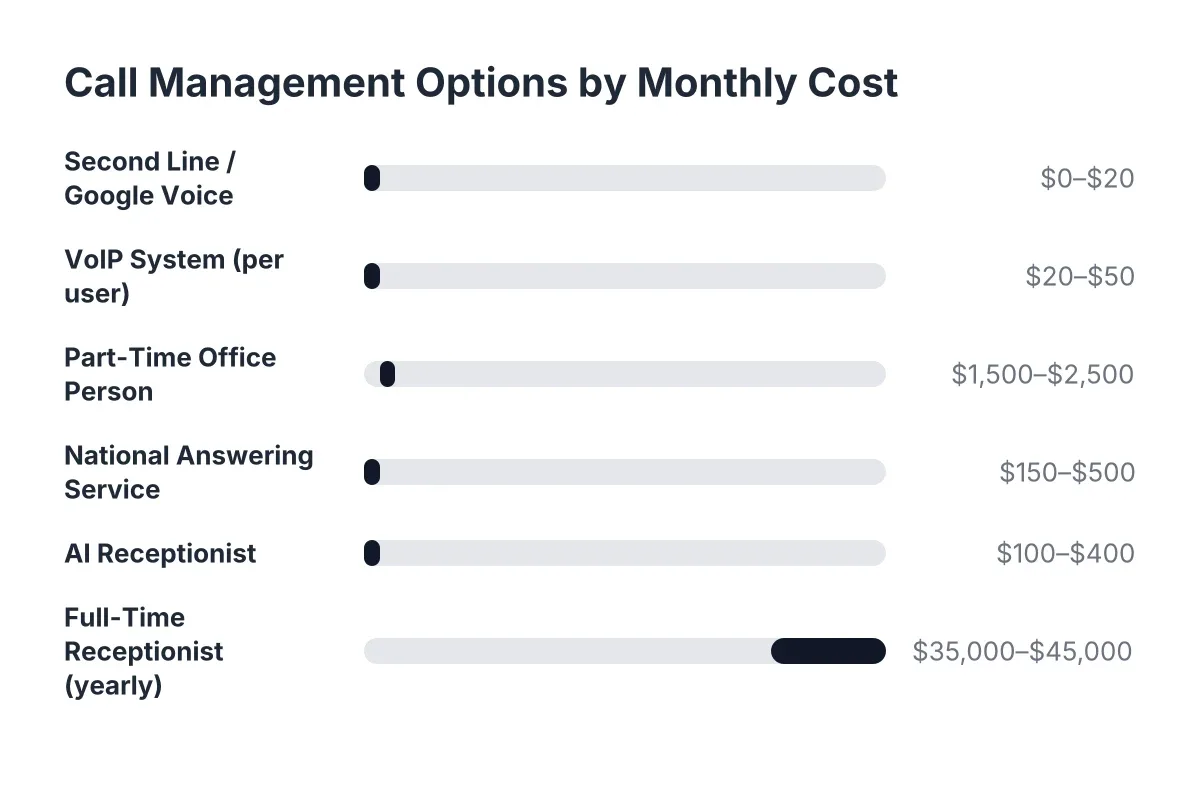
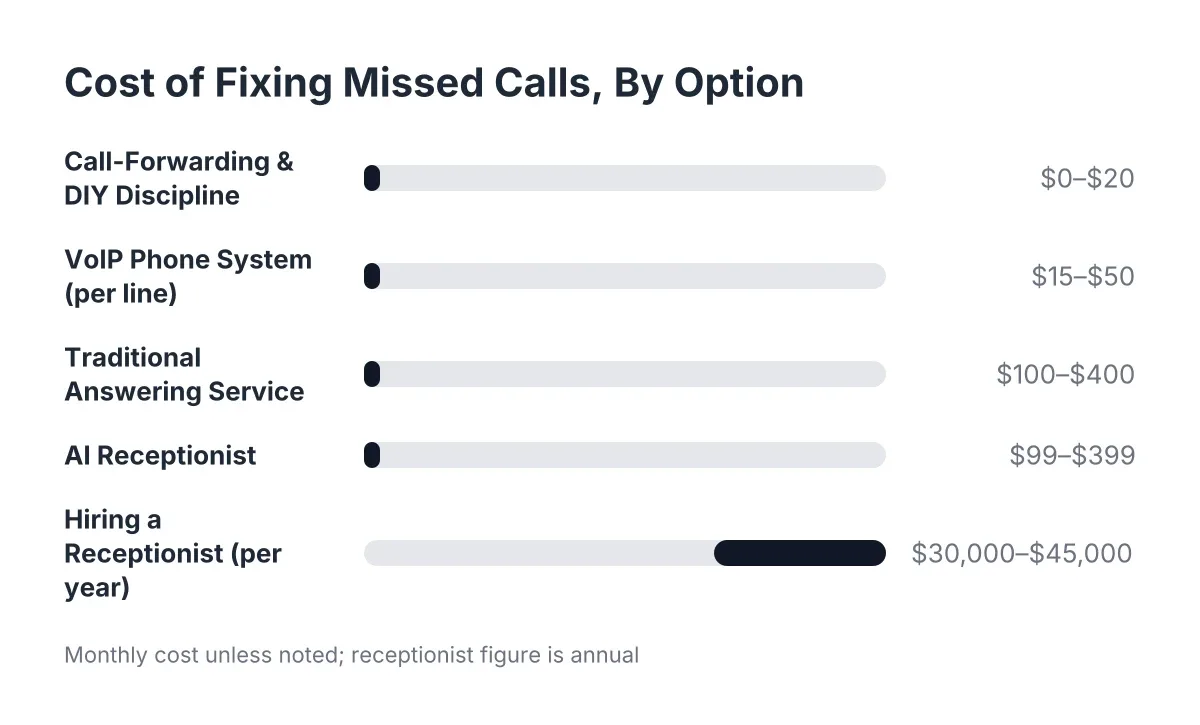
Small business call management for a trade shop comes down to five realistic paths. Each one trades money, time, or lead quality against the others. Here they are, ranked from cheapest to most expensive, with an honest read on where each one fits.
Option 1: Call-Forwarding Hacks and DIY Discipline (Free to $20/month)
The cheapest fix is squeezing more out of the phone you already carry. Set up conditional call forwarding to a family member during peak hours. Record a voicemail greeting that promises a callback within the hour and asks for the address and issue. Enable your carrier's missed-call text-back if it offers one.
This costs almost nothing, which is why every solo operator starts here. However, it only works if someone is actually free to pick up the forwarded call, and it still leaves after-hours completely uncovered. Your spouse answering plumbing calls during dinner is a stopgap, not a system. Fit: brand-new solo operators watching every dollar, as a bridge to something better.
Option 2: A VoIP Phone System for Small Business ($15 to $50/month per line)
A VoIP phone system for small business gives you a dedicated business number, ring groups, business-hours routing, voicemail-to-email, and a call management app on your existing cell phone. If you have a two- or three-person crew, VoIP phone systems can ring everyone at once so the first free tech picks up.
For example, a three-tech electrical shop in Cedar Park can route daytime calls to whoever is between jobs and push after-hours calls to an on-call rotation. That's a genuine upgrade over one personal cell number carrying the whole business.
The catch: VoIP routes calls, it doesn't answer them. If every tech is on site, which is most of the day for a busy shop, the call still lands in voicemail. VoIP solves organization, not coverage. Fit: crews of three or more who need call routing and a professional number, paired with something that actually answers.
Option 3: Traditional Answering Services ($100 to $400/month, often per-minute)
A human answering service picks up when you can't, takes a message, and texts or emails it to you. For decades this was the only real coverage option for trades, and the national services are established for a reason.
Trade-offs are real, though. Most national services charge per minute, so a chatty month blows the budget. The operator reading a generic script in a call center three states away doesn't know that Georgetown and Leander are 30 minutes apart, can't tell a genuine slab leak from a dripping faucet, and often can't book anything. You get a message, not a booked job, and you still have to call back fast enough to beat the 5-minute window. Bilingual coverage frequently costs extra or isn't offered at all. Fit: shops that want a human voice on every call and can absorb variable per-minute pricing.
Option 4: An AI Receptionist ($99 to $399/month, typically flat-rate)
An AI receptionist answers every call 24/7, asks qualifying questions, captures the lead's name, address, and issue, and either sends a booking link or flags the call as urgent. The current generation handles natural conversation well; this is not the phone-tree robot from 2015. Skepticism is fair, and the honest test is simple: call one and try to stump it before you buy. Any provider confident in their product will invite exactly that.
For emergency trades, the details that matter are specific:
- Emergency triage. The AI must distinguish "my toilet runs sometimes" from "water is pouring through my ceiling," and offer live transfer to you for the second one. If a provider can't show you this working, keep looking.
- Bilingual by default. In Central Texas, English and Spanish answering shouldn't be an add-on. It should be standard on every plan.
- Booking, not just messages. The gap between "someone called about a leak" and "a job is booked for 8 a.m. tomorrow" is the whole point. Look for booking link delivery during the call.
- CRM and workflow sync. Lead webhooks into Zapier, HubSpot, Salesforce, or Zoho mean captured leads land where you already work instead of piling up in another inbox.
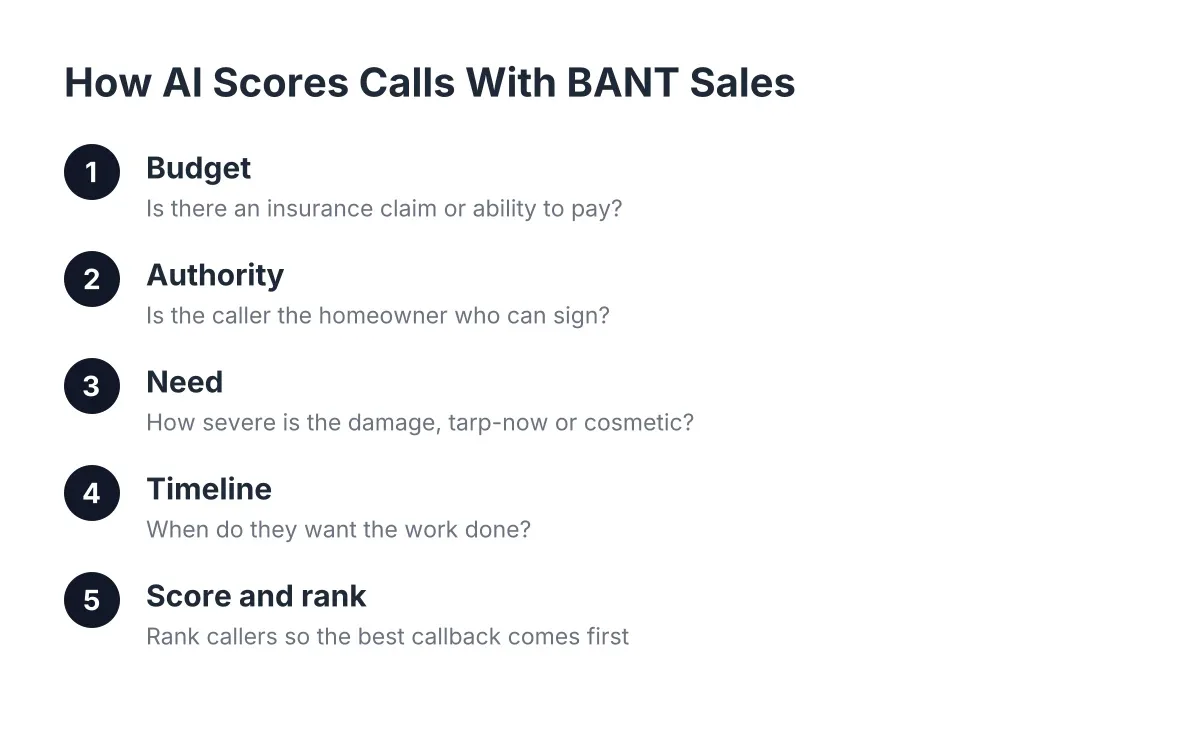
- Call intelligence. Scoring and summaries let you skim ten calls in two minutes from the truck and call the hottest lead first, ideally with one-click call bridging from a dashboard.
Adoption is still early, which cuts both ways. According to the National Federation of Independent Business (NFIB), only 24% of small employers currently use AI tools for business activity. Being ahead of 76% of your competitors on answer rate is a genuine edge in a trade where the first answer wins the job. The same NFIB survey found 98% of small employers using AI reported no change in employee headcount, which matches how trades actually use it: the AI answers the phone so the owner can stay on the tools, it doesn't push anyone out of a job.
One honest limitation: a Five9 survey found 75% of consumers prefer talking to a real human for customer support, and 84% already know companies use AI for service. The practical answer for a solo operator is that the real choice at 9 p.m. isn't AI versus human. It's AI versus voicemail, and callers pick a helpful answer over a beep every time. Fit: solo operators through ten-tech crews in high-urgency trades, especially with after-hours volume and bilingual customers.
Option 5: Hiring a Receptionist ($30,000 to $45,000/year plus taxes and benefits)
A dedicated office person answers with full context, handles paperwork, manages your schedule, and builds relationships with recurring customers. Nothing on this list matches a good office manager for judgment and warmth.
The economics are the barrier. A full-time hire costs 10 to 30 times what any other option here costs, covers 40 hours out of a 168-hour week, and takes sick days during your busiest stretch. After-hours and weekends, when emergency trades get a heavy share of their calls, still go unanswered. Fit: shops past roughly $500K in revenue with enough daytime admin work to fill a full-time role, usually layered on top of 24/7 coverage rather than instead of it.
How to Choose and Stop Losing Calls to Home Service Competitors
The right answer depends on three questions: How many calls do you miss, when do they come in, and what's your average job worth? A handyman doing $150 jobs with light after-hours volume has a different math than a plumber whose 2 a.m. calls run $800 each.
A quick decision path:
- Just starting, under 10 calls a week: DIY forwarding plus a disciplined callback habit. Free, and enough for now.
- Solo, busy, missing calls daily: An AI receptionist is the strongest cost-to-coverage fit. Flat monthly rate, 24/7 answering, booking during the call, and no one to hire or manage.
- Crew of 3 to 10 with daytime routing chaos: A VoIP phone system for internal routing, backed by an AI receptionist or answering service for overflow and after-hours.
- Heavy emergency volume, complex judgment calls: An AI receptionist with opt-in live transfer for urgent calls, so routine calls get booked automatically and genuine emergencies reach you directly.
- $500K+ revenue with real admin load: Hire the office person, and keep 24/7 coverage for nights and weekends, because your hire sleeps and pipes don't.
Whatever you pick, measure it. Compare booked jobs per month before and after, not just answered calls. An option that answers 100% of calls but books nothing is an expensive message-taking machine. Also worth stating plainly: no answering setup fixes slow follow-up, thin online reviews, or a booking calendar you never open. Call coverage is one lever, and if your business has deeper operational problems, a session with a trades-focused business coach will do more than any phone tool.
Stop Losing the Jobs You Already Earned
Every missed call is a lead you already paid for. The homeowner found your Google listing, read your reviews, and dialed your number. The marketing worked. Additionally, the only failure point was that nobody answered, and in 2026 that's the most fixable problem in the trades.
Home service businesses miss calls for one structural reason: the owner is on the job, and the phone doesn't care. Start with your real numbers. Pull last month's call log, count the missed calls, multiply by your average ticket, and cut it in half for the pessimists. If that number is bigger than $199 a month, you're not deciding whether to fix your call coverage. You're deciding how fast.
If you're losing revenue to missed calls, NeverMiss ATX can help.
Prefer to talk it through? Call (512) 980-9267 — a quick call is usually the fastest way to get a straight answer for your situation.