How Much Does Missed Call Recovery Cost?
How much does missed call recovery cost? The honest answer depends on three things: how many calls you need answered, how much you want done with each call beyond answering it, and whether you solve the problem with software, a human service, or a hire. Anyone quoting you a single number before asking about your call volume is guessing. This guide walks through what actually moves the price, so by the end you will know exactly what information to gather and how to get a real number for your business, not a made-up average.
What Drives Missed Call Recovery Costs
Missed call recovery is a simple idea: when you are on a ladder, under a sink, or driving between jobs, something answers the phone, captures the lead, and gets the caller booked instead of letting them dial your competitor. What you pay for that depends on a handful of factors, and knowing where you sit on each one puts you in control of the conversation with any provider.
Call volume
The biggest lever. A one-truck plumber who misses a handful of calls a week needs less capacity than a five-crew HVAC company fielding calls all day in July. Most pricing scales with volume, whether that is a monthly plan tier, per-call billing, or per-minute billing with a human service. To find your side of this factor, pull your phone records for the last month and count the calls you missed or sent to voicemail. That number is the foundation of every honest quote you will get.
What happens after "hello"
Answering the phone is the cheap part. The price climbs with what you ask the service to do next: qualify the lead, ask the right questions about the job, deliver a booking link, sync the lead to your CRM, or transfer an emergency call to you live. If all you want is a message taken, you are at the low end. If you want every caller qualified and booked before you even see the summary, you are paying for more capability, and usually earning more from it. Decide which pieces you actually need before you shop.
AI receptionist vs. human answering service vs. hiring
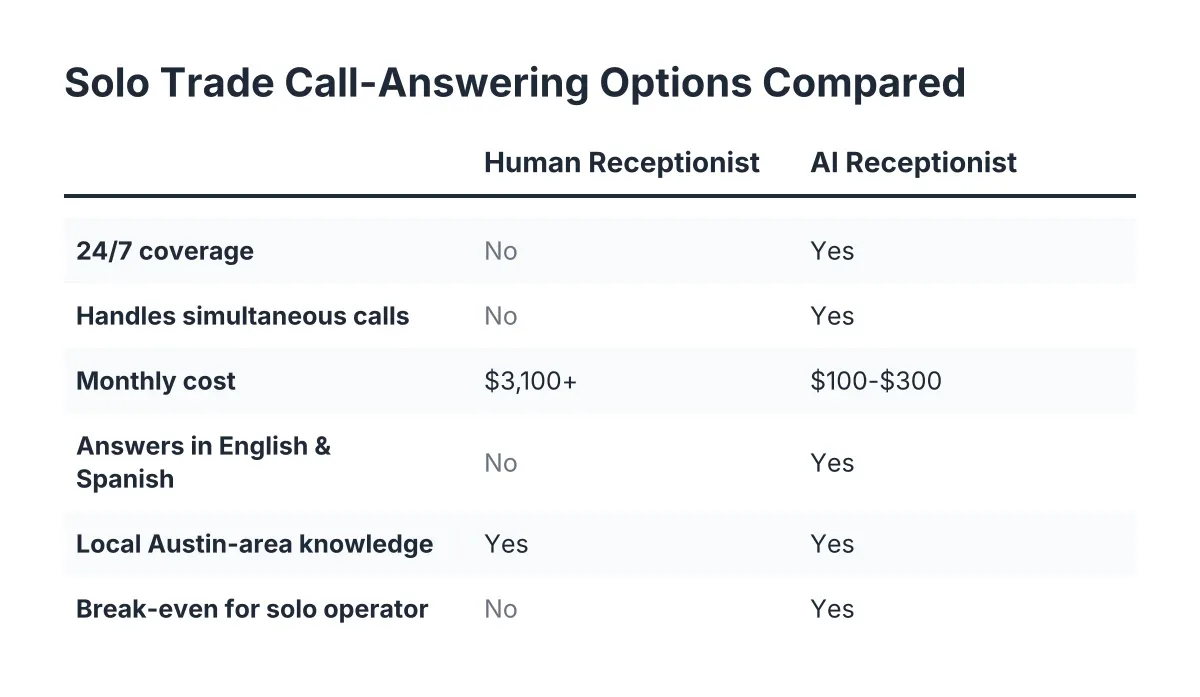
The three paths to the same goal carry different price structures. A traditional answering service bills by the minute or the call, so a busy month costs more than a slow one, and after-hours coverage typically costs extra. Hiring a full-time office person means a salary, payroll taxes, and someone who still goes home at five. An AI receptionist runs on a flat monthly plan, answers 24/7 including nights and weekends, and does not charge more when your phone blows up during a Central Texas heat wave. Which structure is cheapest for you depends on your volume and how much after-hours coverage matters to your trade.
After-hours and 24/7 coverage
Burst pipes do not check business hours. If your work generates emergency calls at 11 p.m., you need coverage that never clocks out, and with human services that is where the bill grows fastest. Nights, weekends, and holidays are premium time for staffed call centers. AI-based coverage flattens this factor because the software costs the same at 2 a.m. as it does at 2 p.m. If most of your missed calls land after hours, this factor alone can decide which type of solution costs less.
Language coverage
A large share of Austin home service customers prefer to talk through a job in Spanish. Some providers charge extra for bilingual answering or route Spanish speakers to a smaller, pricier team. Others, including AI receptionists built for this market, include English and Spanish on every plan. If your customer base speaks both languages, ask up front whether bilingual answering is included or billed as an add-on. It changes the math.
Integrations and setup
Getting captured leads into the tools you already use is the last cost driver. Basic email summaries usually cost nothing extra. Webhooks and CRM sync to platforms like HubSpot, Salesforce, Zoho, or anything Zapier connects to may sit on a higher plan tier. Setup fees vary too: some providers charge for onboarding, some do not. A good rule: the simpler the provider makes setup sound, the more you should ask them to show it, and the fewer surprise line items you should accept. The cost of missed call recovery increases when you demand integrations and onboarding support rather than accepting basic notifications.
Cost Factor Table
| Factor | Pushes the price down when… | Pushes it up when… |
|---|---|---|
| Call volume | You miss only a handful of calls a week | You field steady call traffic across multiple crews |
| Scope of each call | You only need messages taken | You want qualification, booking, and live transfer for emergencies |
| Solution type | Software handles it on a flat monthly plan | You pay per minute for humans or a full salary for staff |
| After-hours needs | Most calls land during business hours | Your trade generates emergency calls nights and weekends |
| Language coverage | Bilingual answering is included by default | Spanish support is a billed add-on or premium routing |
| Integrations and setup | Email summaries are enough for you | You need CRM sync, webhooks, and paid onboarding |
How to Get an Accurate Missed Call Recovery Estimate
Getting a real number takes about fifteen minutes of prep. Before you talk to any provider, gather:
- Your missed call count. Pull last month's phone records. Count calls that went to voicemail or rang out, and note how many came after hours.
- Your average job value. Even a rough figure helps. A missed water heater replacement costs you more than a missed filter change, and it frames what recovering those calls is worth.
- What you want done with each call. Message only? Qualification and booking? Live transfer for emergencies? Write down your must-haves and nice-to-haves.
- Your tools. The CRM or job software you use, if any, so the provider can tell you whether syncing leads costs extra.
A good quote should itemize the monthly plan, what call volume it covers, what happens if you exceed it, whether after-hours and bilingual answering are included, and any setup or onboarding fee. If a quote is one number with no breakdown, ask for the breakdown. If they will not give it, keep shopping.
Estimates differ between providers because the underlying models differ. A per-minute answering service estimates from projected talk time, so their number is a moving target that grows in your busy season. A flat-plan AI receptionist quotes from plan tiers, so the number holds steady month to month. Neither is dishonest; they are just measuring different things. Compare them against your actual volume, not against each other's marketing.
One more test that costs nothing: call the AI before you buy it. We invite prospects to phone ours and try to stump it. Ask it about a slab leak at midnight, switch to Spanish mid-call, or describe a job badly on purpose. Five minutes on the phone tells you more than any pricing page.
Ways to Keep the Cost Down
- Match the plan to your real volume. Do not pay for capacity you will not use. Start with a tier that covers your actual missed call count and move up when your records show you need to.
- Start with core scope, then add. Call answering, lead capture, and booking recover most of the lost revenue. Add live transfer or deeper CRM sync once the basics prove out.
- Avoid per-minute pricing if your calls run long. Trade calls involve details: the model of the unit, the age of the roof, where the water is coming from. Long calls on a per-minute plan get expensive fast. Flat pricing removes that pressure.
- Skip paid add-ons for things that should be standard. Bilingual answering and after-hours coverage are core needs for Austin trades, not luxuries. Choose a provider that includes them rather than billing them separately.
- Get two or three quotes. Not to grind anyone on price, but because the comparison shows you which model fits your call pattern. The cheapest sticker is not always the cheapest solution once overage and after-hours fees land.
Cost Questions People Ask
Is an AI receptionist cheaper than hiring someone?
Compare a flat monthly software plan against a full-time salary plus payroll taxes, and the software wins on raw cost for most one-to-five-crew shops. The bigger difference is coverage: an employee works set hours, while an AI receptionist answers 24/7 without overtime. Many owners keep their office person for relationships and paperwork and let the AI capture the calls that person cannot reach.
Do I pay more for after-hours or weekend calls?
With staffed answering services, usually yes; nights and weekends are premium time for human call centers. With an AI receptionist, no; the plan price covers 2 a.m. the same as 2 p.m. If your trade generates emergency calls, this single question should be the first one you ask any provider.
Are there setup fees or long contracts?
It varies by provider, which is exactly why you ask before signing. Some services charge onboarding fees or lock you into annual terms; others set you up in days with no long-term commitment. A provider confident in the product does not need a contract to keep you, so treat heavy lock-in as a signal worth questioning.
What does missing calls cost me if I do nothing?
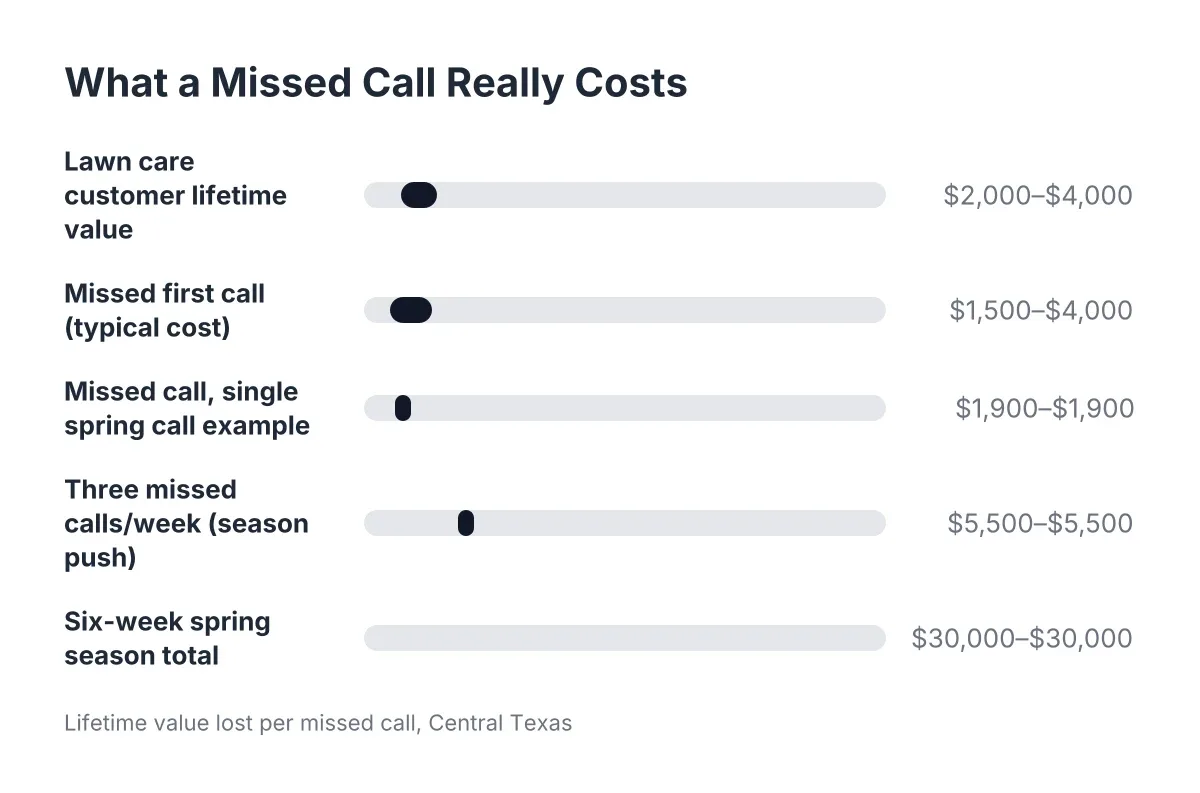
Run your own math: your average job value multiplied by the calls that went to voicemail last month. Then remember that a caller who reaches your competitor once may become their recurring customer, so the real loss compounds over years, not one invoice. For most home service businesses, a single recovered job covers the monthly cost of answering every call.
The Bottom Line
The cost of recovering your missed calls comes down to your call volume, the scope you want handled, and whether you choose software, a staffed service, or a hire. Pull last month's phone records, gather two or three itemized quotes, and compare them against your actual missed calls, not a sales pitch. And if you want the fastest gut check, call the AI receptionist yourself and see whether it earns the money.
If you're losing revenue to missed calls, NeverMiss ATX can help.
Prefer to talk it through? Call (512) 980-9267 — a quick call is usually the fastest way to get a straight answer for your situation.