AI Receptionist vs. Hiring a Virtual Assistant: The Real Cost Comparison for Austin Trades
A burst pipe call at 11pm is worth $800 to $3,000 in immediate work, and sometimes $15,000 or more in follow-on water damage and restoration. If nobody answers, that caller dials the next plumber on the list, and the whole job walks. That is the math forcing Austin trade owners into the receptionist vs virtual assistant decision: pay a person to cover the phone, or set up software that answers 24/7. This guide walks through the comparison step by step, with real numbers, so you can run it for your own business before another after-hours call goes to voicemail.
Step 1: Put a Dollar Figure on Every Missed Call
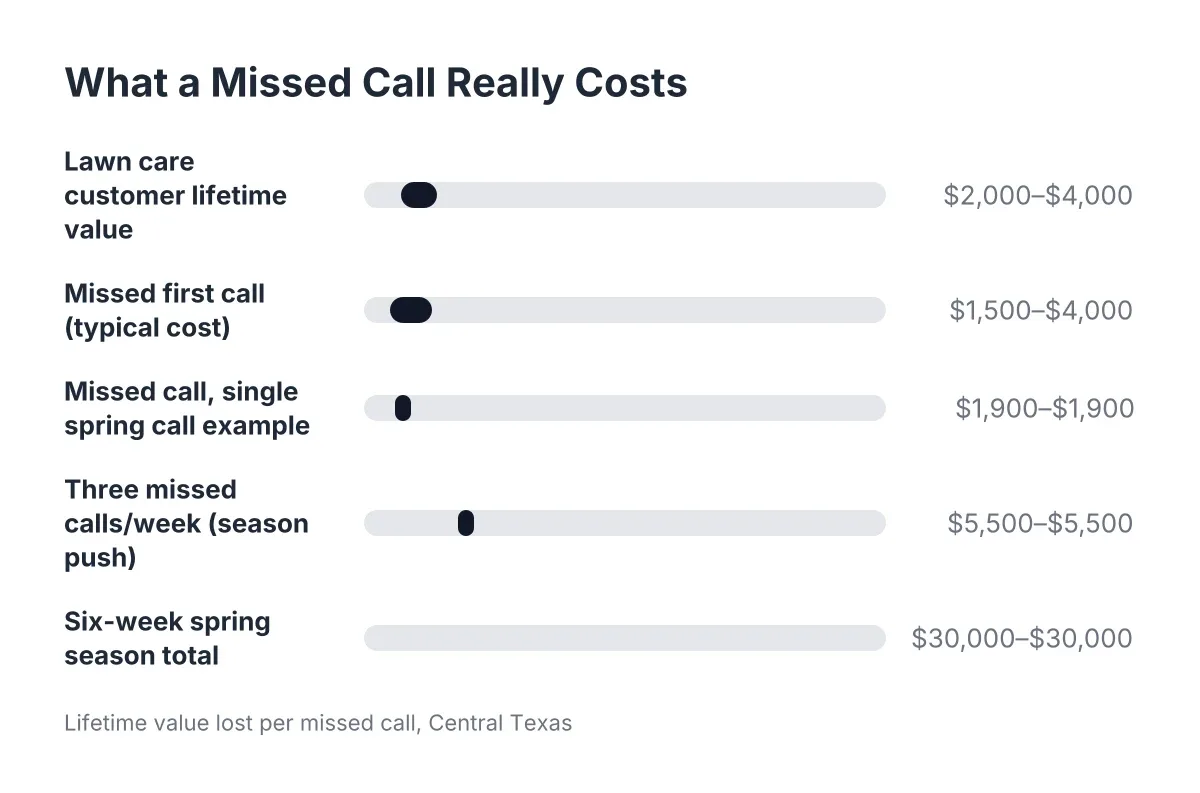
Before you compare anything, know what a ringing phone is worth. For a Central Texas emergency trade, the numbers stack fast.
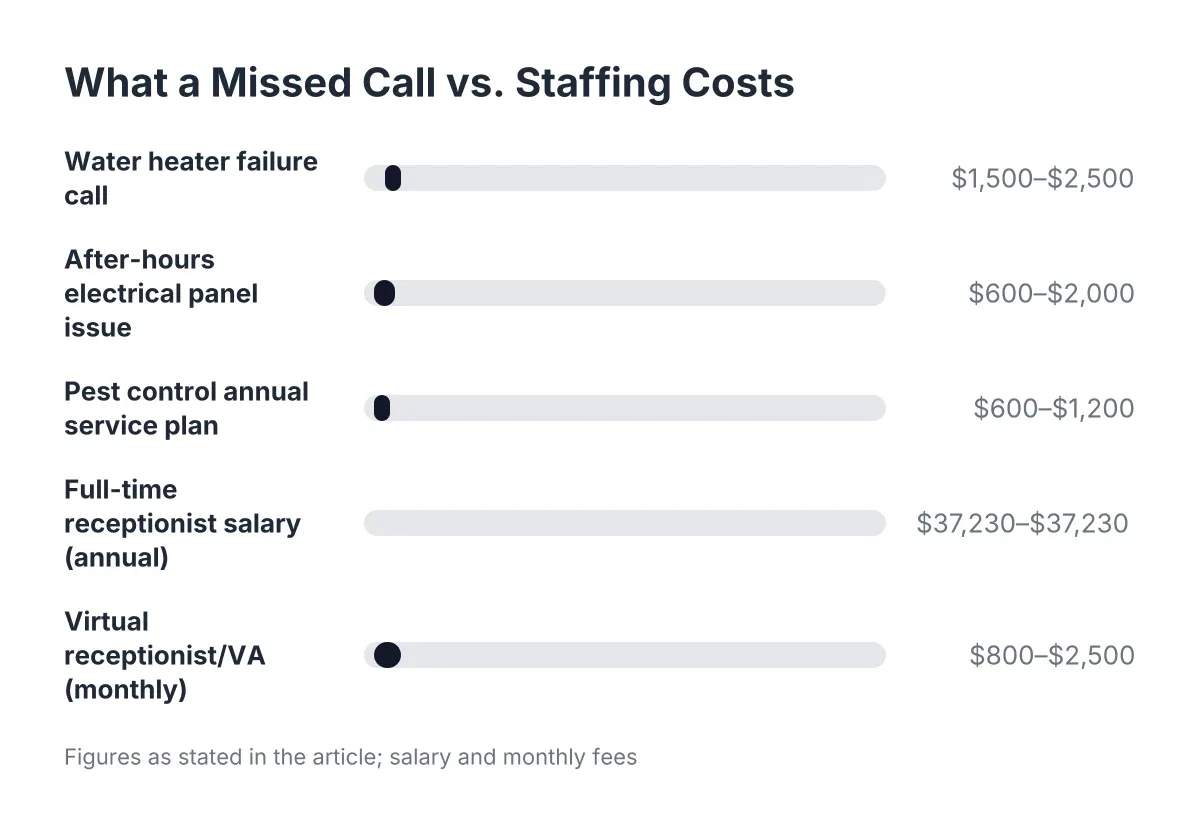
Start with your average ticket. A weekend water heater failure typically runs $1,500 to $2,500 installed. An after-hours electrical panel issue often lands between $600 and $2,000. A pest infestation call that converts to a quarterly service plan is commonly worth $600 to $1,200 a year, every year, as a recurring customer.
Now count the misses. Pull your phone records for the last 30 days and tally calls that hit voicemail. Most owner-operators who actually run this count are surprised by how many went unanswered — you were on a ladder, under a house, or asleep. Multiply your miss count by your average ticket and a realistic close rate of 40 to 60 percent for emergency calls.
As a hypothetical: a solo Round Rock plumber missing 12 calls a month, at a $1,200 average ticket and a 50 percent close rate, would be losing about $7,200 a month. That is $86,000 a year quietly leaving through the voicemail greeting.
Speed makes it worse. According to widely cited lead-response research from MIT Sloan School of Management / InsideSales.com, the odds of contacting a lead drop 100-fold when you call back at 30 minutes instead of within 5 minutes. A panicked caller with water on the floor does not wait 30 minutes. They call your competitor before your voicemail beep finishes.
Step 2: Price Out the Human Option Honestly
A human answering your phone is the traditional fix, and it works, but price it fully before you commit. You have three human paths:
- Hire a full-time receptionist. The median receptionist wage is $17.90 an hour, about $37,230 a year before benefits, payroll taxes, or overtime, according to the U.S. Bureau of Labor Statistics. That covers roughly 40 hours a week. Your burst pipes do not keep business hours.
- Hire a virtual receptionist or VA. A part-time virtual receptionist typically runs $800 to $2,500 a month depending on hours and call volume. Virtual receptionist companies and per-minute answering services stack overage fees fast during a hail storm or a freeze, exactly when call volume spikes.
- Answer everything yourself. Free on paper, expensive in reality. Every call you take mid-job is a job that runs long, and every call you decline is Step 1 all over again.
Notice the coverage gap in all three. One person, virtual or in-office, works one shift. To cover nights, weekends, and holidays with humans, you are building a rotation, and now you are managing a small call center instead of running crews.
Step 3: Training and Knowledge Retention in the AI Receptionist vs. Virtual Assistant Choice
Training is where the comparison stops being about hourly rates. A virtual receptionist typically needs two to six weeks to learn your trade before their answers stop costing you jobs. An AI receptionist gets loaded with your service list, pricing ranges, and service area once, and it holds that knowledge on every call.
Think about what a new hire has to learn for a multi-trade operation: which jobs you take and which you refer out, how you price a drywall patch versus a full remodel quote, whether "no-cool" at 5pm in July gets same-day dispatch. Any virtual receptionist job description you write for that role runs two pages, and turnover means writing it again next year.
There is a real trade-off here, and it is worth naming. A sharp human receptionist who has been with you three years reads tone and improvises in ways software does not. If your business runs on complex negotiated commercial contracts, a dedicated human may still earn their salary. For inbound emergency and residential calls, though, the job is consistent: answer fast, capture the address, qualify urgency, get it booked. That consistency is what AI does without sick days.
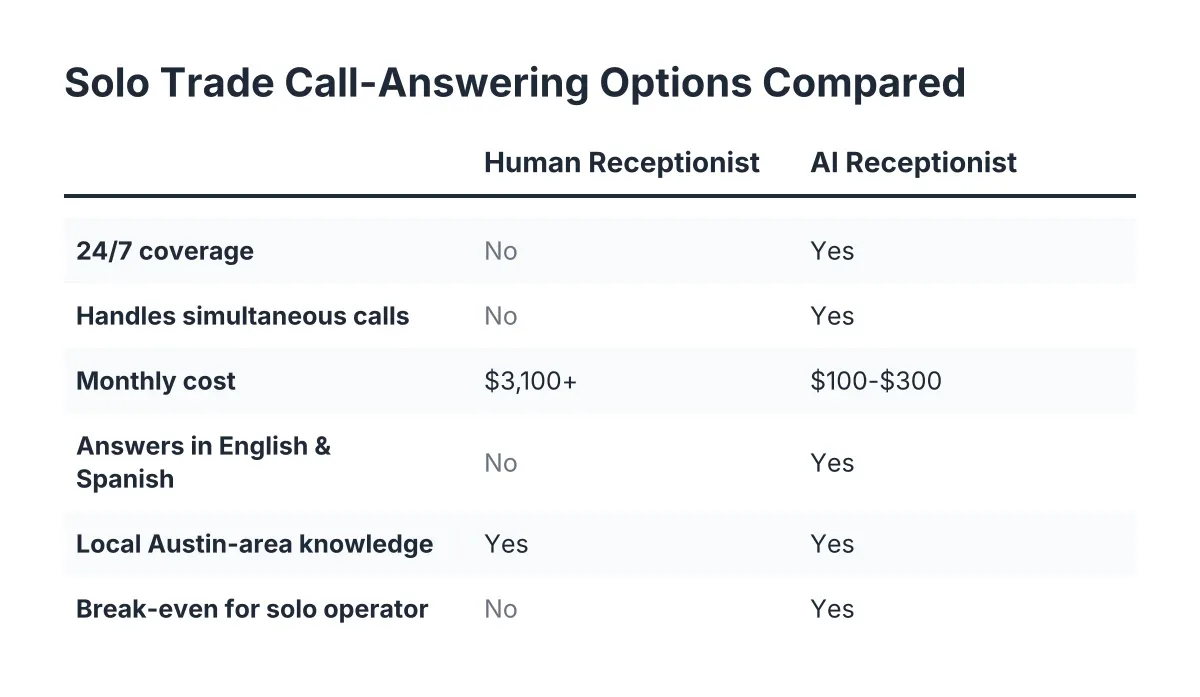
Bilingual coverage widens the gap further. In Central Texas, a Spanish-speaking caller with a flooding kitchen is a common Tuesday. Finding one bilingual virtual assistant is hard; finding one for the overnight shift is harder. An AI receptionist handles English and Spanish on the same line, every call, at no extra staffing cost.
Step 4: Stress-Test Reliability at 2am on a Friday
Reliability for an emergency trade means one thing: does the phone get answered on the first ring at 2am during a February freeze, when 30 people are calling about burst pipes in the same hour?
A single human cannot do it. Even the best virtual receptionist takes one call at a time, sleeps, and quits eventually. An answering service can scale, but a national call center reads a generic script and does not know that Pflugerville and Georgetown are in your service area while a Fort Worth call needs different handling.
Here is what to demand from either option before you sign anything:
- First-ring answering, 24/7, including weekends and holidays, with no per-minute surge pricing during storms.
- Emergency triage that captures the address and urgency before anything else. A panic caller gives you 60 seconds of patience, not five minutes of hold music.
- Live transfer for true emergencies, so a flooding call reaches you or your on-call tech immediately instead of sitting in a message queue.
- Booking on the call, not "someone will get back to you." A caller who hangs up with a booked slot does not keep dialing competitors.
- A written summary of every call, so you wake up knowing exactly what came in overnight and can prioritize the water damage follow-up over the leaky faucet.
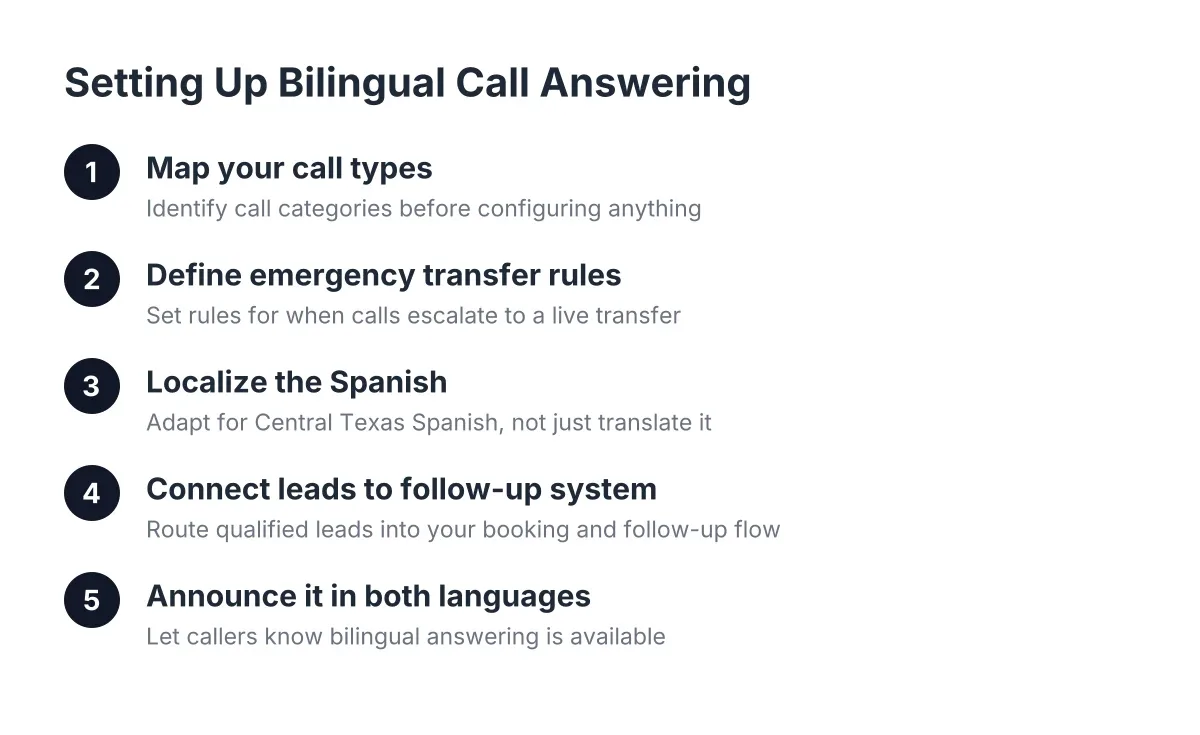
If a human service can genuinely deliver all five around the clock, it will cost several times what one salary suggests. This is also where missed call recovery becomes a system rather than a wish; every call gets answered, captured, and either booked or transferred, so nothing depends on you noticing a voicemail between jobs.
Step 5: Address the Fair Objections About AI on the Phone
Skepticism about AI answering emergency calls is reasonable, so test it instead of taking anyone's word. Call the AI receptionist yourself before your customers do. Describe a burst pipe in Spanish. Ask about a service you do not offer. Try to stump it. If it fumbles your trade's basics in a five-minute test, walk away.
Consumers already expect this technology. According to Five9, 84 percent of consumers know some companies use AI for customer service. The same Five9 survey found 75 percent prefer talking to a human, which sounds like a point against AI until you finish the thought. The comparison at 11pm is not AI versus your best human; it is AI versus your voicemail. Voicemail loses that matchup every time, because emergency callers abandon and redial faster than any other caller type.
The headcount fear deserves a straight answer too. Owners worry that choosing software over a virtual assistant means cutting people. The data says otherwise: 98 percent of small employers using AI reported no change in employee headcount, according to the National Federation of Independent Business. In the trades, the phone was never a job you had filled. The AI captures calls nobody was answering; your techs keep turning wrenches.
Step 6: Run Your Own Numbers Before You Decide on AI Receptionist Hiring or Virtual Staffing
Now put your figures side by side. The receptionist vs virtual assistant comparison usually settles itself once the monthly costs and coverage hours sit on the same page.
For a typical Austin multi-trade operation doing $150K to $600K a year in 2026:
- Full-time receptionist: about $3,100 a month before taxes and benefits, 40 hours of weekly coverage, weeks of trade-specific training, no after-hours answer.
- Virtual receptionist or VA: $800 to $2,500 a month, business-hours coverage with overage fees, turnover risk, bilingual coverage rare.
- AI receptionist: a flat monthly software cost well under one part-time salary, 24/7 and bilingual on every call, trained once on your services, live transfer for the calls that cannot wait.
Then weigh that against your Step 1 number. If missed calls are costing you $5,000 or more a month, and for most Central Texas emergency trades they are, the question is not whether you can afford coverage. It is which option answers on the first ring when the next freeze hits, captures the lead in English or Spanish, and books the job while your competitor's phone is still ringing to voicemail.
You do not have to guess. Track your misses for two weeks, price the three options against your own average ticket, and choose the one that never lets a panic caller hear a beep.
If you're losing revenue to missed calls, NeverMiss ATX can help.
Prefer to talk it through? Call (512) 980-9267 — a quick call is usually the fastest way to get a straight answer for your situation.