AI Answering Service vs. Hiring Staff: 7 Numbers Austin Trades Should Run
Spring booking season in Central Texas has a cruel math problem. Your crew is out on jobs from 7 a.m. to dark, your phone rings 15 to 30 times a day, and every call you miss is probably a recurring customer signing a weekly contract with the company that picked up. Most owners solve this one of four ways: hire a receptionist, sign with a national call answering service, use a virtual receptionist, or set up an AI answering service. Each one has a real cost and a real capability ceiling. This article puts all four side by side, priced against actual Austin call volumes and job values, so you can run the comparison yourself without sitting through a sales call.
Here are the seven numbers and comparisons that matter, in order.
1. What a Missed First Call Actually Costs a Recurring Service Business
Start with your own math before you price any solution. A one-time mow might be worth $60. But a new customer who signs up for weekly service at $50 a visit, April through October, is worth about $1,500 in year one, and recurring customers stick around. Pest control runs the same pattern; a quarterly plan at $130 a visit is $520 a year, often for five-plus years.
That means the first call is not a $60 decision. It is a $1,500 to $2,500 lifetime value decision, and the new customer is won or lost in the first 30 seconds. Callers who hit voicemail during booking season do not leave a message; they call the next lawn care company on Google. Whatever answering option you pick, judge it against that number, not against its monthly fee.
2. Hiring a Full-Time Receptionist: The $45,000 Baseline
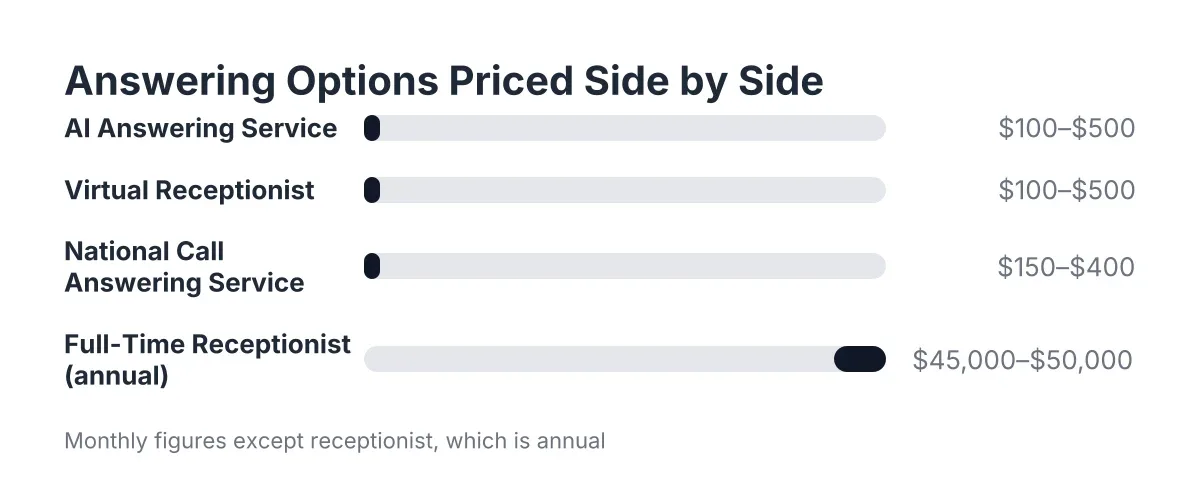
A live hire is the gold standard for warmth, and the most expensive line on this list. According to the U.S. Bureau of Labor Statistics, the median receptionist wage was $17.90 an hour in May 2024, about $37,230 a year before payroll taxes, benefits, or overtime. Fully loaded, most owners land between $45,000 and $50,000 a year.
That buys you roughly 40 hours a week of coverage. It does not buy you nights, weekends, sick days, or lunch breaks, and in pest control, a large share of new-customer calls come in after hours. For a business doing $150K to $800K a year, a full-time hire only pencils out if your daytime call volume alone justifies the salary. For most solo-to-15-crew operations in Austin, it does not, at least not yet.
3. National Call Answering Services: Coverage Without Context
A national call center answers 24/7 for less than a hire, typically $150 to $400 a month plus per-minute charges that climb fast in busy seasons. The trade-off is context. The agent answering your phone at 9 p.m. is reading a script, has never heard of Pflugerville, and cannot tell a $60 one-time cleanup from a weekly-contract prospect worth $1,500.
Message-taking is the core product. Most national services write down a name and number, then send you a message you still have to return, which puts you back in the same callback race you were trying to escape. In addition, per-minute billing means your best months, spring for lawn and summer for HVAC maintenance, are also your most expensive months.
4. Virtual Receptionists: A Human Middle Ground With Hour Limits
Virtual receptionist services split the difference: remote humans, usually shared across many clients, at $100 to $500 a month depending on minutes. A good virtual receptionist for small business use handles calls with warmth and can follow booking instructions, which matters, because a Five9 survey found 75% of consumers prefer talking to a real human for support.
The catch is capacity and hours. Most plans cover business hours only, and minute overages during a seasonal spike can double your bill. If your calls cluster after 6 p.m. or on Saturday mornings, when homeowners are actually standing in their yards noticing the fire ant mounds, business-hours coverage misses the calls you most needed answered.
5. How an AI Answering Service Handles Calls Without Adding Headcount
An AI answering service picks up every call, day or night, and holds a natural conversation instead of playing a menu. It asks what the caller needs, captures name, address, and service details, qualifies the lead against your criteria, and sends a booking link or books the appointment directly. You get a summary and a scored lead in your dashboard, not a voicemail to decode from a truck.
For example, imagine a Round Rock pest control owner getting a call at 8:40 p.m. about carpenter ants. The AI receptionist would answer, ask about the property and the problem, flag the caller's interest in a quarterly plan, book the inspection, and text the owner a summary. No callback race the next morning; the lead is already captured and booked.
Cost-wise, AI receptionist plans for small business typically run $100 to $500 a month with no per-minute meter running during your busiest season. That is a fraction of the $45,000 hire, with coverage the hire cannot offer. As of 2026, adoption is still early; an NFIB survey found only 24% of small employers use AI tools at all, which means answering every after-hours call is still a competitive edge, not table stakes.
6. The Honest Limits of an AI Answering Service
An AI answering service is not the right fit for every call or every business. Complex disputes, delicate customer-retention conversations, and judgment calls about a longtime recurring customer's account belong with you or your office manager. Good setups handle this with live transfer for urgent calls, so a burst-pipe emergency or a panicked caller gets bridged to a human instead of a booking link.
There are also legitimate skeptics. Some callers can tell they are talking to AI, and a Five9 survey found 84% of consumers already know companies use AI for customer service, so pretending otherwise backfires. The fair test is not "does it sound perfectly human"; it is "did the lead get captured and booked instead of hitting voicemail." If you are curious whether the call quality holds up, call one yourself and try to stump it. Any provider confident in their AI receptionist will invite exactly that.
One more caution: if you already employ a full-time receptionist you trust, or you run a multi-location operation with a dispatch team, an AI receptionist is an overflow and after-hours layer, not a reason to change what works. Worth noting, the NFIB's Small Business and Technology Survey found 98% of small employers using AI reported no change in headcount; owners use it to answer the calls nobody was catching, not to cut the people they have.
7. The Side-by-Side: Four Options Priced Against Austin Call Volumes
Assume a lawn care company in Cedar Park getting 20 calls a day in April, a third of them after hours or while the crew is on site. Here is how the four options stack up:
- Full-time hire: About $45,000 a year fully loaded. Warm and local, but covers 40 hours a week; the after-hours third of your calls still goes to voicemail.
- National call answering service: $150 to $400 a month plus per-minute fees. Covers 24/7, but takes messages instead of booking, and does not know Georgetown from Galveston.
- Virtual receptionist: $100 to $500 a month. Human touch during business hours; overage charges spike in booking season, and evenings usually go uncovered.
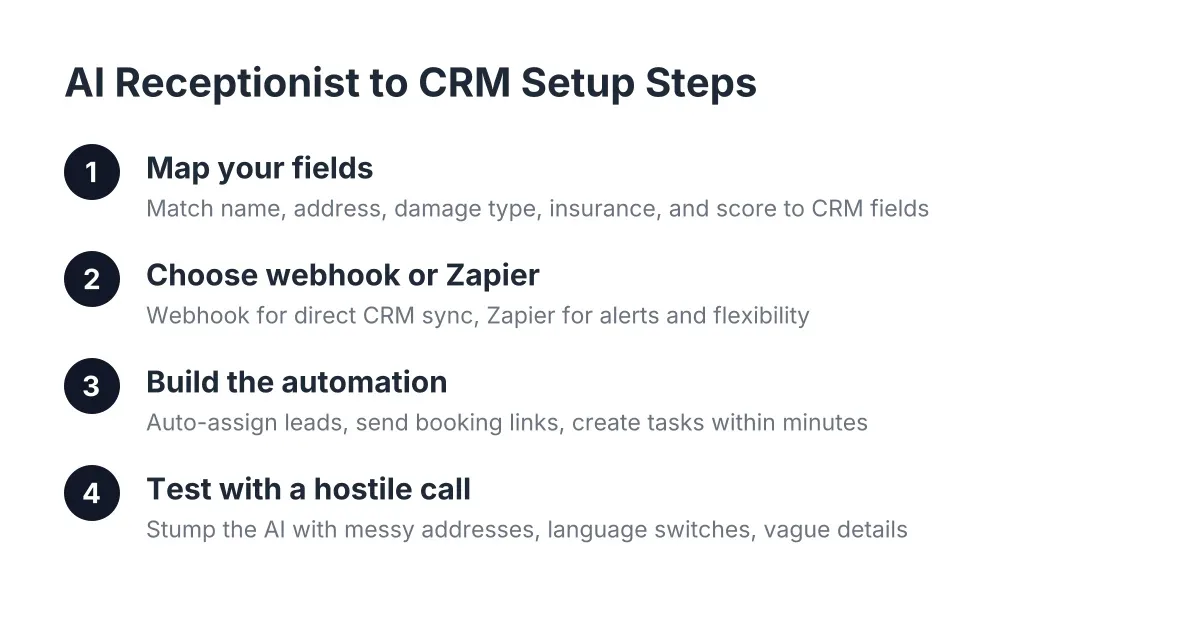
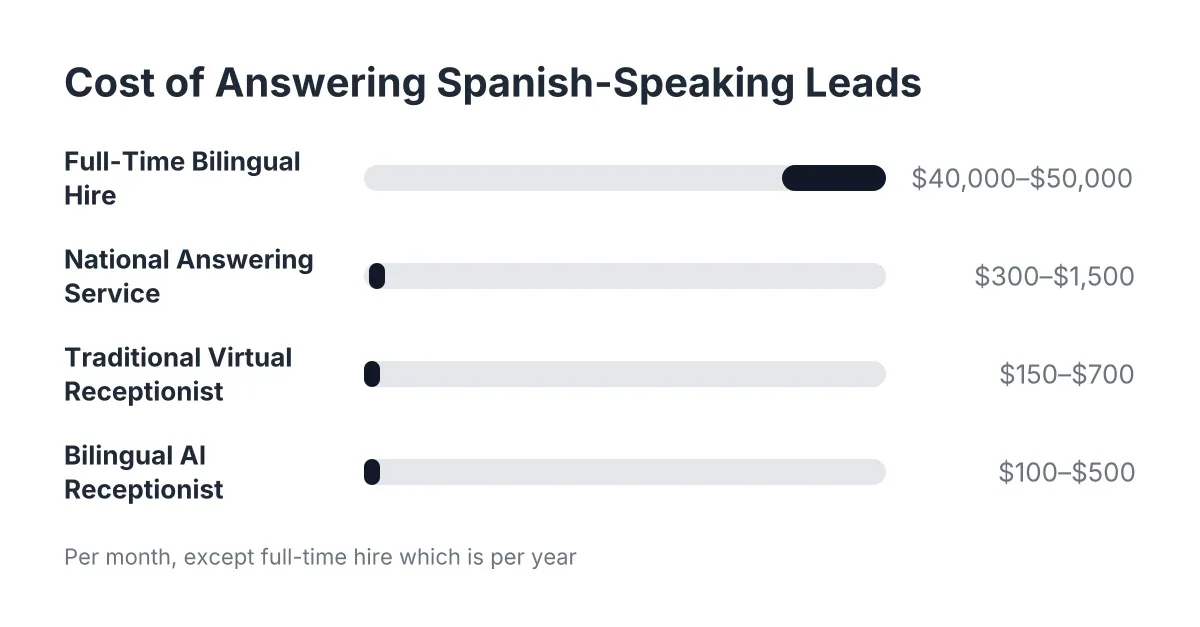
- AI receptionist: Typically $100 to $500 a month, flat. Answers 24/7, qualifies the lead, books the appointment, syncs to your CRM, and handles Spanish-speaking callers on the same line.
That last point deserves a sentence of its own. In Central Texas, a receptionist option that cannot take a call in Spanish is leaving customers on the table, full stop. Bilingual coverage should be built in on every plan, not sold as an add-on, whether the voice is human or AI.
8. How to Run the Decision for Your Own Business
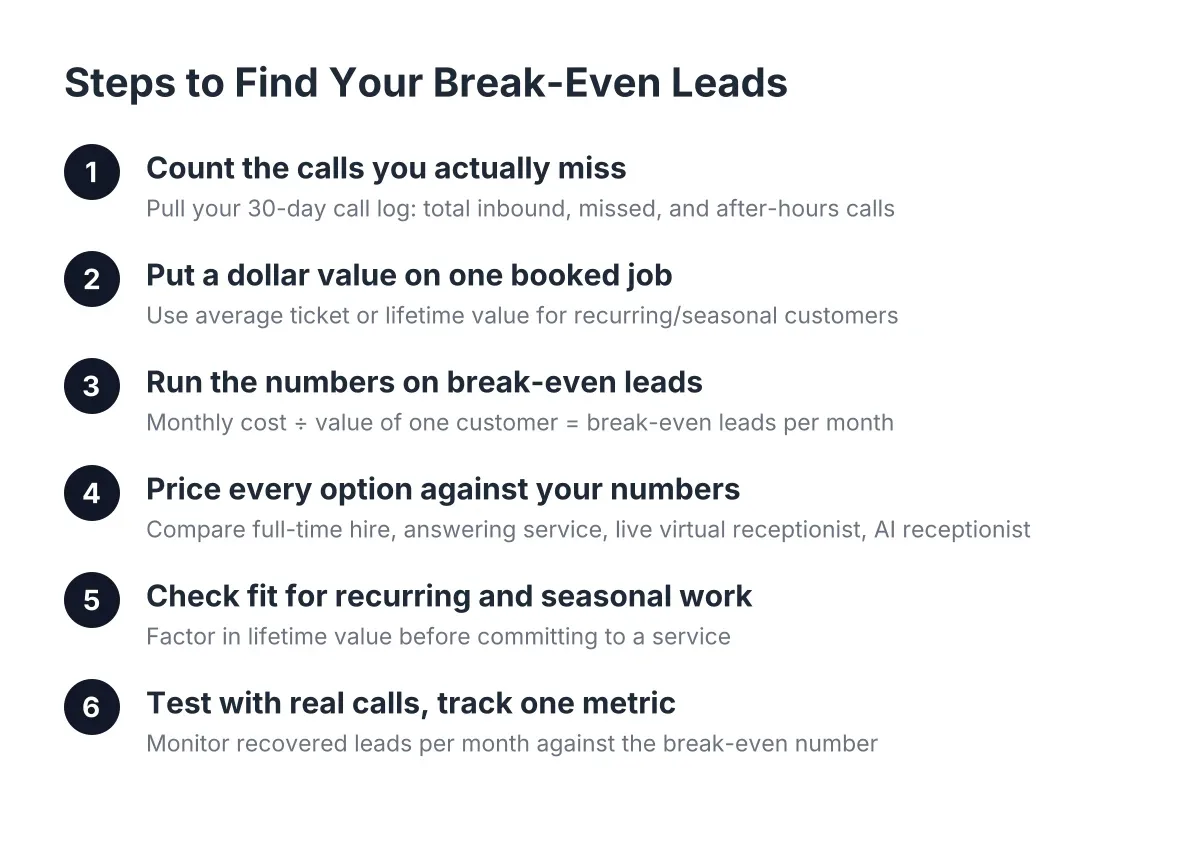
Skip the feature checklists and answer four questions with your own numbers. First, pull your phone records for last spring and count calls received outside 8 to 5, plus calls that hit voicemail during the day. Next, multiply those missed first calls by your average recurring-customer lifetime value, not your one-time job price.
Then match the result against the four cost baselines above:
- If missed-call value exceeds $45,000 a year and your calls are mostly complex daytime conversations, a live hire earns its salary.
- If you mainly need messages relayed overnight, a national call answering service covers the basics cheaply.
- If your volume is moderate, daytime-heavy, and you want a human voice, a virtual receptionist for small business fits.
- If your leads call at all hours, book fast, and are worth 5x their first job in recurring value, an AI receptionist for small business captures the most lifetime value per dollar spent.
Setup anxiety is the last objection worth addressing. A modern AI receptionist takes an afternoon to configure, not a months-long IT project: your services, your service area, your qualification questions, your booking link. If a provider makes setup sound complicated, that is a signal about the provider, not the technology.
The bottom line for Austin trades: your phone is your storefront, and during booking season it is open 24 hours whether you are staffed for it or not. Run the missed-call math once, honestly, and the right answer for your business usually picks itself.
If you're losing revenue to missed calls, NeverMiss ATX can help.
Prefer to talk it through? Call (512) 980-9267 — a quick call is usually the fastest way to get a straight answer for your situation.