Seasonal Call Volume Management Terms Explained: A Plain-English Glossary
If you run a home service business in Central Texas, you already know the phone goes crazy when the first 95° week hits or a cold snap bursts pipes across town. This glossary is for owners and buyers who keep running into jargon while researching answering services, AI receptionists, and call handling tools. Understanding seasonal call volume management means learning what providers are actually quoting, asking sharper questions, and spotting the gaps in a pitch before you sign anything. Every entry here is written to make sense on its own, in plain English, in under thirty seconds.
- Call Volume
- Seasonal Spike
- Peak Season
- Missed Calls
- After-Hours Calls
- Overflow Handling
- AI Receptionist
- Lead Capture
- Lead Qualification
- Booking Link
- Live Transfer
- Emergency Triage
- Bilingual Support
- Call Intelligence
- Call Summary
- CRM Sync
- Webhook
- Per-Minute vs. Per-Call Pricing
- Answer Rate
Call Volume and Seasonality Terms
Call Volume
Call volume means the total number of calls your business receives in a given period, usually measured per day, week, or month. It sounds simple, but it is the number every answering service and AI receptionist prices around. Knowing your own call volume, including the calls you miss while on site, tells you whether a solution is worth the money. Most trades underestimate it because missed calls never show up in memory, only in the log.
Seasonal Spike
A seasonal spike is a sharp, predictable rise in call volume tied to weather or the calendar, like AC calls in a Texas June or pipe repairs after a freeze. Spikes matter because they hit exactly when you are busiest on the job and least able to answer. A provider who talks about handling spikes without extra staffing or surge pricing is addressing the real problem. For a closer look at why these surges hit Central Texas trades so hard, see why call volume spikes during spring and summer.
Peak Season
Peak season is the stretch of the year when demand for your trade is highest and your phone rings the most. For HVAC in Austin that is summer; for many plumbers it is the first hard freeze. Peak season is when missed calls cost the most, because every caller is a motivated buyer with an urgent problem. Ask any provider how their service behaves during peak season, not just on an average Tuesday.
Missed Calls
A missed call is any inbound call that goes unanswered or lands in voicemail instead of reaching a person or system that can help. Missed calls are the quiet leak in most trades businesses, because callers with a burst pipe rarely leave a voicemail; they call the next company on the list. Effective call volume management during seasonal peaks is mostly about turning missed calls into captured leads. If a provider only reports answered calls, ask how they track the ones that got away before you signed up.
After-Hours Calls
After-hours calls are the calls that come in outside your normal business hours, including nights, weekends, and holidays. In home services, after-hours is often when the urgent, high-value work shows up: the water heater fails at 9 p.m., not 9 a.m. A 24/7 answering setup, whether human or AI receptionist, exists mainly to capture this traffic. When comparing quotes, check whether after-hours coverage is included or billed as an add-on.
Overflow Handling
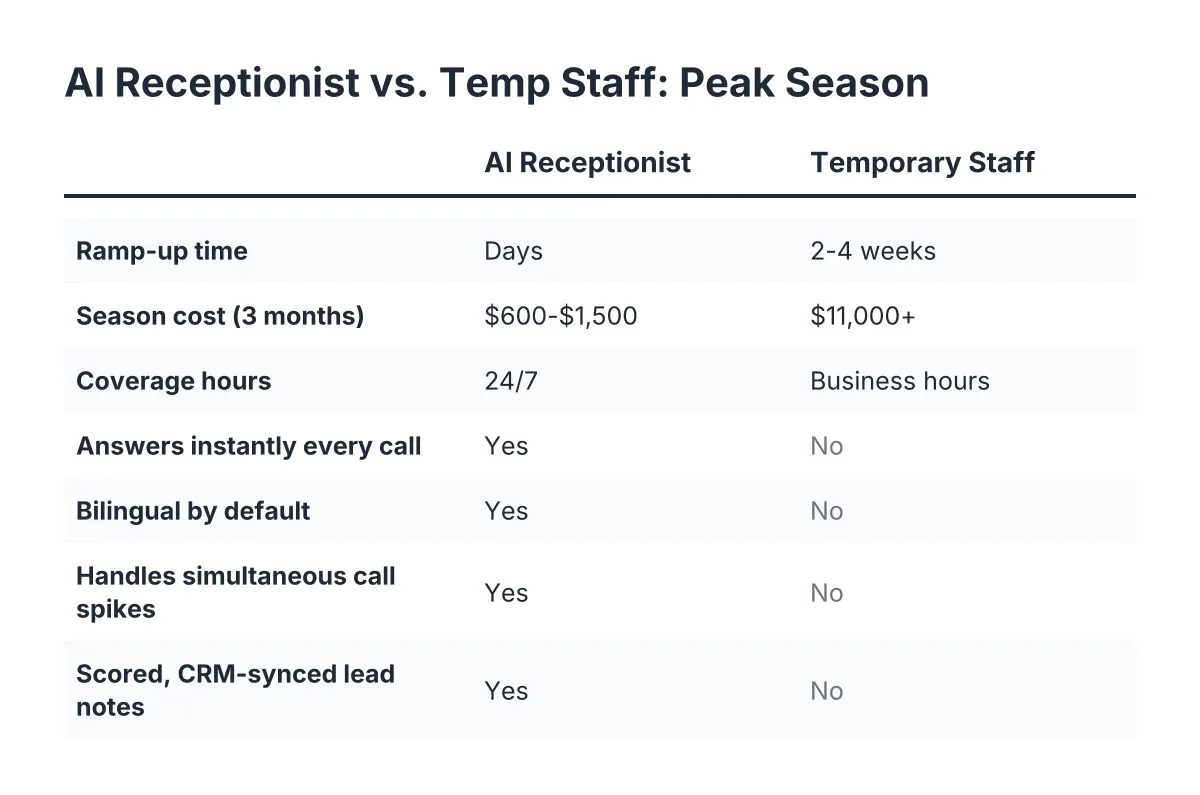
Overflow handling means routing calls somewhere else when your main line is busy or unanswered, so a second caller is not sent to voicemail. It is the classic fix for the two-calls-at-once problem every solo operator knows. An AI receptionist handles overflow differently than a call center: it can take multiple calls at the same time without a hold queue. Ask any provider what happens when three customers call during the same hailstorm.
Answering and Lead Capture Terms
AI Receptionist
An AI receptionist is software that answers your business phone with a natural voice, holds a real conversation, and takes action, like capturing the caller's details or sending a booking link. Unlike voicemail, it engages the caller; unlike a national call center, it does not read from a generic script. The practical test is simple: call one and try to stump it with a real question from your trade. A good one should handle your callers in English and Spanish without you configuring anything extra.
Lead Capture
Lead capture means collecting a caller's name, contact information, and reason for calling so you can follow up and win the job. It is the difference between "someone called" and "here is a customer with a broken AC at this address." Every answering solution should do lead capture by default; the question is how complete and accurate the captured details are. Sloppy lead capture turns into wasted callbacks and lost work.
Lead Qualification
Lead qualification is the process of asking a caller a few questions to figure out whether they are a real prospect, what they need, and how urgent it is. Qualification saves you from driving across Austin for a job that was never a fit. When an AI receptionist qualifies leads, it should follow questions specific to your trade, not a generic checklist. Ask a provider to show you the exact questions their system asks your callers.
Booking Link
A booking link is a web link sent to a caller, usually by text, that lets them pick an appointment time from your available slots. It closes the loop while the customer is still motivated, instead of waiting for a callback that may come too late. When a provider says calls get "booked," ask whether that means a confirmed appointment on your calendar or just a message asking you to call back. The difference decides how much admin work stays on your plate.
Live Transfer
A live transfer is when an answering system connects an urgent caller directly to you or your on-call person in real time, instead of taking a message. It matters for genuine emergencies, like a flooding kitchen, where a callback in an hour is too slow. The best setups make live transfer opt-in, so you decide which situations interrupt you on a ladder. Ask how the system decides what counts as urgent before it rings your cell.
Emergency Triage
Emergency triage means sorting incoming calls by urgency, so a burst pipe gets handled differently than a quote request for next month. Good triage protects your time during a seasonal spike, when everything feels urgent to the caller. A credible provider can explain exactly how their system tells an emergency from a routine call, and what happens next in each case. Vague answers here are a red flag.
Bilingual Support
Bilingual support means the answering service or AI receptionist can hold the full conversation, including lead capture and booking, in more than one language. In Central Texas, English and Spanish coverage is not a nice-to-have; it decides whether a large share of your callers ever become customers. Check whether bilingual coverage is included on every plan or priced as an upgrade. Also confirm the system handles the whole call in the caller's language, not just a greeting.
Reporting, Pricing, and Integration Terms
Call Intelligence
Call intelligence means automatically analyzing calls to score how promising each lead is and summarize what was said. Instead of listening to recordings, you read a short summary and see which callbacks matter most. During a busy week, this is how you decide which of twelve leads to call first from the truck. Ask providers whether summaries and scores are included or a separate line item on the quote.
Call Summary
A call summary is a short written recap of a phone call, covering who called, what they needed, and what happened next. Summaries let you skim ten calls in the time it takes to replay one voicemail. In practice, this is where managing seasonal call volume pays off day to day: the surge still happens, but you process it in minutes instead of losing your evening to callbacks. Look for summaries delivered where you already work, like a dashboard, text, or weekly report.
CRM Sync
CRM sync means automatically pushing captured leads into your customer database, so no lead lives only in a text message or a sticky note. CRM stands for customer relationship management, the software where you track customers and jobs. Sync matters for recurring customers, because the AC tune-up caller from March becomes the repair call in August, and you want that history in one place. Ask which systems a provider connects to before you buy, common ones include HubSpot, Salesforce, Zoho, and Zapier for everything else.
Webhook
A webhook is an automatic message one piece of software sends to another the moment something happens, like a new lead arriving. You do not need to understand the plumbing; you need to know it exists, because it is how a captured call becomes a row in your CRM or a notification on your phone without anyone typing. If a provider mentions webhooks, it means their leads can flow into tools you already use. That usually means less manual copying and fewer leads falling through cracks.
Per-Minute vs. Per-Call Pricing
Per-minute pricing bills you for the time an answering service spends on your calls, while per-call or flat pricing charges by call or by month regardless of length. The difference matters most during a seasonal spike, when per-minute plans can balloon exactly when you can least track them. Flat pricing keeps a busy July predictable. Whatever the model, ask what happens to your bill during your worst week of the year, not your average one.
Answer Rate
Answer rate is the percentage of your inbound calls that actually get answered by a person or system, instead of hitting voicemail or ringing out. It is the single clearest measure of whether your phone setup is working. A solo operator on site all day often has a lower answer rate than they think, because unanswered calls leave no trace unless something logs them. Ask any provider what answer rate you can expect at 2 a.m. on a Saturday, and how they prove it.
Using These Terms
You can now read an answering service quote line by line and know what each item means for your phone, your calendar, and your bill. Bookmark this seasonal call volume management glossary, and when a provider pitches you, ask the specific questions above: what happens during your worst week, who answers at 2 a.m., and where the leads land. The right answers will be concrete, and now you will recognize them.
If you're losing revenue to missed calls, NeverMiss ATX can help.
Prefer to talk it through? Call (512) 980-9267 — a quick call is usually the fastest way to get a straight answer for your situation.