AI Receptionist vs. Hiring Temporary Staff for Seasonal Call Surges in Austin
Every trade owner in Central Texas knows the calendar drives the phone. Spring lawn bookings, the first 100° week in June, a February freeze that bursts pipes across Round Rock. When the surge hits, you have two realistic options: an AI receptionist or hiring temporary help to answer the overflow. This guide compares AI receptionists vs temps, season by season, so you can pick the right setup before the next spike, not during it. If you have been searching for how an ai receptionist hiring temporary staff comparison actually plays out in dollars and missed calls, this is that breakdown.
The short version: temporary hires make sense when the work itself needs hands, like a second crew for storm repairs. For the phone, the math tilts hard the other way. Here are eight points of comparison, built around the actual surge windows Austin trades face.
1. Ramp-Up Time: AI Receptionists Ready Before the Season Starts
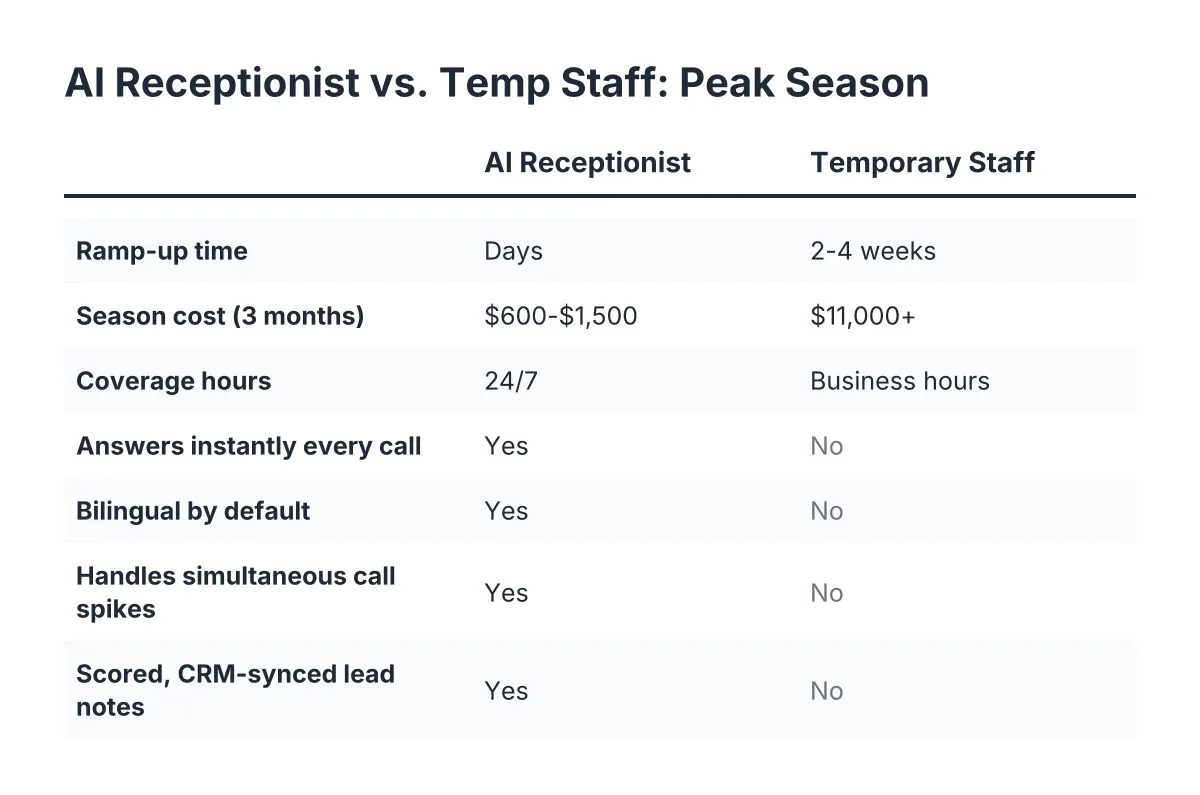
A temporary receptionist needs two to four weeks to recruit, plus another week or two to learn your services, your pricing questions, and your service area. If you start hiring in May for the summer rush, you are training someone while your phone is already ringing off the hook.
An AI receptionist gets set up in days, not weeks. You load your services, your service area from Georgetown down to South Austin, and your booking rules once. It answers the same way on day one of the surge as it does on day sixty. For a small crew owner who decided in April that this spring rush will not repeat last year's chaos, that timeline difference is the whole decision.
2. Cost Per Season: Temp Wages vs. Flat Monthly Pricing
The median receptionist wage in the U.S. is $17.90 per hour, about $37,230 per year, according to the U.S. Bureau of Labor Statistics. A temp covering just weekdays during a three-month peak season runs roughly $8,500 to $9,500 in wages alone, before any agency markup, which often adds 30 to 50 percent on top.
By contrast, an AI receptionist runs as a flat monthly subscription, typically a few hundred dollars per month depending on plan. As an illustrative estimate, three months of AI answering might cost $600 to $1,500 total, against $11,000 or more for an agency temp. For a general construction or handyman business doing $150K to $600K a year, that gap funds a lot of marketing or a new tool trailer.
3. Coverage Hours: Business Hours vs. 24/7 and After-Hours
A temp works a shift. Your calls do not. In summer, HVAC calls stack up between 6 and 9 p.m. when families get home to a hot house. After a freeze, burst-pipe calls start at 2 a.m. A temporary hire covering 8 to 5 misses the exact windows where seasonal demand pays best.
An AI receptionist answers every call, 24/7, including the Saturday morning spring rush when your whole crew is on site. For urgent calls, live transfer can bridge the caller straight to you or your on-call lead, so a genuine emergency still reaches a human. That combination, instant answering plus opt-in escalation, is the part a single temp on a single shift cannot replicate.
4. Speed to Lead: Why Answering First Wins the Bid
Speed is not a nice-to-have during peak season; it is the whole game. A foundational MIT Sloan / InsideSales.com study found the odds of contacting a lead drop 100-fold, and the odds of qualifying that lead drop 21-fold, when the callback happens at 30 minutes instead of within 5 minutes.
Suppose a homeowner in Cedar Park calls three remodelers about a water-damaged ceiling after a storm. Two phones ring out to voicemail. The third answers instantly, captures the details, and sends a booking link before the homeowner has dialed anyone else. In that scenario, the job is decided before your competitors even know they missed a call. A temp answers fast during their shift; an AI receptionist answers fast every time.
5. Bilingual Answering: Standard vs. a Hiring Bottleneck
Central Texas is a bilingual market, and a share of your best recurring customers prefer to explain a job in Spanish. Finding a temporary receptionist who is fluent in both languages, understands trade terminology in both, and is available for exactly your three-month window narrows an already thin candidate pool. Bilingual temps also command higher hourly rates.
An AI receptionist built for Austin trades handles English and Spanish on every call by default. The caller who describes a plomería emergency at 11 p.m. gets the same lead capture and booking flow as the English caller at noon. No extra hire, no premium rate, no coverage gap when that one bilingual temp calls in sick.
6. Consistency Under Pressure: What Happens on the Worst Day
The worst day of peak season is the day both options get tested. Say a typical HVAC-and-handyman crew in Pflugerville gets 40 calls on the first triple-digit Saturday of 2026. A temp handles one call at a time; callers two through six hit voicemail or a busy signal, and most of them dial the next company on the list.
An AI receptionist answers every one of those 40 calls simultaneously, qualifies each lead, and books the ones that fit your rules. Volume that would bury a human answering the phone alone becomes an ordinary day. This is the core of seasonal call volume management: the surge is predictable, so the capacity to absorb it should be too.
7. Lead Quality and Follow-Up: AI Scoring vs. Temp Notes
A temp under pressure writes down a name and a number, maybe. You get a sticky note that says "roof leak, call back." Then you spend your evening returning calls to find out which three of the fifteen are real jobs in your service area and which are price-shoppers or out past Leander.
An AI receptionist qualifies during the call: job type, location, timeline, and urgency. Calls arrive scored and summarized, sync to your CRM through Zapier, HubSpot, Salesforce, or Zoho, and a Monday morning report shows the week at a glance. However you handle follow-up, you start with a ranked list instead of a stack of notes, which matters most when peak season leaves you 45 minutes a day for callbacks.
8. What Happens After the Season: Offboarding vs. Staying On
Temporary staffing has an awkward ending. The season winds down, you let the temp go, and everything they learned about your business walks out the door. Next year you recruit, hire, and train again from zero. Meanwhile, off-season calls still come in, just fewer of them, and each one still matters to a business trying to build recurring customers.
An AI receptionist scales down with your volume without losing anything. The service knowledge, call handling, and booking rules carry into next season untouched. Worth noting: according to NFIB's Small Business and Technology Survey, 98% of small employers using AI reported no change in employee headcount. Owners are not using this to cut people; they are using it to stop missing calls without adding an admin hire they only need four months a year.
How to Decide: Season-by-Season Scenarios for AI vs. Temporary Staffing
Neither option is universally right, so weigh your season against what each does well. A quick decision list:
- Spring lawn and remodel rush (March to May): High call volume, mostly booking and quote requests. AI receptionist wins on simultaneous answering and instant booking links.
- Summer HVAC surge (June to September): Calls spike after hours and on weekends in the 95° heat. AI wins on 24/7 coverage with live transfer for genuine emergencies.
- Post-freeze plumbing surge (any winter week): Unpredictable timing kills the temp option; you cannot hire in 48 hours. AI is already on.
- Storm-response construction: If you need someone physically managing walk-ins, permits, or paperwork on site, hire a temp for that work and let the AI receptionist answer the phone.
- Year-round steady trades: If your calls barely fluctuate and you already have office coverage, evaluate whether after-hours answering alone justifies either option.
One honest limitation: an AI receptionist answers, qualifies, and books, but it does not swing a hammer or manage a jobsite. If your seasonal crunch is labor, not phones, temporary field hires are still the right tool, and a staffing professional can help you scope that correctly.
Is an AI Receptionist Reliable Enough to Trust With Peak-Season Calls?
An AI receptionist built for trades reliably handles the calls that dominate peak season: capturing the lead, qualifying the job, booking the appointment, and escalating genuine emergencies to a human by live transfer. It is not a gamble on unproven tech; it is a defined set of tasks it performs the same way on call one and call one thousand.
Consumer expectations back this up. According to Five9, 84% of consumers already know some companies use AI for customer service. The same Five9 research found 75% still prefer talking to a human for support, which is exactly why the strongest setup pairs AI answering with human follow-up. The AI captures every lead instantly; you or your crew lead make the human connection on the callback, when you are off the ladder and can give the customer real attention. Additionally, the AI is not replacing that relationship. It is making sure the relationship gets a chance to start.
The simplest way to evaluate any AI receptionist before your season hits: call it. Ask it the questions your customers ask. Describe a burst pipe in Spanish at midnight. If it handles your hardest call, it will handle your busiest week.
The Bottom Line on Seasonal Phone Coverage for Central Texas Trades
For the predictable surges Austin trades face, when you are comparing AI receptionists and temporary staff, it comes down to this: temps solve labor shortages, and AI receptionists solve answering shortages. If your bottleneck is the phone, the AI option costs a fraction as much, starts in days, covers 24/7 in English and Spanish, and never quits mid-season.
The businesses that win the 2026 spring rush will not be the ones with the biggest crews. They will be the ones that answered first, booked on the spot, and turned a predictable spike into a stack of recurring customers while their competitors' phones rang out.
If you're losing revenue to missed calls, NeverMiss ATX can help.
Prefer to talk it through? Call (512) 980-9267 — a quick call is usually the fastest way to get a straight answer for your situation.