How Much Does Seasonal Call Volume Management Cost?
How much does seasonal call volume management cost? The honest answer depends on three things: how many calls hit your line during your busy season, how much you need done with each call (answered, qualified, booked, or transferred), and whether you pay for coverage year-round or only when Central Texas weather sends your phone into overdrive. Anyone who quotes you a flat number before asking about your call volume is guessing. By the end of this guide, you will know exactly what drives the price, what a real quote should include, and how to get an accurate number for your business.
What Drives the Cost of Seasonal Call Volume Management
Every provider prices this differently, but the price always comes down to the same handful of factors. Here is what actually moves the number.
Your peak-season call volume
This is the biggest driver. An HVAC shop in Austin during a 95° August takes a different beating than the same shop in February. Human answering services and in-house staff price by the minute or the hour, so more calls means a proportionally bigger bill. An AI receptionist changes that math, because it answers every call at once without adding headcount. Check your phone records from last summer or last freeze. If your busy-season volume is double or triple your slow months, volume-based pricing will punish you exactly when you can least afford it, and flat or plan-based pricing starts to look a lot better.
What happens on each call
Answering the phone is the cheap part. The price climbs with what you need after "hello": lead capture, qualification questions, booking, bilingual conversations, and live transfer for genuine emergencies. If you only need someone to take a message, you are on the low end. If you need every caller qualified, booked, and summarized so you can call the hot leads back from your truck, expect a higher tier. Be honest about which one you are, because a missed booking costs more than the upgrade.
Coverage hours: business hours vs. 24/7
After-hours coverage is where traditional services get expensive. Nights, weekends, and holidays carry premium rates when humans staff the phones, and those are exactly the hours a burst pipe happens. AI-based services flip this factor, since the software does not charge overtime at 2 a.m. Ask yourself when your missed calls actually happen. If most come in while you are on site during the day, business-hours coverage might do. If your trade generates emergency calls, 24/7 is not optional, and how a provider prices those hours will make or break your budget.
Bilingual answering
In Central Texas, a Spanish-speaking caller who hits an English-only line is a missed call, full stop. Many national answering services charge extra for bilingual agents or route Spanish callers to a smaller, slower team. Some providers, ours included, build English and Spanish into every plan at no extra charge. If a meaningful share of your customers prefer Spanish, ask up front whether bilingual support is included or billed as an add-on. That one line item changes quotes more than most owners expect.
Integrations and lead delivery
Getting the call answered is half the job. Getting the lead into your hands is the other half. Basic services email you a message log. Fuller setups push leads into your CRM through webhooks or Zapier, sync with HubSpot, Salesforce, or Zoho, score and summarize each call, and let you call the lead back with one click from a dashboard. More integration usually means a higher plan tier, but it also means fewer leads dying in an inbox. Weigh the estimate against what a single recurring customer is worth to you over years of repeat work.
Contract structure and seasonality
Some providers lock you into annual contracts sized for your peak, which means you overpay for nine slow months. Others bill per minute, which means your bill spikes exactly when a heat wave or freeze spikes your calls. The friendliest structures for trades let you scale up for busy season without penalty and do not charge overage rates that turn a good month into a painful invoice. Read the contract terms as carefully as the monthly price. Understanding how contracts handle seasonal call volume spikes is critical to avoiding surprise charges during your busiest weeks.
Cost Factor Table
| Factor | Pushes the price down when… | Pushes it up when… |
|---|---|---|
| Peak call volume | Your busy and slow seasons look similar | Summer or freeze events double or triple your calls |
| Scope per call | You only need messages taken | You need qualification, booking, summaries, and live transfer |
| Coverage hours | Business-hours coverage fits your trade | You need true 24/7 and after-hours answering |
| Bilingual support | It is included by default in every plan | Spanish answering is a paid add-on or premium agent tier |
| Integrations | An email log is enough | You need CRM sync, webhooks, call scoring, and dashboards |
| Contract structure | Flat plans scale with your season | Per-minute billing or annual contracts sized to your peak |
How to Get an Accurate Estimate for Seasonal Call Volume Management
You can get a real number in one phone call if you show up with the right information. Pull together:
- Your call volume by month. Your phone carrier's records or your phone bill will show it. Flag your busiest week from last summer and last winter.
- Your after-hours reality. How many calls come in on nights and weekends, and how many of those are emergencies that need a live transfer versus jobs that can be booked for tomorrow.
- Your language mix. Roughly what share of callers prefer Spanish.
- Your tools. Which CRM or scheduling system you use, if any, so the provider can tell you whether lead delivery is included or extra.
A good quote names a specific monthly price for your situation, states plainly what counts as included versus overage, spells out after-hours and bilingual coverage, and explains how leads reach you. If a quote is vague on any of those, that is where the surprise charges live.
Estimates differ between providers because their cost structures differ. A national call center pays human agents by the hour, so your price tracks minutes on the phone. An AI receptionist has no per-agent labor cost, so pricing tends toward flat monthly plans that do not flinch when a cold snap floods your line. In-house staff carries salary, benefits, and the awkward fact that one person cannot answer three calls at once. None of these is automatically wrong for you, but comparing a per-minute quote to a flat plan means modeling your worst month, not your average one. That is the core of smart seasonal call volume management: budgeting for the week the phone will not stop, not the week it barely rings.
Ways to Keep the Cost Down
You do not need coupon codes. You need structure that fits how trades actually work.
- Price against your peak, not your average. Ask every provider what your bill looks like during your single busiest week. A plan that looks cheap in October can get ugly in August under per-minute billing.
- Start with the calls you are missing, not every call. If you answer fine during the day, begin with after-hours and overflow coverage. Expand once you see the booked jobs coming in.
- Skip paid add-ons that should be standard. Bilingual answering and lead capture are table stakes for Central Texas home service work. If a quote lists them as extras, get a second quote.
- Compare two or three quotes with the same inputs. Give each provider identical call volumes and requirements so the numbers are actually comparable.
- Test before you commit. Any provider confident in their answering should let you try it. Call the line yourself, ask questions in English and Spanish, and try to stump it. Ten minutes of testing beats a month of buyer's remorse.
Cost Questions People Ask
Is an AI receptionist cheaper than hiring seasonal staff?
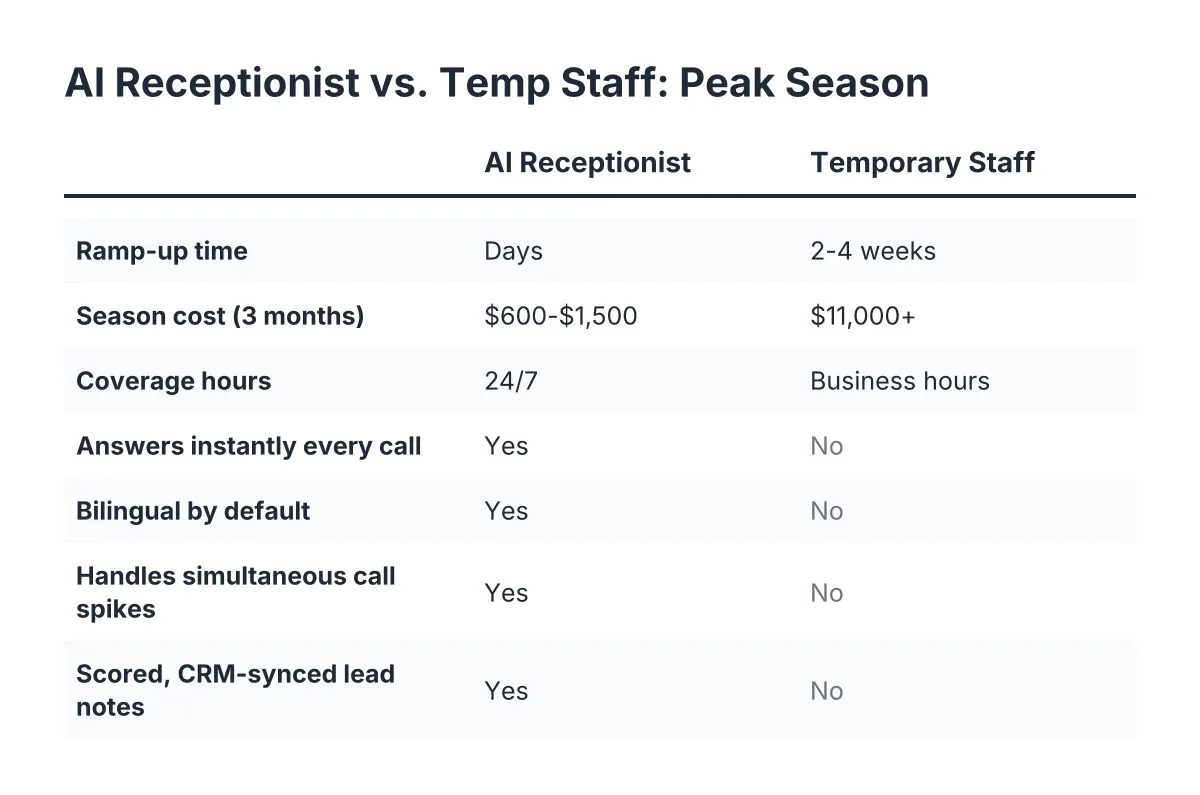
Usually, yes, and the gap widens with your season. A seasonal hire carries wages, training time, turnover risk, and the limit of one call at a time, then you repeat the hiring cycle next year. An AI receptionist answers every call at once, works after-hours without overtime, and does not quit in the middle of July. Get a quote and compare it to one month of a seasonal hire's fully loaded cost; the math is yours to run.
Do I pay more during my busy season?
That depends entirely on the pricing model. Per-minute and per-call billing rises with your volume, which means your biggest bills land in your hardest months. Flat monthly plans hold steady whether the phone rings 40 times or 400. Ask every provider directly: what does my invoice look like the week a freeze hits Austin?
What does missing calls actually cost me?
More than the service does, in most trades. One missed after-hours emergency call is a job that went to whoever answered, and if that caller becomes their recurring customer, you lost years of repeat work, not one ticket. Count your missed calls for a week, multiply by your average job value, and you have the real number to weigh any quote against.
Are there setup fees or long-term contracts?
Some providers charge setup fees and lock you into annual terms; others do not. Setup for an AI receptionist is typically light, since there is no staff to train and no hardware to install. Ask for the contract length, the cancellation terms, and any onboarding charge in writing before you sign anything.
The Bottom Line
Seasonal call volume management cost comes down to your peak volume, what you need done with each call, and whether the pricing model punishes or protects your busiest months. Pull your call records, get two or three quotes built on the same numbers, and test each service by calling it yourself. The provider whose answers survive your hardest questions in both languages is the one worth paying.
If you're losing revenue to missed calls, NeverMiss ATX can help.
Prefer to talk it through? Call (512) 980-9267 — a quick call is usually the fastest way to get a straight answer for your situation.