Seasonal Call Volume Management for Austin Trades: A Step-by-Step Setup Guide
If you run a lawn care, HVAC, or pest control business in Central Texas, you already know when your phone is going to blow up. Spring booking season for lawn care hits in late February. HVAC calls stack up the first week temperatures cross 95. Pest calls spike after the first warm rain. Seasonal call volume management is the plan you build before those weeks arrive, so the surge fills your calendar instead of your voicemail. A seasonal call surge setup requires this kind of advance planning. This guide walks a solo operator through the setup, step by step, using the actual surge windows Austin businesses face.
The stakes are simple. You cannot answer a phone while you are on a ladder, under a condenser, or spraying a crawl space. During peak season, that physical reality collides with your highest call velocity of the year. A foundational study from MIT Sloan School of Management and InsideSales.com found the odds of contacting a lead drop 100-fold when the response comes at 30 minutes instead of within 5. In peak season, "I'll call back at lunch" is the same as handing the job to a competitor.
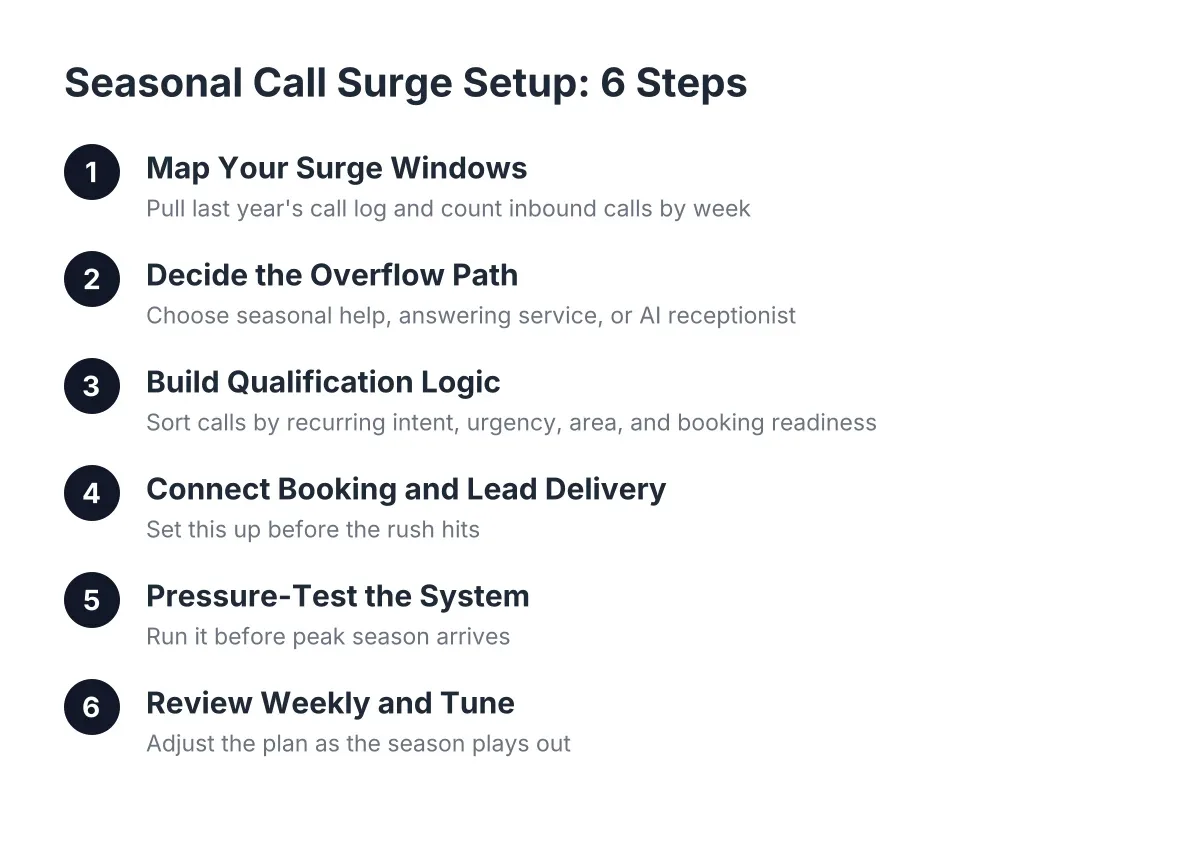
Step 1: Map Your Central Texas Surge Windows
First, write down when your phone actually rings hardest. Not a guess; pull last year's call log from your phone carrier or CRM and count inbound calls by week. For most Central Texas recurring service businesses, the calendar looks like this:
- Lawn care and landscaping: Spring rush from late February through May, when everyone in Round Rock and Cedar Park wants on a mowing schedule before the grass gets away from them.
- HVAC maintenance: May through September, with sharp spikes on the first 95-degree week and during any extended heat wave. During the record 2023 summer, temperatures hit 107 degrees in Austin, according to Texas 2036 and the Office of the State Climatologist at Texas A&M University. Heat like that turns a normal Tuesday into 40 inbound calls.
- Pest control: Warm-weather spikes plus after-hours calls year-round, because nobody discovers a scorpion problem at 2 p.m. on a weekday.
- Plumbing-adjacent work: Post-freeze surges after hard winter snaps, compressed into 48 to 72 chaotic hours.
Mark these windows on a calendar. Everything else in this guide gets built and tested before your first window opens, not during it.
How Many Calls a Day Is Considered High Volume?
For a solo tradesperson, high call volume is any day where inbound calls exceed what you can return the same day, which in practice means 10 to 15 calls while you are on site. Call centers measure volume in hundreds, but that benchmark is useless for a one-person operation. Your threshold is personal: the point where callbacks slip to tomorrow.
Here is the math that matters. If you take 8 calls a day in the off-season and 25 a day during the spring rush, and you can only answer 6 while working, you are missing 19 daily leads at the exact moment demand peaks. Multiply that by a 10-week surge window and a typical recurring customer worth $1,200 to $2,500 a year in lifetime value, and the cost of an unmanaged season gets ugly fast.
Step 2: Decide What Happens to Every Call You Cannot Answer
Next, pick your overflow path before the season starts. Voicemail is not a plan; most callers during a surge will not leave one, and the ones who do have already dialed the next name on Google. You have three realistic options as a solo operator:
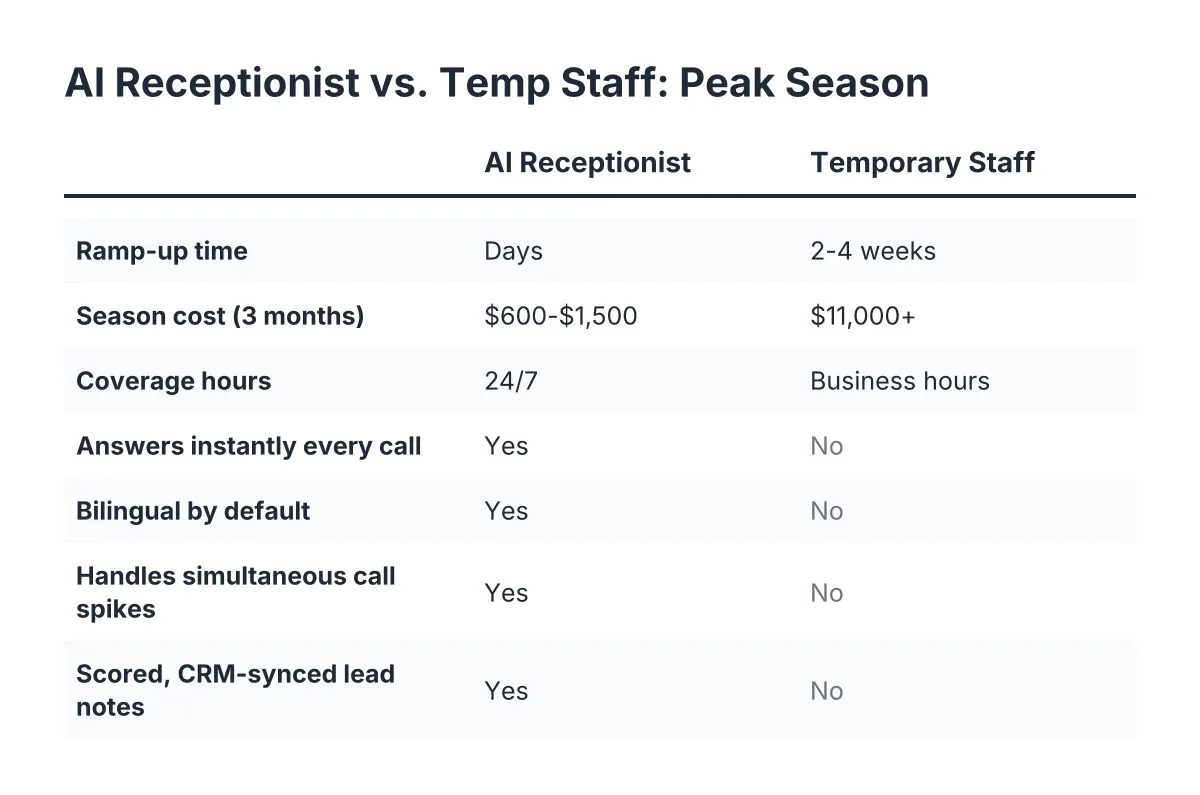
- Hire seasonal help. A part-time phone person costs real money for a three-month window, needs training, and still goes home at 6 p.m. while pest and HVAC calls keep coming after-hours.
- Sign with a national answering service. They will pick up, but a script-reader in another state does not know that "my AC quit and it's 103 out" in Pflugerville is an emergency, or that a caller asking about "weekly mowing through October" is a recurring customer, not a one-off.
- Set up an AI receptionist. It answers 24/7, captures the lead, qualifies it, and books the appointment while you stay on the job. For seasonal businesses, this is usually the option that scales up in March and does not sit idle in December.
Whichever path you choose, the requirement is the same: every inbound call during your surge window gets answered by something that can capture the lead and book the job, in English and Spanish. In Austin, 29.6% of residents age 5 and older are bilingual, according to City of Austin data from the U.S. Census Bureau ACS. During a heat wave, a Spanish-speaking caller with a dead AC will not wait for a callback from an English-only line.
Step 3: Build Your Seasonal Qualification Logic
Now define the questions that sort your surge calls, because peak season is when qualification matters most. When 25 calls come in a day, you need to know which five to call back first from the truck. Write out, in plain language:
- Recurring versus one-time intent. "Do you want ongoing service or a one-time visit?" A weekly mowing customer in Georgetown outranks a one-time cleanup, every time.
- Urgency tiers. For HVAC: no cooling with an elderly resident or infant in the house is a live-transfer emergency; a maintenance tune-up gets a booking link. For pest: active wasp nest by the front door versus quarterly prevention.
- Service area. Confirm the caller is inside your zone, whether that is Austin proper or out to Leander and Georgetown, before a slot goes on your calendar.
- Booking readiness. If they are ready, send the booking link on the call. If not, capture name, number, address, and issue so your callback takes 90 seconds instead of ten minutes of discovery.
If you use an AI receptionist, this logic becomes its call script. If you hire help, it becomes their one-page cheat sheet. Either way, write it down; qualification logic that lives only in your head does not survive a surge. A well-designed qualification framework is the backbone of any successful seasonal call surge setup.
Step 4: Connect Booking and Lead Delivery Before the Rush
In addition to answering, every call needs a next step that does not depend on you stopping work. Set up three connections in the off-season, when you have time to test them:
First, a booking link tied to your real availability, so a qualified caller gets booked on the call rather than "someone will get back to you." Second, lead delivery to wherever you actually look, whether that is a CRM like HubSpot or Zoho through a webhook, or a text summary you can scan at a red light. Third, an opt-in live transfer rule for true emergencies, so a burst-pipe or no-cooling call can reach you directly while routine calls get booked without interrupting the job you are on.
Test all three with a fake call before your surge window. A booking link pointing at a stale calendar is worse than no link at all. These elements define a functioning seasonal call surge setup; without them, even the best intentions collapse under volume.
Step 5: Pressure-Test the System Before Peak Season
Therefore, treat the two weeks before your surge window as a dress rehearsal. Call your own number on a weeknight at 9 p.m. Have a Spanish-speaking friend call and describe a problem. Try to stump whatever answers, because your customers will. Check that the lead summary lands in your inbox, the booking shows on your calendar, and the emergency transfer actually rings your cell.
Suppose you run a solo HVAC maintenance operation in Cedar Park. In a typical July heat wave week, say the first 100-degree stretch of 2026, you might field 30 inbound calls a day while spending nine hours in attics. In that scenario, a tested system books the tune-ups automatically, texts you a scored summary of each lead, and live-transfers only the two calls that are genuine no-cooling emergencies. An untested system fails on day one, when you have zero slack to fix it.
One honest trade-off: no AI receptionist, and no answering service, can diagnose equipment over the phone or replace your judgment on a genuinely dangerous situation, like a suspected gas issue. Build your emergency logic so those calls reach you or direct the caller to the right professional immediately.
Step 6: Review Weekly and Tune Your Plan
Finally, put a 15-minute review on your calendar every Monday morning during the season. Look at four numbers: total calls, calls answered, appointments booked, and leads still waiting on a callback. If booked appointments are flat while call volume climbs, your qualification logic or booking availability needs adjusting midseason, not after.
This weekly loop is what separates a seasonal call surge setup from a one-time setup. Surge patterns shift year to year; a 2026 spring rush that starts two weeks early because of a warm February should show up in your Monday numbers before it shows up as missed calls. Adjust the script, open more booking slots, or tighten the service area as the data tells you.
How Do You Predict Next Season's Call Volume?
Small service businesses predict seasonal call volume by combining last year's weekly call counts with weather triggers, since Central Texas demand tracks temperature more than the calendar. Pull your prior-year log, note the weeks that doubled your baseline, and watch the 10-day forecast for the triggers that started them: the first 95-degree day, the first hard freeze, the first warm spring rain.
You do not need call-center forecasting software. A spreadsheet with 52 rows and last year's counts will predict your surge windows within a week or two. The point of the prediction is timing: your qualification logic, booking links, and answering coverage should be live and tested at least two weeks before the window opens.
The Payoff: A Surge That Fills Your Calendar Instead of Burning You Out
Handled badly, peak season means missed calls, angry half-finished voicemails, and revenue walking to the next name in the search results. Handled with a plan, the same surge books your recurring customer base for the year; spring rush lawn customers stay through October, and a summer tune-up caller becomes a maintenance-plan member.
The steps are not complicated: map your windows, choose your overflow path, write your qualification logic, wire up booking and lead delivery, pressure-test it, and review weekly. Seasonal call surge setup is mostly done in the quiet weeks, so the loud ones run themselves while you stay on the job. Build it once this off-season, and next year's first 100-degree week is a payday instead of a pileup.
If you're losing revenue to missed calls, NeverMiss ATX can help.
Prefer to talk it through? Call (512) 980-9267 — a quick call is usually the fastest way to get a straight answer for your situation.