Can an AI Receptionist Handle 10x Call Volume in Peak Season? An Austin Playbook
Every recurring service business in Central Texas knows the pattern. Lawn care phones go quiet in January, then explode the first warm week of March. HVAC lines sit steady through spring, then ring nonstop when Austin hits 95 degrees in June. Pest control surges after the first big rain. The question owners ask before every one of those windows is the same: can an AI receptionist handle a genuine 10x call volume spike, the kind where your phone rings 80 times a day instead of 8? The short answer is yes, and the reason is structural. An AI receptionist answers every call in parallel, so 80 simultaneous callers get the same instant pickup that one caller gets in the off-season. This guide walks through how that works, season by season, for Austin trades that live and die by predictable surges.
Why Peak Season Breaks the Phone Before It Breaks the Crew
Here is the uncomfortable math of a seasonal business. Your crew capacity scales linearly; you can maybe add one truck or one helper for the busy months. Your call volume does not scale linearly. It spikes 3x to 10x in a matter of days, and it spikes at exactly the moment when everyone on your team is on site, on a ladder, or elbow-deep in a condenser unit.
The calls you miss during that window are not average calls. They are the highest-intent calls of your year. A homeowner calling a lawn care company in mid-March is not browsing; they are booking their season, often as a recurring customer worth 30-plus visits over the next few years. A homeowner calling an HVAC company during the first 100-degree week is ready to say yes to whoever picks up.
Speed decides who wins those calls. According to a foundational study from MIT Sloan School of Management and InsideSales.com, the odds of successfully contacting a lead drop 100-fold, and the odds of qualifying that lead drop 21-fold, when the callback happens at 30 minutes instead of within 5 minutes. In peak season, "I'll call them back tonight" is not a follow-up plan. It is a donation to the competitor down the road who answered first.
Therefore the peak-season problem is not really a staffing problem. It is a coverage problem. You do not need more people in the field on the day the phone melts down; you need someone, or something, answering every single call the moment it comes in.
Can an AI Receptionist Handle a 10x Call Volume Spike?
An AI receptionist can handle 10x, 50x, or 100x normal call volume because it answers calls in parallel rather than in sequence. A human receptionist takes one call at a time; every other caller waits or hits voicemail. An AI receptionist picks up call number one and call number forty at the same instant, with no hold queue and no busy signal.
That distinction matters more than any other feature during a surge. Suppose a typical Cedar Park lawn care crew gets 8 calls on a slow February Tuesday. The owner handles those fine from the truck. Now suppose the first 80-degree Saturday in March brings 47 calls between 8 a.m. and 6 p.m., 11 of them in one lunchtime hour. No single human answers 11 calls in an hour while also giving each caller real attention. The AI receptionist does not feel that pressure at all, because there is no line forming behind any individual call.
Concurrency solves the volume problem, but volume alone is not the whole job. During a spike, each call still needs three things done well:
- Answered instantly, before the caller hangs up and dials the next company on Google
- Qualified, so you know whether it is a new recurring customer, a one-time job, a current customer with a question, or a tire-kicker
- Booked or captured, with a booking link sent by text or the lead pushed straight into your CRM
A well-built AI receptionist does all three on every call, whether it is the third call of the day or the third call of that minute. Voicemail does none of them. An overflow answering service in another state does the first one and mangles the second, because the agent reading a script has never heard of Pflugerville and cannot tell a chinch bug complaint from a grub problem.
What About Call Quality When Volume Spikes?
Call quality on an AI receptionist stays flat as volume climbs, which is the opposite of what happens with humans. A human answering call 40 of the day is tired, rushed, and shortcutting the intake questions. The AI asks the same qualification questions with the same patience on call 400. It captures the caller's name, address, service need, and urgency the same way every time.
Skepticism here is fair, and the honest answer is that quality depends on setup. An AI receptionist trained on your services, your service area, and your seasonal patterns handles Austin-specific calls credibly; a generic out-of-the-box bot does not. The difference shows up in details like knowing that Round Rock and Georgetown are in your service area but a caller from Waco is not, or that "my grass is brown" in July means a different conversation than it does in April. The practical test is simple: call the AI yourself and try to stump it before your busy season starts, not during it.
One honest limitation: an AI receptionist qualifies and triages, but it does not diagnose. A caller describing a gas smell near their furnace needs a human decision fast. That is why urgent-call handling matters as much as volume handling, which the next section covers.
Can an AI Receptionist Triage Emergency Calls During Volume Surges?
An AI receptionist can handle emergency calls during a surge by triaging them, not by resolving them. The AI identifies urgency from what the caller describes, flags the call as an emergency, and, when live transfer is enabled, bridges the caller directly to you or your on-call lead. Routine calls get booked; genuine emergencies reach a human immediately.
This triage layer is what makes managing a 10x call volume spike survivable rather than merely answerable. During Austin's February 2021 freeze, plumbing companies across Central Texas got weeks of call volume in 48 hours. In a scenario like that, the killer problem is not answering the calls; it is telling the burst-pipe-flooding-the-kitchen call apart from the no-hot-water-but-manageable call. A human team drowning in volume triages badly. An AI receptionist applies the same triage logic to every call, so the true emergencies surface instead of sitting in a voicemail queue behind 60 routine messages.
For recurring service businesses, the same logic applies at lower stakes. A pest control company in June needs to separate "I saw one ant" from "there are wasps inside my kid's bedroom." The first gets a booking link for the next available slot. The second gets flagged urgent and, if you have opted in, transferred live. You decide the rules; the AI enforces them at any volume.
It is worth acknowledging the trade-off directly. According to a Five9 and TEAM LEWIS survey of 4,000 consumers, 75% prefer talking to a real human for customer support. That preference is real, and it is exactly why the emergency path should end with a human. But the same Five9 research found 84% of consumers already know companies use AI for customer service. In peak season, the practical comparison is not AI versus your best human on a calm day. It is AI versus voicemail, a busy signal, or a script-reader in a national call center. Callers forgive a professional AI that answers instantly and gets them booked. They do not forgive ringing out.
The Central Texas Surge Calendar: A Season-by-Season Playbook
Every trade in Central Texas has a surge window you can circle on the calendar. Planning for it beats reacting to it. Here is how the year breaks down, and what call handling needs to do in each window.
Spring: The Lawn Care and Landscaping Booking Rush (March–May)
Spring is the season where the first call literally sets the year's revenue. When Austin gets its first stretch of warm weekends, homeowners book their mowing, fertilization, and landscaping for the whole season in a two-to-three-week burst. Whoever answers first usually signs the recurring customer; whoever calls back Tuesday gets the leftovers.
The call-handling job in spring is capture and commit. Every caller should leave the call with a booking link in their text messages or a confirmed slot on your calendar. Qualification matters too: a caller asking about weekly mowing on a quarter-acre lot in Leander is a recurring customer worth thousands over their lifetime, while a one-time cleanup before a graduation party is a nice job but a different priority. An AI receptionist that captures recurring intent, not just contact info, lets you sort your follow-up list by lifetime value instead of by timestamp.
Summer: HVAC Call Volume at 100 Degrees (June–September)
Summer HVAC volume in Austin is the most brutal spike of the year because it combines high volume with high urgency and high emotion. When it is 103 degrees and the AC dies, the homeowner calls down the Google results list until a live voice answers. As a rough illustration, a large share of calls to busy home service businesses go unanswered during peaks, and every one of those in summer is a $300 repair or a $10,000 replacement walking to a competitor.
The call-handling job in summer is instant answer plus honest triage. Elderly resident with no cooling and health concerns: urgent, live transfer. Warm upstairs bedroom, system still running: booked for the next open slot, expectations set. After-hours calls matter most here; a compressor does not check business hours before it quits, and 24/7 coverage is the difference between owning the 9 p.m. call and losing it.
Fall: Pest Control and HVAC Maintenance Season (October–November)
Fall brings the rodent and scorpion calls as temperatures drop and pests move indoors, plus the heating tune-up wave when the first cold front hits Central Texas. Volume is lower than summer but the calls skew toward recurring maintenance plans, which are the backbone of a pest control or HVAC maintenance business's annual revenue.
The call-handling job in fall is plan conversion. A one-time wasp treatment caller should hear about the quarterly plan; a tune-up caller should get offered the maintenance agreement. An AI receptionist can ask the qualifying questions that surface plan interest, then hand you a lead already tagged as recurring-plan potential.
Winter: The Freeze Wildcard (December–February)
Winter is the quiet season, until it is not. A hard freeze turns plumbing and HVAC phones into sirens for 72 hours, and there is no hiring your way into coverage for a three-day event. This is the purest case for capacity that scales instantly: the same AI receptionist that answered 6 calls on a mild January Tuesday answers 120 during a freeze without any change on your end.
The call-handling job in a freeze is triage above all. Active water damage gets escalated live. Frozen but not burst gets guidance captured and a priority booking. Everything else gets logged, summarized, and queued so your team works the list in order of severity, not in order of who happened to get through.
What This Costs Compared to the Alternatives in 2026
Decision time comes down to three realistic options for a small Central Texas crew heading into peak season: hire a receptionist, contract a national answering service, or run an AI receptionist. The numbers are not close.
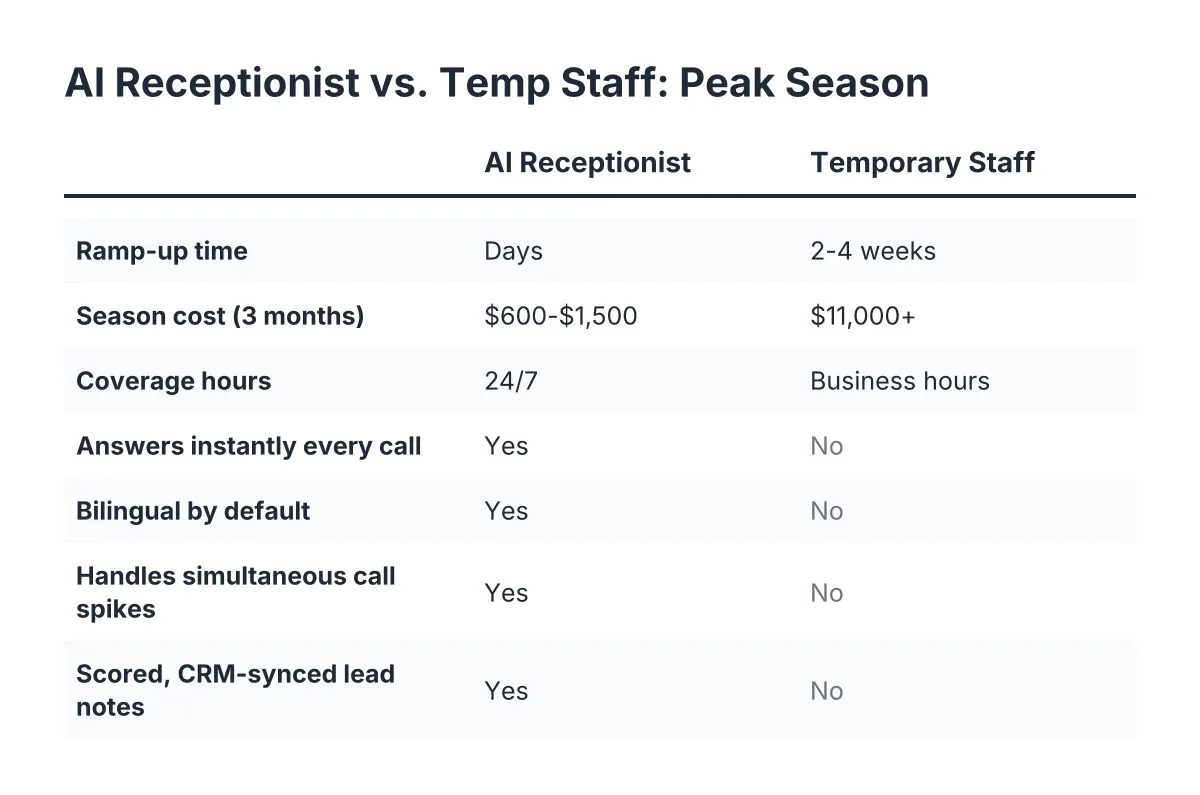
- Hiring a receptionist. According to the U.S. Bureau of Labor Statistics, the median receptionist wage was $17.90 per hour in May 2024, about $37,230 per year before benefits, taxes, or overtime. That buys you one person, 40 hours a week, who still cannot answer two calls at once, still takes vacation, and covers zero after-hours calls in a market where summer AC failures and freeze events do not keep office hours.
- National answering service. Typically billed per minute or per call, which means your costs spike exactly when your volume does. The agents follow generic scripts, do not know Manor from Manchaca, and in most cases take a message rather than booking the job. You pay peak-season prices for what is functionally expensive voicemail with a pulse.
- AI receptionist. Flat monthly pricing in the low hundreds for most small trade businesses as of 2026, with 24/7 coverage, unlimited concurrency, bilingual answering in English and Spanish on every call, qualification, booking link delivery, and CRM sync included. The cost does not balloon in June because your call volume did.
For a business doing $150K to $800K a year, the comparison usually resolves in the first missed-job math. If your average job is $250 and a recurring customer is worth $2,000-plus over their lifetime, recovering even two or three missed peak-season calls a month covers the tool many times over. Those are illustrative figures; run them against your own average ticket and close rate.
There is also a staffing-fear answer worth naming. According to NFIB's Small Business and Technology Survey, 98% of small employers using AI reported no change in employee headcount. In practice, an AI receptionist answers the phone so your field team stays on the job; it captures leads rather than cutting people.
The bilingual point deserves its own sentence for Austin specifically. A meaningful share of Central Texas homeowners prefer to handle a service call in Spanish, and an English-only phone line quietly filters those recurring customers out before you ever know they called. Bilingual answering on every call, at any volume, closes that gap without you hiring for it.
How to Set Up Before Your Surge Window, Not During It
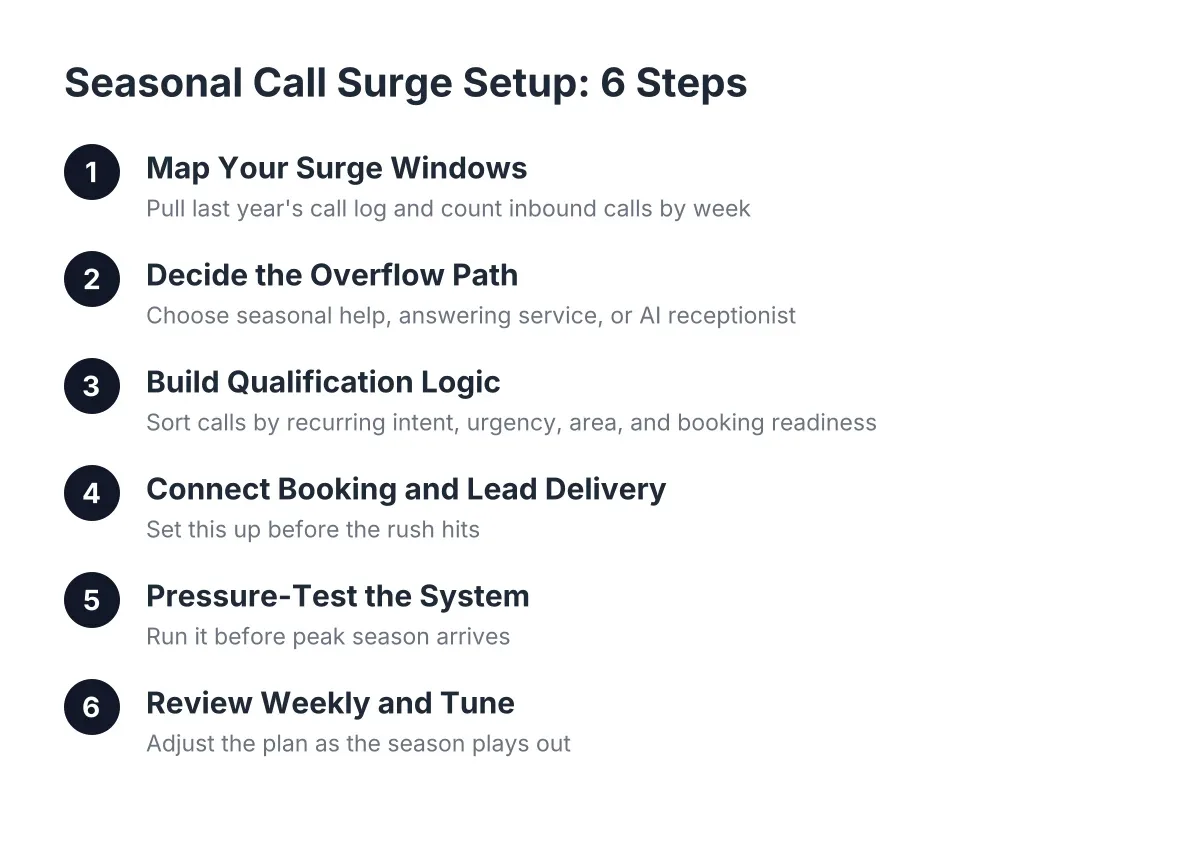
Setup for an AI receptionist is measured in days, not months, but the timing still matters. The businesses that win peak season configure and test in the calm month before their surge. Here is a practical pre-season checklist:
- Map your surge window. Lawn care: late February. HVAC: mid-May. Pest control: early spring and again in fall. Work backward four weeks from your historical spike.
- Write your qualification logic. What makes a lead worth an immediate callback versus a next-day follow-up? Recurring intent, service area, job type, and urgency are the usual four filters.
- Define your emergency rules. Decide which situations trigger a live transfer and who on your team takes those calls, including after-hours.
- Connect your calendar and CRM. Booking link delivery and lead webhooks into Zapier, HubSpot, Salesforce, or Zoho mean leads land in your existing workflow, not in a separate inbox you forget to check from the truck.
- Test it hard. Call the AI yourself in English and in Spanish. Describe a burst pipe, a brown lawn, a scorpion in the bathtub. Try to stump it. Fix anything that stumbles before real callers find it.
Done this way, handling a 10x call volume spike stops being an annual scramble and becomes a system you tune once and trust every year. The weekly reporting layer matters here too: a Monday morning summary of call volume, lead quality, and booked jobs tells you whether the surge is building earlier than usual, so you adjust crew schedules before you are underwater rather than after.
The Bottom Line for Austin Trades
So, can an AI receptionist handle a 10x peak-season spike? Structurally, yes, and without breaking a sweat, because parallel answering makes volume irrelevant. The real questions are the ones underneath: whether it qualifies your callers correctly, triages your emergencies credibly, books jobs instead of taking messages, and speaks both languages your customers speak. Those depend on setup and local knowledge, which is why a tool built around Central Texas trades handles an Austin summer differently than a generic national product does.
The surge is coming either way. Spring will hit, the first 100-degree week will hit, and someday another freeze will hit. The only variable you control is whether every one of those calls gets answered in two rings, qualified, and booked, or whether a large share of the callers who hit your voicemail never call back. For a small crew, that difference is not a nice-to-have. Over a season, it is the gap between a growth year and another year of wondering where the leads went.
If you're losing revenue to missed calls, NeverMiss ATX can help.
Related guide: seasonal call volume management — Complete Guide
Prefer to talk it through? Call (512) 980-9267 — a quick call is usually the fastest way to get a straight answer for your situation.