How AI Receptionists Handle 3x Call Volume in Peak Season Without New Hires
If you run a lawn care, HVAC, roofing, or pest control crew in Central Texas, you already know your busy season is coming. What you may not know is how AI receptionists handle 3x your normal call volume without you hiring a single seasonal admin—and how strategic deployment during peak season windows can transform those surge periods into revenue growth instead of crisis management. That is the plan this guide lays out, season by season, built around the actual surge windows Austin trades face every year, and how an AI receptionist can become your competitive edge during peak season.
Here is the uncomfortable truth first. Your phone problem is not random. It is scheduled. The first 95° week in June, the first hard freeze in January, the first hailstorm that rolls through Round Rock in April; each one triggers a predictable wall of calls. The businesses that win those weeks are not the ones with the best crews. They are the ones that answer first.
The Surge Is Predictable. Missed Calls Are a Choice.
Most small crew owners treat peak season call chaos like weather: something that happens to them. But the spike itself is one of the most predictable events in your business year. Austin HVAC companies can tell you within a week when summer call volume will triple. Roofers know that a hailstorm means 48 to 72 hours of nonstop phone activity, and then it is over.
The problem is what happens during those hours. Your whole crew is on site. You are on a ladder or under a house. The phone rings, rolls to voicemail, and the homeowner does exactly what you would do: calls the next company on the list.
The math on speed is brutal. According to a foundational study from MIT Sloan School of Management and InsideSales.com, the odds of successfully contacting a lead drop 100-fold, and the odds of qualifying that lead drop 21-fold, when you call back at 30 minutes instead of within 5 minutes. During a storm surge, you are not calling back in 30 minutes. You are calling back at 9 p.m., if at all. By then the job is gone.
For a roofing or restoration business where the average job runs around $7,500, missing even four or five of those calls in a surge weekend is a five-figure loss. Multiply that across a season and you are looking at the kind of revenue leak that decides whether you add a second crew next year or not.
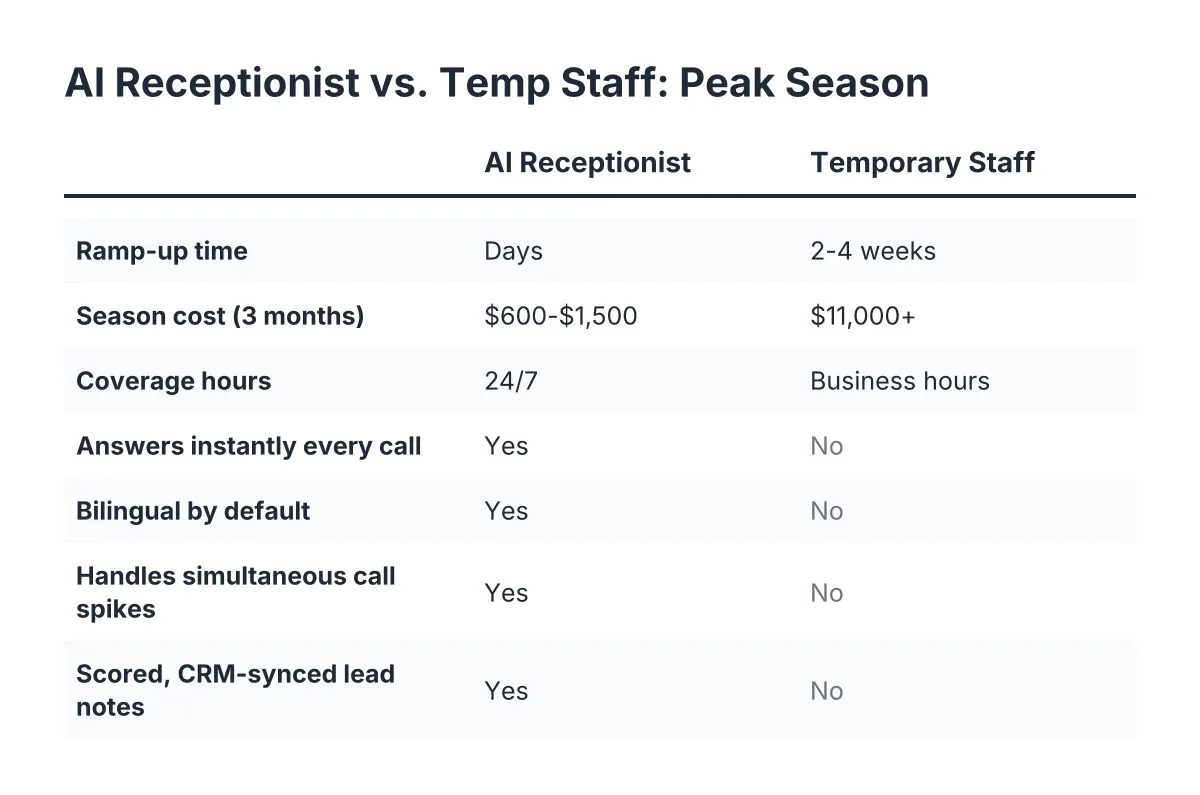
Why Hiring Seasonal Staff Doesn't Solve Peak Season Call Volume
The instinct is understandable: volume triples, so add a person. But seasonal hiring is a mismatch for how trade call surges actually work, and most owners who try it once do not try it twice.
Consider what you are actually asking a seasonal hire to do:
- Start cold in your busiest, most chaotic weeks of the year
- Learn your services, pricing logic, and service area with no ramp time
- Handle insurance intake questions after a storm with zero claims experience
- Answer in both English and Spanish, because a meaningful share of Central Texas callers prefer Spanish
- Work nights and weekends, because a burst pipe does not wait for business hours
Then there is the cost. The median receptionist wage in the U.S. was $17.90 per hour, about $37,230 per year, in May 2024, according to the U.S. Bureau of Labor Statistics. That is before benefits, overtime, or the fact that you only need the coverage for 10 to 14 weeks. Job boards are full of people searching "temporary jobs near me," but the ones who apply for a three-month phone gig are rarely the ones who can triage an emergency plumbing call at 11 p.m.
Some owners look at creative workarounds, like the resort model where companies target seasonal jobs applicants by offering seasonal jobs with housing. That works for a ski lodge with 200 identical roles. It does not work for a six-person restoration crew in Pflugerville that needs one sharp, bilingual person for exactly the weeks when everyone else is also hiring.
The deeper issue is structural. A human, however good, answers one call at a time. When a hailstorm drops 60 calls on your line in three hours, one person answering sequentially still means 50 people hearing a busy signal or voicemail. You cannot hire your way out of simultaneity. You need something that picks up every line at once.
How AI Receptionists Handle 3x Volume Without Adding Headcount
An AI receptionist answers every inbound call at the same time, in full, with no hold queue. That is the core mechanical difference, and it is why an AI receptionist helps you manage peak season surges without the staffing overhead. There is no line to overflow because every caller gets picked up on the first ring.
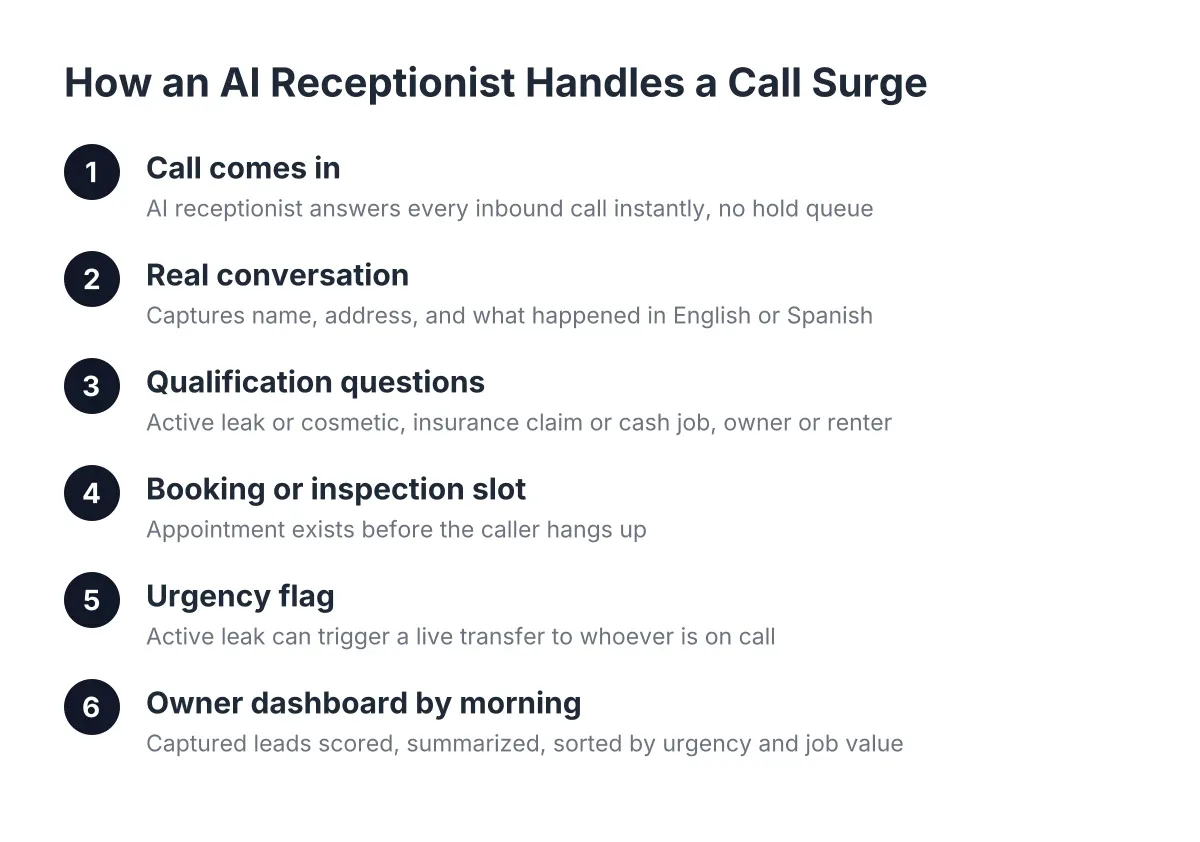
Walk through a hypothetical surge. Suppose a storm cell moves through Cedar Park on a Friday evening and 80 homeowners call local roofers between 6 p.m. and midnight. At the companies relying on voicemail, most of those callers hang up and dial the next number. At a company with an AI receptionist, all 80 calls get answered, in English or Spanish, and each caller gets:
- A real conversation, not a phone tree, that captures their name, address, and what happened
- Qualification questions: active leak or cosmetic damage, insurance claim or cash job, owner or renter
- A booking link or booked inspection slot, so the appointment exists before the caller hangs up
- An urgency flag, so an active leak can trigger a live transfer to whoever is on call
By Saturday morning, the owner opens a dashboard with 80 captured leads, scored and summarized, sorted by urgency and job value. The competitor down the road has 12 voicemails, half of them hang-ups. Same storm, same phones ringing. Completely different Monday.
This is what effective seasonal call volume management actually means: not answering more calls with more people, but removing the ceiling on how many conversations can happen at once, then organizing the output so a small crew can act on it fast.
One honest caveat: an AI receptionist does not climb the roof or reset the compressor. It also should not diagnose over the phone; a caller describing a gas smell needs a human decision and an emergency dispatch, which is why live transfer for urgent calls matters. The AI's job is capture, qualification, and booking. Your job is still the trade.
What "Answered" Has to Mean During a Surge
Answering is not enough on its own. A national call center technically answers your calls too, and plenty of Austin trades have tried one. The usual result: a script-reader in another state who does not know that Georgetown and Leander are 30 minutes apart, cannot say whether you service Fort Worth, and takes a message you still have to return.
During peak season, "answered" has to mean five things happened before the caller hung up:
- Captured: name, number, address, and problem description are in your system, not on a sticky note
- Qualified: you know if it is a $200 tune-up or a $7,500 insurance job before you call back
- Booked: the appointment is on the calendar, not "someone will reach out"
- Routed: the lead landed in your CRM through a webhook or sync, and urgent calls reached a human
- Bilingual: the Spanish-speaking caller got the same full experience, not a request to call back
If any of those five is missing, you have not solved the surge. You have just moved the bottleneck from the phone to your evening callback list.
A Season-by-Season Playbook for Central Texas Trades
Central Texas hands you four distinct surge windows a year. Each one has a different shape, and each one rewards a different preparation. Here is the calendar as it actually plays out from Austin to Georgetown.
Spring: The Booking Land Grab (March to May)
Spring is the lawn care and pest control land grab. The first warm weekend in March, every homeowner in Travis and Williamson County looks at their yard at the same time. Spring booking season for lawn care is not about emergencies; it is about locking in recurring customers before your competitors do.
This is the season where speed compounds. The company that answers first does not just win one mow. It can win a weekly or biweekly route slot plausibly worth a couple of thousand dollars over the season, and often a recurring customer worth several seasons. The company that lets spring calls hit voicemail is not losing calls; it is donating route density to the crew across town.
Spring is also hail season. A single April storm can turn a roofer's normal Tuesday into 100-plus inbound calls, most of them time-sensitive insurance claims. This is the sharpest test of whether an AI receptionist manages peak season call volume in practice: every one of those calls answered simultaneously, insurance details captured, inspections booked, and the highest-value claims flagged for first callback.
Summer: The 95° Marathon (June to September)
Summer in Austin is not a spike; it is a plateau of spikes. HVAC summer call volume runs triple baseline for three straight months, and every heat wave inside that window stacks another surge on top. Your techs are running eight to ten calls a day in 95° heat. Nobody is answering the office line, because there is no one in the office.
The summer problem is endurance. A seasonal hire burns out by July. An answering service's per-minute overflow pricing gets expensive by August. The AI receptionist answers call number 400 in week ten exactly like call number one in week one, at 2 p.m. or 2 a.m., because a broken AC in an Austin August is an after-hours emergency by any homeowner's definition.
Summer also produces your highest share of after-hours calls all year. A family whose AC dies at 8 p.m. on a Friday will book with whoever answers that night. If your line goes to voicemail from Friday evening to Monday morning, you are handing your weekend pipeline to the competitor who picks up.
Fall and Winter: The Freeze Lottery (November to February)
Fall looks calm, and that is the trap. Central Texas winters are quiet right up until they are catastrophic. When a hard freeze hits, plumbers get a year of demand compressed into 72 hours. Burst pipes, failed water heaters, flooded slab foundations; the calls come in faster than anyone can dial out.
The freeze surge is the most extreme call event in the Texas trades. Volume does not triple. It can go up tenfold in a day, and it is concentrated in a window so short that any solution requiring lead time, like hiring or onboarding an answering service mid-crisis, fails by definition. The businesses that capture freeze demand are the ones whose answering capacity was already in place in November.
Restoration crews live the same pattern in reverse: the calls start when the thaw begins and homeowners discover the damage. Insurance intake matters most here. A captured lead with the carrier name, claim intent, and damage description already recorded is worth double a voicemail that says "call me back about my pipes."
Turning a Predictable Spike Into a Competitive Advantage
Once every call gets answered, the surge stops being a crisis and becomes a sorting problem. This is the part most owners underestimate: the goal is not just to catch 3x the leads. It is to work them in the right order with the same small crew.
Three practices separate the businesses that grow through peak season from the ones that just survive it.
First, score before you call back. When 60 leads land overnight, calling them in the order they arrived wastes your best hours. AI call intelligence that summarizes and scores each conversation lets you call the active-leak insurance job before the "maybe next month" estimate request. Your callback list becomes a ranked pipeline, not a stack of messages.
Second, book while the caller is still motivated. A booked appointment survives the weekend. A promise to call back does not. When the AI receptionist sends a booking link or books the slot during the first call, the lead has committed before your competitor's morning even starts.
Third, review the pattern weekly. A Monday morning report showing call volume, capture rate, lead sources, and booked jobs turns each surge into data for the next one. After two seasons, you know your spike windows to the week, and you can staff crews, not phones, accordingly.
There is a trust question worth addressing head-on. A Five9 and TEAM LEWIS survey of 4,000 U.S. and U.K. consumers found 75% prefer talking to a real human for customer support. That preference is real, and it is exactly why the bar for an AI receptionist is a natural conversation, not a phone tree, with a live transfer path when a call is urgent. The same research found 84% of consumers already know companies use AI for customer service, according to Five9. During a surge, the practical comparison is not AI versus a human. It is AI versus voicemail, and homeowners with water coming through the ceiling choose whoever answers.
What This Means for a Small Crew Trying to Grow
The fear behind most hesitation is that adopting AI means restructuring the business or cutting people. The evidence points the other way. According to NFIB's Small Business and Technology Survey, 98% of small employers using AI reported no change in employee headcount. For trades, that tracks with reality: the AI answers and captures; your people still sell, build, and fix. It augments the relationship with your customers rather than standing in for it.
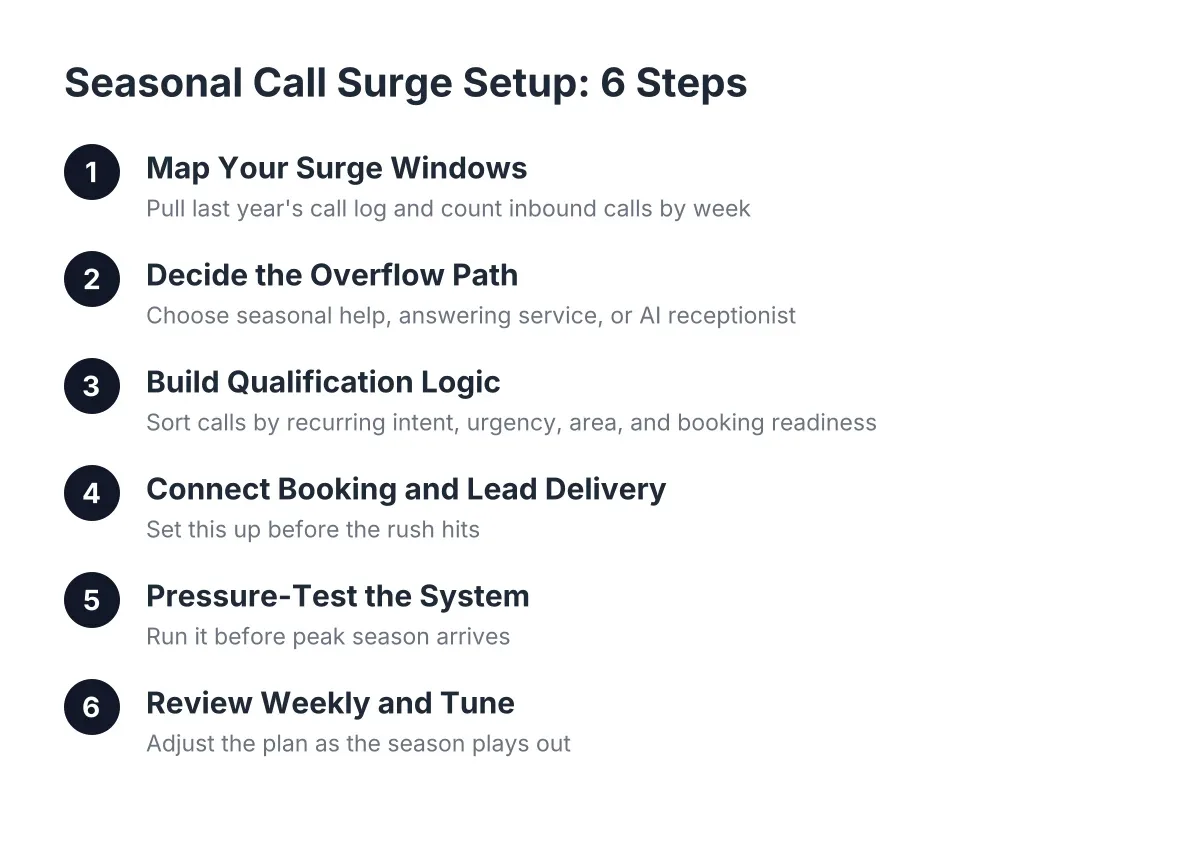
The practical takeaway for a Central Texas crew owner is a short checklist, done before your next surge window, not during it:
- Pull your call log from last peak season and count the after-hours and missed calls; that number is your leak
- Decide what qualification questions actually sort your leads: service area, job type, insurance or cash, urgency
- Put unlimited simultaneous answering in place at least a month before your season starts
- Connect lead capture to your CRM so nothing lives on paper
- Confirm Spanish-language callers get the full experience, because in this market that is not optional
The surge is coming either way. The June heat, the April hail, the January freeze; you can circle the windows on a calendar right now. Additionally, the only open question is whether your business answers three times the calls with the crew you already have, or lets the busiest weeks of the year ring through to voicemail. In 2026, with the technology proven and the setup measured in days rather than months, that is a choice, not a circumstance.
If you're losing revenue to missed calls, NeverMiss ATX can help.
Prefer to talk it through? Call (512) 980-9267 — a quick call is usually the fastest way to get a straight answer for your situation.