Seasonal HVAC and Plumbing Demand in Central Texas: Prep Your Phones Now
If you run a solo trade operation in Austin, you already know the pattern. Seasonal HVAC plumbing demand follows the Central Texas weather like clockwork, but HVAC seasonal call surges hit solo operators differently than multi-truck shops: the first 100 degree week in June floods AC companies with calls, and one hard February freeze can generate more plumbing inquiries in 72 hours than the previous two months combined. The surge itself is not the problem. The problem is that when your phone rings the most, you are the least able to answer it, because you are on a ladder, under a house, or elbow deep in a condenser. This guide is a season-by-season playbook for handling those spikes as a one-person operation, so a predictable rush becomes booked revenue instead of a voicemail graveyard.
Why Seasonal HVAC Plumbing Demand Hits Solo Operators Hardest
Seasonal demand spikes hurt solo tradespeople more than any other business size because the same person doing the work is the person answering the phone. A five-truck shop can put someone in the office during June. You cannot answer a call while sweating a joint or pulling a blower motor. Physics wins, and the call goes to voicemail.
Here is the math that matters. Ask solo operators and most will admit a painful share of inbound calls goes unanswered during normal weeks. During a surge week, call volume can double or triple while your availability stays exactly the same, because your hands are still full. Every one of those missed calls is a homeowner with a real problem and a list of three other companies to try.
Speed compounds the damage. According to MIT Sloan School of Management / InsideSales.com, the odds of contacting a lead drop 100-fold, and the odds of qualifying that lead drop 21-fold, when the callback happens at 30 minutes instead of within 5 minutes. During a freeze event, 30 minutes might as well be a week. The caller with a burst pipe has already hired whoever picked up.
There is a flip side worth naming. Because these surges are predictable, they are also plannable. You know roughly when they hit, what callers will ask, and which jobs pay best. That knowledge is an advantage the national franchises cannot match, if your phone system is ready before the weather turns.
The Central Texas Surge Calendar
Central Texas has four distinct demand windows, and each one behaves differently on the phone. Knowing what each surge sounds like, literally what callers say and ask, lets you set up call handling that fits the season instead of one generic setup all year.
Spring: Tune-Ups, Inspections, and the Booking Race (March to May)
Spring calls are booking calls, not emergencies. Homeowners in Round Rock, Cedar Park, and Georgetown start scheduling AC tune-ups, irrigation checks, and the remodel projects they put off all winter. For a multi-trade or handyman operation, this is also quote-request season: deck repairs, fence work, bathroom updates before summer guests arrive.
The phone challenge in spring is volume of low-urgency, high-value calls. Nobody has an emergency, so nobody leaves a voicemail either. They just call the next name. A missed spring call is often a missed recurring customer, because the homeowner who books a $129 tune-up in April is the same one who calls you first when the system dies in August.
Your spring priority: capture and book, fast. Every caller should leave the conversation with an appointment or a clear next step, not a promise that you will call back tonight after your last job.
Summer: HVAC Emergency Season (June to September)
Summer is the big one, the heart of HVAC seasonal call surges in Central Texas. At the peak of the record 2023 summer, temperatures reached 107 degrees in Austin, according to Texas 2036 and the Office of the State Climatologist at Texas A&M University. ERCOT set an all-time peak electricity demand record of 85,464 MW on August 10, 2023, per the Federal Reserve Bank of Dallas, driven almost entirely by air conditioning load. Every one of those maxed-out systems is a service call waiting to happen.
Summer callers are urgent, stressed, and price-insensitive compared to spring callers. A family in Pflugerville with a dead AC and a 103 degree forecast is not shopping three quotes. They are hiring the first company that answers, sounds competent, and commits to a time window.
That is exactly why summer punishes the solo operator. You are running back-to-back capacitor swaps and refrigerant calls from 7 a.m. to dark. Suppose your phone rings 20 times a day during that stretch and you physically manage to answer six. During these seasonal call surges, the revenue you miss in a single July week can exceed what an entire off-season month brings in.
Fall: The Quiet Window That Isn't (October to November)
Fall looks slow but carries two important call types. First, heating check calls start trickling in after the first cool front, usually mid-October. Second, this is when general construction and remodel work picks back up, because homeowners want projects done before the holidays.
For a multi-trade operator, fall calls are messy in the best way: a mix of small repairs, quote requests, and pre-winter prep. The challenge is qualification. A caller might want a $150 faucet swap or a $15,000 kitchen refresh, and you cannot tell which from a missed-call notification. Fall is when good lead qualification on the phone earns its keep.
Winter: The Freeze Lottery (December to February)
Central Texas winters are mild until they are catastrophic. When a hard freeze hits, and every few years one does, plumbing demand goes vertical within hours. Burst pipes, frozen lines, failed water heaters, and busted irrigation backflows generate a wall of calls that no solo operator can touch while actively working.
Freeze surges have three traits that make them brutal for call handling:
- They are compressed. Most calls land within a 48 to 96 hour window.
- They are emergencies. Callers will not wait for a callback; they dial the next number in under a minute.
- They happen after hours. Pipes burst at 2 a.m. when the temperature bottoms out, not at 10 a.m. on a Tuesday.
Now run a hypothetical freeze week for a solo plumber in Leander: suppose two nonstop days leave dozens of missed calls on the log. At $400 to $900 a ticket for freeze-related repairs, converting even half of those calls would make a five-figure week. Instead, those homeowners hire someone else and, worse, save that competitor's number.
Building a Call System That Absorbs Peak Demand Surges
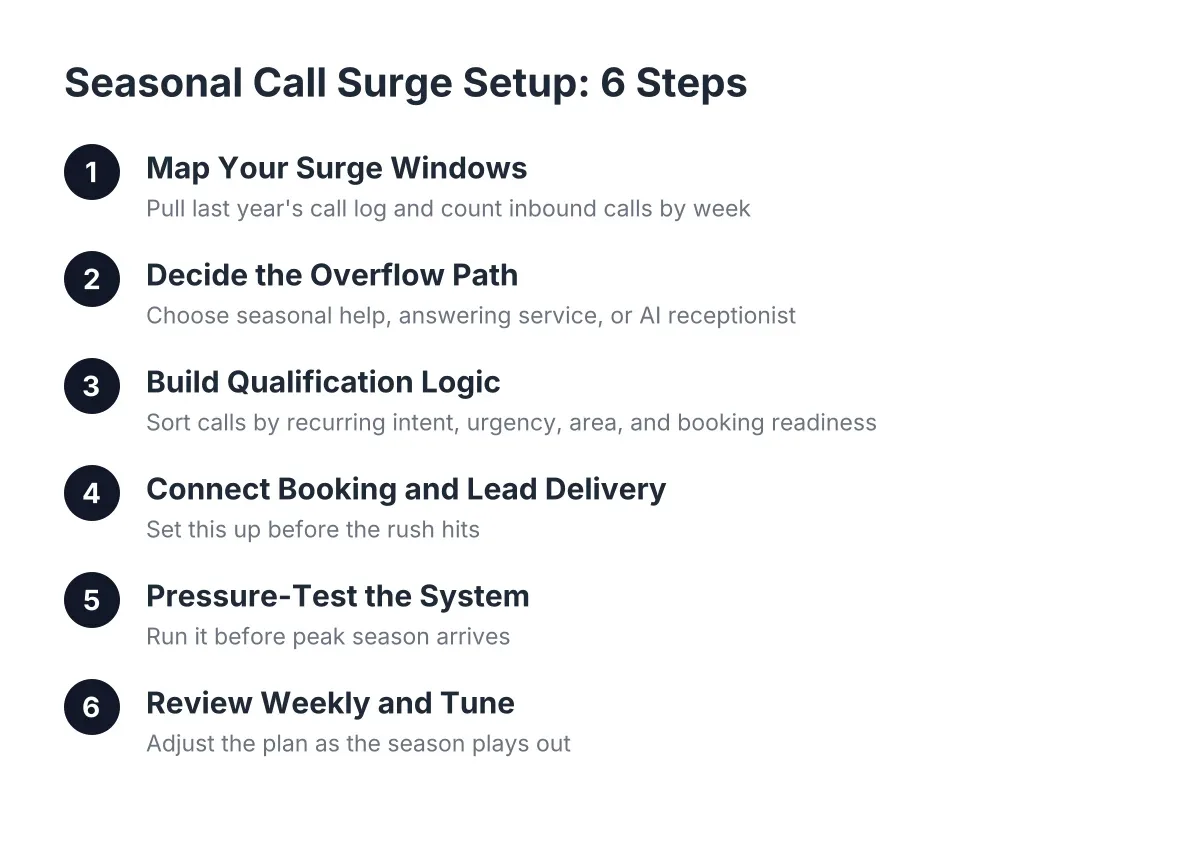
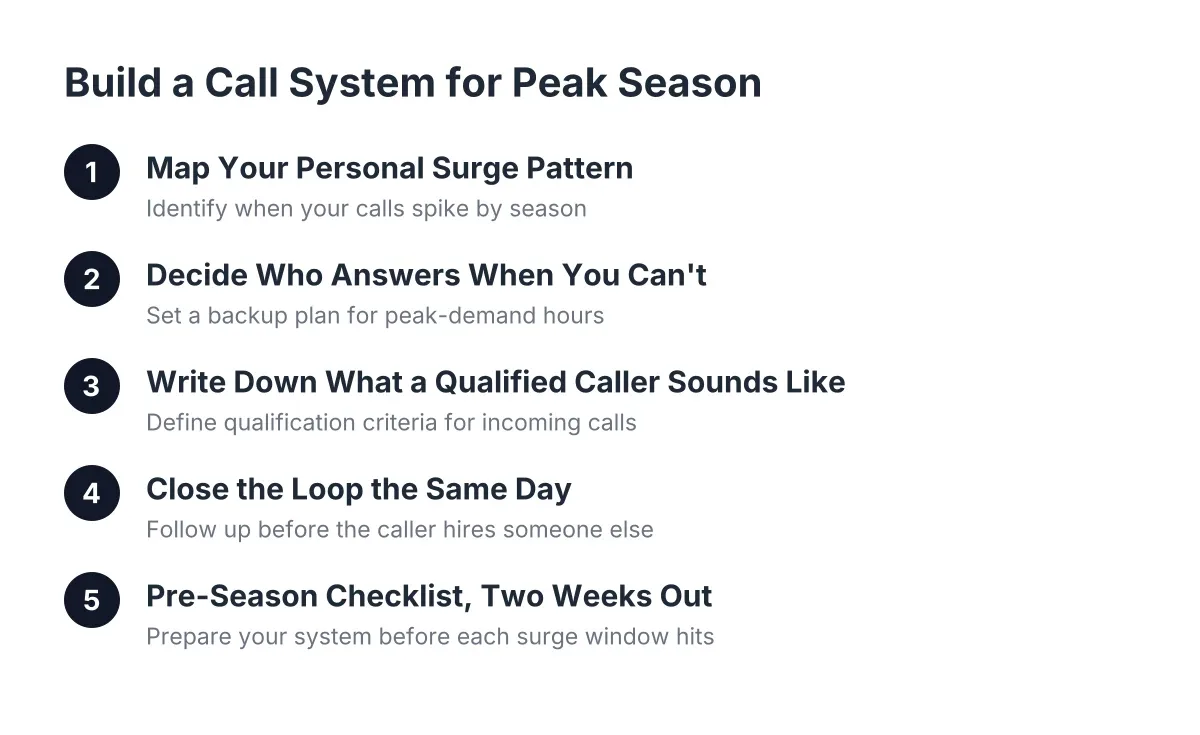
You cannot add hours to your day during peak season, so the fix has to happen on the phone side, not the labor side. The goal of seasonal call volume management for a one-person shop is simple: every caller gets answered, qualified, and booked or scheduled for follow-up, whether you are on site, driving, or asleep. Here is how to build that before the next surge, step by step.
Step 1: Map Your Personal Surge Pattern
Before changing anything, pull your call history from last year. Your phone's call log and voicemail box hold the data. Look for three things:
- Which weeks did inbound calls double or more? Mark those on a 2026 calendar.
- What percentage of calls went unanswered during those weeks? Be honest; count them.
- What did the missed callers want? Listen to old voicemails and note job types and rough ticket values.
This takes an evening and gives you a number: the revenue you left on the table last season. For many solo Central Texas operators, it lands somewhere in the tens of thousands a year. That number tells you what a real answering solution is worth, and it keeps you from either overspending or cheaping out on voicemail and hope.
Step 2: Decide Who Answers When You Can't
You have three realistic options, and it helps to be blunt about each.
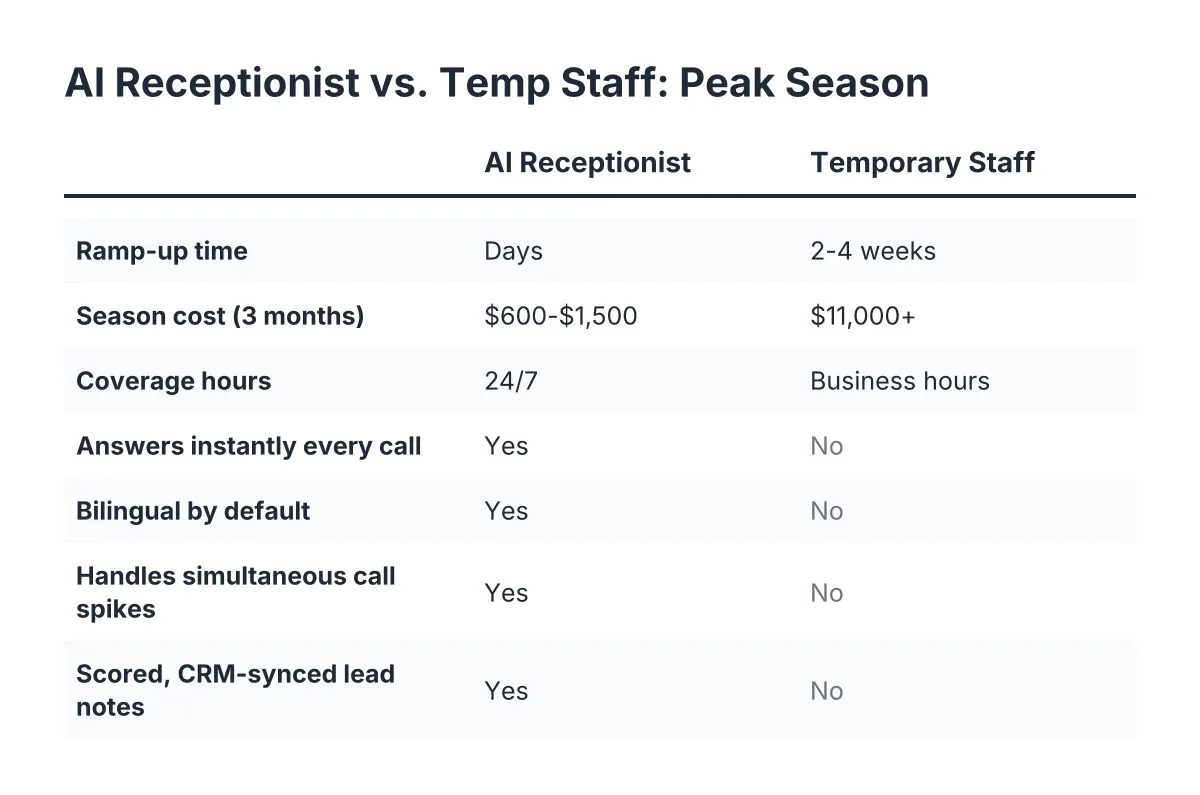
Hiring office help costs $35,000 or more a year plus training, and a part-timer still misses evenings, weekends, and the 2 a.m. freeze calls. For a shop doing $150K to $600K, that math rarely works.
A national answering service covers the hours but not the knowledge. Their operators read scripts, cannot tell a tripped breaker question from a compressor failure, and often frustrate Spanish-speaking callers, which matters in a metro where the U.S. Census Bureau counts roughly one in three residents speaking a language other than English at home.
An AI receptionist answers 24/7, in English and Spanish, and can be loaded with your actual services, service area, and pricing rules. Modern AI receptionists hold real conversations, qualify the job, capture the lead, and book the appointment or send a booking link. The good ones also flag genuine emergencies for live transfer, so a burst-pipe call at midnight can still reach you if you opt in. If you doubt the call quality, the honest test is to call one yourself and try to stump it; five minutes on the phone settles the question better than any sales page.
Whichever route you choose, decide before the surge. Setting up call handling in the middle of a July heat wave is like installing gutters during the storm.
Step 3: Write Down What a Qualified Caller Sounds Like
Whoever or whatever answers your phone needs your rules in writing. Spend 30 minutes documenting:
- Service area: which ZIP codes or towns you actually cover, and which you decline.
- Job types you take, job types you refer out, and any minimums.
- Emergency criteria: what counts as urgent enough to interrupt you on site.
- The three to five questions that tell you whether a job is worth driving to.
For a multi-trade operator, this matters double. "Can you fix my fence?" and "Can you remodel my kitchen?" need different questions and different next steps. Write both paths down. A well-configured AI receptionist can follow these branches consistently on call number one and call number forty, which is more than any exhausted human, including you, can claim in week three of a heat wave.
Step 4: Close the Loop the Same Day
Answering is half the job; follow-up is the other half. Set up a system where every captured lead lands somewhere you will actually see it: a CRM, a Zapier-connected sheet, or at minimum a daily summary. Then block 20 minutes each evening, coffee in hand, to review the day's calls and bridge back to anyone who needs a human decision, like a complex quote.
During peak season, this evening review is your command center. You will see which calls got booked automatically, which need a callback, and which were tire-kickers you never had to touch. Call intelligence features that score and summarize each call cut this review from an hour to minutes, because you read summaries instead of listening to recordings.
Step 5: Pre-Season Checklist, Two Weeks Out
However you handle calls, run this checklist two weeks before each surge window:
- Update your greeting and service list for the season, tune-ups in spring, AC repair in summer, freeze prep in winter.
- Confirm your booking calendar reflects real availability, including buffer time between jobs.
- Test your emergency transfer path with a real call at an odd hour.
- Verify Spanish-language handling works end to end, greeting through booking.
- Check that lead notifications actually reach your phone in the field.
Turning Predictable Demand Into a Competitive Edge
Most of your competitors treat surge season as something to survive. The five-truck shops throw bodies at the phones; the other solo operators let voicemail eat the overflow. Answering every call, day and night, in both languages, is how a one-person operation out-competes both.
Consider what a caller experiences during a July heat wave. They call the big franchise and sit on hold. They call another solo operator and get voicemail. They call you, and someone answers on the second ring, asks smart questions about their system, and books them for tomorrow at 8 a.m. You just won the job without touching your phone, and you were on a roof in 95 degree heat the whole time.
Then the compounding starts. According to a Five9 and TEAM LEWIS survey of 4,000 consumers, 75% prefer talking to a real human over the phone for customer support. That preference cuts in your favor: they got a phone answer instead of a web form, and then you personally showed up and did the work. The relationship still belongs to you; the phone system just made sure it started. The homeowner you save during the freeze becomes the recurring customer who calls you for the water heater, the remodel, and the referral to their neighbor in Georgetown.
Seasonal HVAC plumbing demand in Central Texas is not going to flatten out. Summers keep breaking records, and freezes keep finding unprotected pipes. The operators who grow through 2026 will not be the ones who work more hours during the spike; there are no more hours to work. They will be the ones whose phones convert the spike into booked jobs automatically.
One honest caveat: no phone system fixes a capacity problem. If you are booked solid for three weeks, answering every call means politely waitlisting people, which still beats silence, but it will not clone you. For sustained overload, the fix is subcontracting, raising prices during peak weeks, or eventually hiring, and a good accountant or business advisor is worth consulting before you make that jump.
Your Next Move Before the Season Turns
Start with Step 1 this week: pull last year's call log and count what you missed. That single number will tell you how urgent the rest of this playbook is for your business. Then pick your answering approach, write down your qualification rules, and test everything before the next HVAC seasonal call surge window hits.
The freeze will come. The 100 degree stretch will come. Additionally, the spring booking race will come. None of that is in your control. Whether those calls reach a dead end or a booked appointment is entirely in your control, and it is a decision you make now, in the quiet weeks, not in the middle of the storm.
If you're losing revenue to missed calls, NeverMiss ATX can help.
Prefer to talk it through? Call (512) 980-9267 — a quick call is usually the fastest way to get a straight answer for your situation.