Why Call Volume Spikes During Spring and Summer Hit Central Texas Trades Hardest
If you run a plumbing, electrical, pest control, or HVAC operation around Austin, you already know call volume spikes during the same windows every year—what the trades call seasonal call surge trades. The first 95° week in June, the spring pest swarm after the March rains, the post-freeze pipe bursts in January. The phone rings off the hook, you are on a ladder or under a house, and every call you miss walks straight to a competitor. This guide is a season-by-season playbook for handling those surges as a solo operator, without hiring staff you only need for eight weeks a year.
The spikes are predictable. That is the good news. A predictable spike is a plannable spike, and the trades that plan for it turn their busiest season into their most profitable one instead of their most chaotic. Here is how to do it, step by step.
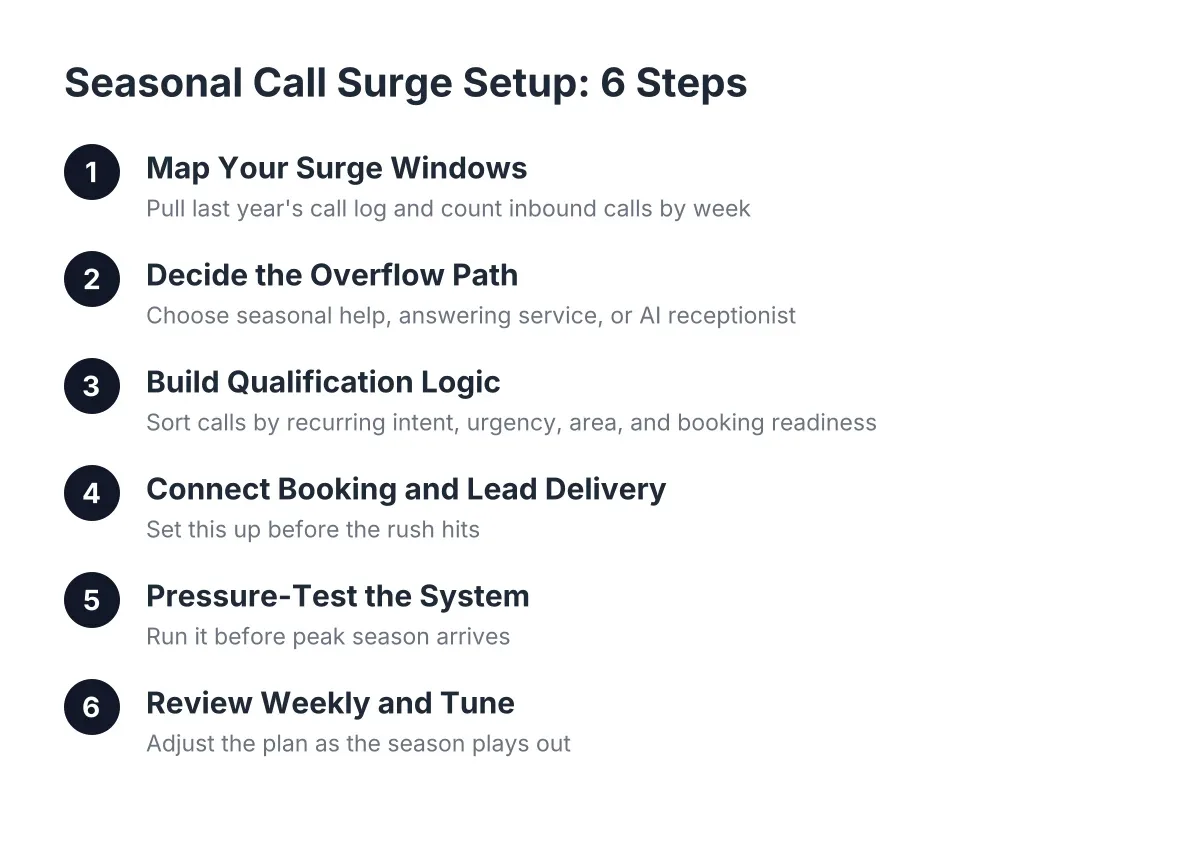
Step 1: Map When Call Volume Spikes During Your Year
Start by putting real dates on your surge windows. Central Texas demand follows the weather, and the weather here follows a script. Pull your call log or invoice history from the last two years and mark the weeks where inbound calls jumped 50% or more over your baseline.
For most Austin-area trades, the calendar looks like this:
- Late February through April: Spring rush. Pest calls surge after the first warm rains. Irrigation and lawn systems come back online and break. Homeowners test their AC before summer and find problems.
- May through September: The summer grind. HVAC calls peak with the heat, and electrical panels and breakers fail under sustained load. During the 2023 heat wave, temperatures hit 107 degrees in Austin, and ERCOT set an all-time grid demand record of 85,464 MW that August, according to the Federal Reserve Bank of Dallas. Every degree of that heat translates into service calls.
- October through November: The shoulder season. Heater tune-ups, rodent intrusion as temperatures drop, and holiday prep projects.
- December through February: Freeze events. One hard freeze in Central Texas can generate a month of plumbing work in 72 hours. Burst pipes do not wait for business hours.
Write your version of this calendar down. The rest of the playbook builds on it. If your records only go back a season, use the calendar above as your starting draft and correct it as data comes in.
Step 2: Calculate What a Missed Call Costs You in Peak Season
Before you decide how to handle the surge, put a dollar figure on the problem. Solo operators lose a painful share of inbound calls during busy season because answering and working are physically incompatible. You cannot sweat a copper joint and qualify a caller at the same time.
Run the math on your own numbers. Say your average job is worth $400, and a freeze week brings 40 calls instead of your usual 15. If you miss 14 of those calls and half of them would have booked, that is seven jobs and $2,800 gone in one week. During these seasonal surge trading periods, emergency callers do not leave voicemails; they dial the next number on the list.
Speed matters even outside emergencies. Research from MIT Sloan School of Management and InsideSales.com found the odds of contacting a lead drop 100-fold when the callback happens at 30 minutes instead of within 5 minutes. During a surge, "I'll call them back tonight" is functionally the same as not calling back at all.
Step 3: Compare Your Options for Managing Peak Call Volumes
Once you know when call volume spikes during your year and what each missed call costs, weigh the four realistic ways a one-person operation can cover the phone. Each has honest trade-offs.
How Seasonal Staffing Affects Your Surge Capacity
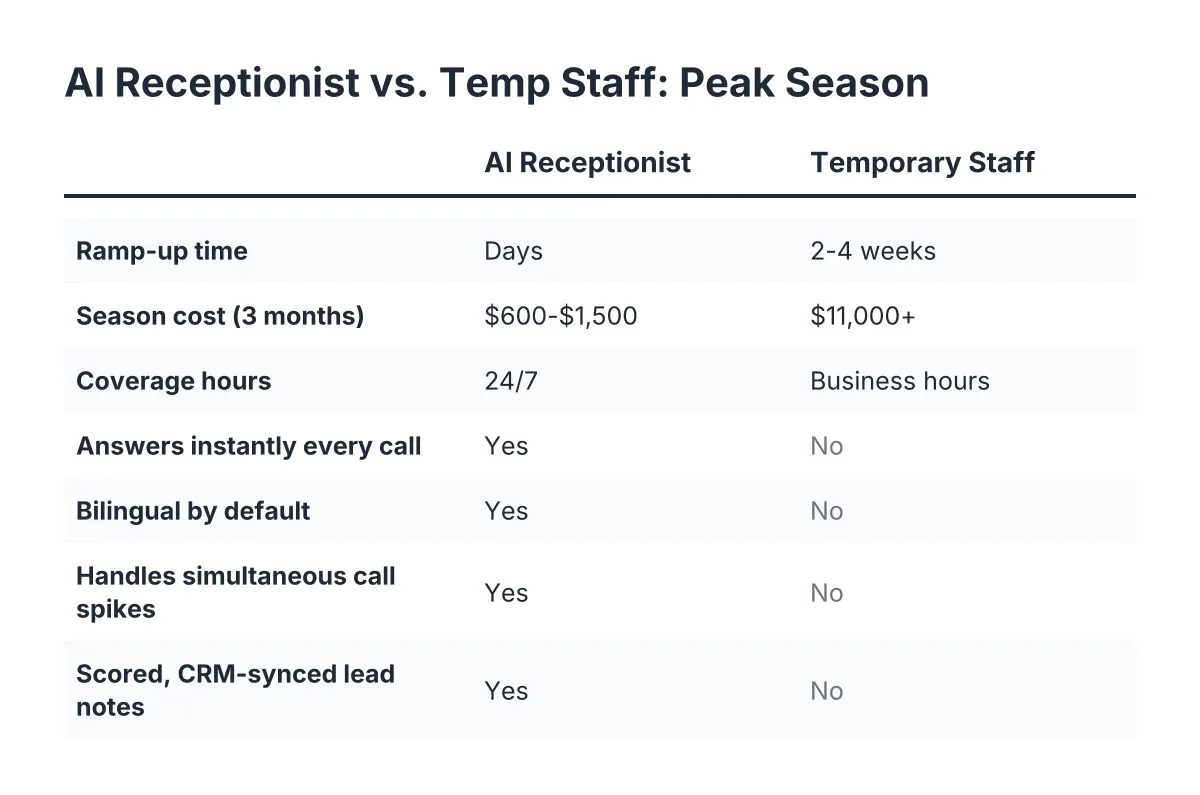
Search results for seasonal jobs near me or temporary jobs near me hiring immediately fill up every spring for a reason; bigger companies staff up for the surge. However, this rarely pencils out for a solo operator. A part-time phone hire runs $2,000 to $3,000 a month, needs training on your trade, and covers 20 to 30 hours a week at most. Your freeze calls come at 2 a.m. on a Saturday. Even in December, when seasonal holiday jobs near me listings peak, temporary hires want daytime retail shifts, not overnight emergency dispatch.
National answering services
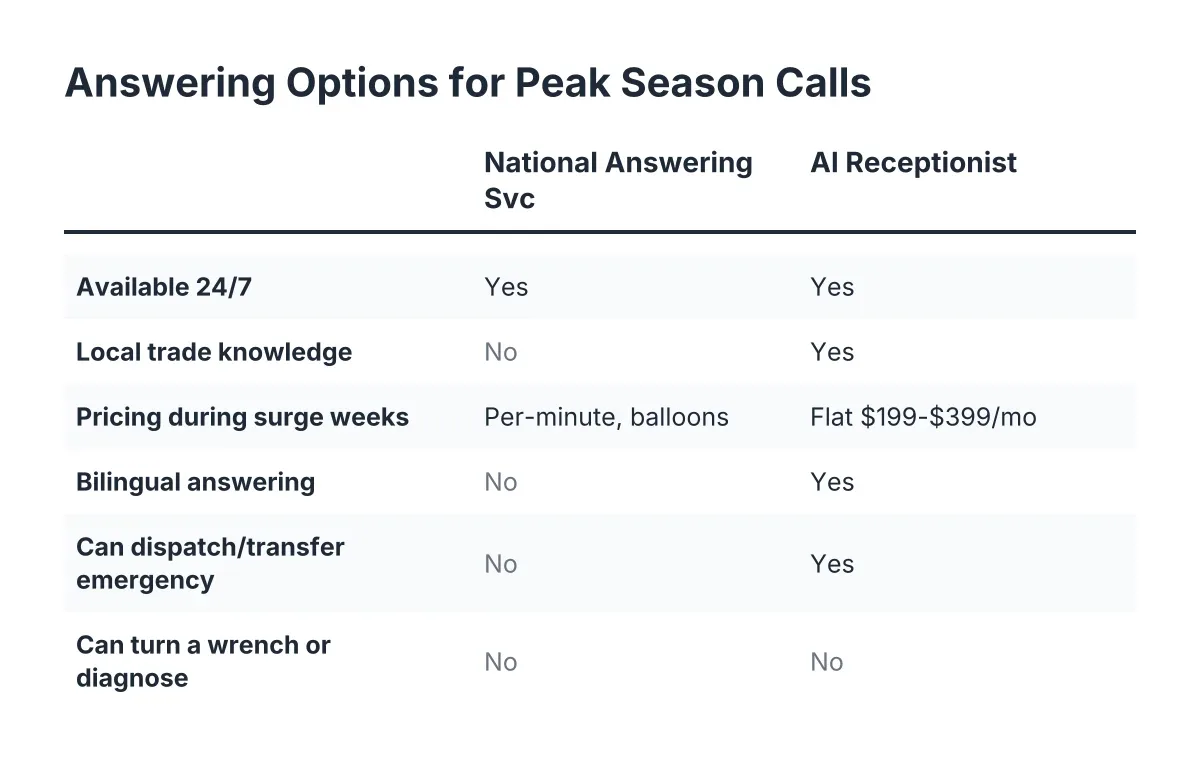
Traditional answering services take messages around the clock, and for some businesses that is enough. The trade-offs: per-minute pricing that balloons exactly when your volume spikes, operators reading from generic scripts who cannot tell a dripping faucet from a slab leak, and no local knowledge. A caller in Pflugerville describing a burst pipe deserves better than "someone will get back to you."
Voicemail and callbacks
This is the default, and it is free. It also fails hardest during surges. Most emergency callers hang up on voicemail and keep dialing. The MIT Sloan numbers above explain why the callbacks you do make convert poorly; by the time you return the call, the job is booked with someone else.
An AI receptionist
An AI receptionist answers every call in seconds, 24/7, qualifies the caller, captures the lead, and can send a booking link or transfer a genuine emergency straight to your cell. Pricing is typically flat monthly, in the $199 to $399 range, so a surge week costs the same as a slow one. For Austin trades, bilingual answering matters too; a Spanish-speaking caller at 11 p.m. gets served instead of lost.
The honest limitation: AI cannot turn a wrench, and it should not diagnose over the phone. Complex disputes, warranty arguments, and anything requiring judgment about liability still need you. A Five9 survey found 75% of consumers prefer talking to a real human for customer support, which is why the strongest setup uses AI to answer, qualify, and book, then bridges urgent callers to you live when it counts.
Step 4: Build a Triage Plan Before the Surge Hits
Whatever coverage you choose, decide in advance what counts as an emergency and what can wait. Write it down as three tiers:
- Transfer now: Active water leak, no AC when it is over 100°, sparking outlet, wasp nest by a doorway with kids in the house. These calls reach you live, on site or not.
- Book same-day or next-day: Water heater making noise, one room not cooling, ants in the kitchen. Capture the lead, send a booking link, confirm the slot.
- Book within the week: Tune-ups, quotes, non-urgent inspections. These fill the gaps in your calendar and become recurring customers if you handle them well.
Give this triage sheet to whoever or whatever answers your phone. An answering service without it takes flat messages. An AI receptionist configured with it qualifies callers against your rules, so the 2 a.m. transfer is a real burst pipe and not a squeaky faucet.
Step 5: Capture Every Lead, Even the Jobs You Cannot Take
During peak weeks you will get more calls than you can serve. That is not a problem; it is an asset, if you capture the leads. A caller you cannot fit this week is a booked job next week and a recurring customer next season. Managing the seasonal trades surge means making sure every call ends with a name, number, address, and problem description logged somewhere you can act on. If your setup syncs leads to a CRM or fires a webhook into a simple spreadsheet, you can work the backlog from your truck between jobs, with call summaries and lead scores telling you which callback to make first. This is the core of handling seasonal call surge trades for a solo operator: the surge stops being a firehose you drink from and becomes a pipeline you drain on your schedule.
Step 6: Review After Each Season and Adjust
After each surge window closes, spend one hour with your numbers. How many calls came in, how many booked, how many transferred as emergencies, and how many leads went stale. A weekly summary report makes this painless; without one, pull your phone log manually.
Then adjust the playbook. Maybe your freeze-week triage tier was too loose and you got woken up for drips. Maybe spring pest calls skewed Spanish-speaking and your greeting should lead bilingual. Small corrections each season compound, and within a year the weeks that used to bury you become the weeks that fund your slow months.
Call volume spikes during the same Central Texas windows every year. The trades that treat that as a schedule instead of a surprise are the ones that stay booked, capture every lead, and never again stand on a ladder listening to a $400 job ring through to voicemail.
If you're losing revenue to missed calls, NeverMiss ATX can help.
Related guide: seasonal call volume management — Complete Guide
Prefer to talk it through? Call (512) 980-9267 — a quick call is usually the fastest way to get a straight answer for your situation.