Converting Thumbtack and TaskRabbit Leads Into Booked Jobs: A Speed-First Playbook
You pay for the lead either way. Converting Thumbtack and TaskRabbit leads into booked appointments comes down to one variable more than any other: how fast someone answers when that homeowner calls or messages. If you are a solo tradesperson in Central Texas, you already know the pattern. You accept a lead on the app, the homeowner calls twenty minutes later, and you are on a ladder in 95° heat with a drill in one hand. The call goes to voicemail, the homeowner taps the next pro on the list, and your lead fee bought you nothing. For marketplace leads, that speed—the speed at which you respond—often determines whether you capture the job. Marketplace lead speed is the single most important factor in converting these leads into booked work.
This article compares the two platforms side by side, but not on the usual "which app is better" axis. The real comparison that matters for your revenue is what happens after the lead arrives: how each platform delivers leads, where they leak, and how to plug every gap from first ring to your CRM without hiring anyone.
How Thumbtack and TaskRabbit Deliver Leads Differently
The two platforms hand you leads in structurally different ways, and that difference decides your capture strategy. Thumbtack is a pay-per-lead marketplace; TaskRabbit is a booking marketplace. Treat them the same and you will leak money on both.
Thumbtack: You Pay, Then You Race
On Thumbtack, a homeowner describes a job, and the platform charges you when they contact you or when you reach out and they respond. In 2026, lead prices for trades in the Austin market commonly run anywhere from about $15 for a small handyman task to $80 or more for a remodeling or roofing lead, as an illustrative estimate; prices vary by category and competition.
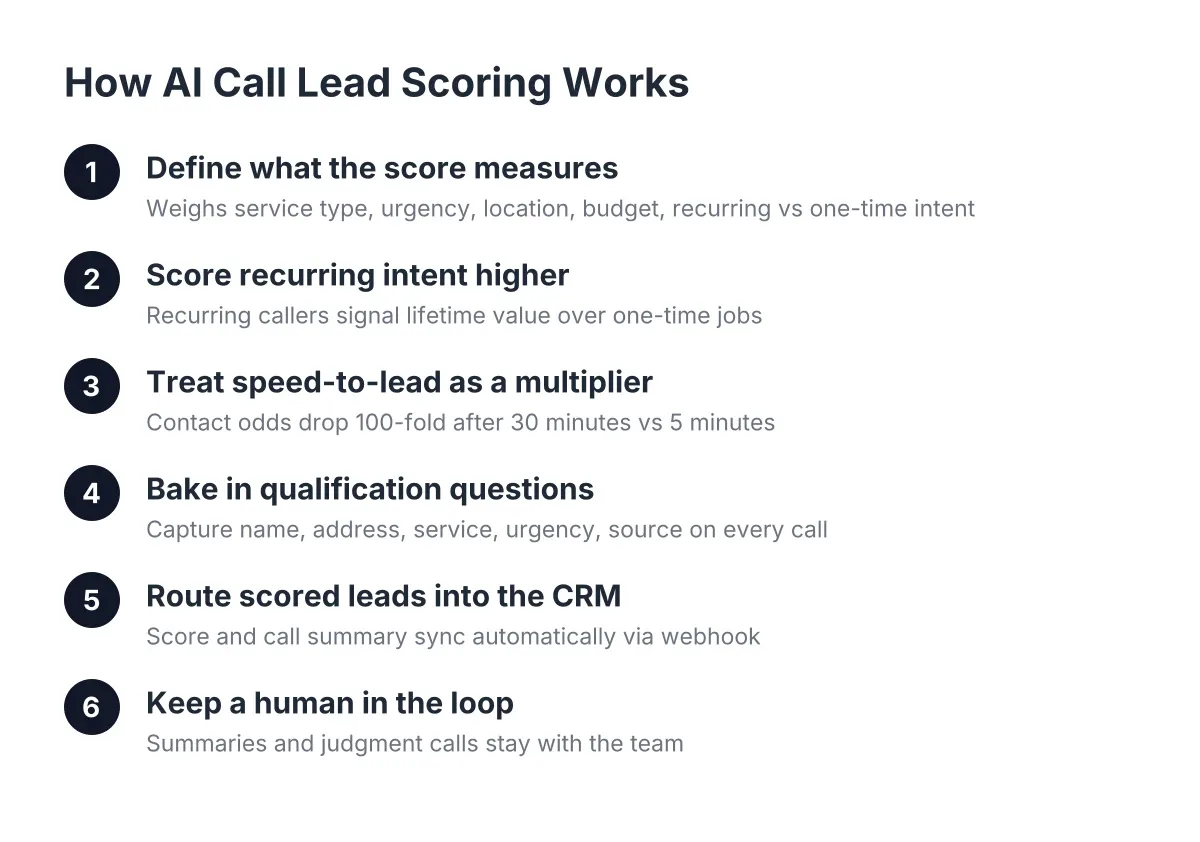
The critical detail: Thumbtack typically sends the same lead to multiple pros. You are not buying a customer. You are buying a spot in a footrace, and the pro who responds first usually wins. That is not a guess about human nature. A foundational study from MIT Sloan School of Management / InsideSales.com found the odds of contacting a lead drop 100-fold, and the odds of qualifying that lead drop 21-fold, when the callback happens at 30 minutes instead of within 5 minutes.
Thirty minutes is one attic run. It is one panel swap. It is less time than you spend on a single service call, and it is enough to turn a paid lead into a total loss. The difference in marketplace lead speed—how quickly you answer—can mean the difference between capturing the job and losing it to a competitor.
TaskRabbit: The Booking Happens In-App, but the Phone Still Rings
TaskRabbit works differently. Clients browse Tasker profiles, pick you based on your hourly rate and reviews, and book directly through the app. You do not pay per lead; TaskRabbit takes a service fee on the client side and controls the transaction.
That sounds like the capture problem is solved for you, and inside the app it mostly is. However, TaskRabbit leads leak in a different place: the edges. Clients message with pre-booking questions, reschedule requests, and scope changes. Slow replies tank your response-time metrics, which lowers your ranking, which quietly reduces future bookings. In addition, TaskRabbit clients who like your work often want to hire you directly next time, and that repeat call comes to your cell phone, not the app. Miss it and you lose the most profitable lead there is: a recurring customer with zero acquisition cost.
Where Converting Thumbtack and TaskRabbit Leads Breaks Down
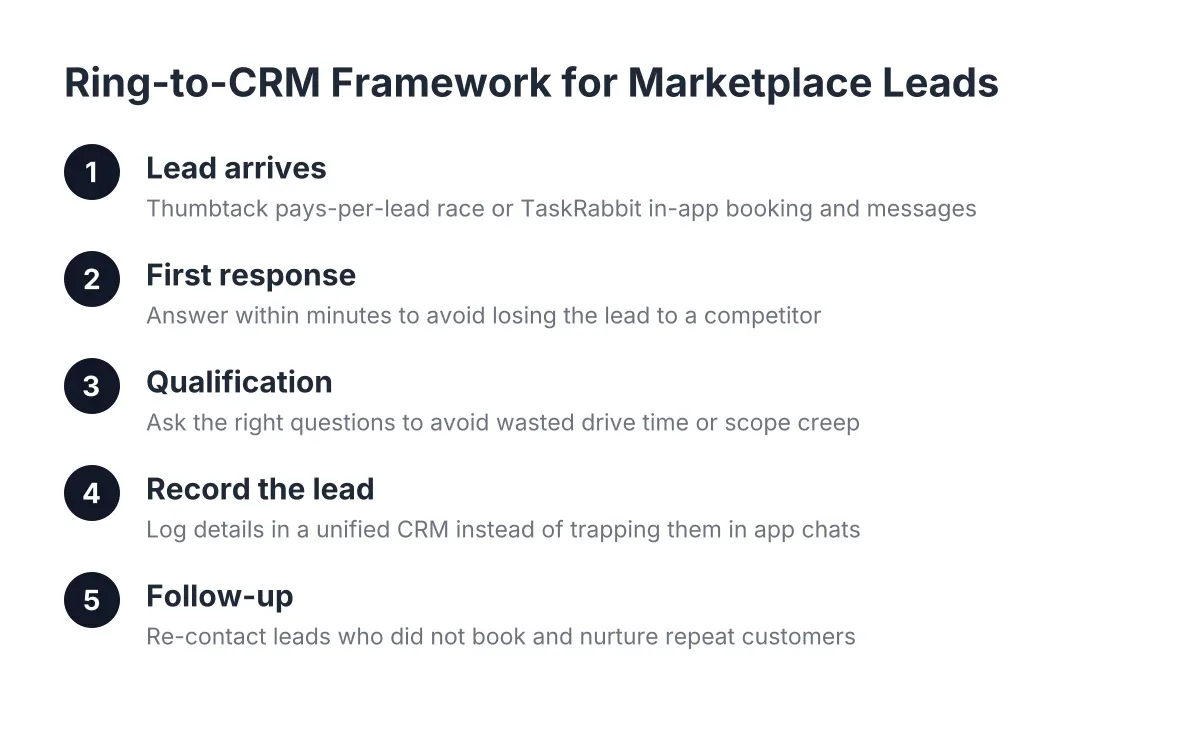
Converting Thumbtack and TaskRabbit leads breaks down at four predictable points: the first response, the qualification conversation, the record of the lead, and the follow-up. Most solo operators lose leads at every one of them, not because they are bad at sales, but because they are on the job when the lead arrives. Marketplace lead speed determines your success at each of these points.
Here is where each platform leaks, side by side:
- First response. Thumbtack: the multi-pro race means a missed call or a two-hour reply usually kills the lead outright. TaskRabbit: slow replies do not kill a single booking as fast, but they erode your ranking and future volume.
- Qualification. Thumbtack: leads arrive with a short job description and gaps everywhere; you burn drive time on jobs that were never a fit. TaskRabbit: the task description helps, but scope creep on site is common because nobody asked the right questions up front.
- Record keeping. Both platforms trap lead data inside their own app. If the conversation lives only in Thumbtack messages or TaskRabbit chat, you have no unified lead management tool, no follow-up list, and no way to see which platform actually pays for itself.
- Follow-up. Thumbtack: leads who did not book on the first contact are recoverable for days, but only if someone tracks and re-contacts them. TaskRabbit: past clients are your direct-repeat pipeline, and they go cold if their calls hit voicemail.
Suppose a solo handyman in Round Rock spends $400 a month on Thumbtack leads at roughly $25 each. That is 16 leads. Say he answers 10 within a few hours and misses 6 entirely because he was mid-install. If those 6 had even a modest one-in-three close rate at a $350 average ticket, that is about $700 a month in lost jobs, plus roughly $150 in lead fees that bought nothing. In that scenario, the leak costs more than double what a capture system would.
Comparing the Fixes: Three Ways to Answer When You Cannot
You cannot answer a phone from a ladder. The fix is deciding, once, what happens to every inbound contact when you are on site. Here are the three realistic options for a one-person operation, compared honestly.
Option 1: Voicemail and Catch-Up Texting
This is the default, and it is free. It is also the reason the 30-minute callback statistic hurts. A Five9/TEAM LEWIS survey found 75% of consumers prefer talking to a real human over the phone for support, which means a voicemail greeting is where most Thumbtack callers hang up and dial the next pro. Voicemail works for existing customers who will wait for you. It fails for competitive marketplace leads where you are one of five names.
Option 2: A National Answering Service
A traditional answering service puts a human on the line, which solves the pickup problem. The trade-offs for a Central Texas trade are real, though. Operators in another state do not know that a "hail claim in Georgetown" is urgent and insurance-driven, per-minute pricing punishes the post-storm spikes when 30 calls land in an afternoon, and most services take a message rather than qualify the job or send a booking link. You get a callback list, which puts you back at square one: calling leads back hours later, after the race is over.
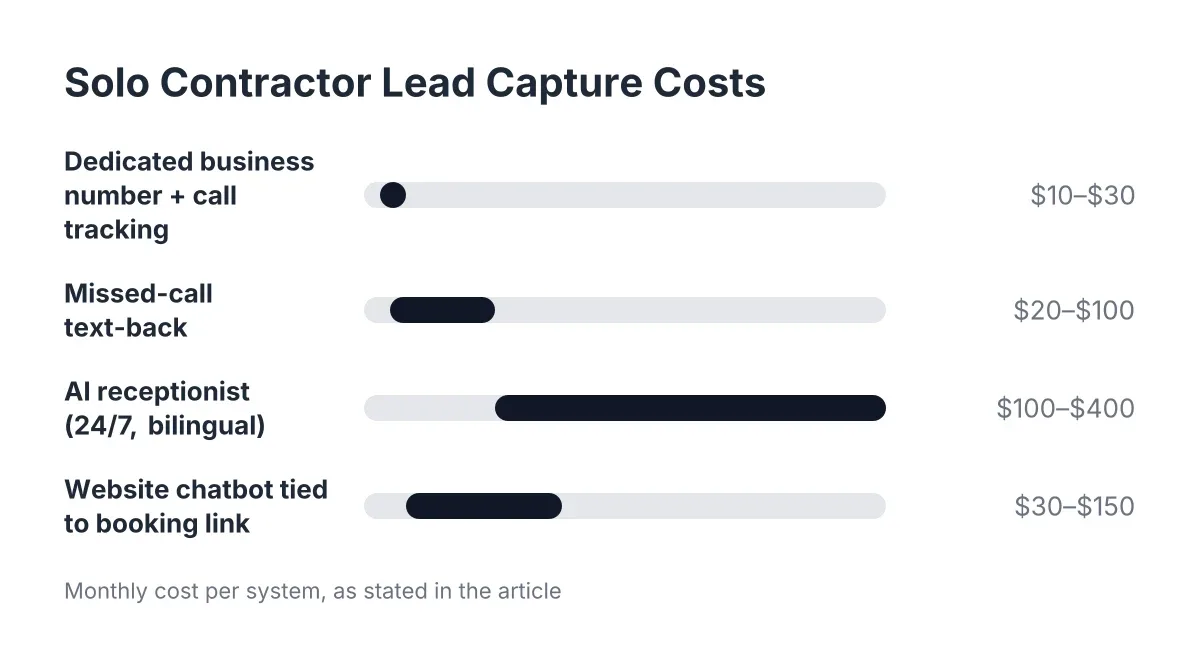
Option 3: An AI Receptionist Plus a CRM
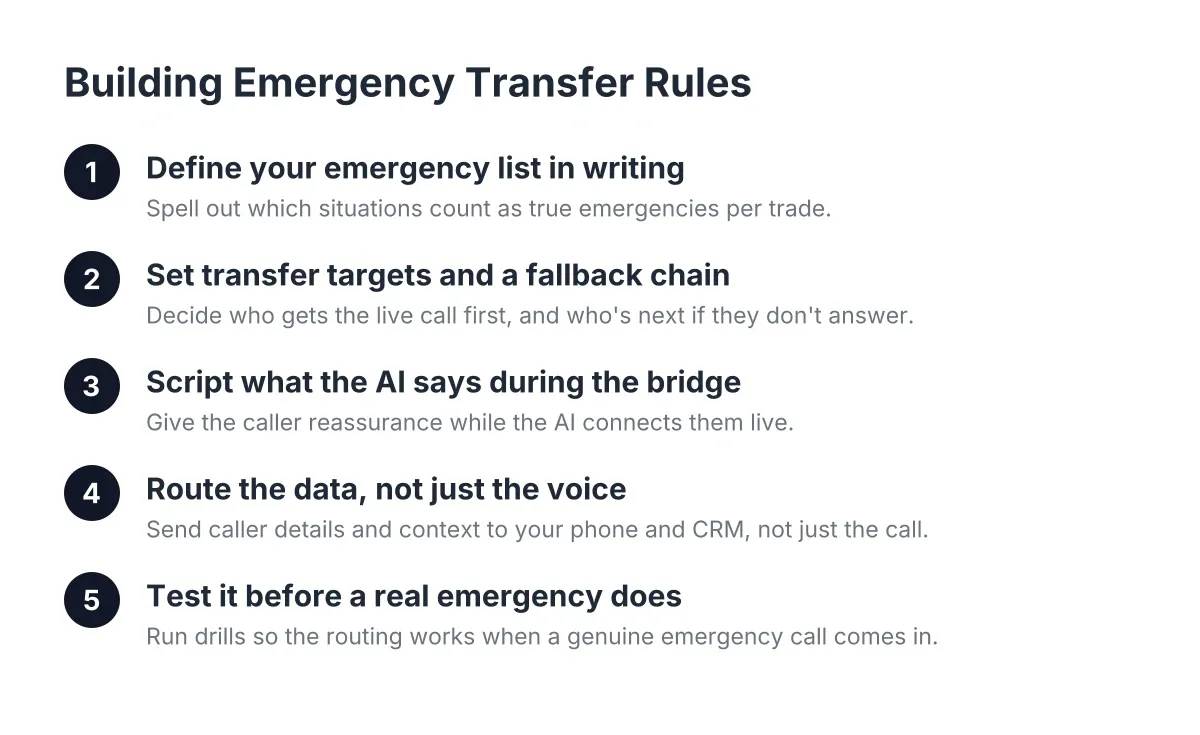
An AI receptionist answers every call on the first ring, 24/7, asks the qualification questions you define, captures the lead's details, and sends a booking link or books the appointment on the spot. Consumers already expect this; the same Five9 survey found 84% are aware companies use AI for customer service. The honest trade-off: AI handles structured intake and booking well, but a complex negotiation, a distraught homeowner after a house fire, or a nuanced insurance dispute still needs you. A good setup routes those as urgent live transfers rather than pretending the AI can close a $40,000 restoration contract.
For solo operators worried this means becoming an "AI company" instead of a tradesperson, the adoption data is reassuring. An NFIB survey found only 24% of small employers currently use AI tools, so answering every call this way is still a competitive edge rather than table stakes. In addition, 98% of small employers using AI reported no change in employee headcount, according to NFIB. It captures calls you were already missing; it does not restructure your business.
The Ring-to-CRM Framework for Marketplace Leads and Lead Speed
Whichever answering option you choose, the leads still need somewhere to live. This is the full lifecycle, from first contact to booked job, built for someone who is on the clock all day. This framework is the core of lead capture for contractors and trades working marketplace leads, and every step exists to plug one of the four leaks above.
- Route every contact to one front door. Forward your cell to your answering layer when you are on site. Add a website chatbot for after-hours browsers. Put your tracked phone number in your Thumbtack profile and messages so app leads convert to direct calls you actually capture.
- Answer inside 5 minutes, every time. This is the whole game for Thumbtack. An AI receptionist answers on the first ring at 2 p.m. on a Tuesday and at 11 p.m. on a Saturday, in English or Spanish, which matters in the Austin market where a meaningful share of homeowners prefer Spanish.
- Qualify before you drive. Capture job type, address, timeline, budget signal, and for storm work, whether an insurance claim is involved. Three good questions save a 40-minute drive to Leander for a job that was never a fit.
- Book on the first contact. Send a booking link or set the appointment during the call. "I will call you back tonight" is where marketplace leads die; "You are booked for Thursday at 9" is where they convert.
- Sync every lead to a CRM automatically. Webhooks or Zapier can push each captured lead into HubSpot, Zoho, Salesforce, or even a lead management software free tier if you are starting out. The point is one list, outside any app, that you own.
- Follow up on the not-yets. Tag Thumbtack leads that did not book and re-contact within 48 hours. Tag TaskRabbit clients as repeat prospects. A Monday morning report showing last week's calls, booked jobs, and open leads takes five minutes to review and catches everything that slipped.
The same framework absorbs leads from every other source you add later, whether that is a lead generation form Facebook campaign, Google Local Services, or plain word of mouth. One front door, one qualification script, one CRM.
Converting Thumbtack and TaskRabbit Leads During a Storm Surge
Converting Thumbtack and TaskRabbit leads after a Central Texas hail or wind event is a different sport, because volume concentrates into 48 to 72 hours. Marketplace lead prices spike, every roofer in Austin, Round Rock, Cedar Park, and Pflugerville is bidding on the same homeowners, and your phone rings while you are physically on a roof.
Here is an illustrative post-storm Tuesday. A typical solo roofer or small restoration operator might see 25 to 40 inbound contacts in a day instead of the usual 4 to 6. No human, and no per-minute answering service budget, absorbs that gracefully. An AI receptionist handles simultaneous calls without a queue, captures insurance claim details on every one, scores leads so you call the $12,000 full-replacement prospect before the $300 patch job, and books inspections into your calendar in the order you can actually run them.
The storm window is also where the CRM sync earns its keep. Insurance claims are time-sensitive, and a lead captured on Tuesday but never logged is a claim deadline missed two weeks later. Every contact, logged and scored, the moment it happens.
How to Choose Your Setup
Match the fix to how your leads actually arrive. Use this as a quick decision guide:
- Mostly TaskRabbit, low direct-call volume: Tighten your in-app response habits first. Add call capture when repeat clients start dialing your cell directly, because those calls are your highest-margin leads.
- Paying for Thumbtack leads: Speed is non-negotiable. Voicemail actively wastes your lead budget; put an answering layer in front of your phone before you buy another lead.
- Storm or event-driven work: You need simultaneous call handling, insurance intake questions, and lead scoring. Neither voicemail nor a per-minute service survives a surge week. Locally tuned AI answering plus CRM sync is the only option on this list built for that volume profile.
- Any of the above in the Austin market: Bilingual answering is not optional. An English-only front door quietly filters out a real slice of Central Texas homeowners before you ever hear about the job.
One caution to close on. No capture system rescues a bad platform fit; if a lead category consistently loses money after you are answering within five minutes and qualifying every call, cut the category rather than the capture. And for complex insurance restoration claims, loop in your insurance contact or a public adjuster early rather than letting intake automation stand in for professional claims guidance.
Answer in five minutes, qualify before you drive, book on the first contact, and log everything in one place you own. Do those four things and the platform you picked matters a lot less than the leads you stop leaking.
If you're losing revenue to missed calls, NeverMiss ATX can help.
Prefer to talk it through? Call (512) 980-9267 — a quick call is usually the fastest way to get a straight answer for your situation.