Lead Qualification Best Practices: The Exact Questions Your AI Should Ask
You do not have a lead generation problem. You have a lead capture problem. Many solo tradespeople in Central Texas lose more money to unanswered calls than to slow seasons, and the leads that do get answered often go unqualified, unrecorded, and unbooked. This guide walks through lead qualification best practices for home service businesses, with a specific focus on the AI receptionist qualification questions that should be asked when an automated system answers on your behalf. If you are comparing options, whether that is an answering service, a hire, or AI, the qualification questions are where the differences actually show up.
Here is the promise: by the end of this article you will have a contractor-specific framework that follows a lead from the first ring to your CRM, shows exactly where leads leak out, and gives you the question script that plugs each gap. No admin hire required.
Where Leads Actually Leak for a One-Person Operation
Leads leak at four points, and most solo operators only see the first one.
Leak one: the missed call. You are on a ladder in an attic in 95° heat, the drill is running, and your phone buzzes in your pocket. You cannot answer. Plenty of solo tradespeople lose a painful share of inbound calls this way, and in emergency trades like plumbing, electrical, and pest control, a missed call is a lost job. A homeowner with a burst pipe does not leave a voicemail and wait. They call the next number on the list.
Leak two: the unqualified answer. Sometimes you do pick up. You are mid-install, you take the call one-handed, you say "I'll call you back," and you get a first name and half a callback number. That is not a qualified lead. That is a rumor of a lead.
Leak three: the unrecorded lead. The call happened, the details lived in your head, and by Thursday you cannot remember whether the lady in Pflugerville said her water heater was leaking or her softener. Nothing was logged, so nothing gets followed up.
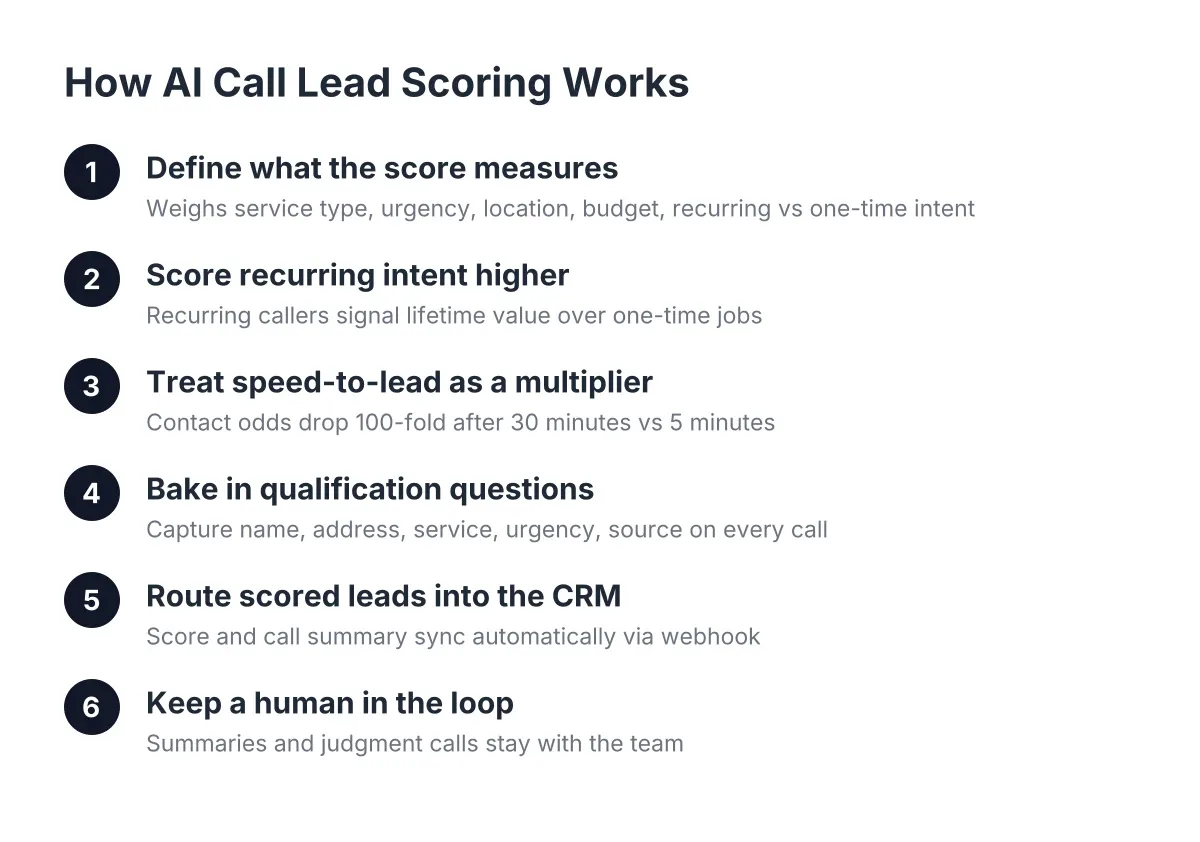
Leak four: the slow follow-up. The lead was captured and logged, but you called back six hours later. The research here is brutal. According to MIT Sloan School of Management / InsideSales.com, the odds of contacting a lead drop 100-fold, and the odds of qualifying that lead drop 21-fold, when the callback happens at 30 minutes instead of within 5 minutes. Six hours later, that homeowner has hired someone else.
Every serious approach to lead capture for contractors has to plug all four leaks, not just the first. Answering the phone is table stakes. Qualifying, recording, and routing are where the money is.
Why Qualification Matters More in Emergency Trades
Qualification matters more in emergency trades because urgency is the whole game. A B2B sales team qualifying software leads can take a week. A plumber qualifying a Saturday night call has about 90 seconds to figure out whether this is a burst main that needs a live transfer or a dripping faucet that can wait until Monday.
That is why the generic lead qualification frameworks you find when you search this topic, BANT, MEDDIC, lead scoring matrices, mostly do not translate. They were built for sales teams with pipelines and quarterly quotas. You need something built for a phone that rings at 11 p.m. while you are asleep, or at 2 p.m. while you are under a house.
For high-urgency trades, qualification answers three business questions:
- Is this an emergency or can it be booked for later? This decides whether you get woken up or the caller gets a booking link.
- Is this a job you actually do, in an area you actually serve? A drain call from Waco is not a lead if you work Round Rock and Georgetown.
- Is this caller ready to hire, or shopping five companies? Both are worth capturing, but they get handled differently.
Get those three answers on every call and you have done more qualification than most small home service businesses do today.
AI Receptionist Qualification Questions and Best Practices
The best practice list below is trade-specific. It assumes calls come in around the clock — pest control especially skews toward evenings and weekends — and that the person answering is software acting on your rules rather than you.
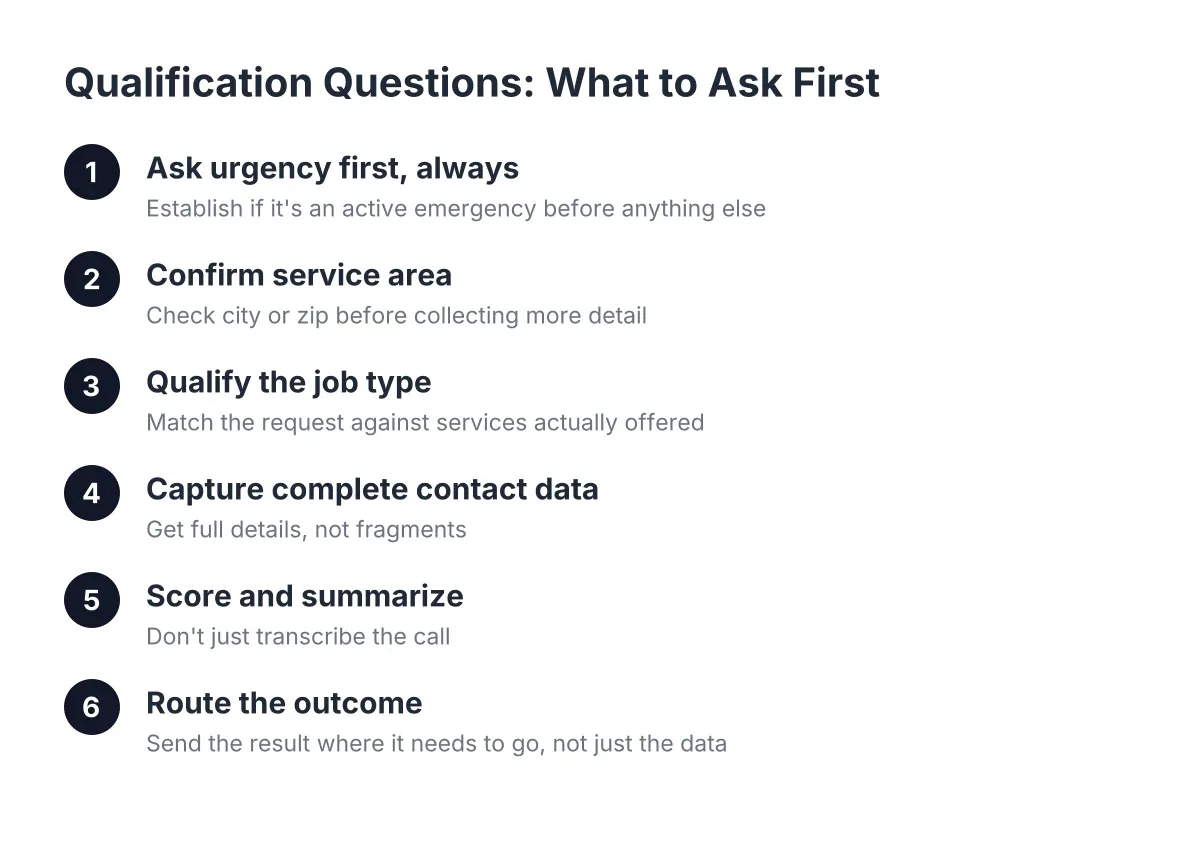
Ask urgency first, always
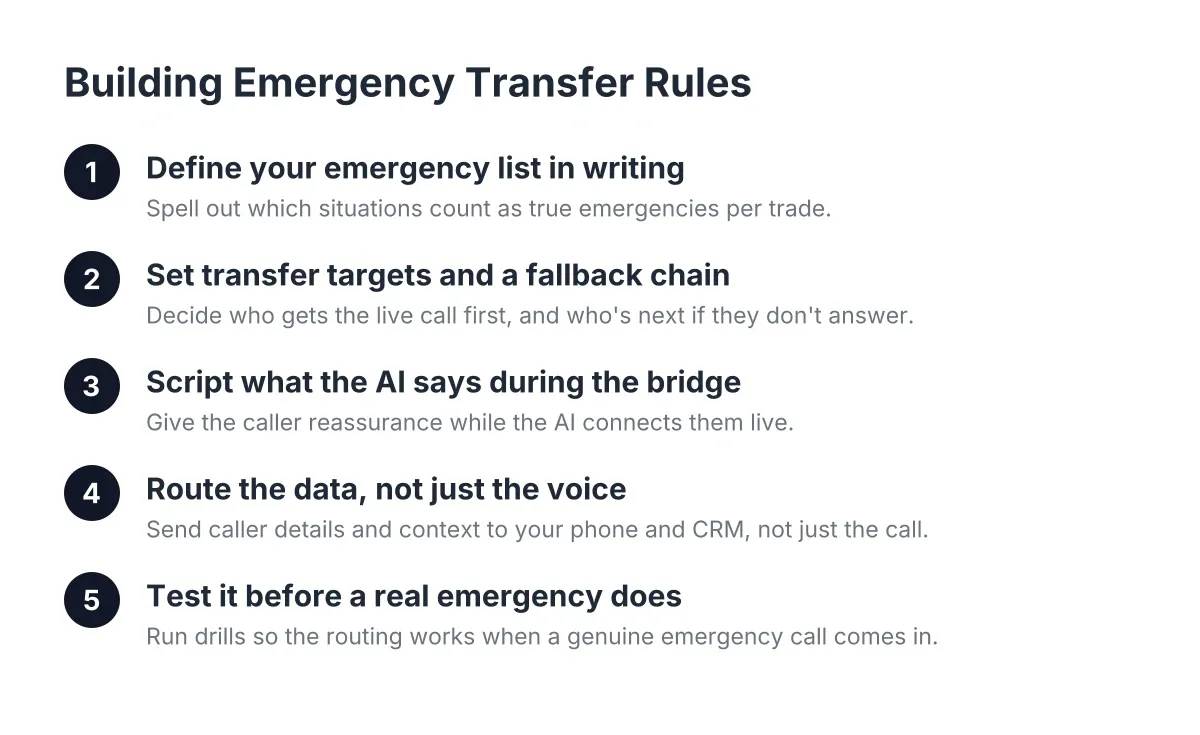
Urgency is the first question because it changes everything downstream. An AI receptionist should establish within the opening exchange whether the caller has an active emergency: water flowing, sparks, no power, a gas smell, or a stinging-insect situation near kids. If yes, the call follows your emergency path, which might mean a live transfer to your cell. If no, the AI moves into standard qualification and booking.
Ordering matters here. If the AI asks for name and address first and the caller has water pouring through a ceiling, you have built a bad experience and probably lost the job. Urgency first is the single most important of the lead qualification best practices in this list.
Confirm service area before anything else that takes time
Nothing wastes a caller's patience like collecting five minutes of detail and then discovering they are 60 miles outside your territory. The second question should confirm location: "What city or zip code are you in?" If the answer is Cedar Park, Leander, or Pflugerville and you serve those areas, continue. If not, the AI politely closes and logs the call so you can see demand patterns anyway.
Qualify the job type against what you actually do
Next, the AI should identify the specific service needed and match it against your list. A solo electrician who does residential panel work but not commercial build-outs should have that boundary encoded. A good qualification flow lets the caller describe the problem in their own words, then maps it: "Sounds like a breaker that keeps tripping. Is that in your home or a business?"
This is also where a bilingual caller base changes the requirements. In Austin, a meaningful share of homeowner calls come in Spanish. If your qualification only works in English, you are leaking leads before qualification even starts. Any AI receptionist worth considering should qualify in both English and Spanish without the caller pressing a button or waiting for a different line.
Capture complete contact data, not fragments
A qualified lead with no callback number is worth nothing. Minimum viable capture for a home service lead:
- Full name
- Mobile number, confirmed by reading it back
- Service address or at least city and zip
- The problem, in one or two sentences
- Timing: emergency now, this week, or flexible
- How they found you, if it comes up naturally
Treat that list as your lead generation form template too. Whatever asks these questions, an AI receptionist on the phone, a chatbot on your website, or a form on a landing page, should collect the same fields in the same order so every lead in your system looks the same.
Score and summarize, do not just transcribe
A raw transcript of a seven-minute call does not help you at 6 p.m. when you are deciding who to call back first. Qualification should end in a score and a summary: hot, warm, or informational, plus three lines you can read at a red light. AI call intelligence that scores and summarizes each call turns your call log into a prioritized callback list instead of a chore.
Route the outcome, not just the data
Finally, qualification best practice number six: every qualified lead needs a next step baked in. A hot emergency triggers a live transfer or an immediate text to you. A warm lead gets a booking link by text before the call even ends. Every lead, regardless of temperature, lands in your CRM through a webhook or a Zapier, HubSpot, Salesforce, or Zoho sync, so nothing depends on your memory. Capture without routing is just a fancier voicemail.
The Question Script: What a Well-Qualified Call Sounds Like
The framework above turns into a concrete flow. Here is what a well-run AI receptionist qualification question sequence looks like for a plumbing lead on a Tuesday night while you are at your kid's game:
- Greeting and urgency check. "Thanks for calling. Is this an emergency, like active leaking or no water, or something we can book for you?"
- Location. "Got it, not an emergency. What city are you in?" Caller: "Georgetown."
- Problem description. "What's going on with the water heater?" Caller describes rust-colored water and a rumbling tank.
- Timing and availability. "He can typically get to Georgetown within a day or two. Are mornings or afternoons better?"
- Contact capture with read-back. Name, mobile number confirmed digit by digit, and the street address.
- Booking and confirmation. The AI texts a booking link, the homeowner picks Thursday at 9 a.m., and the job is booked before you leave the bleachers.
- Summary delivery. You get a three-line summary and a lead score. The lead syncs to your CRM automatically.
Total caller time: about three minutes. Your time: zero, until you review the summary. Compare that with the alternative, which is a voicemail that says "call me back about my water heater" from a number you cannot read in the sun.
Now run the same flow with an emergency. The caller says water is spraying under the kitchen sink. The AI walks them to the shutoff valve location as a courtesy note, captures address and callback number in under a minute, and live-transfers to your cell because you opted into emergency transfers. That call can easily be worth $400 to $900 on an Austin emergency plumbing job, and it only exists because urgency came first in the script.
How Lead Qualification Best Practices Differ Across Your Options
You have three realistic ways to get calls answered and qualified as a solo operator, and each handles the framework above differently. A fair comparison helps you pick.
Hiring part-time office help
A part-time office person can qualify well during business hours and brings human judgment that no software matches. The trade-offs are cost and coverage. Even part-time help typically runs $1,500 to $2,500 a month in the Austin market, and they go home at 5 p.m. In pest control, where a large share of calls come in after hours, business-hours coverage still leaks your highest-urgency leads. Hiring makes the most sense once you have a crew of four or more and enough daytime admin work to fill the hours.
National answering services
A national answering service answers 24/7, which plugs leak one. Qualification is where they struggle for trades. Operators work from generic scripts across dozens of industries, so they rarely distinguish a tripped GFCI from a dead panel, and emergency triage judgment is thin. Message delivery is often an email you read hours later, which reintroduces leak four. If your callers expect someone who knows what Round Rock water pressure problems sound like, a call center in another state will feel like exactly what it is.
An AI receptionist built for trades
An AI receptionist answers every call, 24/7, and runs your exact qualification script every time without a sick day. It qualifies in English and Spanish on the same line, scores and summarizes each call, texts booking links, and syncs leads straight to your CRM. Consumers are ready for this more than most owners assume; according to Five9, 84% of consumers already know companies use AI for customer service.
Honesty about the trade-off: the same Five9 research found 75% of consumers still prefer talking to a human for support. That is why the strongest setup is not AI instead of you, it is AI capturing and qualifying so the human conversation happens with you, the actual tradesperson, at the right moment. An AI receptionist that offers live transfer for genuine emergencies respects that preference instead of fighting it. And for complex, high-stakes situations, a suspected gas leak, or anything involving immediate safety, the qualification script should always route the caller to 911 or the utility first and you second; no capture system should stand between a caller and emergency services.
One more data point worth knowing while you compare. According to the National Federation of Independent Business (NFIB), only 24% of small employers currently use AI tools in their business, and 98% of those who do report no change in employee headcount. Translation: adopting AI for call answering is still early enough to be an edge over the competitor down the road, and it is not about cutting people. For a one-person operation, there is nobody to cut anyway; there is only revenue to capture.
Building the Ring-to-CRM Pipeline Without an Admin Hire
Qualification questions only pay off if the answers land somewhere useful. Here is the full pipeline, and it is shorter than most owners expect.
Step one: every ring gets answered. Calls you cannot take, which for a solo operator is most of them during working hours, forward to the AI receptionist. Your website gets a chatbot running the same qualification flow, because the homeowner googling "electrician near me" at 10 p.m. may type instead of dial.
Step two: every answer runs the script. Urgency, location, job type, contact capture, timing, in that order. Same questions on the phone and on the web, so your data stays consistent.
Step three: every lead gets scored and delivered. Summaries and scores hit your phone. Leads sync to HubSpot, Zoho, Salesforce, or wherever you keep customers, through native sync or Zapier. When people search for the best app for contractor leads or compare the best lead generation tools, this delivery layer is what separates a tool that generates contacts from a system that books jobs. A lead that lives in a dashboard you never open is leak three wearing a new outfit.
Step four: every hot lead gets fast action. One-click call bridging from the dashboard lets you return a hot lead's call the moment you climb down from the ladder. Given the MIT Sloan / InsideSales.com finding on 5-minute versus 30-minute callbacks, this step alone can be worth more than every marketing dollar you spend.
Step five: review weekly, adjust the script. A Monday morning report showing call volume, after-hours percentage, lead scores, and booked jobs tells you whether your qualification questions are working. If half your calls are for a service you do not offer, adjust your ads. If Spanish-language calls are climbing in Leander, you already have them covered.
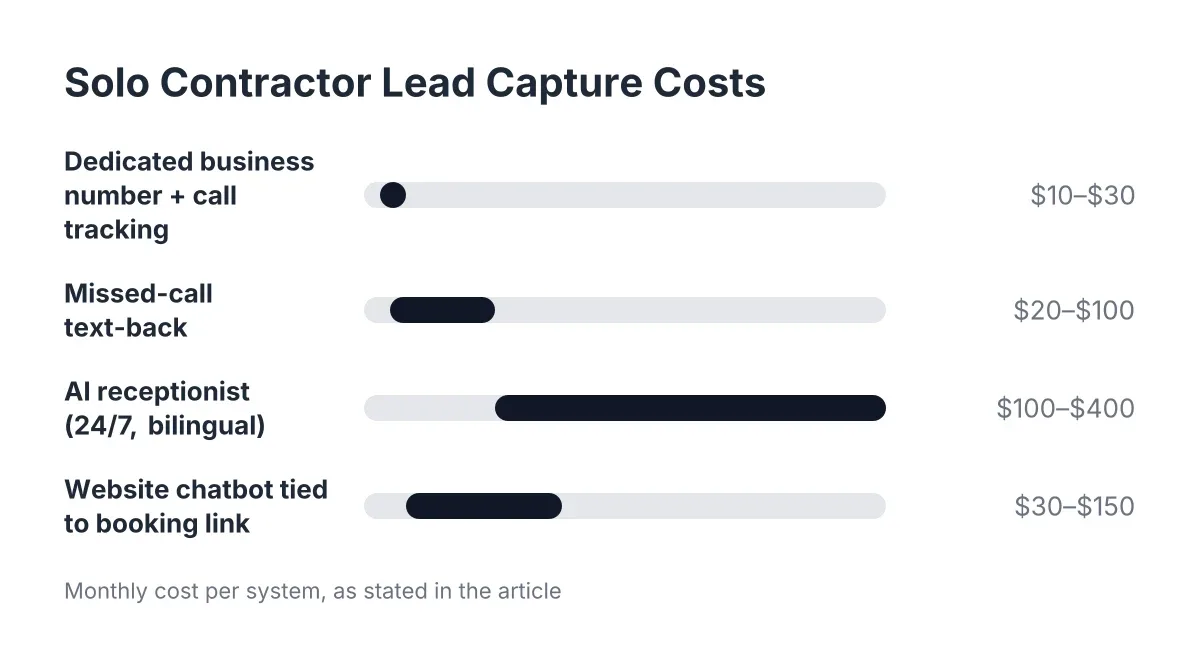
Notice what is missing from that pipeline: a hire. As of 2026, a solo tradesperson doing $200K to $500K a year can run this entire capture and qualification system for a few hundred dollars a month, against the tens of thousands a year that missed and unqualified calls can cost an emergency trade.
A Quick Self-Audit: Grade Your Current Qualification
Before you change anything, score your current setup. For each question, answer yes or no:
- Does every inbound call get answered by a person or system, including after-hours and weekends?
- Does every answered call establish urgency in the first 30 seconds?
- Does every lead record include a confirmed callback number and service address?
- Can a caller complete the whole flow in Spanish?
- Does every lead land in a CRM or log without you typing anything?
- Do hot leads reach you within five minutes?
- Can you say, right now, how many calls you missed last week?
Five or more yes answers means your leaks are small; tighten what remains. Three or four means you are losing real jobs monthly. Two or fewer means your lead problem is not generation, and no amount of new ad spend will fix a bucket with four holes in it.
The best test of any qualification system, human or AI, is the same one you would give an apprentice: throw hard calls at it. Call it in Spanish. Describe a weird intermittent electrical fault. Say you are outside the service area and see what it does. A system that handles your trade's messiest calls will handle the easy ones. The one-person shops staying booked through 2026 are not the ones with the most leads. They are the ones where every ring, every question, and every answer has somewhere to go.
If you're losing revenue to missed calls, NeverMiss ATX can help.
Prefer to talk it through? Call (512) 980-9267 — a quick call is usually the fastest way to get a straight answer for your situation.