AI Call Intelligence Lead Scoring: How to Find Your Best Prospects First
Every missed spring booking call costs more than one job. For a lawn care or pest control owner, a new recurring customer is worth roughly five times a one-time ticket, and that customer is usually won or lost on the first call. This is where AI call intelligence with lead scoring changes the math: instead of treating every ring the same, it tells you which callers are your best prospects, so the leads worth the most get your attention first. Call lead scoring turns that chaos into a ranked pipeline.
Here is the problem most Central Texas trades face. It is not a lead shortage. It is that leads come in while the crew is on site, phones stay in pockets, and by 6 p.m. nobody remembers which of the eleven calls was the property manager asking about weekly service for four rental homes. The lead was never logged, never qualified, never routed anywhere. It just evaporated.
This listicle breaks down seven ways lead scoring and call intelligence plug those leaks, from the first ring all the way to your CRM. Each item stands on its own, so skim to the gap that is costing you the most.
1. Understand What an AI Call Intelligence Lead Score Actually Measures
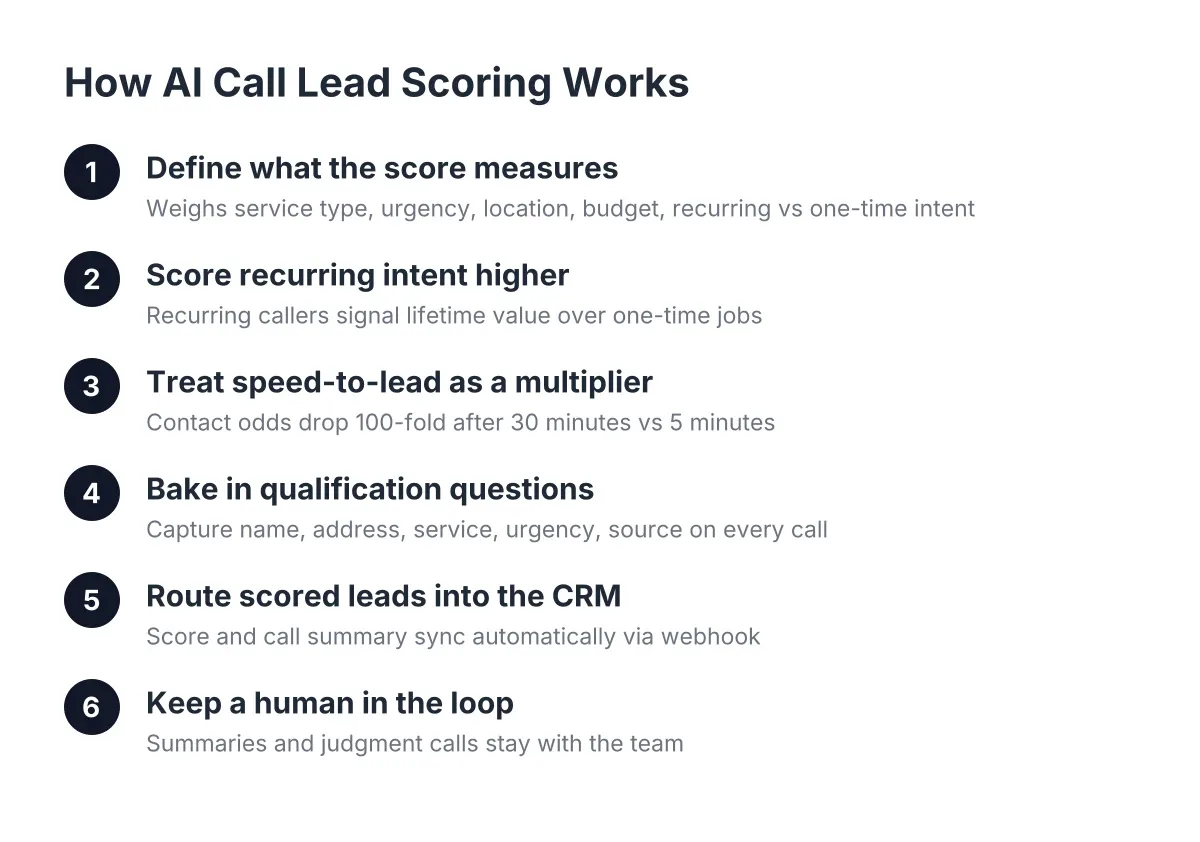
An AI call intelligence lead score is a rating the system assigns to each inbound call based on what the caller said, asked for, and committed to. It weighs signals like service type, urgency, location, budget hints, and whether the caller wants recurring service or a one-time fix. The output is a ranked list, so the caller asking about a year-round pest contract in Round Rock sits above the person price-shopping a single wasp nest.
If you have ever asked what lead generation is versus lead capture, here is the short version: generation gets the phone to ring; capture makes sure the ring becomes a logged, qualified record. Scoring is the layer on top that says which records matter most. Without it, every call looks identical in your call log, and your follow-up order is basically guesswork.
2. Score Recurring Intent Higher Than One-Time Jobs
For recurring-revenue businesses, the single most valuable signal a call can carry is recurring intent. A caller who says "weekly mowing" or "quarterly pest treatment" is signaling lifetime value, not just a ticket. Your scoring logic should weight that language heavily, because a recurring customer in lawn care or pest control typically outearns a one-time job several times over across a year.
Suppose a typical Cedar Park lawn crew gets 30 calls during a spring booking week. Say eight of those callers mention weekly or biweekly service. In that scenario, those eight calls carry most of the week's future revenue, and they deserve callbacks before the one-time cleanup requests. Scoring surfaces them automatically instead of leaving it to whoever checks voicemail after dark.
3. Use Speed-to-Lead as a Scoring Multiplier, Not an Afterthought
A high score decays fast. According to MIT Sloan School of Management / InsideSales.com, the odds of contacting a lead drop 100-fold, and the odds of qualifying that lead drop 21-fold, when the callback happens at 30 minutes instead of within 5 minutes. Therefore, the best systems pair scoring with immediate action: answer the call live, capture the details, and deliver a booking link on the spot rather than queuing a callback.
This is why answering matters more than analyzing. Call intelligence on top of missed calls is a report card on money you already lost. Call intelligence on top of answered calls is a ranked pipeline you can act on before lunch.
Why Does Speed Matter in Call Lead Scoring?
An AI call intelligence lead goes cold fast because home service callers are usually solving an active problem, and they dial the next company on the list when nobody picks up. A scored lead from 9 a.m. that waits until 5 p.m. has often already booked with a competitor. Speed protects the value the score identified.
The practical takeaway: build your process so the highest-scored calls trigger something immediate. That could be a live transfer for genuine emergencies, a booking link texted during the call, or a same-hour call bridge from your dashboard between jobs. The score tells you where to spend your limited callback minutes; speed makes those minutes count.
4. Bake Qualification Questions Into Every Answered Call
Scoring is only as good as the answers behind it. Every inbound call should capture the same core fields, whether it is 2 p.m. on a Tuesday or 11 p.m. on a Saturday, because a meaningful share of pest calls come in after hours during peak season, and after-hours callers are just as qualified as daytime ones.
At minimum, capture these on every call:
- Name, phone number, and service address (Austin, Georgetown, Pflugerville, or wherever the job sits)
- Service requested, and whether the caller wants recurring or one-time work
- Urgency: active infestation and burst pipe now, or flexible scheduling
- How they found you, so you know which marketing actually pays
- Preferred contact method and best time to reach them
An AI receptionist can run this qualification consistently, in English and Spanish, without your crew climbing off a ladder to do it. Consistency is the point; a lead form template only works if every lead actually passes through it, and phone calls are where most home service leads arrive.
5. Route Scored Leads Straight Into Your CRM, Not a Sticky Note
Lead management in a CRM only works when leads arrive there automatically, with the score and call summary attached. If your process depends on someone transcribing voicemails into HubSpot at the end of the day, the leak is not the phone; it is the handoff. Webhooks and native syncs to HubSpot, Salesforce, Zoho, or Zapier move each qualified call into your pipeline the moment it ends.
This is the part of lead capture for contractors and trades that gets skipped most often, and it is the cheapest to fix. Once scored leads land in the CRM with summaries, your Monday morning looks different: a sorted list of prospects by value, each with context, instead of a call log full of unknown numbers. In addition, you can finally see which lead sources produce recurring customers versus one-off tire kickers.
6. Let Summaries Replace the End-of-Day Memory Test
Call summaries are the unglamorous half of call intelligence, and arguably the more useful half for an owner-operator. A two-line summary per call, plus the score, means you can review a full day of call volume in three minutes from the truck. No replaying voicemails at a red light, no "who was that 512 number again."
For example, a summary might read: "Maria, Leander, requesting biweekly lawn service starting March, Spanish-language call, booking link sent, high score." That is everything you need to prioritize her over the caller who asked whether you haul brush. Over a season, summaries also show patterns: which neighborhoods call most, which services spike after storms, and where your Spanish-language demand is growing.
7. Keep a Human in the Loop for Judgment Calls
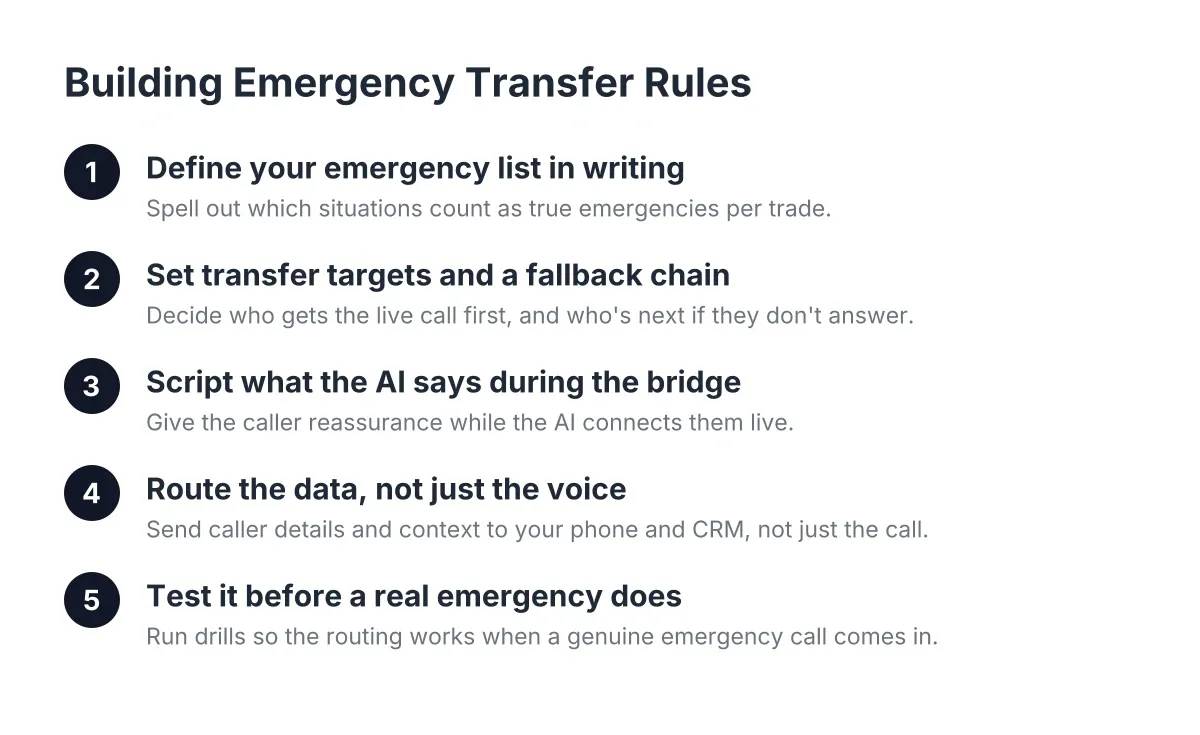
Scoring is a filter, not a decision-maker. Some situations still need your judgment on the phone: a commercial property manager negotiating a multi-site contract, a caller describing a possible gas smell, or anything with liability attached. Good systems handle this with opt-in live transfer for urgent calls and one-click call bridging, so the AI receptionist captures and qualifies, and you close.
There is also a trust reality worth respecting. A Five9/TEAM LEWIS survey found 75 percent of consumers prefer talking to a real human for customer support, and the same research found 84 percent of consumers are aware companies use AI for customer service. The lesson is not to hide the AI; it is to use it for what it does well, answering every call and capturing every lead, while you stay the human relationship behind the business. One honest limitation: no scoring model reads tone and local context as well as an experienced owner, so treat the score as a strong recommendation, not gospel, and spot-check it during your first month.
How AI Call Intelligence Turns Lead Chaos Into a Ranked List
AI call intelligence turns raw call volume into a ranked pipeline by answering every call, qualifying each caller with consistent questions, scoring the answers, and syncing the result to your CRM with a summary attached. The outcome is simple: you always know which lead to call back first, even during a spring surge.
Here is an illustrative Tuesday during booking season for a hypothetical two-crew pest control company in Pflugerville. Fourteen calls come in while both crews are on jobs. By the old process, maybe five reach voicemail and two leave messages. With every call answered and scored, the owner opens the dashboard at 4 p.m. and sees three high-score leads: two quarterly contracts and one same-week termite inspection, each with a summary and a synced CRM record. The owner bridges a call to the termite lead first, texts booking confirmations to the contract leads, and the entire follow-up takes twenty minutes.
Worried this means restructuring your team? The evidence says otherwise. According to the National Federation of Independent Business, 98 percent of small employers using AI reported no change in employee headcount, and only 24 percent of small employers currently use AI tools at all. Translation: the owners adopting this are not cutting people; they are capturing calls that used to hit voicemail, and most of your competitors have not started yet.
The businesses winning Central Texas booking seasons in 2026 are not the ones with the most leads. They are the ones where no lead goes unanswered, unqualified, or unlogged, and where the best prospect of the day is obvious by the time the truck gets back to the shop.
If you're losing revenue to missed calls, NeverMiss ATX can help.
Prefer to talk it through? Call (512) 980-9267 — a quick call is usually the fastest way to get a straight answer for your situation.