Emergency Call Transfer for Contractors: When to Go Live vs. Let AI Handle It
A burst pipe at 11 p.m. does not wait for business hours, and neither does the homeowner calling about it. If you run an emergency trade in Central Texas, knowing how to implement emergency call transfer rules for contractors is the decision that determines whether that caller becomes a booked job or your competitor's recurring customer. The question is not whether to answer every call; you already know you have to. The question is which calls need to reach you or a tech live, right now, and which ones an AI receptionist can capture, qualify, and book without waking anyone up.
This guide gives you a contractor-specific framework for that decision, from the first ring to your CRM. You will see exactly where leads leak, which emergencies justify a live transfer, and how to set up routing rules that protect both your sleep and your revenue.
Why Missed Emergency Calls Cost More Than Missed Regular Calls
An unanswered emergency call is the most expensive missed call in your business. A homeowner with a flooded kitchen or a dead panel calls the next number on the list within minutes. There is no voicemail-and-wait behavior on a true emergency; there is only whoever answers first.
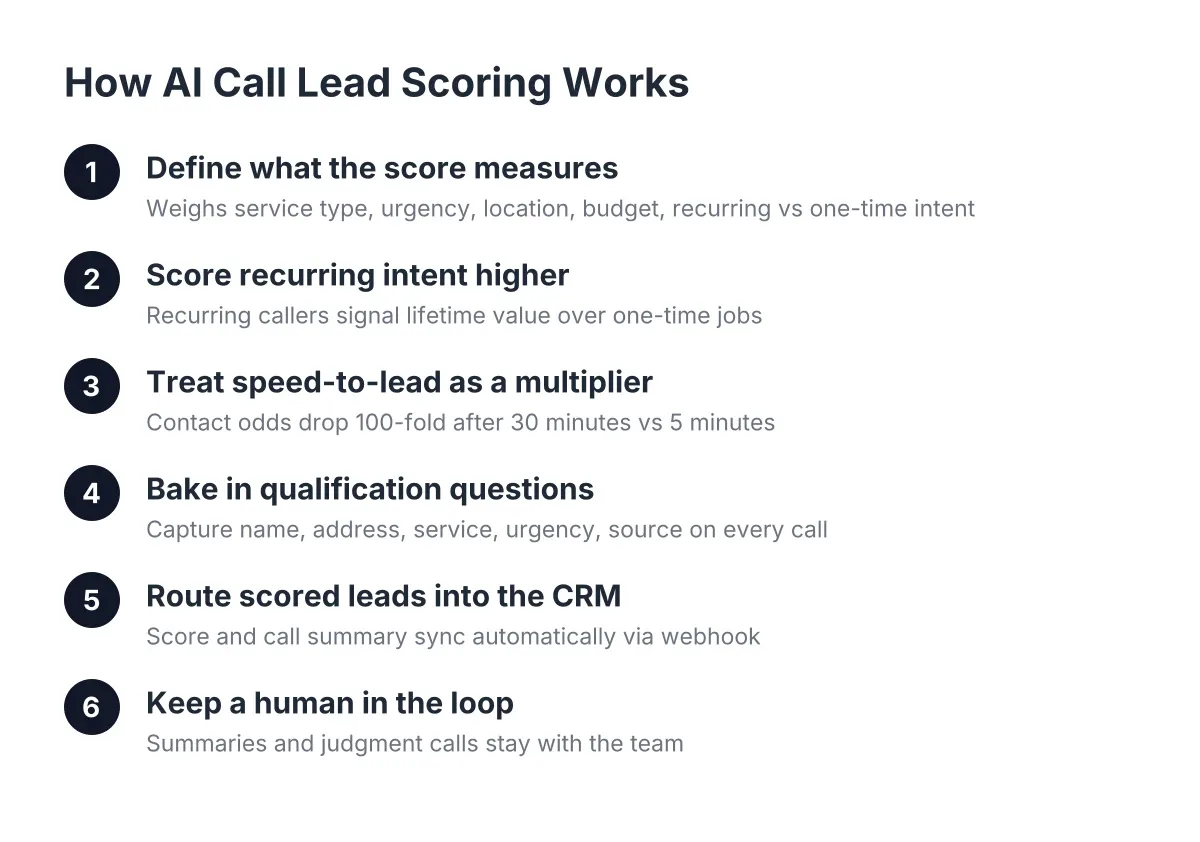
The math backs this up. According to MIT Sloan School of Management / InsideSales.com, the odds of successfully contacting a lead drop 100-fold, and the odds of qualifying that lead drop 21-fold, when the callback happens at 30 minutes instead of within 5 minutes. For a regular quote request, a 30-minute callback stings. For an emergency, it means the job is already gone.
Now stack that against when emergency calls actually arrive. For high-urgency trades like plumbing, electrical, and pest control, a large share of demand hits after-hours, on weekends, and during peak season when your crew is booked solid. A typical small crew in Austin might be underwater in July: two techs on jobs, the owner on a ladder, and the phone ringing in a truck cab. Every one of those rings is a lead that either gets captured or leaks.
That is the real problem emergency call transfer solves for contractors. It is not about answering more calls. It is about making sure the calls that need a human get one immediately, while everything else still gets captured, qualified, and booked instead of hitting voicemail.
The Two Paths an Emergency Call Can Take
Every after-hours call to your business can go one of two ways, and both are legitimate. The mistake is treating them as an either-or choice for your whole business instead of a per-call decision.
Path one: live transfer. The AI receptionist answers, recognizes a genuine emergency, and bridges the caller straight to you or your on-call tech. You hear the phone ring, you pick up, and you are talking to a homeowner with water on the floor within 60 seconds of their first ring.
Path two: AI capture and rapid follow-up. The AI receptionist answers, qualifies the caller, captures name, address, callback number, and problem description, books them into your first available emergency slot or sends a booking link, and pushes a scored summary to your phone and CRM. You call back on your terms, with full context.
Neither path is universally right. A live transfer for every call means your phone rings at 2 a.m. for a squirrel-in-the-attic question that could have waited until 7. Pure AI capture for every call means a genuine gas leak or sparking panel waits on a callback when it needed a human voice and a truck rolling. The framework below tells you which calls belong on which path.
When Emergency Call Transfer Rules Guide Your Routing Decisions
Route a call live when three things are true at once: the problem is actively causing damage or danger, the caller needs judgment or reassurance that only a licensed pro can give, and you can actually act on it tonight. If any one of those is false, AI capture with a fast callback usually wins.
Here is how that plays out by trade:
- Plumbing: Active flooding, a burst supply line, sewage backing into the home, or no water to the entire house. These calls should transfer live. A slow drain, a running toilet, or a water heater that died quietly can be captured and booked for the morning.
- Electrical: Burning smell, visible sparking, a hot panel, or a full outage that the utility has not caused. Transfer live. A dead outlet in the guest room or a flickering fixture gets captured, qualified, and booked.
- Pest control: Aggressive wasp or bee activity around an entryway, a snake inside the home, or a bat in a bedroom. Transfer live if you offer same-night response. Roaches, ants, and routine rodent signs get captured; the caller still books faster than your competitor's voicemail can.
- HVAC and other trades: No cooling during a Central Texas heat advisory with an elderly resident or infant in the home is a live transfer. No cooling on a mild October evening is a first-slot-tomorrow booking.
Notice the pattern. Live transfer is for calls where delay creates damage, danger, or a lost job to a faster competitor. Everything else is a capture-and-book call, and treating it that way protects your on-call tech from burnout without leaking a single lead.
The Three-Question Triage Test for Emergency Calls and Transfer Protocols
If you want a rule your whole crew can remember, use this test. The AI receptionist can apply it too, because these become the qualification questions it asks every after-hours caller:
- Is something actively getting worse? Water flowing, sparks, smoke, sewage, or a pest posing immediate risk to people. Yes means escalate.
- Can the caller safely wait until the next business window? If shutting a valve or flipping a breaker stabilizes the situation, the AI walks them through nothing medical or hazardous, captures the lead, and books the first slot.
- Do you have someone who can respond tonight? A live transfer to a tech who cannot roll a truck until morning frustrates everyone. If nobody can respond, capture the lead, set expectations honestly, and book the earliest slot.
Two or three yes answers on questions one and three: transfer live. Otherwise: capture, qualify, book, and follow up first thing.
Why AI Should Answer First, Even on Emergencies
Every call, including a real emergency, should hit the AI receptionist first, not your cell phone. That sounds backwards until you look at what the first 45 seconds of an emergency call actually need: a calm answer on the first ring, in the caller's language, with structured questions that separate a flooded kitchen from a drippy faucet.
You cannot do that from under a house. Your tech cannot do it while driving. A national call center can do part of it, but the operator reading a script in another state does not know that a slab leak in a 1970s Allandale ranch house is a different animal than one in a new Leander build, and they will not catch the Spanish-speaking caller in Pflugerville without a language line and a hold.
An AI receptionist built for Austin trades answers instantly, in English or Spanish, and runs your triage questions the same way every time. Then it makes the routing decision you configured: bridge the genuine emergency to your on-call number, or capture and book everything else. You get consistency at 2 p.m. and 2 a.m., which no human on-call rotation delivers.
There is an honest tension here worth naming. According to Five9, 75% of consumers prefer talking to a real human for support, while 84% know companies use AI for customer service. The lesson is not to avoid AI at the front door; it is to make sure the AI's job is getting callers to the right outcome fast. A homeowner with a burst pipe does not want a chatbot experience or a human experience. They want a truck. The AI that answers on ring one and bridges them to your on-call tech in under a minute beats the human answering service that puts them on hold, every time.
One limitation deserves a plain statement: an AI receptionist is not a substitute for 911. Any caller describing a gas smell, fire, electrocution risk, or a medical situation should be told immediately to hang up and call 911. Set that as a hard rule in your call flow before anything else, and if you are unsure how to word those safety scripts for your trade, have your licensed master or your insurance carrier review them.
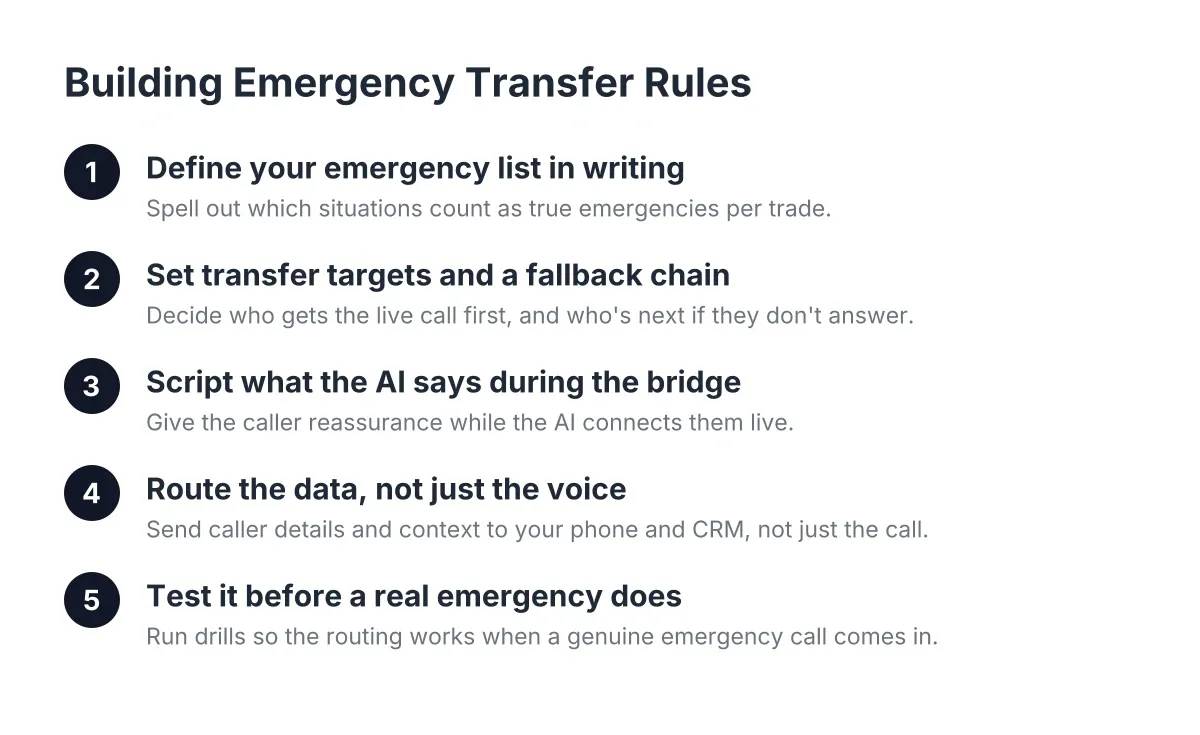
Building Your Emergency Transfer Rules, Step by Step
You have chosen to put an AI receptionist in front of your line. Here is how to configure live transfer so it works the first weekend it runs.
Step 1: Define your emergency list in writing
Sit down for 30 minutes and list the five to ten situations in your trade that justify waking someone up. Use the three-question triage test above. Be specific: "active water leak that the caller cannot stop at the valve" is a rule the AI can apply; "bad plumbing problem" is not. This list becomes the AI's escalation criteria, word for word.
Step 2: Set your transfer targets and a fallback chain
Decide who receives live transfers and when. A common setup for a crew of four: owner takes transfers weeknights, techs rotate weekends, and every target has a fallback. If the on-call tech does not pick up within 25 seconds, the call rings the owner; if the owner misses it, the AI takes over, captures everything, and flags the lead as an unanswered emergency at the top of the queue. Never let a transferred call dead-end in a personal voicemail.
Step 3: Script what the AI says during the bridge
The handoff matters. The caller should hear something like: "This sounds urgent. I am connecting you with our on-call technician right now; stay on the line." Meanwhile, the tech answering should get a whisper or text summary before the bridge connects: caller name, address, problem, and language. Walking into the call with context saves two minutes of repeated questions and sounds like the professional operation you are.
Step 4: Route the data, not just the voice
A live transfer that leaves no record is a half-captured lead. Every emergency call, transferred or not, should land in your system with a transcript summary, a lead score, and the caller's details. If you run HubSpot, Zoho, or lead management in Salesforce, sync it there through a webhook or Zapier so the job shows up as a record, not a memory. If your CRM is a whiteboard, the Monday morning report and dashboard callback still beat a sticky note on the dash. This is the unglamorous half of lead capture for contractors, and it is where most crews leak revenue: the call got answered, but nobody logged it, so nobody followed up on the estimate.
Step 5: Test it before a real emergency does
Call your own number at 9 p.m. on a Tuesday. Describe a burst pipe and see whether you get bridged. Then call back and describe a slow drain and confirm you get captured and booked instead of transferred. Try it in Spanish. Try to stump it. Fifteen minutes of testing tells you more than any sales page, and you will adjust two or three rules the first week. That is normal, not a failure.
Where Contractors Get Emergency Transfers Wrong
Even with good rules, a few predictable mistakes undermine the setup. Watch for these in your first month.
Transferring everything. Owners nervous about missing a job sometimes set the AI to bridge every after-hours call. Within two weeks the on-call phone becomes the old problem in a new wrapper: interrupted dinners, 3 a.m. rings for Thursday appointments, and a tech who starts ignoring the phone. Trust the capture path for non-emergencies; the lead is logged, booked, and waiting with a summary.
Transferring nothing. The opposite failure is turning off live transfer entirely to protect the crew. For an emergency trade, that hands your highest-ticket jobs to whoever answers live. Suppose a Round Rock homeowner calls three plumbers at midnight about a burst line under the slab; that is plausibly a $2,000 to $6,000 job depending on access, as a rough illustrative range. The plumber whose AI bridged the call live wins it. The two whose systems only took a message find out at 7 a.m. that the caller booked elsewhere.
No language plan. Central Texas has a large Spanish-speaking customer base, and emergencies do not translate themselves. If your AI receptionist handles Spanish but your on-call tech does not, decide in advance whether Spanish emergency calls bridge to a bilingual tech, or whether the AI completes capture in Spanish with an immediate flagged callback. Either works; improvising at 1 a.m. does not.
Ignoring the follow-up leak. A transferred emergency you served tonight is a recurring customer you can lose tomorrow. If the job details never reach your CRM, there is no follow-up for the permit inspection, the annual service, or the review request. Close the loop on data every time, even when the voice handoff went perfectly.
What Good Looks Like: An Illustrative Friday Night
Here is a hypothetical run-through so you can picture the whole system working. Say you run a three-tech electrical shop serving Cedar Park and Georgetown, and it is 10:40 p.m. on a Friday in 2026.
Call one: a homeowner reports a burning smell near the panel. The AI answers on the first ring, confirms the smell is electrical and active, tells the caller to shut off the main if safely reachable, and bridges the call to your on-call tech with a text summary already on his screen. He is rolling in twelve minutes. That is emergency call transfer working the way contractors need it to: fast triage, live human, truck moving.
Call two, twenty minutes later: a landlord wants three ceiling fans installed next month. The AI qualifies the job, captures the property address and unit count, books a Tuesday estimate, and syncs the lead to your CRM. Nobody's phone buzzed.
Call three, in Spanish, at 12:15 a.m.: a Pflugerville tenant reports half the outlets in the apartment are dead but nothing smells or sparks. The AI walks the triage questions in Spanish, determines the panel is fine, captures the lead, and books the first morning slot with a note for your bilingual tech. Saturday's board shows one emergency served, two jobs booked, and zero missed calls.
That is one plausible night, not a case study. But every owner running an emergency trade recognizes the shape of it, usually from the nights it went the other way.
The Bottom Line on Live vs. AI for Emergency Calls
Emergency call transfer gives contractors a scalpel where most answering setups offer a hammer. The AI receptionist answers every call in under a second, in English and Spanish, and applies your triage rules the same way at any hour. Genuine emergencies bridge live to a human who can act. Everything else gets captured, qualified, and booked, then lands in your CRM with a score and a summary.
If you are worried this means restructuring your business, it does not. According to the National Federation of Independent Business, only 24% of small employers use AI tools at all, and 98% of those who do report no change in employee headcount. This is not about staffing; it is about routing. Your crew keeps doing the work. The phone just stops deciding which jobs you win based on who happened to be near it.
Start with your written emergency list, set one on-call target with one fallback, test the flow yourself at night, and adjust weekly for a month. The goal is simple to state and worth stating plainly: every emergency reaches a human fast, every other lead gets captured and booked, and nothing rings into the dark.
If you're losing revenue to missed calls, NeverMiss ATX can help.
Prefer to talk it through? Call (512) 980-9267 — a quick call is usually the fastest way to get a straight answer for your situation.