Bilingual Lead Capture in Spanish: Why Austin Trades Can’t Skip It in 2026
If you run a one-person operation in Austin, TX, the ability to capture leads from bilingual and Spanish-speaking customers is not a nice-to-have. It is the difference between booking the kitchen remodel and never knowing the call happened. According to City of Austin data based on 2022 Census American Community Survey figures, 29.6% of Austin residents age 5 and older are bilingual, and 10.3% speak English less than "very well." If your phone only works in English, roughly one in ten potential customers hits a wall the moment you answer, or worse, the moment your voicemail picks up while you are on a ladder.
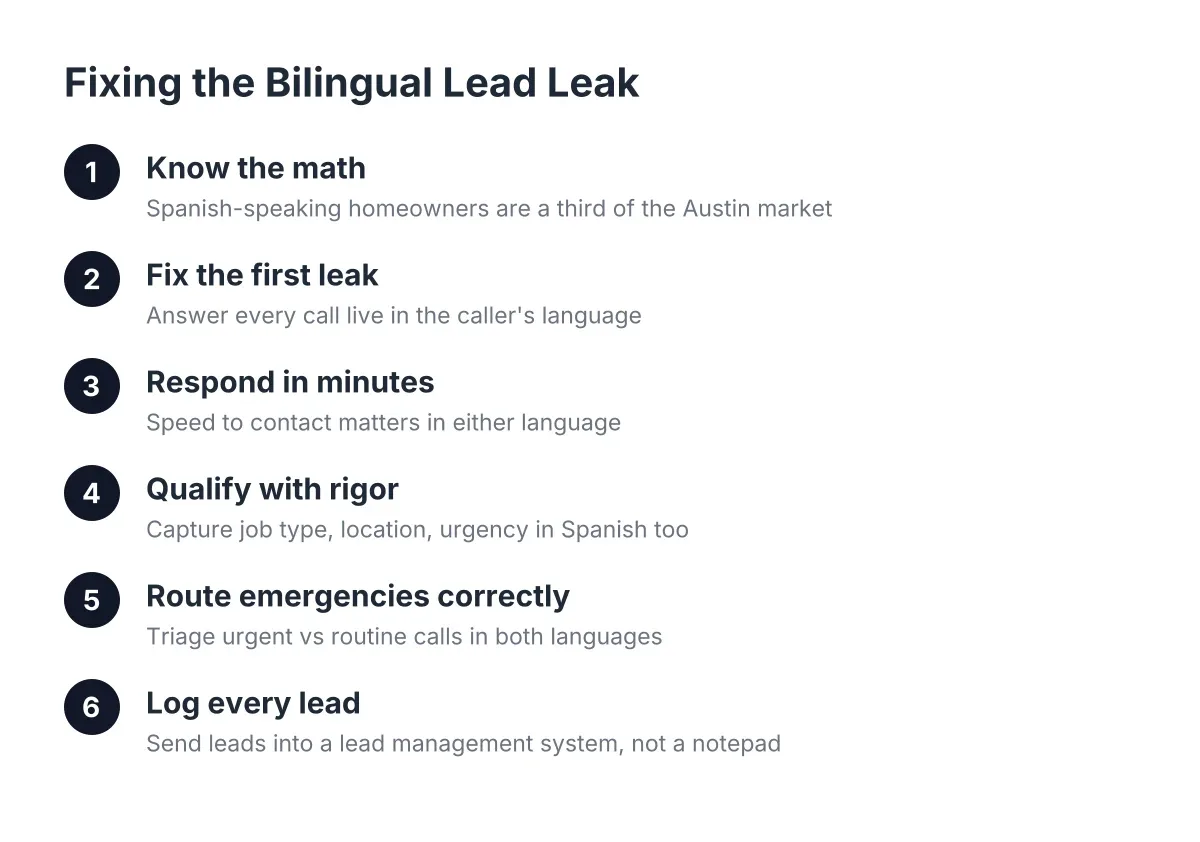
This article walks through eight specific points in your ring-to-CRM pipeline where Spanish-speaking leads leak out, and how to plug each gap without hiring office staff. It is written for the solo tradesperson who is on site all day and cannot stop a tile job to take a call in either language.
1. Know the Math: Spanish-Speaking Homeowners Are a Third of Your Market
Nearly 7.8 million Texans, about 28.5% of the state, speak Spanish at home according to U.S. Census Bureau estimates covering 2018 to 2022, as reported via KXAN. In Central Texas trades, that translates to remodels, repair calls, and renovation projects that go to whoever picks up the phone in the caller's language.
Here is the part most owners miss: many of these homeowners are bilingual and could get through an English-only call. But comfort wins jobs. A homeowner describing a foundation crack or a bathroom gut job wants to explain it in the language they think in. If your competitor's line answers in Spanish and yours does not, the estimate request goes there first.
2. Fix the First Leak: The Call You Physically Cannot Answer
Solo operators miss a big share of inbound calls for one simple reason: you cannot hold a phone and a circular saw at the same time. Phone in pocket, compressor running, both hands on a cabinet. The call goes to voicemail, and most callers with a real project do not leave one. They dial the next name in the search results.
Now stack the language problem on top. Suppose a Spanish-speaking homeowner in Pflugerville calls about a water-damaged ceiling at 6:40 p.m. Your voicemail greeting is in English. Even if she leaves a message, you will not hear it until 8 p.m., and calling back into a language mismatch is awkward for everyone. In that scenario, the lead was gone before you ever knew it existed.
The fix is answering every call live, in the caller's language, whether you are mid-install or asleep. That is exactly the job an AI receptionist with bilingual support on every plan is built for: it answers 24/7, greets the caller, and continues the conversation in English or Spanish based on how the caller responds.
3. Respond in Minutes, Not Hours, in Either Language
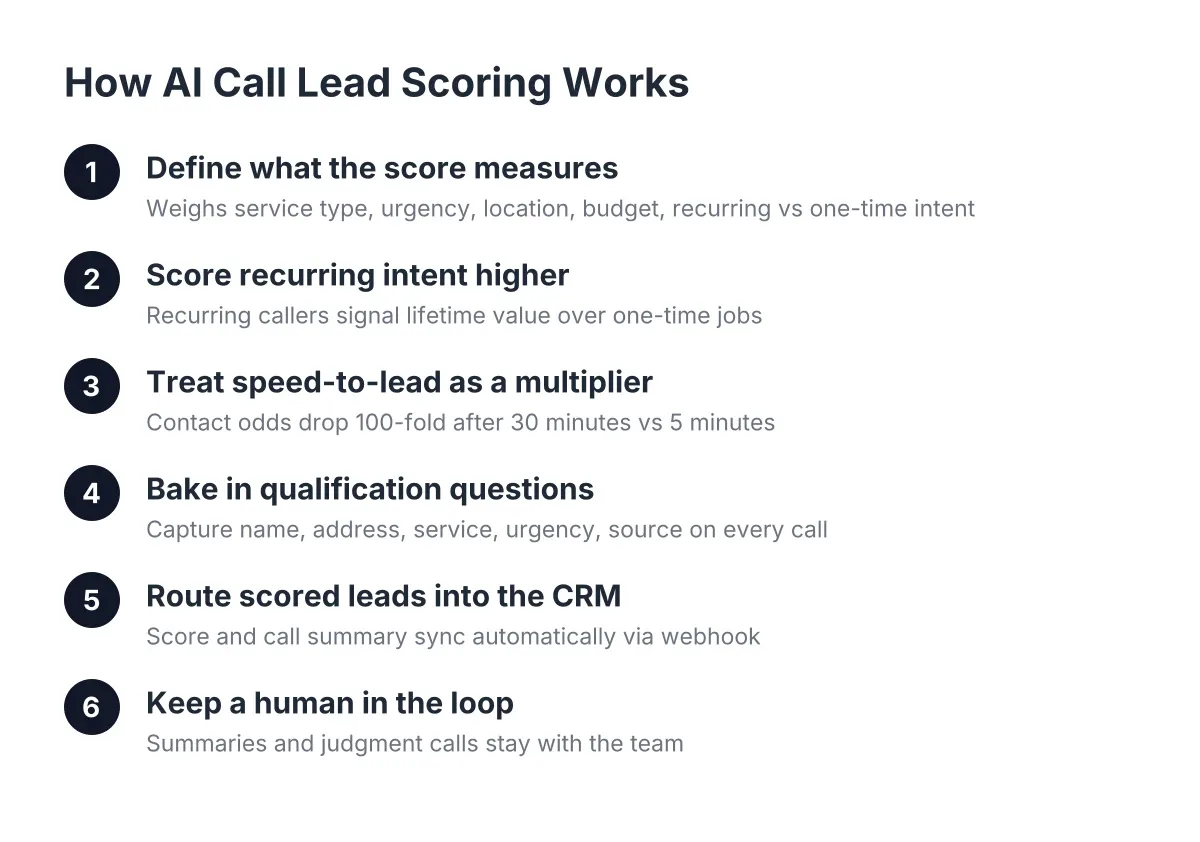
Speed decides who gets the job. A foundational study from MIT Sloan School of Management and InsideSales.com found the odds of contacting a lead drop 100-fold, and the odds of qualifying that lead drop 21-fold, when the callback happens at 30 minutes instead of within 5 minutes.
For a bilingual market, this cuts twice. An English-speaking lead who reaches voicemail might wait an hour before moving on. A Spanish-speaking lead who reaches an English-only voicemail moves on immediately. Therefore, your lead capture system needs to do two things at once: engage instantly, and engage in the right language. A live bilingual answer at second one beats a perfect English callback at minute forty.
4. Qualify Spanish-Speaking Leads with the Same Rigor as English Ones
Answering in Spanish is table stakes. Capturing a usable lead means qualifying in Spanish too: what is the job, where is the property, what is the timeline, is this an emergency or a quote request. A greeting in Spanish followed by "someone will call you back" is not genuine bilingual lead capture; it is a bilingual brush-off.
A properly configured AI receptionist asks the same qualification questions in both languages and logs the answers in a consistent format. For a multi-trade operation handling everything from drywall patches to full remodels, that consistency matters. You want every lead record, English or Spanish, to show:
- Job type and scope (repair, remodel, new install)
- Property location (Austin, Round Rock, Cedar Park, Georgetown, Leander)
- Urgency (burst pipe now versus bathroom remodel this spring)
- Preferred callback language and best time to reach them
- How they found you
With that record in hand, you call back once, prepared, instead of playing phone tag to extract basics.
5. Route Emergencies Correctly, Because Triage Fails Hardest Across Languages
Emergency triage is where language gaps get expensive. A caller describing "una fuga de agua en el techo" at 11 p.m. needs someone who understands that means water is coming through the ceiling right now, not a form submission for Monday. Mishandle that call and you lose the emergency job plus every future job from that household.
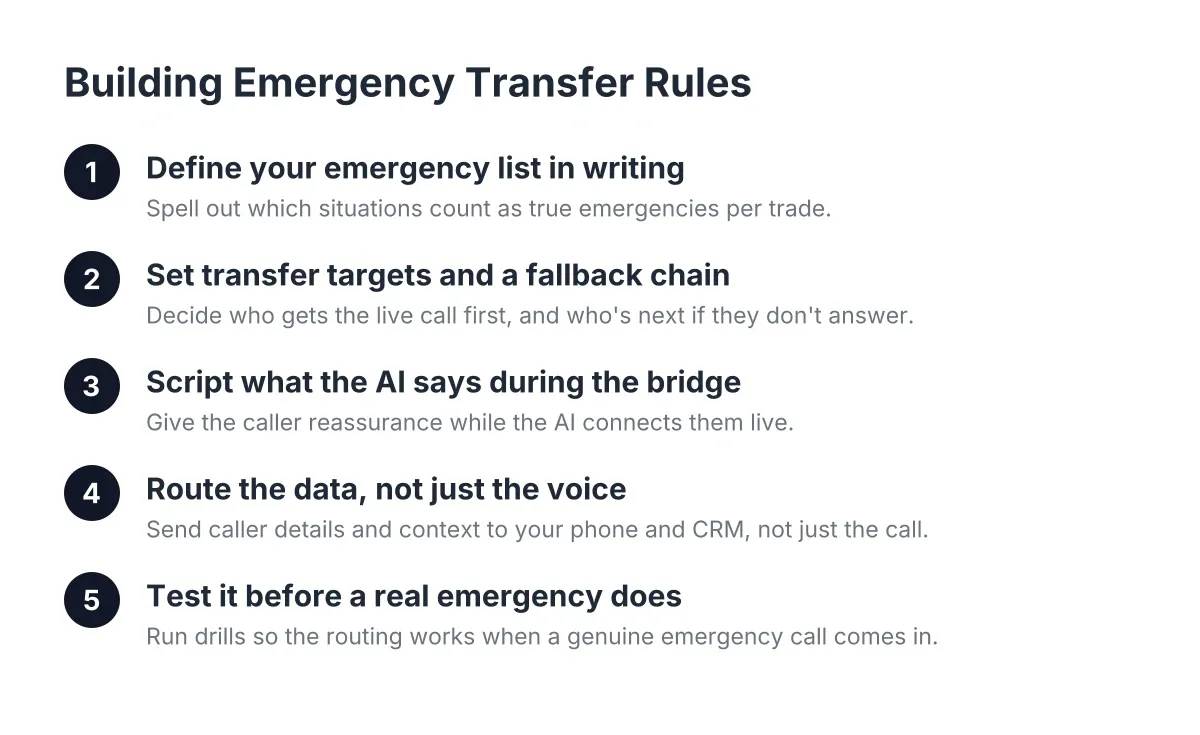
A system designed to capture Spanish-speaking leads should distinguish urgent from routine in both languages, then act differently on each. Routine quote requests get logged, summarized, and queued for your morning callback. Genuine emergencies can trigger a live transfer to your cell if you opt in, so the burst-pipe call at midnight reaches you while the spring remodel inquiry waits politely in your dashboard.
One honest caveat: no AI should diagnose gas leaks, electrical hazards, or structural failures over the phone. Its job is to recognize urgency, capture the details, and get a qualified human, you, connected fast. Anything involving immediate safety risk still needs a professional on site or a call to emergency services.
6. Make Sure Every Lead Lands in a Lead Management System, Not a Notepad
Capturing a lead on the phone and losing it in a text thread is the same as missing the call. Every qualified lead, English or Spanish, should flow automatically into one place: a CRM or lead management software you actually check. If a Spanish-language call gets summarized in English in your dashboard, you can act on it without translating anything yourself.
For solo operators, this does not require enterprise tooling. The best free CRM for small business use is often whichever one you will open daily; HubSpot's free tier is a common starting point, and Zoho works well for trades on a budget. Webhooks and Zapier connections push each captured lead straight into HubSpot, Salesforce, or Zoho the moment the call ends. As a result, your lead management system becomes the single source of truth: name, number, job details, urgency score, and language preference, all logged without you typing a word.
This is the core of effective lead capture for contractors and trades: the gap is rarely a shortage of inbound interest. It is inbound interest that was never answered, never qualified, or never recorded anywhere you could act on it.
7. Extend Bilingual Lead Capture to Spanish Speakers on Your Website Too
Lead capture in Spanish should cover your website, not just your phone line. Plenty of homeowners research at 9 p.m., compare three local operations, and message the one whose chat responds in their language. An English-only contact form quietly filters out a meaningful slice of Austin's market.
A bilingual website chatbot handles this the same way the phone side does: it engages the visitor in English or Spanish, asks the qualification questions, captures contact details, and can send a booking link on the spot. The lead syncs to the same CRM record stream as your calls. Consequently, whether the first touch is a ring or a webpage, the pipeline behind it is identical.
Worth noting as a trade-off: a Five9 and TEAM LEWIS survey of 4,000 U.S. and U.K. consumers found 75% prefer talking to a real human for customer support. Chat and AI answering do not remove the human relationship; they hold the lead warm until you, the human they actually hired, call back. The AI captures; you close.
8. Follow Up in the Caller's Language, and Track What the Data Tells You
The callback is where you win or lose the job you just captured. If the lead record shows the caller prefers Spanish and you speak it, lead with it. If you do not, a captured record with full job details still lets you text a clear, translated summary and confirm the appointment; the homeowner already gave the AI everything in their own words.
In addition, review your call data weekly. A Monday morning report showing call volume, language split, lead scores, and booked appointments tells you things gut feel cannot. Say 20% of your inbound calls last month came in Spanish and only half got booked; that is a measurable revenue gap with an obvious fix, not a vague hunch. Over a year, closing that gap can mean the difference between a $150K year and pushing toward $250K on the same marketing spend, as a rough illustrative estimate for a solo multi-trade operation.
What This Looks Like on a Real Tuesday in Austin, TX
Here is an illustrative Tuesday for a hypothetical solo remodeler working a bathroom gut in Cedar Park. Between 8 a.m. and 6 p.m., six calls come in while both hands are busy. Two are in Spanish: one about a fence repair in Georgetown, one about water pooling under a kitchen sink in East Austin.
Without bilingual answering, the two Spanish calls hit an English voicemail and likely vanish. With an AI receptionist handling lead capture for Spanish speakers, callers get answered live, qualified, and logged. The sink caller flags as urgent; the fence job books a Thursday estimate through a booking link texted during the call. At 6:15 p.m., the owner opens the dashboard, sees five qualified leads with summaries in English, and one-click bridges a call to the sink customer first. Nothing leaked.
That is the whole framework: answer every ring in the caller's language, qualify consistently, route emergencies to your cell, sync everything to a CRM, and follow up fast with full context. Summers here hit 107 degrees, according to Texas 2036 and the Office of the State Climatologist at Texas A&M University during the record 2023 heat, and demand for home services spikes with it. The trades that grow in Central Texas in 2026 will not be the ones with the most leads. They will be the ones that stop letting a third of the market ring through to a voicemail it cannot understand.
If you're losing revenue to missed calls, NeverMiss ATX can help.
Prefer to talk it through? Call (512) 980-9267 — a quick call is usually the fastest way to get a straight answer for your situation.